Abstract
Background: Postdate pregnancies are associated with maternal complications and perinatal risks like increased cesarean delivery and still birth. Induction of labor is a commonly performed procedure to reduce these risks. This study aims to evaluate short term maternal outcomes after induction with dinoprostone in a tertiary care setting.
Objective: To determine the short-term maternal outcomes (mode of delivery and postpartum hemorrhage) after induction of labor with dinoprostone in postdate pregnancies at a tertiary care hospital.
Method: This study was conducted at the department of Obstetrics & Gynecology, Watim General Hospital, Rawalpindi from 24th April 2024 - 10th July 2024. This was the descriptive cross-sectional study, in which the sample size was calculated on WHO formula by keeping proportion of postpartum hemorrhage 3.07%, confidence interval 95% and margin of error 2% as 286. All women by using consecutive sampling (non probability) were subjected to detailed clinical history and detailed physical and obstetrical examination (as per hospital protocol) to detect confounders to exclude bias from the study results. Maternal outcomes were stratified with age, parity and gestational age to see effect of modifications, by entering recorded data on statistical software SPSS version 23 and post stratification chi square test was applied to have a 5% level of significance.
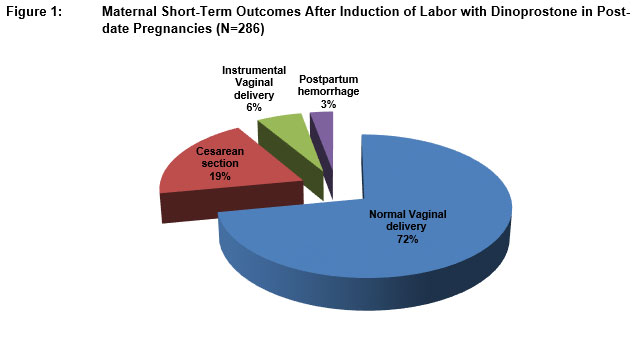
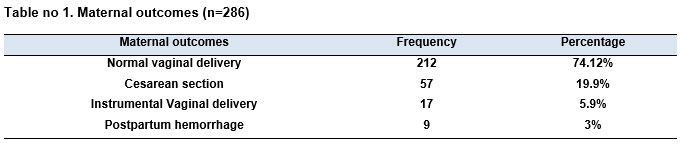
Results: The present study shows that among 286 patients mean age was 27 years ± 5.57. 174(61%) patients were primipara, 112(39%) patients were multipara. More over 212(74%) had spontaneous vaginal delivery, 57(19.9%) patients had cesarean section, 17(5.9%) patients had instrumental delivery, 9(3%) patients had postpartum hemorrhage.
Conclusion: Our study concludes that induction of labor reduced the risk of cesarean section and instrumental vaginal delivery, however it didn’t increase the risk of postpartum hemorrhage in postdate pregnant women presenting at tertiary care hospital.
Keywords: Induction of labor, Mode of delivery, Postpartum hemorrhage, Dinoprostone, Prostaglandin E2.
Introduction
Induction of Labor (IOL) is one of the most frequently performed obstetric procedures in the world [1,2] by using artificial methods to stimulate the onset of labor [3]. It is indicated when the benefits of prompt delivery outweigh the maternal and fetal risks of expectant management [4]. The most common indications include post term pregnancy, preeclampsia, intrauterine fetal growth restriction (IUGR), hypertension, pre labor rupture of membranes [5]. Risks of labor induction include prolonged labor, high Caesarean rate, high rate of epidural analgesia, low APGAR score at one minute and five minutes [6,7]. There is substantial variation in IOL rate, and it is increasing steadily worldwide, estimated to be 25% in high income countries [2]. Recent data from different studies showed the rate of induction is up to 35.5% in Sri Lanka [8], 31.5% in the republic of Ireland [9], 22% in India [10] while in United States, rate of induction rose from 9.6% in 1990, 27.1% in 2018 to 31.4% in 2020 [11] reported by the National Center for Health Statistics.
Few maternal complications and Perinatal risks are associated with postdate pregnancies. The risk of still birth associated with prolonged pregnancy is 14% [13], which means one third of stillbirths are documented after 37 weeks of gestation [14]. Neonatal death mortality is also double beyond term [15]. WHO recommends induction of labor at 41weeks 6days to avoid maternal and perinatal complications [16]. The main factor associated with success of induction is certainly the bishop score [17], other associated factors are partly gestational age, fetal size, maternal age, body mass index (BMI) and co morbidities [2]. Although induction of labor is considered to have a high risk of postpartum hemorrhage (PPH) in comparison to spontaneous labor, different studies have reported conflicting data regarding association of induction of labor with postpartum hemorrhage [18].
There are many methods available for the induction of labor including pharmacological, mechanical and combinations of methods [12]. Pharmacological method including Dinoprostone vaginal tablet is selected for this study as it is more effective in bishop score≤6 [19], a lower operative rate than oxytocin, less risk of uterine rupture and easily reversible as compared to other pharmacological methods (misoprostol) [20]. Cost savings may be realized by a reduction in operative deliveries and/or lengths of stay. Dinoprostone is a bronchodilator and is not contraindicated in women who suffer from asthma [21]. and it can be removed from vagina in case of hyper stimulation easily as compared to oral, sublingual routes of administration of misoprostol.
Many studies on labor induction have been conducted globally and in Pakistan, but not in our specific population highlighting the need for this study. This study aims to provide updated information on short term maternal outcomes after labor induction with Dinoprostone in term patients and the results will be shared with health care professionals for guidance of patients. Induction of labor with dinoprostone is commonly used to reduce post-date pregnancies like cesarean delivery and postpartum complications. However, there is limited local data on its outcomes in our population. There are high rates of successful vaginal deliveries with low complications in our study. This study supports the safe and effective use of dinoprostone for induction by health care professionals. Implementing this practice can improve maternal outcomes, enabling shared decision making, reduction of surgical load in hospitals and future research work involving multiple center hospitals and larger sample sizes to improve maternal care.
Method
This Descriptive, Cross-sectional study was conducted from 24th April 2024 to 10th July 2024 at Department of Obstetrics & Gynecology, Watim general hospital, Rawalpindi after approval from hospital’s research and ethical board, approval number “WMDC/ R&D (ERB)/2024/129 dated 24-4-24”. The sample was calculated on WHO formula for sample size calculation by keeping proportion of postpartum hemorrhage 3.07%, confidence interval 95% and margin of error 2%. The total sample size was 286. Consecutive sampling (non probability) was used. All the women presenting with singleton pregnancy, with age group between 20-35 years Para1-Para 5, undergoing induction of labor at gestation ≥ 40 weeks (assessed on last menstrual date and dating scan) were enrolled in the study through labor room Patients with advanced maternal age, co morbidities, previous uterine surgery (including caesarean section), malposition and malpresentations of fetuses, abnormal lie, fetal growth restriction, prolapsed umbilical cord, polyhydramnios/ Oligohydramnios, placenta previa and morbidly adherent placenta, carcinoma of cervix, active herpes of genital tract and patients with ‘favorable’ cervix (defined as a modified Bishop score of ≥8) were excluded. Intrauterine fetal death on ultrasound was also not included. The purpose and benefits of the study were explained to the patients and they were assured that the study is done purely for data publication and research purpose and their confidentiality was maintained, a written informed consent was obtained from all patients at the time of admission.
All women were subjected to detailed clinical history and detailed physical and obstetrical examination (as per hospital protocol) to detect confounders to exclude bias from the study results. All procedures were conducted under the supervision of an expert obstetrician consultant. Maternal outcomes were evaluated. Cesarean section was performed as the surgical procedure by which one or more babies were delivered through an incision in the mother's abdomen when vaginal delivery could put the baby or mother at risk in cases of fetal distress and non-progress of labor. Instrumental delivery was done in cases of fetal distress at fully dilated cervix or maternal exhaustion etc by the use of forceps or a vacuum device to assist the mother in delivering the baby. Postpartum hemorrhage was considered positive if there was loss of blood more than 500ml (small size kidney tray or slow per vaginal trickling soaking three or four sanitary pads in one hour and weighing pad before and after soakage) in normal vaginal delivery and more than 1000ml in caesarean section. All the above-mentioned information i.e. age, gestational age and parity were recorded in a pre-designed proforma. Strictly exclusion criteria had followed to control confounders and bias in the study results.
Results
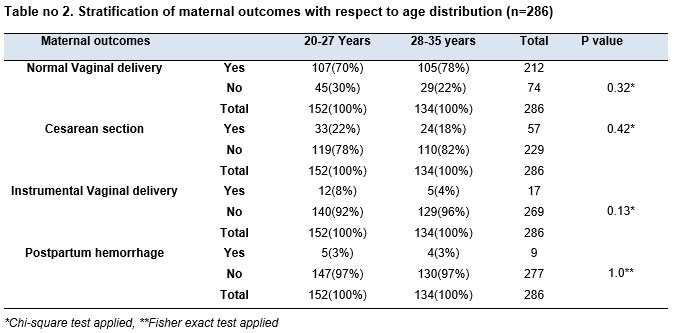
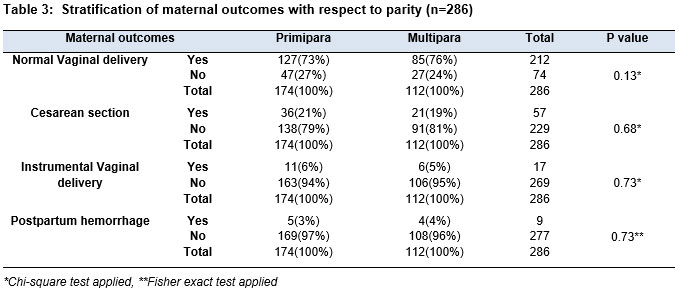
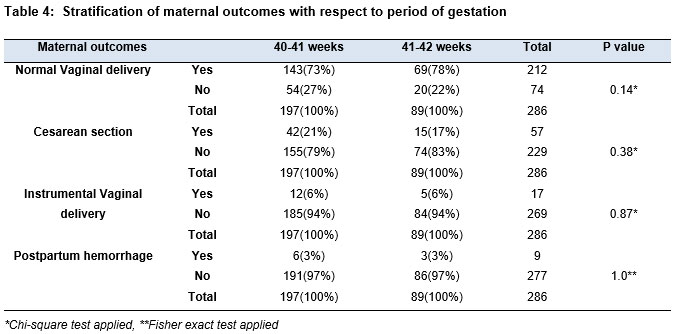
In this study age distribution among 286 patients was analyzed as 152(53%) patients were in age range 20-27 years and 134(47%) patients were in age range 28-35 years. The mean age was 27 years ± 5.57. Status of parity among 286 patients was analyzed as 174(61%) patients were primipara, 112(39%) patients were multipara. Status of period of gestation among 286 patients was analyzed as 197(69%) patients had gestation range 40-41 weeks and 89(31%) patients had gestational range 41-42 weeks. Status of maternal outcomes among 286 patients was analyzed as 212 (74.12%) had vaginal delivery, 57(19.9%) patients had cesarean section, 17(5.9%) patients had instrumental delivery, 9(3%) patients had postpartum hemorrhage (Table 1). Stratification of maternal outcomes with respect to age, gestational age and parity is mentioned in table 2-4.
Discussion
Introduction of labor is an obstetric procedure which is currently in an uprising trend in the term and postdate pregnancies worldwide to prevent outcomes such as perinatal morbidity and mortality, operative delivery [22] prolonged labor, traumatic birth [23] and postpartum hemorrhage. Although IOL is recommended at 41weeks, but it is also recommended to offer IOL at 39 weeks in patients with uncomplicated pregnancies by National Institute for Health and Care Excellence (NICE) guidelines MAY 2021. If there are maternal or neonatal risk factors associated with complications, including assisted conception, elderly mother and BMI above 30 kg/m2, then IOL at 39weeks is also recommended [24].
In this study we enrolled 286 postdate patients and they were subjected to induction of labor by dinoprostone and maternal outcomes were assessed. In present study frequency of successful vaginal delivery was 212 (74.12%). It was observed slightly more in the later age group between 28-35yrs as 105(78%) in comparison to 107 (70%) in the age group between 20-27 yrs. Almost similar results were found in cases of parity and gestation. Vaginal deliveries achieved in 127 (73%) primiparous while 85 (76%) in multiparous women With regard to gestation there was also slight increase in success of induction leading to vaginal deliveries in gestation 41-42 weeks that is 69 (78%) as compared to 143 (73%) at gestation 40-41weeks, may be due to increased cervical ripening at increased gestation. These results are more consistent with the findings of a study done in Ethopia [25] and in a systematic review by Hong J, et al [26].
In the current study the babies delivered through cesarean section was 57 (19.9%). Out of these 33(22%) had cesarean delivery in age group 20-27years and 24(18%) in 28-35years. There was increased relative risk of operative delivery in primiparous 36(21%) verses 21(19%) in multiparous women. Moreover, cesarean delivery occurred in 42(21%) at gestation 40-41weeks and 15(17%) at 41-42 weeks. In a study conducted by Souter V, et al [27] on 55694 patients, the overall cesarean section was 14.7% which was lower than our results, but it was reduced to 39 weeks of gestation in nulliparous 14.7% as compared to ongoing pregnancies (23%). So, there was same rate of cesarean delivery in both postdate primiparous and multiparous women. Similar results were observed in another study conducted by Grobman WA and Caughey AB [28] in which 18.6% had cesarean section when subjected to labor induction vs 22.2% with expectant management.
According to the research carried out by Kazi S et al [29], the low risk of feto-maternal outcome with induction of labor at term. They observed rate of cesarean section (13%) is lower as compared to overall institutional rate when 302 patients were induced for labor at term. It can be attributed to careful selection of patients and better labor management. 17 (5.9%) patients had instrumental delivery in our enrolled patients for labor induction. In which 12 (8%) were in the earlier age group as compared to 5 (4%) in the later age group. However, this rate was same in primiparous women 11 (6%) versus multiparous 6 (5%) and at gestation after 40 weeks 12 (6%) and 5 (6%). There was increased rate of instrumental delivery was observed by Souter V, et al [27] in their trial at 39 weeks of gestation in nulliparous women. Moreover there was an increased rate of instrumental vaginal birth (18.5%) as compared to our results. This may be attributed to more expertise, high precision of decision making to proceed for instrumental vaginal delivery as well as availability of better maternal and newborn care in their clinical setups and it is also the reason that their cesarean rate was low as compared to present study.
We observed 9(3%) of our patients had postpartum hemorrhage after labor induction which was unaffected by age groups, parity and gestation after 40weeks. Similar results (2.8%) were observed by Bukhari RS, et al [30] in their research. However, the increased frequency of postpartum hemorrhage (%) was noticed by Kazi S et al [29]. Similar findings of high rate of PPH (13%) after IOL were also observed in another study by Shah D et al [31]. These high rates may be due to lack of managing the third stage of labor actively or inclusion of patients with high risk of PPH.
Although our study had certain limitations as masking was not feasible, enrollment of less number and only low risk patients were carried out, so it is recommended that additional research should be done in multicenter of our region with larger sample size and inclusion of high risk patients and more feto-maternal parameters to assess the association of timing of labor with maternal and fetal outcomes. Studying of long-term outcomes for thorough analysis should also be carried out in future studies. It will help the health professionals in policy making regarding induction of labor and expectant management at term. Meanwhile it also concluded that timings of labor are important for pre and postnatal maternal and neonatal health, as Neonatal morbidity and mortality risk is increased in both the periods.
Conclusion
This study concludes that the frequency of maternal outcomes (mode of delivery and postpartum hemorrhage) was better in postdate pregnancies after induction of labor with dinoprostone. Postdate pregnant women should be informed about the pros and cons and offered both the management plans (induction versus expectant) while in term, pregnant women indication for induction of labor should be reviewed carefully and discussed with patients presenting at a tertiary care hospital.
References
- Dogl M, Vanky E, Heimstad R. Changes in induction methods have not influenced cesarean section rates among women with induced labor. Acta ObstetGynecol Scand. 2016; 95(1):112–5. https://doi.org/10.1111/aogs.12809
- [Farah FQ, Aynalem GL, Seyoum AT and Gedef GM. The prevalence and associated factors of success of labor induction in Hargeisa maternity hospitals, Hargeisa Somaliland 2022: a hospital-based cross-sectional study. BMC pregnancy and child birth.13 june 2023; 23:437https://doi.org/10.1186/s12884-023-05655-w
- Gill P, Lende MN and Hook JWV. Induction of labour: stat pearls. NIH.February 20, 2023.
- Marconi AM. Recent advances in the induction of labor. F1000Res. 2019 Oct 30;8:F1000 Faculty Rev-1829. doi: 10.12688/f1000research.17587.1. PMID: 31723412; PMCID: PMC6823899.https://doi.org/10.12688/f1000research.17587.1
- McCarthy CM, Meaney S, McCarthy M, Conners N, Russell N. Induction of labor: reviewing the past to improve the future. AJOG Glob Rep. 2022 Sep 16;2(4):100099. doi: 10.1016/j.xagr.2022.100099. PMID: 36338538; PMCID: PMC9633735.https://doi.org/10.1016/j.xagr.2022.100099
- O'Dwyer S, Clark A, Taggart H, Noori M. Woman-centered induction of WHO recommendations for induction of labour. Geneva: World HealthOrganization. 2011 (https://apps.who.int/ iris/handle/10665/44531).labour (the WOCIL project). BMJ Open Qual. 2019; 8(2):e000389
- Arage MW. Labor Induction. In Panagiotis Tsikouras, Georg Friedrich Von Tempelhoff, Werner Rath and Nikolettos Nikos.New aspects in cesarean sections. Greece: 09 May 2023.104-119 DOI: 10.5772/intechopen.110478
- Lazzerini M, Senanayake H, Mohamed R, Kaluarachchi A, Fernando R, Sakalasuriya, et al. Implementation of an individual patient prospective database of hospital births in Sri Lanka and its use for improving quality of care. BMJ. 2019 Feb 3. doi: 10.1136/bmjopen-2018-023706. PMCID: PMC6368149http://dx.doi.org/10.1136/bmjopen-2018-023706
- National women and infants health programme: clinical programme for obstetrics and gynaecology. Irish Maternity Indicator System National report. 2018 June 2019. https://www.hse.ie/eng/about/who/acute-hospitals-division/woman-infants/national-reports-on-womens-health/imis-national-report-2019.pdf. Accessed September 30, 2022
- Dagli S and Fonseca M. To Study the Maternal and Neonatal Outcome in Postdated Women Undergoing Induction of Labour Versus Spontaneous Labour.J ObstetGynaecol India. April ;71(2):131-135, 10.1007/s13224-020-01395-5[ https://doi.org/10.1007/s13224-020-01395-5
- Sanchez-Ramos L, Levine LD, Sciscione AC, Mozurkewich EL, Ramsey PS, Adair CD, Kaunitz AM, McKinney JA. Methods for the induction of labor: efficacy and safety. Am J Obstet Gynecol. 2024 Mar;230(3S):S669-S695. doi: 10.1016/j.ajog.2023.02.009. Epub 2023 Jul 13. PMID: 38462252.https://doi.org/10.1016/j.ajog.2023.02.009
- Lueth GD, Kebede A, Medhanyie AA. Prevalence, outcomes and associated factors of labor induction among women delivered at public hospitals of MEKELLE town-(a hospital based cross sectional study). BMC Pregnancy Childbirth. 2020 Apr 9;20(1):203. doi: 10.1186/s12884-020-02862-7. PMID: 32272905; PMCID: PMC7147044.https://doi.org/10.1186/s12884-020-02862-7
- Suliman AA, Abdelrahman GM, Ahmed HSI, Ibrahim AS, Hammad KMA, et al. Postdate Pregnancy Maternal and Fetal Outcomes among Sudanese Women. Clin J Obstet Gynecol. 2023; 6: 165-171.DOI: 10.29328/journal.cjog.1001146http://dx.doi.org/10.29328/journal.cjog.1001146
- Jeer B, Haberfeld E, Khalil A, Thangaratinam S, Allotey J. Perinatal and maternal outcomes according to timing of induction of labour: A systematic review and meta-analysis. Eur J ObstetGynecolReprod Biol. 2023 Sep;288:175-182. doi: 10.1016/j.ejogrb.2023.07.021. Epub 2023 Aug 4. PMID: 37549509. https://doi.org/10.1016/j.ejogrb.2023.07.021
- Middleton P, Shepherd E, Morris J, Crowther CA, Gomersall JC. Induction of labour at or beyond 37 weeks' gestation. Cochrane Database Syst Rev. 2020 Jul 15;7(7):CD004945. doi: 10.1002/14651858.CD004945.pub5. PMID: 32666584; PMCID: PMC7389871.https://doi.org/10.1002/14651858.cd004945.pub5
- Guidelines Review Committee, Maternal, Newborn, Child & Adolescent Health & Ageing (MCA), Sexual and Reproductive Health and Research (SRH). WHO recommendations on induction of labour at or beyond term; Geneva:World Health Organization: update 5th Oct 2022 /Guideline. ISBN: 978 92 4 005279 6
- Vilchez G, Nazeer S, Kumar K, Warren M, Dai J, Sokol RJ. Risk of Expectant Management and Optimal Timing of Delivery in Low-Risk Term Pregnancies: A Population-Based Study. Am J Perinatol. 2018 Feb;35(3):262-270. doi: 10.1055/s-0037-1607042. Epub 2017 Sep 22. PMID: 28938501.https://doi.org/10.1055/s-0037-1607042
- Habitamu D, Goshu YA, Zeleke LB. The magnitude and associated factors of postpartum hemorrhage among mothers who delivered at Debre Tabor general hospital 2018. BMC Res Notes. 2019 Sep 23;12(1):618. doi: 10.1186/s13104-019-4646-9. PMID: 31547856; PMCID: PMC6757371.https://doi.org/10.1186/s13104-019-4646-9
- Borovac-Pinheiro A, Inversetti A, Di Simone N, Barnea ER; FIGO Childbirth and Postpartum Hemorrhage Committee. FIGO good practice recommendations for induced or spontaneous labor at term: Prep-for-Labor triage to minimize risks and maximize favorable outcomes. Int J Gynaecol Obstet. 2023 Oct;163 Suppl 2:51-56. doi: 10.1002/ijgo.15114. PMID: 37807591.https://doi.org/10.1002/ijgo.15114
- NICE clinical guideline: Inducing Labour: (NG 207). Nov 2021 update.
- Towers CV, Briggs GG, Rojas JA. The use of prostaglandin E2 in pregnant patients with asthma. Am J Obstet Gynecol. 2004 Jun;190(6):1777-80; discussion 1780. doi: 10.1016/j.ajog.2004.02.056. PMID: 15284797.https://doi.org/10.1016/j.ajog.2004.02.056
- Grobman WA, Rice MM, Reddy UM, et al; Eunice Kennedy Shriver National Institute of Child Health and Human Development Maternal–Fetal Medicine Units Network. Labor induction versus expectant management in low-risk nulliparous women. N Engl J Med. 2018;379(6):513-523. doi:10.1056/NEJMoa1800566https://doi.org/10.1056/nejmoa1800566
- El-Sayed YY, Rice MM, Grobman WA, Reddy UM, Tita ATN, Silver RM, et al. Elective Labor Induction at 39 Weeks of Gestation Compared With Expectant Management: Factors Associated With Adverse Outcomes in Low-Risk Nulliparous Women. Obstetrics & Gynecology. 2020; 136: 692–697.https://doi.org/10.1097/aog.0000000000004055
- National Institute for Health and Care Excellence. Guideline: Inducing Labour, draft for consultation, May 2021. London, UK; 2021. Available from: https://www.nice.org.uk/guidance/ng207/documents/draft-guideline-2, accessed 2023 May 26.
- Beshir YM, Kure MA, Egata G, Roba KT. Outcome of induction and associated factors among induced labours in public Hospitals of Harari Regional State, Eastern Ethiopia: A two years' retrospective analysis. PLoS One. 2021 Nov 9;16(11):e0259723. doi: 10.1371/journal.pone.0259723. PMID: 34752507; PMCID: PMC8577748.https://doi.org/10.1371/journal.pone.0259723
- Hong J Atkinson J, Roddy Mitchell A, et al. Comparison of Maternal Labor-Related Complications and Neonatal Outcomes Following Elective Induction of Labor at 39 Weeks of Gestation vs Expectant Management: A Systematic Review and Meta-analysis. JAMA Netw Open. 2023;6(5):e2313162. doi:10.1001/jamanetworkopen.2023.13162https://doi.org/10.1001/jamanetworkopen.2023.13162
- Souter V, Painter I, Sitcov K, Caughey AB. Maternal and newborn outcomes with elective induction at term. AJOG. March 2019.Vol 220,issue 3,p 273.DOI:https://doi.org/10.1016/j.ajog.2019.01.223 https://doi.org/10.1016/j.ajog.2019.01.223
- Grobman WA, Caughey AB. Elective induction of labour at 39weeks compared with expectant management; a meta analysis of cohort studies. AJOG.2019.Oct;221(4):304-310. doi: 10.1016/j.ajog.2019.02.046 https://doi.org/10.1002/uog.23141
- Kazi S, Naz U, Naz.U, Hira A, Habib A, Perveen F. Fetomaternal outcome among the pregnant women subject to the induction of labour. Cureus. May 24, 2021. VOL 13(5).e15216. DOI: 10.7759/cureus.15216 https://doi.org/10.7759/cureus.15216
- Bukhari RS, Ashraf A, Javed M, Kham MM; Fetomaternal outcomes of medical induction of labour in postdated pregnancies.PJHMS;2022,VOL 16(5);931-932https://doi.org/10.53350/pjmhs22165931
- Shah D, Khattak S, Qazi Q. Maternal and Neonatal Outcomes After Induction of Labor in Post-dated Pregnancy at Lady Reading Hospital, Peshawar. SOGP. 2023;VOL 13(3) (JULY-SEPT). ISSN NUMBER 2307-7115 http://dx.doi.org/10.32007/jfacmedbagdad.6121515