Abstract
Background: After menopause, women undergo substantial hormonal changes that are associated with an increased risk of developing cardiovascular diseases (CVD). This risk is further exacerbated in individuals with obesity. Cardiovascular conditions, including hypertension and dyslipidemia, contribute significantly to the morbidity and mortality observed in postmenopausal women. However, there is a paucity of data comparing cardiovascular risk markers between obese and non-obese postmenopausal women within the Pakistani population. This gap underlines the requirement for further research to better comprehend the interplay between obesity and cardiovascular health in this demographic.
Objective: To compare the lipid profile and blood pressure of obese and non-obese post-menopausal women with BMI < 25 and above 25.
Method: This is a cross-sectional comparative study conducted in Postgraduate Medical Institute, Ameer-ud-Din Medical College, LGH, Lahore, December 2019 - July 2021 that includes 80 post-menopausal women between the ages of 50 to 65 years. Subjects were divided into two groups: Group I had obese & over-weight (BMI ≥ 25 kg/m²) while Group II included non-obese (BMI ≤ 25 kg/m²) post-menopausal women. After recording anthropometric measurements, blood samples were collected in fasting state of 9 to 12 hours, to evaluate triglycerides (TG), total cholesterol (TC), low-density lipoproteins (LDL) and high-density lipoproteins (HDL). Ambulatory blood pressure monitoring was conducted over a period of 6 hours. IBM-SPSS version 23 was used to perform statistical analysis. p ≤ 0.05 considered statistically significant.
Results: Triglycerides, total cholesterol, and low-density lipoprotein levels were significantly higher with significantly lower HDL levels in the group with BMI above 25 as compared to the BMI < 25 group (p<0.001). BMI above 25 group also showed elevated levels of arterial blood pressure, with a significant difference in diastolic and systolic pressures (p<0.001). The Mann-Whitney U test and independent t-test showed significant differences in all evaluated cardiovascular risk markers among the two groups.
Conclusion: Obese and over-weight post-menopausal women show significantly higher levels of cardiovascular risk markers than their normal and under-weight counterparts. Prompt intervention and lifestyle modifications can prove essential in mitigating these risks.
Keywords: Obesity, Lipid profile, Cardiovascular Diseases, hypertension, anthropometric, BMI
Introduction
Menopause marks the eternal cessation of menstruation due to the waning of ovarian follicular activity, typically occurring between 44.6 and 50 years of age in women [1]. The postmenopausal transition is characterized by a significant decline in estrogen levels, which is associated with a spectrum of metabolic and circulatory changes [2]. Among these, the increased risk of cardiovascular disease (CVD) represents one of the most serious health concerns in postmenopausal women. With the depletion of oocytes during reproductive aging, there is a marked reduction in the secretion of estrogen and inhibin by ovarian granulosa cells, resulting in disinhibition of the hypothalamic-pituitary-ovarian axis and a compensatory rise in circulating levels of follicle-stimulating hormone (FSH) and luteinizing hormone (LH) [3]. This hormonal imbalance contributes to an unfavorable metabolic profile, characterized by increased adiposity, insulin resistance, and dyslipidemia, thereby elevating cardiovascular risk [4].
Obesity, defined as an excess accumulation of adipose tissue that impairs health [5], is increasingly prevalent in women worldwide, particularly after menopause. Studies suggest that postmenopausal women have a higher predisposition to obesity and associated cardiovascular complications compared to age-matched men [6]. This may be attributed, in part, to hormonal changes that alter fat distribution from the protective gynoid pattern to the more harmful android or central obesity pattern due to the hormonal changes that alter fat distribution from the protective gynoid pattern to the more harmful android or central obesity pattern [7,8].
Central obesity is a recognised risk marker for hypertension, dyslipidemia, and other components of metabolic syndrome, all of which contribute to increased cardiovascular linked illness and death in this population. Estrogen has a crucial part in lipid metabolism and vascular function. It promotes favorable lipid profiles by modulating the expression of LDL receptors and enhancing the clearance of low-density lipoprotein cholesterol (LDL-C) [9]. Moreover, it exerts vasodilatory effects through multiple mechanisms, including increased prostacyclin production, calcium channel inhibition, and direct endothelial relaxation. The decline in estrogen levels after menopause diminishes these protective effects, leading to vascular stiffness, elevated blood pressure, and dysregulated lipid profiles [10].
Postmenopausal women display a higher prevalence of hypertension and CVD compared to their male counterparts [11]. El Khoudary et al. reported that every 10 mm Hg rise in systolic blood pressure (SBP) is linked with a 15% increase in cardiovascular risk in this demographic [12]. Similarly, dyslipidemia, defined as quantitative or qualitative abnormalities in lipid parameters such as total cholesterol (TC), high-density lipoprotein cholesterol (HDL-C), triglycerides (TG) and LDL-C, is a key contributor to cardiovascular pathology in postmenopausal women, particularly in Asian populations where the burden of CVD is rising [13,14]. Notably, global data indicate a higher prevalence of dyslipidemia in women (40%) compared to men (37%) [15].
Despite growing global evidence, there is limited research focusing specifically on the comparative cardiovascular risk profiles of obese versus non-obese postmenopausal women in the Pakistani population. Given the increasing prevalence of obesity and CVD in Pakistan, it is imperative to explore the impact of obesity on cardiovascular risk markers in this vulnerable group. Understanding these associations may guide early identification of at-risk individuals and inform targeted preventive strategies. The current study aims to compare the lipid profile and blood pressure of post-menopausal women with BMI < 25 and above 25 groups.
Method
This cross-sectional comparative study was conducted at the Post-Graduate Medical Institute, Lahore, over a period of 20 months from December 2019 to July 2021 after the approval of institutional Ethical Review Committee under research no.0023A2018 dated 26 February, 2024. The sampling technique used was nonprobability purposive sampling and sample size was calculated using the WHO sample size calculator version 12.2.6. With a confidence level of 95% and precision of 0.05, the minimum sample size came out to be 35 per group. For better precision and statistical power, the data was inflated to a final sample size of 80 [16]. The study population comprised of eighty (80) healthy postmenopausal females between the ages of 50 and 65 years. These were divided into two groups: Group I (n = 40) included women with a BMI ≤ 25 kg/m², while Group II (n = 40) consisted of women with a BMI ≥ 25 kg/m². Eligible females were aged 50–65 years with at least 12 months of natural amenorrhea (postmenopausal) while females were excluded based on known history of cardiovascular disease, diabetes mellitus, renal or hepatic disorders, history of current or recent use (past 3 months) of hormone replacement therapy, antihypertensives or lipid-lowering medications, smoking or alcohol use or surgically induced menopause.
After obtaining informed consent, anthropometric measurements were recorded, and Body Mass Index was calculated using Quetelet’s index. According to the Asian-Pacific criteria for obesity, a BMI of 18.5–24.9 kg/m² was classified as non-obese, whereas a BMI ≥ 25 kg/m² was considered obese. Blood samples (venous) were obtained following a 12-hour overnight fast, centrifuged, and stored at −20°C. All biochemical analyses were completed within one month of storage. Lipid profile was measured using the enzymatic colorimetric method with a commercially available kit manufactured by Bio Research for Medical Diagnostics, Jordan. Ambulatory blood pressure monitoring (ABPM) was performed using the CARDIOLINE CUBE ABPM Walk 200b device, which was attached to the non-dominant arm and programmed to record blood pressure at 30-minute intervals over a 6-hour period [17].
Anthropometric measurements (height, weight, BMI) were recorded using standard protocols. Fasting venous blood samples were collected after 9–12 hours of overnight fasting to assess lipid profile parameters, including triglycerides (TG), low-density lipoprotein cholesterol (LDL-C), total cholesterol (TC) and high-density lipoprotein cholesterol (HDL-C), using enzymatic colorimetric methods. Ambulatory blood pressure monitoring (ABPM) was conducted using a validated oscillometric device (CARDIOLINE CUBE ABPM walk 200b to the non-dominant arm) over a 6-hour daytime window, with readings taken at 30-minute intervals while participants engaged in routine sedentary activities. This shorter monitoring period was chosen to ensure patient compliance in an outpatient setting while still capturing meaningful variability in blood pressure.
The primary variables analyzed were BMI, lipid profile (TG, TC, LDL-C, HDL-C), and systolic/diastolic blood pressure. Data was analyzed using IBM-SPSS version 23. Group comparisons were performed using independent sample t-tests after confirming normal distribution through the Shapiro-Wilk test. A p-value ≤ 0.05 was considered statistically significant. Mean ± SD was calculated for quantitative variables normally distributed and median, IQR for quantitative non-normal variables. The independent sample t-test was used for comparison between two normally distributed quantitative variables and Spearman’s rank correlation was used as the variables were non-normally distributed. A p-value of ≤ 0.05 was considered statistically significant.
Results
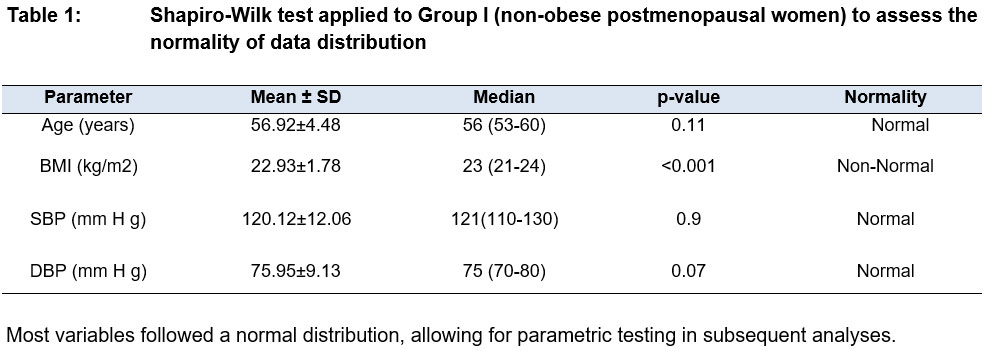
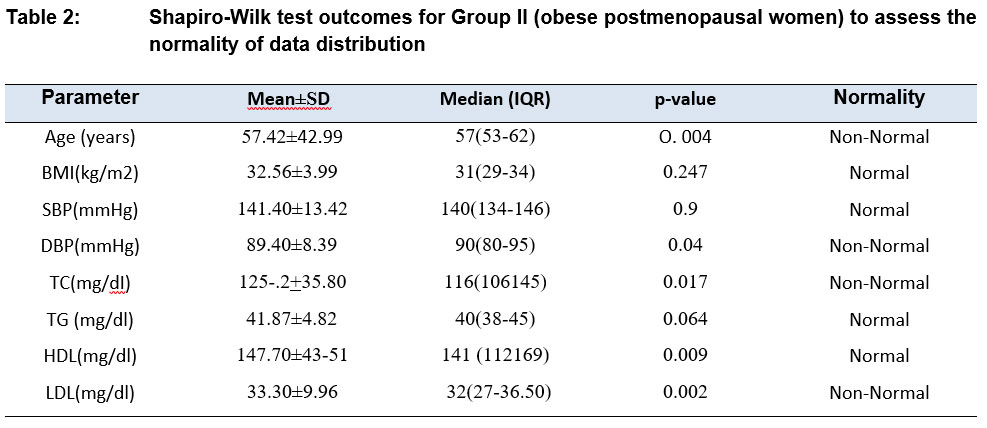
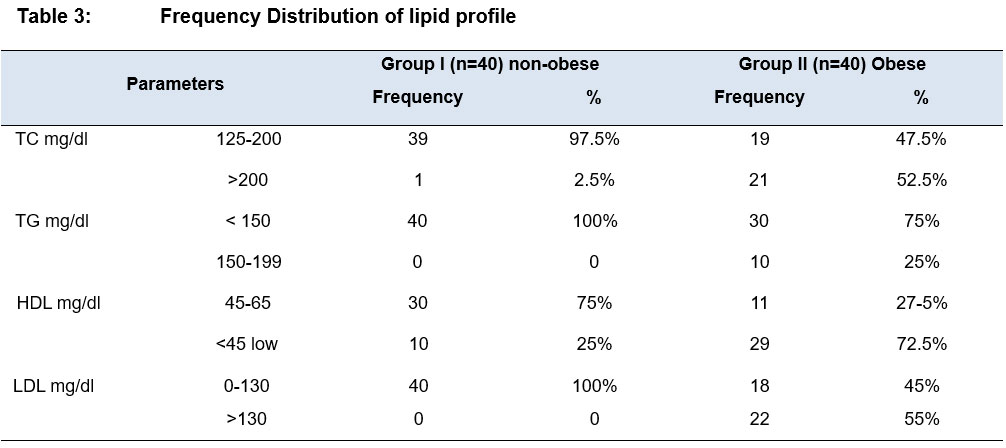
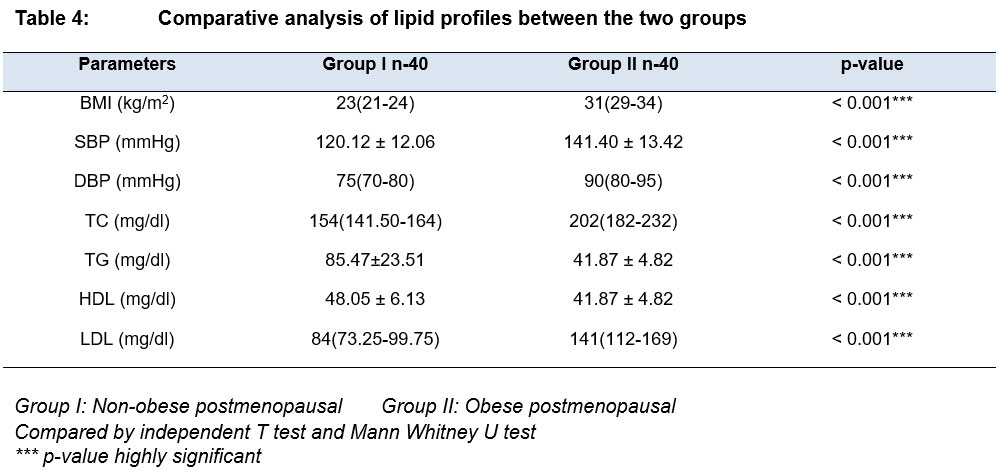
Data normality was assessed and showed in table 1 and 2. The lipid profile in both groups is shown in table 3. A statistically significant difference was observed in triglyceride levels (p < 0.001) and total cholesterol (p = 0.004), both of which were higher in the obese group. High-density lipoprotein (HDL) levels were significantly lower in Group II (p = 0.03) mentioned in table 4. These findings suggest a strong association between obesity and dyslipidemia in postmenopausal women, indicating an elevated cardiovascular risk.
Discussion
In the present study, all lipid parameters were found to be significantly altered in obese postmenopausal women compared to their non-obese counterparts (p < 0.001). Specifically, serum levels of total cholesterol (TC), triglycerides (TG), and low-density lipoprotein (LDL) were significantly elevated in the obese group, while high-density lipoprotein (HDL) levels were reduced. These findings are consistent with previous research conducted in Nepal, which demonstrated a similar association between increased BMI and adverse lipid profiles among postmenopausal women [18]. Comparable results were also reported by Ahmed et al. in a Pakistani cohort, who found elevated LDL and cholesterol levels among postmenopausal women with higher BMI [19].
In our study, HDL-C levels were significantly higher among non-obese participants. This finding is supported by a controlled intervention study in which physical activity among sedentary postmenopausal women led to increased HDL and reduced LDL levels [20]. Similar observations were reported by Karvinen et al. [21], reinforcing the beneficial role of lifestyle interventions. Barua et al. [22] also emphasized that low HDL levels in inactive postmenopausal women contribute to elevated cardiometabolic risk.
Despite general consensus on the lipid-altering effects of menopause and obesity, the literature contains some inconsistencies. For instance, Bucaktepe et al. (2019) found no statistically significant difference in lipid profiles between obese and non-obese postmenopausal women [23]. This discrepancy could be attributed to variations in study design, sample size, duration since menopause, dietary intake, and levels of physical activity—factors that were either not uniformly controlled or not reported across studies. Moreover, atherosclerosis progression in the postmenopausal phase has been linked to increased endothelin levels, oxidative stress, and a decline in nitric oxide availability. These factors collectively contribute to vascular inflammation and endothelial dysfunction [24].
The pathophysiology underlying these changes is multifactorial. Although estrogen deficiency remains a central factor, attributing dyslipidemia solely to hormonal decline overlooks important metabolic and lifestyle variables. Estrogen plays a well-established cardioprotective role by enhancing hepatic LDL receptor expression, promoting reverse cholesterol transport, and suppressing lipoprotein lipase activity in adipose tissue [25]. Its deficiency during menopause leads to increased adiposity, altered fat distribution (from gynoid to android), and heightened insulin resistance, all of which contribute to dyslipidemia [25].
Another important cardiovascular risk marker evaluated in this study was blood pressure. Consistent with findings from Bucaktepe et al. [23], we observed a higher prevalence of hypertension among obese postmenopausal women. The mechanisms underlying this association are complex and include increased visceral adiposity, enhanced sympathetic nervous system activity, leptin-mediated aldosterone stimulation, and impaired endothelial vasodilatory response. While estrogen deficiency may contribute to salt sensitivity and vascular stiffness even in non-obese women, the additional burden of obesity likely exacerbates hypertension risk through these additive pathways. Estrogen’s withdrawal unmasks this vulnerability, resulting in a substantial rise in cardiovascular morbidity among postmenopausal women [26].
Local literature remains underrepresented in this domain. Although some Pakistani studies have highlighted the elevated risk of CVD in this demographic, they often lack stratification by obesity status or adjustment for lifestyle and dietary factors. Given the cultural context marked by carbohydrate-rich diets, physical inactivity (especially in urban women), and limited awareness of cardiovascular health these variables warrant more detailed exploration in future studies. In summary, our findings support existing evidence that obesity significantly worsens lipid profiles and blood pressure among postmenopausal women, thereby increasing cardiovascular risk. However, it is important to interpret these results in light of broader metabolic, behavioral, and sociodemographic factors.
Conclusion
This study highlights that obese postmenopausal women exhibit significantly higher cardiovascular risk markers, including BMI, blood pressure, and dyslipidemia compared to their non-obese counterparts. These findings reflect the combined effects of estrogen deficiency, central adiposity, and altered metabolic regulation during menopause. Given the rising burden of cardiovascular disease in Pakistani women, these results emphasize the need for targeted prevention strategies focused on weight control, physical activity, and routine cardiovascular screening. Future research should address regional lifestyle factors, including longitudinal follow-up, and evaluate interventions tailored to postmenopausal populations. Awareness campaigns regarding postmenopausal obesity and its associated cardiovascular disease morbidity and mortality are highly required at mass levels in developing countries like Pakistan to improve the quality of life in this neglected group. Screening of postmenopausal women should be done with pre-examination questionnaires that must include traditional risk factors.
References
- Bustami M, Matalka KZ, Elyyan Y, Hussein N, Hussein N, Abu Safieh N, Thekrallah F, Mallah E, Abu-Qatouseh L, Arafat T. Age of natural menopause among Jordanian women and factors related to premature and early menopause. Risk management and healthcare policy. 2021 Jan 19:199-207.https://doi.org/10.2147/RMHP.S289851
- Anagnostis P, Lambrinoudaki I, Stevenson JC, Goulis DG. Menopause-associated risk of cardiovascular disease. Endocrine connections. 2022 Apr 1;11(4).http://dx.doi.org/10.1530/EC-21-0537
- Talaulikar, V., 2022. Menopause transition: Physiology and symptoms. Best. Pract. Res. Clin. Obstet. Gynaecol., 81: 3-7https://doi.org/10.1016/j.bpobgyn.2022.03.003
- Pardhe, B.D., Ghimire, S., Shakya, J., Pathak, S., Shakya, S., Bhetwal, A., Khanal, P.R. and Parajuli, N.P., 2017. Elevated cardiovascular risks among postmenopausal women: a community based case control study from Nepal. Biochem. Res. Int., 2017. [Online available] doi: 10.1155/2017/3824903 https://doi.org/10.1155/2017/3824903
- Piché ME, Tchernof A, Després JP. Obesity phenotypes, diabetes, and cardiovascular diseases. Circulation research. 2020;126(11):1477-500.https://doi.org/10.1161/CIRCRESAHA.120.316101
- Knight, M.G., Anekwe, C., Washington, K., Akam, E.Y., Wang, E. and Stanford, F.C., 2021. Weight regulation in menopause. Menopause, 28(8): 960-965 https://doi.org/10.1097/gme.0000000000001792
- Davis SR, et al.., Understanding weight gain at menopause, 2012. Climacteric, 15(5): 419-429.https://doi.org/10.3109/13697137.2012.707385
- Leeners, B., Geary, N., Tobler, P.N. and Asarian, L., 2017. Ovarian hormones and obesity. Hum. Reprod., 23(3): 300-321. https://doi.org/10.1093/humupd/dmw045
- Song, Y., Wang, E.S., Xing, L.L., Shi, S., Qu, F., Zhang, D., Li, J.Y., Shu, J., Meng, Y., Sheng, J.Z. and Zhou, J.H., 2016. Follicle-stimulating hormone induces postmenopausal dyslipidemia through inhibiting hepatic cholesterol metabolism. J. Clin. Endocr., 101(1): 254-263. https://doi.org/10.1210/jc.2015-2724
- Bagdey, P.S., Ansari, J.A. and Barnwal, R.K., 2019. Prevalence and epidemiological factors associated with hypertension among post-menopausal women in an urban area of central India. Clin. Epidemiology Glob. Health., 7(1): 111-114. https://doi.org/10.1016/j.cegh.2018.02.008
- El Khoudary, S.R., Aggarwal, B., Beckie, T.M., Hodis, H.N., Johnson, A.E., Langer, R.D., Limacher, M.C., Manson, J.E., Stefanick, M.L., Allison, M.A. and American Heart Association Prevention Science Committee of the Council on Epidemiology and Prevention; and Council on Cardiovascular and Stroke Nursing, 2020. Menopause transition and cardiovascular disease risk: implications for timing of early prevention: a scientific statement from the American Heart Association. Circulation., 142(25): 506-532. https://doi.org/10.1161/cir.0000000000000912
- Oguejiofor, O.C., Onwukwe, C.H. and Odenigbo, C.U., 2012. Dyslipidemia in Nigeria: prevalence and pattern. Ann. Afr. Med., 11(4): 197-202.https://doi.org/10.4103/1596-3519.102846
- Lin, C.F., Chang, Y.H., Chien, S.C., Lin, Y.H. and Yeh, H.Y., 2018. Epidemiology of dyslipidemia in the Asia Pacific region. Int. J. Gerontol., 12(1): 2-6.https://doi.org/10.1016/j.ijge.2018.02.010
- Rahman, S., Islam, S., Haque, T., Kathak, R.R. and Ali, N., 2020. Association between serum liver enzymes and hypertension: a cross-sectional study in Bangladeshi adults. Cardiovasc. Disord., 20(1): 1-7. https://doi.org/10.1186/s12872-020-01411-6
- Sousa, S., Teixeira, D., Santos, C., Delerue-Matos, C., Calhau, C. and Domingues, V.F., 2018. The relationship of plasma fatty acid profile and metabolic biomarkers among postmenopausal obese and overweight women. Obes. Med., 10: 8-15.http://dx.doi.org/10.1016/j.obmed.2018.02.002
- Ernst, M.E., Sezate, G.S., Lin, W., Weber, C.A., Dawson, J.D., Carter, B.L. and Bergus, G.R., 2011. Indication-specific 6-h systolic blood pressure thresholds can approximate 24-h determination of blood pressure control. J. Hum. Hypertens., 25(4): 250-255. https://doi.org/10.1038/jhh.2010.66
- Garg, B., Kumar, G.K., Vardhan, H. and Yadav, N., 2017. Cardiovascular disease risk in pre-and postmenopausal women. J. Physiol., 13(2): 11-14 https://doi.org/10.69656/pjp.v13i2.42
- Ahmed, Q.N., Rahim, C.F.M.M., Masood, N., Nahar, K. and Khatun, S., 2020. Association of Dyslipidemia and Obesity in Postmenopausal Bangladeshi Women. Bangladesh J. Obstet. Gynecol., 35(1): 20-24. https://doi.org/10.3329/bjog.v35i1.58259
- Mazurek, K., Żmijewski, P., Kozdroń, E., Fojt, A., Czajkowska, A., Szczypiorski, P. and Mazurek, T., 2017. Cardiovascular risk reduction in sedentary postmenopausal women during organised physical activity. Kardiol. Pol. 75(5): 476-485.35 https://doi.org/10.5603/kp.a2017.0035
- Karvinen, S., Jergenson, M.J., Hyvärinen, M., Aukee, P., Tammelin, T., Sipilä, S., Kovanen, V., Kujala, U.M. and Laakkonen, E.K., 2019. Menopausal status and physical activity are independently associated with cardiovascular risk factors of healthy middle-aged women: cross-sectional and longitudinal evidence. Front. Endocrinol., 10: 589. https://doi.org/10.3389/fendo.2019.00589
- Barua, L., Faruque, M., Banik, P.C. and Ali, L., 2018. Physical activity levels and associated cardiovascular disease risk factors among postmenopausal rural women of Bangladesh. Indian Heart J., 70: 161-166.https://doi.org/10.1016/j.ihj.2018.09.002
- Bucaktepe, P.G.E., Çelepkolu, T., Aslan, İ., halis TANRIVERDİ, M., YILMAZ, A., Aslanhan, H. and Veysel, K.A.R.S., 2019. The Relationship between Obesity and Cardiovascular Risk in Postmenopausal Women. Konuralp tıp. derg., 11(2): 208-216. http://dx.doi.org/10.18521/ktd.514048
- Manchikanti, L.L., Taranikanti, M., Dronamraju, A., Bala, S. and Guntuka, R.K., 2019. Ankle-Brachial Index as a Predictor for Cardiovascular Disease in Postmenopausal Women. Indian J. Cardiovasc. Dis., 4(1): 15-19 http://dx.doi.org/10.1055/s-0039-1692311
- Wang X, He B. Endothelial dysfunction: molecular mechanisms and clinical implications. MedComm. 2024 Aug;5(8):e651. https://pmc.ncbi.nlm.nih.gov/articles/PMC11261813/
- Zhang D, Wei Y, Huang Q, Chen Y, Zeng K, Yang W, Chen J, Chen J. Important hormones regulating lipid metabolism. Molecules. 2022 Oct 19;27(20):7052. https://www.mdpi.com/1420-3049/27/20/7052
- Sabbatini AR, Kararigas G. Estrogen-related mechanisms in sex differences of hypertension and target organ damage. Biol Sex Differ. 2020; 11: 31 [Internet]. https://bsd.biomedcentral.com/articles/10.1186/s13293-020-00306-7