Abstract
Background: Stroke is a common illness globally and is a major cause of disability that results in some serious complications during acute phase including aspiration pneumonia. Stroke patients and caregivers are usually not aware of the difficulty in swallowing and results in aspiration pneumonia.
Objective: To determine the frequency of aspiration pneumonia in acute stroke patients and its’ associated demographic pattern.
Method: A descriptive cross-sectional study was carried out involving 96 patients admitted with stroke at the Department of Neurology, Federal Postgraduate Medical Institute, Shaikh Zayed Hospital Lahore, from January 2023 to December 2023.
Results: There was a total of 96 stroke patients, 18 were with hemorrhagic stroke and 78 patients were with ischemic stroke. Total 24/96 (25%) patients developed aspiration pneumonia, where 17/24 (70.83%) patients were with ischemic and 7/24 (29.16%) were with hemorrhagic stroke.
Conclusion: One fourth of the admitted stroke patients developed post-stroke aspiration pneumonia which shows a high proportion of such a major cause of in-hospital mortality in stroke patients. Aspiration pneumonia is a silent, serious threat in acute stroke patients, which needs quick management plans and intubation of nasogastric tubes to minimize the risk.
Keywords: Pneumonia, Acute, Stroke, Dysphagia, Hospitalized Patients.
Introduction
Stroke is a sudden vascular event that causes focal neurological deficits in the brain, retina, or spinal cord that results in weakness of limbs and or affecting the cranial nerves [1]. Stroke is the second most common illness in the world associated with some serious complications [2]. Both ischemic and hemorrhagic strokes develop after vascular events with sudden onset [3]. Complications after a stroke event are related to the illness itself as well as related to the daily life activities. Patients with acute stroke mostly have difficulty swallowing food items, liquids, oral medicines and even saliva depending upon the severity and site of the lesion [4]. Aspiration Pneumonia is defined as the difficulty in respiration and congestion of the lungs after swallowing anything in the air passageway [5,6]. One of the most important complications is the aspiration pneumonia develops after stroke secondary to the passage of any food item solid or liquid or saliva of the patient in the respiratory tract instead of gastrointestinal tract [7]. The gag reflex impairment is common in posterior circulation /brain stem stroke that mostly involve the lower cranial nerves which are actively control the swallowing activities [8,9].
Aspiration pneumonia is an under-recognized complication of stroke. Burden and incidence of aspiration pneumonia varies by severity, type of stroke and other factors like demographic and presence of co-morbidities also influence the incidence. There is a dire need to measure the frequency and associated factors in a LMIC like Pakistan where the burden of HAI’s is already there for such stroke patients and a preventable and predictable condition like aspiration pneumonia must not contribute to the existing morbidities in a stroke patient. Investigating the pattern of aspiration pneumonia in ischemic and hemorrhagic stroke and determining its demographic co-relates can guide and inform the protocol development and revisions in tertiary care setups of LMICs. The study is timely and will bridge the evidence gap in patient safety and quality of care in stroke patients by reducing preventable causes aligning with better neurological outcomes. The study aims to determine the frequency of aspiration pneumonia in acute stroke patients and its’ associated demographic pattern in a tertiary care hospital in an LMIC.
Method
A cross-sectional study was conducted in the Department of Neurology, Federal Postgraduate Medical Institute, Sheikh Zayed Hospital, Lahore from January 2023 to December 2023. Total 96 admitted patients with both ischemic and hemorrhagic strokes were recruited in this study. Sample size was calculated based on the frequency of aspiration pneumonia after stroke as 15.56% with confidence interval of 95% and 5% margin of error [11]. Non-probability consecutive sampling technique was used for sampling. Patients with ischemic and hemorrhagic strokes, all ages and both genders were included. Patients with pre-existing pneumonia before the stroke event, patients with known pulmonary diseases like asthma and chronic obstructive pulmonary diseases were excluded. A proforma was used for data collection, and SPSS software version 25.0 was used. Symptoms like fever, cough, and shortness of breath were noted in a specified proforma. Complete blood count, C- Reactive proteins, Chest X-Ray, Arterial Blood Gases and chest auscultation were the diagnostic tools for pneumonia. Data was recorded for frequency of aspiration pneumonia. Ethical approval was obtained from the institutional review board of Shaikh Zayed Hospital/ SZPGMI Lahore, under the approval number 02-TERC/NHRC-SZH/Int-SC/606 dated at 19-12-24.
Results
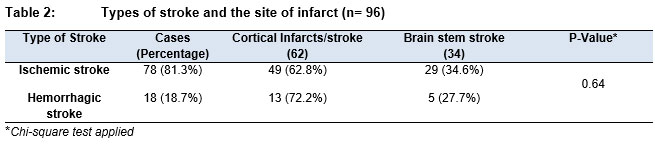
Out of 96 stroke patients 56 (58.33%) were male and 40 (41.66%) were female with a mean age of 63 ± 9.1 SD years and 59 ± 11 SD years respectively. The age range was 39 to 75 years (Table 1). Out of these 96 stroke patients, 18 (18.75%) were of hemorrhagic stroke and 78 (81.25%) patients were with ischemic stroke. In 18 hemorrhagic stroke patients, 5 patients (27.7%) were with brainstem hemorrhagic stroke and 13 (72.3%) patients were with cortical hemorrhagic stroke. In 78 ischemic stroke patients there were 27 (34.61%) brainstem infarcts, and 49 (62.82%) patients were with cortical ischemic infarcts (Table 2). No significant difference was found by applying chi-square test between the stroke type and the site of infarct (p=0.64).
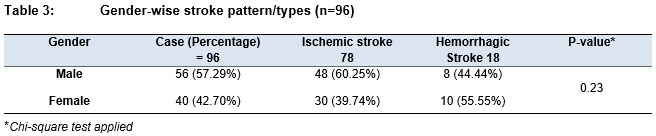
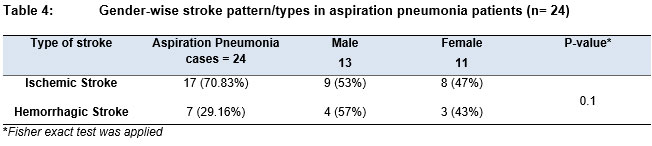
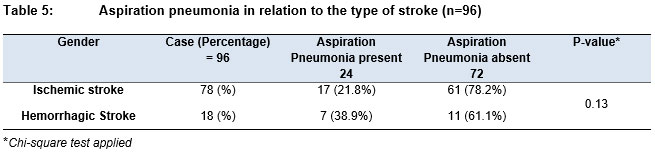
Out of 18 hemorrhagic stroke patients, 8 (44.44%) were male and 10 (55.55%) were female patients while in 78 ischemic stroke patients, 47 (60.25%) male and 31(39.74%) female patients were present (Table 3). The gender is not statistically associated with type of stroke (p=0.23). Out of these 96 stroke patients, total 24 (25%) patients had developed aspiration pneumonia after stroke event during hospital admissions. In these 24 aspiration pneumonia patients, 17 (70.83%) were ischemic stroke patients with 9 male and 8 female while 7(29.16%) were of hemorrhagic stroke with 4 male and 3 female patients respectively and no significant association was found by applying Fisher exact test (Table 4). In table 5, although there is no significant association but the Odds Ratio (OR) of 1.8 (95% CI: 0.6–5.7) shows that the hemorrhagic strokes had numerically higher odds than ischemic group of having aspiration pneumonia.

Discussion
Our study focused on patients admitted with acute stroke to find the silent threat of aspiration pneumonia which is an important post stroke complication. Pneumonia in patients with stroke during hospital admission can be treated properly if it is detected early and it can be prevented if proper measures are taken. In our study 25 % of stroke patients developed aspiration pneumonia during hospital admission which is an alarming signal to have such critical condition in paralyzed patients. Patients affected with stroke are mostly have difficulty in chewing and swallowing which leads to aspiration of food particles, liquids, medications or even the saliva. According to Westendorp W, et al, pneumonia occurring in around 10% of hospitalized patients which is less frequent compared to our study [10]. A local study of 180 stroke patients shows 15.56% aspiration pneumonia in stroke patients which has significant numbers of prevalence but shows less frequency of aspiration pneumonia than observed in our study [11]. In that study the duration of study, number of male and female participants as well as the ischemic and hemorrhagic cases were about equal as were in our study.
Stroke associated pneumonia is a common post-stroke complication that generally occurs within 7 days of stroke onset in approximately one-third of patients with acute stroke [12,13, 14]. Two out of 3 pneumonias in the first 3 months after stroke occur in the first week, with a peak incidence on the third day was documented in a study [15]. Takayoshi Akimoto et al documented 8.5% post stroke pneumonia that is very low frequency compared to 25% as recorded in our study [16].
In patients with advanced age, severe stroke, and post stroke dysphagia, the incidence of pneumonia may be as high as 40% and this study has higher level of aspiration pneumonia than our study results [17]. Two other local studies are more comparable to our study findings as documented by 17% and 20% frequency of aspiration pneumonia in stroke patients respectively [18,19]. A study shows 50.6% prevalence of aspiration pneumonia in dysphagic stroke patients, and the rate of aspiration pneumonia was higher in hemorrhagic stroke patients compared with ischemic stroke patients [20]. Aspiration pneumonia may prolong hospital stay and recovery process of the disease process [21].
Current study highlights the pattern of aspiration pneumonia in stroke patients of ischemic and hemorrhagic categories but due to feasibility issues the study was limited to one center and in a specified time duration, otherwise the number of cases could have increased. This study has policy and practice implications.
Conclusion
Post stroke aspiration pneumonia documented to be 25% in our study which shows a significant clinical complication and a severe silent threat in stroke patients. Patients with dysphagia and low conscious level (GCS <10) after stroke are more frequently developing aspiration pneumonia and may prolong hospital stay and slow down the recovery process. There should be quick management plans and intubation of nasogastric tubes to minimize the risk of aspiration. Gag reflex of the stroke patients should be checked by the attending physician before giving any food, medicines and liquid items by mouth. The family and care givers need to be educated for restrictions of any food materials by mouth without proper medical advice.
References
- Sacco RL et al; American Heart Association Stroke Council, Council on Cardiovascular Surgery and Anesthesia. Council on Cardiovascular Radiology and Intervention. Council on Cardiovascular and Stroke Nursing. Council on Epidemiology and Prevention. Council on Peripheral Vascular Disease. Council on Nutrition, Physical Activity and Metabolism. An updated definition of stroke for the 21st century: a statement for healthcare professionals from the American Heart Association/American Stroke Association. Stroke. 2013 Jul;44(7):2064-89. https://doi.org/10.1161/strokeaha.108.192218
- Katan M, Luft A. Global Burden of Stroke. Semin Neurol. 2018 Apr;38(2):208-211. doi: 10.1055/s-0038-1649503. Epub 2018 May 23. PMID: 29791947.https://doi.org/10.1055/s-0038-1649503
- Girgenti, Sophia et al; Longitudinal outcomes of ischemic versus hemorrhagic stroke: Differences may impact future trial design;Journal of Stroke and Cerebrovascular Diseases, Volume 33, Issue 11, 107952. https://doi.org/10.1016/j.jstrokecerebrovasdis.2024.107952
- Cohen DL, Roffe C, Beavan J, et al. Post-stroke dysphagia: A review and design considerations for future trials. International Journal of Stroke. 2016;11(4):399-411. https://doi.org/10.1177/1747493016639057
- Jordi Almirall, Ramon Boixeda, Mari C. de la Torre, Antoni Torres. Aspiration pneumonia: A renewed perspective and practical approach; Respiratory Medicine 185 (2021) 106485.https://doi.org/10.1016/j.rmed.2021.106485
- Sanivarapu RR, Vaqar S, Gibson J. Aspiration Pneumonia. [Updated 2024 Mar 20]. https://www.ncbi.nlm.nih.gov/books/NBK470459.
- Finlayson, O., Kapral, M., Hall, R., Asllani, E., Selchen, D., Saposnik, G., et al. (2011). Risk factors, inpatient care, and outcomes of pneumonia after ischemic stroke. Neurology 77, 1338–1345. doi: 10.1212/WNL.0b013e31823152b1.https://doi.org/10.1212/wnl.0b013e31823152b1
- Sivakumar S, Prabhu A. Physiology, Gag Reflex. [Updated 2023 Mar 12]. In: StatPearls [Internet]. https://www.ncbi.nlm.nih.gov/books/NBK554502/
- Cohen DL, Roffe C, Beavan J, et al. Post-stroke dysphagia: A review and design considerations for future trials. International Journal of Stroke. 2016;11(4):399-411. doi:10.1177/1747493016639057. https://doi.org/10.1177/1747493016639057
- Westendorp W, Nederkoorn P, Vermeij J, Dijkgraaf M, van de Beek D. Post-stroke infection: a systematic review and meta-analysis. BMC Neurol 2011; 11: 110.) https://doi.org/10.1186/1471-2377-11-110
- Muhammad Khalid, Iftikhar Ali Kakar, Haris Khan, Muhammad Haroon Shahid, Hazrat Abbas, Muhammad Salman, Prevalence of aspiration Pneumonia in Stroke Patients at Tertiary Care Hospital, Vol. 16 No. 10 (2022): Pakistan Journal of Medical and Health Sciences.https://doi.org/10.53350/pjmhs221610569
- Chen Y, Yang H, Wei H, et al. Stroke-associated pneumonia: a bibliometric analysis of worldwide trends from 2003 to 2020. Medicine (Baltimore). 2021;100(38):e27321. https://doi.org/10.1097/md.0000000000027321
- Verma R. Stroke-associated pneumonia: management issues. J Neurosci Rural Pract. 2019;10(3):472-473. doi:10.1055/s-0039-1696743. https://doi.org/10.1055/s-0039-1696743
- Sellars C, Bowie L, Bagg J, et al. Risk factors for chest infection in acute stroke: A prospective cohort study. Stroke. 2007;38(8):2284–2291. https://doi.org/10.1161/strokeaha.106.478156
- Jeroen C. de Jonge, MD https://orcid.org/0000-0002-0025-8760 [email protected], Diederik van de Beek, MD, PhD, Patrick Lyden, MD https://orcid.org/0000-0001-6170-4042, Marian C. Brady, PhD, Philip M. Bath, DSc, FMedSci; Temporal Profile of Pneumonia After Stroke, Stroke,Volume 53, Number 1 https://doi.org/10.1161/STROKEAHA.120.032787
- Takayoshi Akimoto *ORCID,Makoto Hara,Masaki Ishihara,Katsuhiko Ogawa andHideto Nakajima, Post-Stroke Pneumonia in Real-World Practice: Background, Microbiological Examination, and Treatment, Neurol. Int. 2023, 15(1), 69-77 https://doi.org/10.3390/neurolint15010006
- Hoffmann S, Malzahn U, Harms H, et al. Development of a clinical score (A2DS2) to predict pneumonia in acute ischemic stroke. Stroke 2012; 43: 2617–2623.) https://doi.org/10.1161/strokeaha.112.653055
- MUHAMMAD IMRAN, ABDUL WARIS KHAN, MUHAMMAD UMAR et al; Frequency of Aspiration Pneumonia in Patients with Stroke; P J M H S Vol. 16, No.01, JAN 2022. http://dx.doi.org/10.53350/pjmhs221611062
- HUSNAIN HASHIM, LARAIB SHAHID, DANIAL BAJWA; Prevalence of Stroke Associated Pneumonia in Stroke Patients; P J M H S Vol. 16, No. 10, October, 2022. https://doi.org/10.53350/pjmhs221610590
- Moulaei N. A et al Aspiration pneumonia after cerebrovascular stroke: a comparison between patients with and without dysphagia; Anest. intenziv. Med.2022;33(3-4):148-152.https://doi.org/10.36290/aim.2022.023
- Wakabayashi T, Hamaguchi S, Morimoto K; Adult Pneumonia Study Group – Japan. Clinically defined aspiration pneumonia is an independent risk factor associated with long-term hospital stay: a prospective cohort study. BMC Pulm Med. 2023 Sep 18;23(1):351. doi: 10.1186/s12890-023-02641-y. PMID: 37718411; PMCID: PMC10506309. https://doi.org/10.1186/s12890-023-02641-y