Abstract
Background: Thromboprophylaxis is a proven and safe strategy for hospitalized patients. However, many hospitals still don’t use these preventive measures enough, despite their benefits.
Objective: To evaluate the risk and adoption of thromboprophylaxis guidelines in acutely ill and immobilized patients in a tertiary care hospital.
Method: This prospective observational study was conducted in the medical wards of Hayatabad Medical Complex (HMC), Peshawar from April 2021 to September 2022. A total of 4260 patients were hospitalized in medical wards during the study period. The simple random sampling technique allowed the inclusion of 600 patients with equal representation from all the three medical units of HMC.
Results: Among the admitted patients, 336 (56%) were females while 264 (44%) were males. Patients stratified as High Risk were 435 (72%) while the remaining 165 (28%) were in Low-risk group. Total 345 (57.5%) patients received Venous thromboembolism (VTE) prophylaxis with 187 (31.2%) in the High-Risk group while 158 (26.4%) in the low-risk group. Amongst these74 (12.3%) patients received both the modalities Thromboembolic Deterrent (TED) Stockings and anticoagulation therapy while remaining 173 (28.6%) received TED Stockings alone, and 101 (16.7%) received anticoagulation therapy alone. Implementation of VTE prophylaxis is estimated to be 31.2% in high-risk group and 26.4% in low-risk group patients.
Conclusion: Present investigation revealed substantial underutilization of venous thromboembolisms prophylaxis to seriously ill medical ward patients and emphasize the urgent requirement for amended implementation of current guidelines in hospitals, so as to ensure optimal venous thromboprophylaxis practices and prevent avoidable cases of venous thromboembolism.
Keywords: Venous Thromboembolism, Thromboprophylaxis, Medical Ward, Evidence based guidelines
Introduction
Venous thromboembolism (VTE) continues to pose a significant threat to public health, with a substantial mortality rate and a high risk of recurrence. Approximately one-third of patients who experience VTE will have another episode at some point in their life. The condition is responsible for an estimated 1000,000 deaths annually. Notably, nearly half of all cases are linked to hospitalization [1]. Several research have confirmed that practicing thromboprophylaxis in hospitalized patients who are at danger of developing VTE is an efficient and safe approach [2,3]. Despite the benefits, prophylactic remedies for VTE remain underused in many hospital setups [4,5]. In view of VTE prophylaxis, the general practitioners should take interest in the relative risks of VTE, potential benefits of accessible prophylactic agents, plausible complications (the risk of bleeding) and expenditures [6]. For more than 15 years, there have been consensus guidelines based on evidence for VTE prophylaxis. In 1986, the American College of Chest Physician published consensus guidelines for prevention of VTE, which were updated in 2021 [7,8].
Existing guidelines emphatically recommend the use of VTE prophylaxis in medically ill patients; however, the rate of prophylaxis practice remains disconcertingly low. Despite concerted efforts to develop and enhance strategies for improving adherence to prophylaxis regimens, the gap between recommendation and reality persists [9]. However, adequate VTE prophylaxis should consider not just correct dosing, but also appropriate patient selection, avoidance of contraindications, and minimization of unnecessary use. Optimizing thromboprophylaxis strategies through improved risks assessment could lead to better patient outcomes, reduced complications, and more effective prevention of both bleeding and thrombosis [10,11]. Several anticoagulants have been investigated up-till now such as heparin, warfarin and recently fondaparinux in preventing VTE in orthopedic surgery patients [12]. The current study was planned to evaluate number of patients at risk of developing venous thromboembolism and that at what extent VTE prophylaxis is applied in acutely ill and immobilized hospitalized patients at Hayatabad Medical Complex, Peshawar, that can be further improved through multifocal educational programs regarding VTE prophylaxis.
Method
This clinical audit was conducted in Hayatabad Medical Complex (HMC), Peshawar from April 2021 to September 2022 to evaluate the number of seriously ill and immobilized patients (at risk of venous thromboembolism) receiving adequate VTE prophylaxis according to established guidelines. IRB permission was acquired before the conduct of study (Ref No: CPSP/REU/MED-2018-021-14082). The simple random sampling technique was used to include 600 patients with equal representation from all the three medical units of HMC. All the included patients were stratified into low risk and high-risk groups according to the ANZ WP (Australia and New Zealand Working party) recommendations which categorize patients into these two groups based on medical history (presence of risk factors, old age, history of previous thromboembolic events), current health status and treatment plans [13]. Main objective was to evaluate whether patients were being adequately managed according to their risk profiles, categorizing them into high-risk and low-risk groups to ensure tailored care. The patients were audited on the basis of the need for the VTE prophylaxis and the modalities used for prevention including TED Stockings alone, anticoagulation alone or use of both modalities Frequencies and percentages were calculated for the variables.
Results
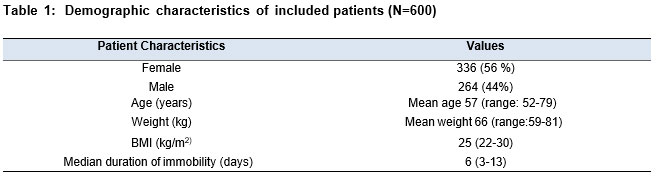
A total of 4260 patients were hospitalized in medical wards during the study period. A total of 600 patients with equal representation from all the three medical units of HMC. 56% (336) were females while 44% (264) were males. Patients stratified as High Risk were 72% (435) while remaining 28% (165) were in the Low-risk group. Detailed demographic characteristics of patients are shown in table 1.
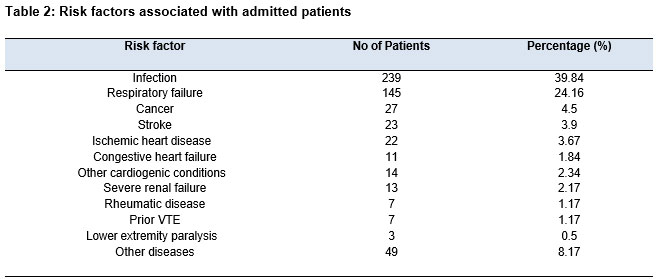
Highest risk factors of VTE identified in admitted patients were found to be: infection (39.84%), respiratory failure (24.16%) and cancer (4.5%). Whereas the risk factors observed in the High-risk groups were age >60 years, past history of stroke with resultant neurological deficits, admission with acute lung conditions on the background of previous known chronic lung disorders, and active cancers. (Table 2).
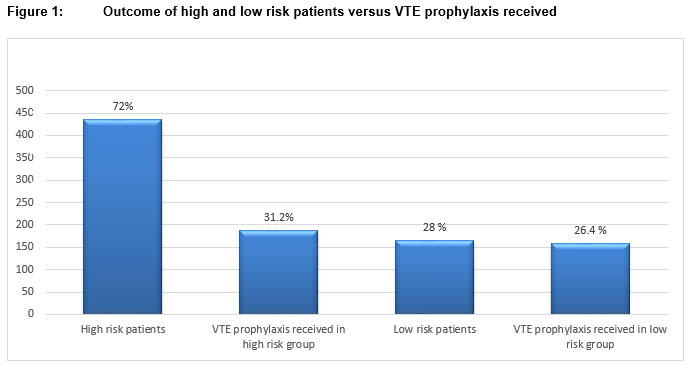
A total of 57.5% (345) were found to be receiving VTE prophylaxis with 31.2% (187) in the High-Risk group while 26.4% (158) in the low-risk group. Amongst the patients receiving the VTE prophylaxis, it was observed that 12.3% (74) patients were receiving both the modalities while the remaining 28.6% (173) were having TED Stockings alone besides 16.7% (101) were receiving anticoagulation alone. (Graph 1)
Discussion
This clinical audit of VTE patients hospitalized in Hayatabad Medical Complex, Peshawar confirm the underuse of VTE prophylaxis which is estimated to be 31.2% in high-risk group and 26.4% in low- risk group. Recently Naseema Ambra investigated incidence and practice of thromboprophylaxis in hospitalized patients at Qatar hospital and revealed annual incidence of venous thromboembolism of 32.55 per 100,000 admissions (0.032%) [14]. Among the patients, 64.7% underwent risk evaluation and 69.7% received VTE prophylaxis as per established guidelines. It was concluded that physicians require further education and training on VTE evaluation and prophylaxis to accurately identify and manage risk factors in all patients at admission, despite the relatively low incidence of VTE [14]. A study conducted in Saudi Arabia exposed that while 60.5% of the study participants got some form of VTE prophylaxis, only 38.4% received VTE prophylaxis that was in line with the recommended guidelines from the American College of Chest Physicians (ACCP) [15]. Hameed etal reported a comparable percentage (40.9%) of VTE prophylaxis in a study conducted in 7 hospitals of Saudi Arabia [16]. Results from ENDORSE conducted in three Gulf countries discovered that 40.2% of the research participants got ACCP guidelines- compliant VTE prophylaxis, highlighting a significant gap in adherence to recommended practices [17]. The continuing IMPROVE study has reported that 60% of the patients who are at risk are receiving VTE prophylaxis consistent with ACCP guidelines [18]. A notable discrepancy was observed in the CURVE study in Canada, where a significantly lower proportion of eligible patients (16%) received VTE prophylaxis [19]. Although the scientific results confirm the advantages of routine VTE evaluation and thromboprophylaxis of eligible patients, the practice of these measures remains inconsistent all over the world [20]. Although current research demonstrates a promising trend of increased compliance to ACCP guidelines for thromboprophylaxis during hospital stays.
However, this progress is offset by a significant decline in overall adherence to prophylaxis regimens after patients are discharged, highlighting the need for more effective strategies to ensure continued implementation of guidelines beyond the hospital setting [21]. Haris Shah etal also recognized patients at risk of VTE and implemented prophylaxis measures at Northwest General Hospital and Research Centre, Peshawar, and indicated suboptimal adherence to established guidelines for VTE risk assessment and prophylaxis. However, educational programs yielded substantial improvement in patient health related to VTE, amplifying the effectiveness of targeted interventions in driving quality improvement [22]. These results align with the outcomes of another study in Gaza which also revealed suboptimal adherence to VTE prophylaxis, reinforcing the notion of a widespread issue [23]. A notable disparity exists in the adoption of VTE prophylaxis guidelines in developing and developed countries, with the former demonstrating markedly higher rates of adoption, highlighting the need to targeted support and resource allocation to bridge this gap [24]. The prevention of VTE should be the focus of a formal strategy that should be created by each hospital. In general, a written prophylactic policy should be used, particularly in patients who are at high risk of developing DVT. Implementing a preventive treatment approach might be made easier with the aid of a computerized system. Susan’s review of RCTs revealed that hospital-wide initiatives, including alerts and interventions, significantly improved thromboprophylaxis in hospitalized patients, leading to increased prescription of prophylactic measures [25].
Conclusion
Findings of present study indicated substantial underutilization of venous thromboembolisms prophylaxis to acutely ill hospitalized medical ward patients and underscore the crucial requirement for revised implementation of prevailing evidence-based guidelines in hospitals, to guarantee optimal venous thromboprophylaxis practices and prevent avoidable cases of venous thromboembolism.
References
- Skeik N, Westergard E. Recommendations for VTE Prophylaxis in Medically Ill Patients. Ann Vasc 2020 Mar 25;13(1):38-44. doi:10.3400/avd.ra.19-00115. PMID: 32273920; PMCID: PMC7140153.https://doi.org/10.3400/avd.ra.19-00115
- Bartlett MA, Mauck KF, Stephenson CR, Ganesh R, Daniels Perioperative venous thromboembolism prophylaxis. In Mayo Clinic Proceedings 2020; 95(12): 2775-2798 doi.org/10.1016/j.mayocp.2020.06.015 ttps://doi.org/10.1016/j.mayocp.2020.06.015
- Segon YS, Summey RD, Slawski B, Kaatz S. Surgical venous thromboembolism prophylaxis: clinical practice update. Hospital Practice 2020; 48(5):248-57.doi: 1097/CCM.0000000000004466https://doi.org/10.1097/CCM.0000000000004466
- Nkoke C, Tchinde Ngueping MJ, Atemkeng F, Teuwafeu D, Boombhi J, Menanga A. Incidence of Venous Thromboembolism, Risk Factors and Prophylaxis in Hospitalized Patients in the South West Region of Cameroon. Vasc Health Risk Manag. 2020 Jul 22;16:317-324. doi: 2147/VHRM.S205935.https://doi.org/10.2147/VHRM.S205935
- Onwuzo C, Olukorode J, Sange W, Tanna SJ, Osaghae OW, Hassan A, Kristilere H, Orimoloye DA, Omokore O, Ganiyu B, Fayemi T, Addeh A Review of the Preventive Strategies for Venous Thromboembolism in Hospitalized Patients. Cureus. 2023 Nov 7;15(11):e48421. doi: 10.7759/cureus.48421. PMID: 38074047; PMCID: PMC10701607.https://doi.org/10.7759/cureus.48421
- Nicholson M, Chan N, Bhagirath V, Ginsberg J. Prevention of Venous Thromboembolism in 2020 and J Clin Med. 2020 Aug 1;9(8):2467. doi: 10.3390/jcm9082467. PMID: 32752154; PMCID: PMC7465935https://doi.org/10.3390/jcm9082467
- Geerts WH, Bergqvist D, Pineo GF, Heit JA, Samama CM, Lassen MR, Colwell Prevention of venous thromboembolism: American College of Chest Physicians Evidence- Based Clinical Practice Guidelines (8th Edition). Chest. 2008 Jun;133(6 Suppl):381S-453S. doi:10.1378/chest.08-0656. PMID:18574271https://doi.org/10.1378/chest.08-0656
- Stevens SM, Woller SC, Kreuziger LB, Bounameaux H, Doerschug K, Geersing GJ, Huisman MV, Kearon C, King CS, Knighton AJ, Lake Antithrombotic therapy for VTE disease: second update of the CHEST guideline and expert panel report. Chest. 2021 Dec 1;160(6):e545-608.https://doi.org/10.1016/j.chest.2021.07.055
- Stashenko GJ, Tapson Prevention of venous thromboembolism in medical patients and outpatients. Nat Rev Cardiol. 2009;6:356–363.https://doi.org/10.1038/nrcardio.2009.33
- Alckmin CA, Garcia MD, Bricola SA, Martins Mde A, Lichtenstein A, Paiva EF. Venous thromboembolism risk assessment in hospitalised patients: a new proposal. Clinics (Sao Paulo). 2013 Nov;68(11):1416-doi:10.6061/clinics/2013(11)06. https://doi.org/10.6061/clinics/2013(11)06
- Schaefer JK, Grant PJ. A need to refine venous thromboembolism risk assessment: the challenge of optimizing patient selection for thromboprophylaxis among hospitalized adults. Res Pract Thromb Haemost. 2023 Nov 9;7(8):102258. doi: 1016/j.rpth.2023.102258.https://doi.org/10.1016/j.rpth.2023.102258
- Becker, Richard C, and Frederick A Spencer, 'Venous Thromboembolism Prophylaxis', Fibrinolytic and Antithrombotic Therapy: Theory, Practice, and Management, Second Edition (New York, 2006; online edn, Oxford Academic, 12 2020), https://doi.org/10.1093/oso/9780195155648.003. 0030, accessed 26 Aug. 2024.https://doi.org/10.1093/oso/9780195155648.003.0030
- Gibbs H, Fletcher J, Blombery P, Collins R, Wheatley D. Venous thromboembolism prophylaxis guideline implementation is improved by nurse directed feedback and audit. Thromb 2011 Apr 5;9(1):7. doi: 10.1186/1477- 9560-9-7. PMID: 21466681; PMCID: PMC3080276. https://doi.org/10.1186/1477-9560-9-7
- Ambra N, Mohammad OH, Naushad VA, Purayil NK, Mohamedali MG, Elzouki AN, Khalid MK, Illahi MN, Palol A, Barman M, Sharif M, Chalihadan S, Punnorath A, Mostafa A, Al Hariri B, Khidir TGM, Varikkodan I. Venous Thromboembolism Among Hospitalized Patients: Incidence and Adequacy of Thromboprophylaxis - A Retrospective Study. Vasc Health Risk 2022 Jul 24;18:575-587. doi: 10.2147/VHRM.S370344. PMID:35912018; PMCID: PMC9333096.https://doi.org/10.2147/VHRM.S370344
- Kharaba A, Al Aboud M, Kharabah MR, Alyami K, Al Beihany A. Venous thromboembolism risks and prophylaxis in King Fahad Hospital, Madinah, Saudi Arabia. J Epidemiol Glob 2017;7(4):295 298.doi:10.1016/j.jegh.2017.09.003 https://doi.org/10.1016/j.jegh.2017.09.003
- Al-Hameed FM, Al-Dorzi HM, Qadhi AI, et al. Thromboprophylaxis and mortality among patients who developed venous thromboembolism in seven major hospitals in Saudi Ann Thorac Med. 2017;12(4):282–289. doi: 10.4103/atm.ATM_101_17 https://doi.org/10.4103/atm.ATM_101_17
- Alsayegh F, Kamaliddin H, Sheshah E, Bukhamseen N, Alkhuwaitir T, Elhoufi A. Assessment of venous thromboembolism risk and adequacy of prophylaxis in selected acute care medical centres in Arabian Gulf States: results from the ENDORSE study. Med Princ Pract. 2012;21(6):522–528. doi: 10.1159/000339081 https://doi.org/10.1159/000339081
- Tapson VF, Decousus H, Pini M, et al. Venous thromboembolism prophylaxis in acutely ill hospitalized medical patients: findings from the international medical prevention registry on venous Chest. 2007;132(3):936–945. doi: 10.1378/chest.06-2993 https://doi.org/10.1378/chest.06-2993
- Kahn SR, Panju A, Geerts W, et al. Multicenter evaluation of the use of venous thromboembolism prophylaxis in acutely ill medical patients in Canada. Thromb Res. 2007;119(2):145–155.doi:1016/j.thromres.2006.01.011https://doi.org/10.1016/j.thromres.2006.01.011
- Khoury H, Welner S, Kubin M, Folkerts K, Haas Disease burden and unmet needs for prevention of venous thromboembolism in medically ill patients in Europe show underutilisation of preventive therapies. Thromb Haemost. 2011;106(4):600–608.doi: 10.1160/TH11-03-0168https://doi.org/10.1160/TH11-03-0168
- Farfan M, Bautista M, Bonilla G. Worldwide adherence to ACCP guidelines for thromboprophylaxis after major orthopedic surgery: A systematic review of the literature and meta-analysis. Thrombosis Research 2016; 141:163-170. doi: 10.1016/j.thromres.2016.03.029 https://doi.org/10.1016/j.thromres.2016.03.029
- Shah MH, Khan MS, Ahmad S, Aftab U, Khan A, Ahmad W, Iftikhar U, Ahmad I. Risk Assessment and Prophylaxis of Venous Thromboembolism in Patients of Medical Ward of Northwest General Hospital and Research Center, Peshawar, Pakistan: A Quality Improvement Project. Cureus. 2022 Dec 22;14(12):e32811. doi: 10.7759/cureus.32811. PMID: 36699801; PMCID: PMC9870187.https://doi.org/10.7759/cureus.32811
- Abuowda Y, Alswerki M, Alsheikh Ahmad A, et al. Pharmacological prophylaxis of venous thromboembolism in adult medical and surgical wards in the Gaza Strip: a multi-centre clinical audit. Lancet. 2019;393:1.http://dx.doi.org/10.13140/RG.2.2.22085.96482
- E Ismail A, Jadawji N, Adebayo P, et al. Evaluation of venous thromboembolism (VTE) risk assessment and thrombo-prophylaxis practices in hospitalized medical and surgical patients at Aga Khan Hospital Dar es Salaam: single-centre retrospective Pan Afr Med J. 2022;42:160.https://doi.org/10.11604/pamj.2022.42.160.28278
- Kahn SR, Morrison DR, Cohen JM, Emed J, Tagalakis V, Roussin A, Geerts W. Interventions for implementation of thromboprophylaxis in hospitalized medical and surgical patients at risk for venous thromboembolism. Cochrane Database Syst Rev. 2013 Jul 16;(7):CD008201.doi:10.1002/14651858.CD008201.pub2. Update in:Cochrane Database Syst Rev. 2018 Apr 24;4:CD008201.doi:10.1002/14651858.CD008201.pub3. PMID:23861035. https://doi.org/10.1002/14651858.CD008201.pub3