Abstract
Background: Imposter syndrome is the persistent feeling of self-doubt and the fear of being exposed as fraud, even in the face of clear accomplishments. It can cause anxiety, burnout, and difficulty accepting success. However, it can be managed through increased self-awareness, seeking support, and challenging negative thought patterns.
Objective: The objective of this study was to determine the frequency, severity and other characteristics of impostor phenomenon among students of different disciplines of health professional education.
Method: A cross-sectional study was conducted on 1419 conveniently selected eligible students in different disciplines of health professions education at Superior University, Lahore, Pakistan during April to May 2020. Clance Imposter Phenomenon Scale (CIPS) was administered through anonymous online google form. Data were analyzed by SPSS version 20.
Results: Out of 1419 students, 328, 818 and 272, were from MBBS, Doctor of Physiotherapy and Allied Health Sciences respectively and amongst them 60.6% were females. 43.8% of students showed moderate IP characteristics, out of these 59.06% were females. 42.28% students showed frequent IP experiences, out of these 62.66% were females. Intense IP was found among 8.38% students (68.06% females). Female students were having significantly higher IP scores than male students. MBBS students had significantly higher IP scores as compared to DPT or allied health sciences students.
Conclusion: Imposter phenomenon was found to be significantly high among the MBBS students and in females. This has policy and practice implications.
Keywords: Imposter Phenomenon, Clance Imposter Phenomenon Scale, Medical students, Health professions students.
Introduction
Education in the present era is not a straightforward process. It involves a huge number of different aspects of human as well as educational psychology. In year 1978 Clance and Imes, studied characteristics of some highly successful women and found multifaceted phenomenon among them, they named this as “Imposter phenomenon” (IP) [1]. In this phenomenon the sufferers have doubts about their abilities and accomplishments, despite the reality being contrary to what they believe. Initially it was a static trait among females. After further research it was found out that males are also affected equally or at least significantly and it is a situational affective response [2].
Imposter phenomenon may be defined in many ways. Different researchers have described it in different ways. Clance in 1985 described that there are six cardinal characteristics which comprise an “Imposter Cycle”. These are, (i) need to be at best or special, (ii) the superman/superwoman aspect, (iii) the fear of having failure, (iv) discounting praise, (v) denial of the competence and lastly (vi) feeling of guilt regarding the successes [3]. The sufferers of imposter phenomenon usually have the habit of typically attributing their successes and achievements to external factors like luck or favorable circumstances, while on contrary, attribute their failures to the internal traits. They are mostly to maintain the impression on others and thus fall prey to the potentially serious levels of anxiety, depression and low self-confidence [4,5,6,7].
Imposter phenomenon is associated with many other psychological characteristics like anxiety, neuroticism, perfectionism etc., and may lead to many detrimental effects on personalities like stress, and lack of initiative, self-confidence, motivation etc. These sufferers cannot enjoy their successes and achievements because they think of themselves as frauds and cheats, not deserving what they have accomplished [2]. The people with IP give credit to certain external factors for their success and achievements, like pure luck, error by others, or just a coincidence [8].
The Imposter phenomenon is very relevant to health-related professional education. Various studies support the fact that medical students with characteristics of this phenomenon have higher levels of psychological stress, anxiety, depression and burnout which may lead to their dropping out or quitting the medical schools [2,9,10,11]. This may even lead to suicidal tendencies in extreme cases. So, it can be well imagined that a “to be” healthcare provider, who is suffering from such potentially serious psychological problem, may have many adverse effects on his/ her career and may compromise patient’s wellbeing and care [12,13]. This has an impact not only on the life & career of the sufferer as an individual, but also on the community. The person with IP will be hesitant to explore his/ her talent in competitive, experimental and productive opportunities and will not contribute to the society and relevant community for being doubtful for the outcome [13].
This study was designed to determine the frequency, severity, and associated characteristics of the Impostor Phenomenon among students enrolled in health professional education disciplines. Despite increasing global attention to the psychological well-being of medical and health sciences students, there is a lack of localized data on the prevalence and nature of the Impostor Phenomenon in the context of Pakistani health professions education. This study addresses that gap by providing institution-specific insights, contributing novel data from a single medical college in Lahore, an area where such research remains limited.
Method
A cross-sectional study was conducted on students enrolled at Azra Naheed Medical College, departments of Physiotherapy and Allied Health Sciences at the Superior University, Lahore Pakistan. A convenient non-probability sampling technique was used to get the responses. Sample size was calculated by using RAOSOFT, keeping p value and confidence level at 0.05 and 95% respectively [14]. The duration of study was from April to May 2020. The ethical clearance was taken from the Institutional Review Board of Azra Naheed Medical College, Lahore (Ref. No. IRB/ANMC/2020/07). Verbal informed consent was obtained. The anonymity was maintained by creating an online survey form through which even authors cannot track which response is given by which particular participant. This feature of anonymity was clearly explained to the participants prior to the consent. They were given the right not to participate without any repercussions on any aspect of their studies and stay in the institution. Data was accessible only to the research team. Being an online survey form, the study carried no physical risk and minimal psychological risk (of becoming aware of the symptoms of imposter syndrome or the phenomenon) to the participants.
Medical students from all five years of the MBBS program at Azra Naheed Medical College, along with students from the Doctor of Physiotherapy (DPT) and Allied Health Sciences programs at Superior College Lahore, were invited to participate in this study. A total of 1419 participants submitted fully completed survey forms. Data were collected using an anonymous online Google Form, which included 28 questions. The first eight questions gathered basic demographic information such as age, gender, course, and year/semester of study. The remaining 20 questions comprised the validated Clance Impostor Phenomenon Scale (CIPS), designed to assess levels of impostorism. Completing the survey typically took 10–15 minutes.
The final questionnaire consisted of the demographic section followed by the Clance Impostor Phenomenon Scale, which includes 20 items rated on a 5-point Likert scale (1 = not at all true, 5 = very true). Total scores ranged from 20 to 100, with higher scores indicating more frequent and intense experiences of impostor feelings. According to Clance's scoring system: scores <40 suggest few impostor characteristics; scores between 41–60 indicate moderate impostor feelings; scores between 61–80 reflect frequent impostor experiences; and scores >80 suggest intense impostor characteristics. For the purpose of this study, a score of 62 or higher was considered indicative of impostor phenomenon. All responses were automatically compiled into Microsoft Excel spreadsheets via Google Forms and subsequently analyzed using SPSS Version 22. The form was designed to accept only fully completed responses, excluding any incomplete submissions by default.
Results
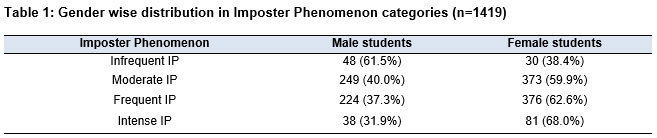
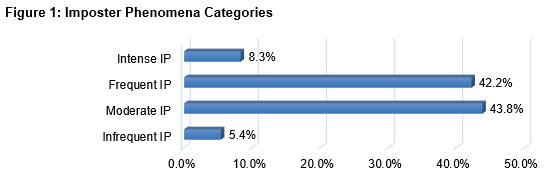
In total, 1419 students participated in this study. Out of these, 559 were male (39.4%) and 860 (60.6%) females. Three hundred & twenty-eight (328, 23.1%) students were from the MBBS discipline, 818 (57.6%) from DPT and 273 from Allied health sciences. The mean age of students participating was 20.69+2.1 SD years. Students 20 years or younger were 785 (55.3%) while more than 21 years were 634 (44.7%). Four hundred and thirty-six (30.7%) students had a health-related professional person among their parents or siblings. Students were asked about their own perception regarding academic performance. They were asked to rank themselves in top, middle or bottom one third students of their class based on the grades they achieved in previous professional examinations. Four hundred and fifty-two (452, 31.9%) students ranked themselves among the top one third, while 899 (63.4%) and only 68 (4.8%) students ranked themselves in middle and lower thirds respectively. Nine hundred and thirty (930, 66.6%) students were from urban and 466 (34.4%) from rural background. Clance imposter phenomenon scale was used in this study to assess the frequency of imposter phenomenon characteristics among study participants. A large number of students (1222) had either moderate or frequent IP as shown in Figure 1. The number of students who had few IP characteristics (scores from 0-40) was 78 (5.49%). The number of students who had moderate IP characteristics was 622 (43.8%). Out of these, there were 249 (40.03%) male students and 373 (59.96%) female students. There were 600 (42.28%) students who had frequent IP experiences (. Of these, there were 224 (37.33%) male and 376 (62.66%) female students. There were 119 (8.38%) students who had intense IP experiences, comprising of 38 male (31.9%) and 81 (68.06%) female students (Table 1).
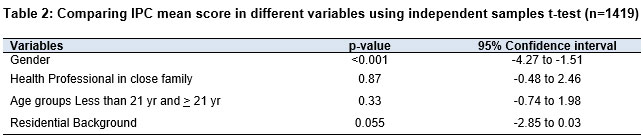
An independent samples t-test was used to compare the mean IP scores in both genders as shown in Table 2. Female students were significantly more likely to have higher IP scores than male students (p<0.001; 95% CI -4.27 to -1.51). The mean score for male students in Clance IP scale was 59.63 while the mean score for female students was 62.53. There was no statistically significant difference in mean IP scores between students with and without health-related professional parents or siblings and in students 21 years and above compared to students less than 21 years old. Students belonging to the rural population had higher IP scores than students who identified themselves as belonging to the urban population, but this was just significant (p= 0.055; 95% CI -2.85 to 0.03).
Analysis of variance (ANOVA) was used to analyze the difference between students on their IP scores based on their affiliation to study program (MBBS/ DPT/Allied health sciences). MBBS students (mean= 63.33) had significantly higher IP scores as (p=0.009) compared to DPT (mean= 60.75) or allied health sciences students (mean= 60.83). ANOVA was also used to analyze the difference between students based on their self-perception of academic performance. There was no statistical difference on IP scores of students irrespective of whether they considered themselves as being in the top (mean= 61.05), middle (mean= 61.52) or bottom (mean= 61.94) one-third of students in their respective classes (p= 0.77).
Discussion
Clance, who first described this phenomenon, identified six key features: (a) the impostor cycle, (b) need to be special or the best, (c) superman/superwoman aspects, (d) fear of failure, (e) denial of competence and discounting praise, and (f) fear and guilt about success [8]. The Impostor Phenomenon is common, affecting about 70% of people at some point in their careers, across all walks of life [16]. Despite success, sufferers attribute achievements to luck or external factors and fear being exposed as frauds. This leads to persistent guilt and lack of confidence. Sheryl Sandberg, a successful executive, admitted in Lean In that she often felt like an impostor during her student and professional life, fearing embarrassment and exposure [17]. In our study the prevalence of IP was quite high (86.11%). This is in conjunction with a study from India in which 90.3% of the participants had moderate to high / intense characteristics of IP [18].
In a systematic review on imposter phenomenon, Dena M Brevata and colleagues found a widely variable prevalence of imposter syndrome ranging from 9% to 82% and attributed this variance to multiple factors [19]. Another study from India showed that 76% participating surgical interns were having severe Imposter syndrome [20]. But in many studies this prevalence is found relatively less. In a study from USA, 51 % of the participating medical students were having imposter phenomenon, with 44% males and 56% females [2]. In a study from Malaysia 45.7% participants had imposter phenomenon [21]. Other studies showed 57% [22] & 54.5% [23]. In a review of six studies from different parts of the world much less frequency or incidence of IP was found [15]. In a study from Malaysia, it was 45.7% [21], in Canada 43.8 % [24], in U.S.A % 36.35 [9]. One major reason for this low incidence is that they had a cut-off level of 62 (CIPS), which shows more frequent or intense IP. While in our study we divided IP into 04 categories and the high incidence is because we included moderate, frequent and intense or severe IP, for labelling a person having IP and excluded the infrequent ones.
The cut-off value of ≥62 was chosen based on the original Clance Impostor Phenomenon Scale (CIPS) guidelines, which identify scores in the frequent (61–80) and intense (>80) range as indicative of significant impostor feelings. Including moderate levels (41–60) aligns with the aim of early identification, recognizing that even moderate impostorism can impact academic performance and mental well-being. Excluding infrequent cases (<40) helped ensure that only students with meaningful impostor characteristics were classified as having IP. This is very much in line with the recommendations of Clance for scoring. A study from India used same 04 categories as we did and their incidence of IP was 91.3% [25]. If we consider the same “cut-off” score of 62, as used by most studies in above mentioned review of studies [15], our study also showed almost the same frequency. The number of students in our study who scored equal to or more than the cut-off score of “62” were 683 (48.13%), comprising of 235 (34.40%) males and 448 (65.59%) female students.
We considered that having moderate IP is significant and these students should also be offered improvement strategies to combat IP. Possibly this high prevalence of IP in our study and that from India, may be because we have a context, similar with each other but different from the developed world. IP is slightly less explored phenomenon especially in our setup. Life in health-related professions is now very competitive and demanding, leading more individuals to fall prey to this phenomenon. The gender wise distribution of our study was similar to many other studies conducted on IP. A study from India, by Von R. Mascarenhas, & colleagues on young medical interns, showed that 38% of the participating interns were males and 62% were females [18]. Regarding the mean Clance Imposter Phenomenon Score, the male students from our study had CIPS of 59.63 and in female students it was 62.53. In the review of studies, mentioned earlier also, the mean CIPSs for female Participants were from 46.14 to 65.2 [15]. The highest among these was from Canada (65.2). Similarly for male participants it was found as from 47.4 to 62.4, and highest being from Malaysia (62.4) [15]. These are quite like our study.
Imposter Phenomenon may have many significant implications among health-related professionals. The sufferers of imposter phenomenon usually hesitate to participate actively in learning activities and academic discussions so are neglected by others. Moreover, health related professionals need good decision making while managing patients. But if these professionals have self-doubts and feeling of inadequacy, this affects their skills development and professional growth adversely. This will further add an inability to reasonably logical patient management and proficiency. Von R. Mascarenhas and colleagues from India in their study have suggested measures to increase the confidence and self-esteem and to reduce impostorism traits. These should be taken and implemented [18]. The sufferers of the Imposter Phenomenon are not only afraid of failures in their careers, but they also are afraid of success deep inside them. They fear getting exposed to after failure and at the same time fear that after becoming successful they will lose connection from their colleagues, like after getting promotion over colleagues may result in loss of their support and even friendship [26].
The importance of IP is because the sufferers cannot internalize their potential, talents, or skills as well as their achievements. The result is low level of self-confidence & a lack of decision making. The activities, such as counselling sessions and regular evaluations of confidence building & capacity enhancement, may help alleviating IP. In addition to these, a strong vigilance should be maintained for the early detection of signs that a person is having impostor characteristics. There must be some modifications in the instructional strategies focusing on confidence boosting of medical students or heath professional. As a result, there will be reduced numbers of medical errors & quality enhancement of the patient care. The medical students and health related professionals will be more capable of the ever-growing demands of this competitive profession at the appropriate time [18]. Although the number of participants in our study was adequate, more studies from more institutions, both from the public and private sector, will help unfold many aspects of this very common and important phenomenon.
This study is limited by its single-institution scope, which restricts the generalizability of the findings to other health professions education settings in Pakistan. Additionally, the use of self-reported, cross-sectional data may be subject to response bias and does not allow for causal inferences.
Conclusion
The study found that impostor phenomenon was more common among female students and MBBS students compared to DPT and Allied Health Sciences students. No significant difference was observed based on age or having a healthcare professional in the family. Early identification and intervention are essential to minimize IP’s impact on academic and professional growth. To address the IP among health professions students, institutions should implement awareness programs, provide accessible mental health support, and establish peer mentorship systems. Faculty training and integration of psychological well-being topics into the curriculum can further promote a supportive academic environment. Regular screening for at-risk students may also enable early intervention and reduce the long-term impact of impostor feelings.
References
- Freeman KJ, Houghton S, Carr SE, Nestel D. Measuring impostor phenomenon in healthcare simulation educators: a validation of the clance impostor phenomenon scale and leary impostorism scale. BMC Med Educ. 2022;22(1):139. doi: 10.1186/s12909-022-03190-4.https://doi.org/10.1186/s12909-022-03190-4
- Villwock J, Sobin LB, Koester LA, Harris TM. Impostor syndrome and burnout among American medical students: a pilot study. Int J Med Educ. 2016;7:364-369.https://doi.org/10.5116/ijme.5801.eac4
- Huecker MR, Shreffler J, McKeny PT, Davis D. Imposter Phenomenon. [Updated 2023 Jul 31]. In: StatPearls [Internet]. Treasure Island (FL): StatPearls Publishing; 2025 Jan-. Available from: https://www.ncbi.nlm.nih.gov/books/NBK585058/
- Sukhera J, Poleksic J, Zaheer J, Pack R. Normalising disclosure or reinforcing heroism? An exploratory critical discourse analysis of mental health stigma in medical education. Med Educ. 2022;56(8):823-833. doi: 10.1111/medu.14790. https://doi.org/10.1111/medu.14790
- Jaremka LM, Ackerman JM, Gawronski B, Rule NO, Sweeny K, Tropp LR, et al. Common Academic Experiences No One Talks About: Repeated Rejection, Impostor Syndrome, and Burnout. Perspect Psychol Sci. 2020;15(3):519-543. doi: 10.1177/1745691619898848.https://doi.org/10.1177/1745691619898848
- Al Lawati A, Al Rawahi N, Waladwadi T, Alhabsi A, Al Lawati H, Al-Mahrouqi T, et al. Impostor phenomenon: a narrative review of manifestations, diagnosis, and treatment. Middle East Curr Psychiatry. 2025;32:18. doi:10.1186/s43045-025-00512-2. https://doi.org/10.1186/s43045-025-00512-2
- Meghji KA, Shaikh UM, Hiba U, Asif H. Prevalence of imposter phenomenon in students and its correlation with burnout syndrome: Torn between perfection and exhaustion. Khyber Med Univ J. 2025 Mar;17(1):19-25. doi:10.35845/kmuj.2025.23636.https://doi.org/10.35845/kmuj.2025.23636
- Siraj RA, Aldhahir AM, Alzahrani YR, Alqarni AA, Alanazi TM, Alruwaili A, et al. The impact of imposter syndrome on self-esteem and intention to quit among respiratory therapy (RT) students in Saudi Arabia. SAGE Open Med. 2024;12:20503121241260149. https://doi.org/10.1177/20503121241260149
- Mazurkiewicz R, Korenstein D, Fallar R, Ripp J. The prevalence and correlations of medical student burnout in the pre-clinical years: a cross-sectional study. Psychol Health Med. 2012;17(2):188-95. https://doi.org/10.1080/13548506.2011.597770
- Bore M, Kelly B, Nair B. Potential predictors of psychological distress and well-being in medical students: a cross-sectional pilot study. Adv Med Educ Pract. 2016;7:125-35. https://doi.org/10.2147/AMEP.S96802
- Dyrbye LN, Harper W, Moutier C, Durning SJ, Power DV, Massie FS, et al. A multi-institutional study exploring the impact of positive mental health on medical students' professionalism in an era of high burnout. Acad Med. 2012;87(8):1024-31.https://doi.org/10.1097/acm.0b013e31825cfa35
- Panagioti M, Panagopoulou E, Bower P, Lewith G, Kontopantelis E, Chew-Graham C, et al. Controlled Interventions to Reduce Burnout in Physicians: A Systematic Review and Meta-analysis. JAMA Intern Med. 2017;177(2):195-205. https://doi.org/10.1001/jamainternmed.2016.7674
- Panagioti M, Geraghty K, Johnson J, Zhou A, Panagopoulou E, Chew-Graham C, et al. Association Between Physician Burnout and Patient Safety, Professionalism, and Patient Satisfaction: A Systematic Review and Meta-analysis. JAMA Intern Med. 2018;178(10):1317-1331.https://doi.org/10.1001/jamainternmed.2018.3713
- Raosoft.com. Sample size calculator [Internet]. 2004. Available from: https:// http://www.raosoft.com/samplesize.html.
- Thomas M, Bigatti S. Perfectionism, impostor phenomenon, and mental health in medicine: a literature review. Int J Med Educ. 2020;11:201-213. https://doi.org/10.5116/ijme.5f54.c8f8
- Zeller TA, Rhoden PA, Pipas CF. What Are Doctors For? A Call for Compassion-Based Metrics as a Measure of Physician Value. Ann Fam Med. 2024;22(4):352-354. https://doi.org/10.1370/afm.3132
- Hutchins HM. Outing the imposter: A study exploring imposter phenomenon among higher education faculty. New Horizons in Adult Education and Human Resource Development. 2015;27(2):3-12.https://doi.org/10.1002/nha3.20098
- Mascarenhas VR, D’Souza D, Bicholkar A. Prevalence of impostor phenomenon and its association with self-esteem among medical interns in Goa, India. Int J Community Med Public Health. 2019;6(1):355-359. https://doi.org/10.18203/2394-6040.ijcmph20185272
- Bravata DM, Watts SA, Keefer AL, Madhusudhan DK, Taylor KT, Clark DM, et al. Prevalence, Predictors, and Treatment of Impostor Syndrome: a Systematic Review. J Gen Intern Med. 2020;35(4):1252-1275.https://doi.org/10.1007/s11606-019-05364-1
- Bhama AR, Ritz EM, Anand RJ, Auyang ED, Lipman J, Greenberg JA, et al. Imposter Syndrome in Surgical Trainees: Clance Imposter Phenomenon Scale Assessment in General Surgery Residents. J Am Coll Surg. 2021;233(5):633-638. https://doi.org/10.1016/j.jamcollsurg.2021.07.681
- Ikbaal MY. Prevalence of impostor phenomenon among medical students in a Malaysian private medical school. International Journal of Medical Students. 2018;6(2):66-70.https://doi.org/10.5195/ijms.2018.10
- Alrayyes S, Dar UF, Alrayes M, Alghutayghit A, Alrayyes N. Burnout and imposter syndrome among Saudi young adults. The strings in the puppet show of psychological morbidity. Saudi Med J. 2020;41(2):189-194. https://doi.org/10.15537/smj.2020.2.24841
- Egwurugwu JN, Ugwuezumba PC, Ohamaeme MC, Dike EI, Eberendu I, Egwurugwu EN, et al. Relationship between Self-Esteem and Impostor Syndrome among undergraduate medical students in a Nigerian university. Int J Brain Cogn Sci. 2018;7(1):9–16.doi:10.5923/j.ijbcs.20180701.02
- Legassie J, Zibrowski EM, Goldszmidt MA. Measuring resident well-being: impostorism and burnout syndrome in residency. J Gen Intern Med. 2008;23(7):1090-4. https://doi.org/10.1007/s11606-008-0536-x
- Bostock IC, Antonoff MB. Wellness Strategies Among Bad Outcomes and Complications. Thorac Surg Clin. 2024;34(3):207-212. DOI: 10.1016/j.thorsurg.2024.04.009
- Neureiter M, Traut-Mattausch E. An Inner Barrier to Career Development: Preconditions of the Impostor Phenomenon and Consequences for Career Development. Front Psychol. 2016;4(7):48. https://doi.org/10.3389/fpsyg.2016.00048