Abstract
This case report details a 16-year-old male admitted to the emergency department after a high-speed motor vehicle accident. He was diagnosed with a grade IV (2 -degree) liver damage, with blunt abdominal injury considered in the differential diagnosis. Surgeon did the exploratory laparotomy as well as stitched the laceration to arrest bleeding, preserved a clear surgical field, achieved proper hemostasis, and avoided fluid gathering.
Core features of the case report encompasses the incorporation of early initiation of movement, ventilatory exercises, core stability, muscle power boosting activities, and pain relief techniques into the treatment plan for grade IV hepatic damage. These measures facilitate early movement, minimize adverse events of extended bed confinement, and support generalized body healing. Physical therapy measures target maximize recovery, augment functional capacities, and reduce postoperative sequelae. The report also covers the postoperative medicines administered to the patient.
Keywords: Hepatic damage, Pain relief, Physical therapy measures
Introduction
Hepatic damage can seriously affect the health and wellness of patients. Such damages are usually identified by imaging methods such as ultrasound or CT scans, or via surgical procedure called exploratory laparotomy [1]. These techniques are essential for the diagnosis and precise identification of hepatic damage, delivering significant information related to the type and seriousness of the condition. Moreover, in situations where imaging techniques may not furnish adequate knowledge or when urgent action is necessitated, exploratory laparotomy is performed to directly examine the liver [2]. By utilizing these conventional techniques, physicians are able to recognize hepatic damage more precisely, permitting timely and suitable treatment approaches. The American Association of Surgery in Trauma’s Liver injury scale is used to categorized hepatic damages. Liver is usually resected using wedge resection [3]. The liver is a large organ with high blood flow and severe damage to the liver may cause severe bleeding that can be fatal [4]. Understanding contrasting treatment modalities in these patients is important to reduce morbidity and temporality. Hence, the dynamic situation starts with monitoring of vitals, where the very sick patient should be taken to the operating theatre for control of any suspected massive ongoing hemorrhage [5]. Incorporating early mobilization, breathing exercises, and efficient pain management into the treatment protocols for injuries due to road traffic accidents is highly recommended [6]. This case report adheres to ethical guidelines with informed consent obtained and measures taken to protect patient anonymity, maintain confidentiality, ensure data accuracy.
CASE STUDY
A 17-year-old boy was brought to the emergency department of Jinnah Post Graduate Medical Center following a high-velocity motor vehicle collision. On arrival, he was presented with severe abdominal pain, hemodynamic instability, and signs of peritoneal irritation. On entry, his GCS was 8/15. His vitals become unstable, and his blood pressure becomes 70/30mmHg, pulse reached 120bpm, and respiratory rate 30bpm. His general impression was pallor.
The systemic examination includes inspection of abdomen which appeared distended or swollen due to accumulation of blood. The affected area of the abdomen was tender to touch. His labs and imaging include CT- Cervical spine 3D, X-rays of the chest, abdomen, and pelvis, prothrombin time, LFT, RFT, serum electrolytes, urine examination, stool examination, glucose studies, and CBC.
Diagnosis indicated liver injury grade IV (2-degree) due to road traffic accident along with its differential diagnosis which was blunt abdominal trauma. He got his surgery done which was an exploratory laparotomy and a repair of a laceration.
During the surgical procedure, aseptic measures were taken, and a midline incision was made. The subcutaneous fat was incised, followed by the incision of the rectus sheath. Careful attention was given as the peritoneum was incised, exposing the abdominal cavity. The cavity was filled with fifteen abdominal packs to stop the bleeding and keep the operating field clear. VICRYL 10-0 sutures were used to repair a liver laceration, guaranteeing adequate hemostasis. A drain was installed to keep fluid from building up. PROLEN 30-0 sutures were used to close the skin after carefully sealing the cavity in layers. Lastly, an aseptic dressing was applied to encourage recovery and guard against infection.
During the operation, notable findings included the drainage of approximately 200ml of frank blood. Additionally, a laceration measuring 10x40cm was identified at the junction of the right and left lobe of the liver, located approximately 4cm deep, just below the central tendon of the diaphragm. Fortunately, the rest of the viscera appeared normal, without any significant abnormalities. To address the liver laceration, it was repaired using interrupted horizontal sutures, ensuring proper alignment and closure.
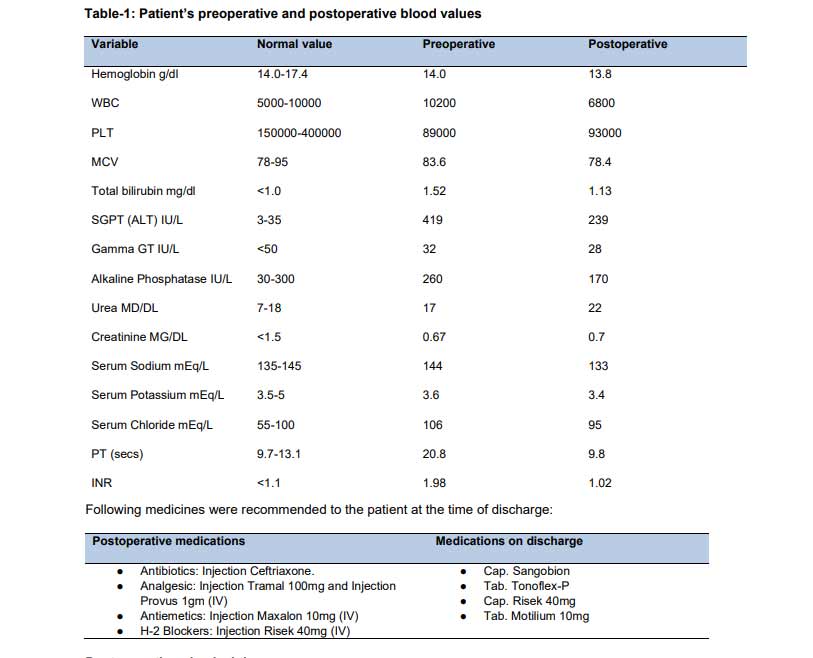
Post-operative physical therapy:
- The patient learned the following methods of physical therapy:
Early Mobilization: It started within 24-48 hours post-operative period. This entails starting bed exercises, supported ambulation, and mild movements. It aided in the patient's rehabilitation overall and prevented the problems brought on by extended bed rest [7]. - Breathing exercises:. Deep breathing exercises were taught to the patient to increase ventilation and maintain good respiratory function, as well as to encourage lung expansion and prevent respiratory problems [8]. These exercises were also initiated on postoperative day 1-2.
- Pain Management: To alleviate pain and agony, mild manual rehabilitation methods were used. Additionally, techniques like heat or cold treatment were used to decrease pain intensity [9]. These were started immediately post-operative period.
- Core Stabilization and strengthening: Abdominal muscles have a substantial contribution in strengthening the damaged liver. The treatment regimen includes exercises that focused on strengthening the main muscles. These were introduced at 2-4 week post-operative period. Physical therapy reduced length of hospital stay and improved mobility of patient compared to routine practice. Patient was followed up at 6 weeks and 3 months, showing sustained improvement without complications or any adverse event.
Discussion
Prompt movement, ventilatory activities, and muscular power boosting and pain alleviation strategies are essential in improving their recuperation and quality of life with fourth-grade hepatic damage. Enhancing muscle power and postural alignment safeguards the damaged organ, and boosts bodily movements [10]. Hence, present case report was intended to explore the effectiveness of employing the advantageous role of physical therapy interventions chiefly timely movement, core stability, and muscle power boosting exercises in grade four hepatic damage patient.
The patient's treatment strategy focused on increasing activity gradually and progressively in order to improve range of motion, flexibility, and general strength. To prevent undue stress on the healing tissues, it is crucial to take into account the particular safety measures associated with liver laceration and surgery. Following liver damage and surgery, these physical therapy methods are intended to maximize the patient's recuperation, improve functional capacities, and lower the risk of sequelae [11].
Physical therapy interventions promote early initiation of movement, preventing complications associated with prolonged bed rest and aiding in overall recovery. Breathing exercises help maintain optimal respiratory function and prevent respiratory complications [12]. Muscle toning exercises specifically target the abdominal muscles, providing support to the injured liver and improving stability [13]. Pain management techniques, including gentle manual therapy and modalities like heat or cold therapy, alleviate pain and promote comfort during therapy sessions. Gradual progression of activity ensures safe and effective rehabilitation, considering the specific precautions related to liver laceration and surgery [14].
Conclusion
Physical therapy interventions such as early initiation of movement, core stability, and muscular power boosting exercises improves the functional capacities, accelerated recovery, and eventually improves overall health of life in fourth grade hepatic injury patients.
ACKNOWLEDGMENT: The authors acknowledge the use of AI-based tools for language editing and clarity enhancement. The final content, interpretation, and conclusions remain the sole responsibility of the authors.
References
- Li J, Fan JG. Characteristics and mechanism of liver injury in 2019 coronavirus disease. . 2020 Mar J. Clin. Transl. Hepatol. 3;8(1):13. https://doi.org/10.14218/JCTH.2020.00019
- Costello E, Rock S, Stratakis N, Eckel SP, Walker DI, Valvi D et al. Exposure to per-and polyfluoroalkyl substances and markers of liver injury: a systematic review and meta-analysis. . 2022 Environ. Health Perspect.. Apr 27; 130(4):046001. https://doi.org/10.1289/EHP10092
- Kang BH, Jung K, Choi D, Kwon J. Early re-laparotomy for patients with high-grade liver injury after damage-control surgery and perihepatic packing. Surgery Today. 2021 Jun;51(6):891-6. https://doi.org/10.1007/s00595-020-02178-1
- Björnsson HK, Björnsson ES. Drug-induced liver injury: Pathogenesis, epidemiology, clinical features, and practical management. 2022 Mar Eur. J. Intern. Med. 1;97:26-31. https://doi.org/10.1016/j.ejim.2021.10.035
- Kanani, A., Sandve, K.O. & Søreide, K. Management of severe liver injuries: push, pack, pringle – and plug!. Scand J Trauma Resusc Emerg. 2021 Jul 14 ;29(1):93. https://doi.org/10.1186/s13049-021-00907-0
- Latif A, Alim M, Khan B, Khan KA, Kumar J. Study of Spleen and Liver Injuries in Patients of Blunt Trauma Abdomen. 2022 Apr Pak J Med Health Sci. 12;16(03):320- https://doi.org/10.53350/pjmhs22163320
- Chandok, Natasha, and Kymberly DS Watt. Pain management in the cirrhotic patient: the clinical challenge. In Mayo Clin. Proc 2010 May 1: 85;5:451-58. https://doi.org/10.4065/mcp.2009.0534
- Cavaggioni L, Ongaro L, Zannin E, Iaia FM, Alberti G. Effects of different core exercises on respiratory parameters and abdominal strength. J. Phys. Ther. Sci.. 2015;27(10):3249-53. https://doi.org/10.1589/jpts.27.3249
- Roeb E. Diagnostic and therapy of nonalcoholic fatty liver disease: a narrative review. Visc Med. 2022;38(2):126-32. https://doi.org/10.1589/jpts.27.3249
- Teng YX, Xie S, Guo PP, Deng ZJ, Zhang ZY, Gao W, Zhang WG, Zhong JH. Hepatocellular carcinoma in non-alcoholic fatty liver disease: Current progresses and challenges. J. Clin. Transl. Hepatol. 2022 Oct 28;10(5):955-64. https://doi.org/10.14218/JCTH.2021.00586
- Kayambu G, Boots R, Paratz J. Physical therapy for the critically ill in the ICU: A systematic review and meta-analysis. Crit Care Med 2013; 41:1543-154. https://doi.org/10.1097/CCM.0b013e31827ca637
- Barawid E, Covarrubias N, Tribuzio B, Liao S. The benefits of rehabilitation for palliative care patients. Am. J. Hosp. Palliat. Care 2015 Feb;32(1):34-43. https://doi.org/10.1177/1049909113514474
- Farhan H, Moreno-Duarte I, Latronico N, Zafonte R, Eikermann M. Acquired muscle weakness in the surgical intensive care unit: nosology, epidemiology, diagnosis, and prevention. 2016 Anesthesiol. Jan;124(1):207-34. https://doi.org/10.1097/ALN.0000000000000874
- Morishita S, Tsubaki A. Physical therapy in patients with cancer. Clin Phys therapy. 2017 May 31:95-120. https://doi.org/10.5772/67286