Abstract
Background: The carrying angle of elbow alters with age, gender and anatomical variations, influencing the stability and function of the joint. Due to repetitive stress athletes may experience altered carrying angle, increasing the chances of injuries. Although it has clinical importance limited research is available comparing carrying angle of athletes & non athletes, highlighting a need for focused study.
Objective: This study investigates the differences in the carrying angle of elbow joint between athletes and non-athletes among medical students at the University College of Medicine & Dentistry.
Method: A cross-sectional study was carried out at UCMD for a period of six months. The data was collected and obtained from fifty participants (25 athletes and 25 non-athletes). Both genders were included in our research (age ranging from 18 to 21 years). The participants were included in the study after an informed consent. The carrying angle of students was measured using a goniometer. The data was computed and analyzed using SPSS version 26.0.
Results: The Shapiro-Wilk test was used to assess the normality of data. The results showed that there is a remarkable difference in the carrying angle between athletes & non-athletes, with athletes having a greater carrying angle. This analysis and findings suggest that physical activity, muscular development & repetitive joint movements lead to variations in carrying angle. Such insights are important for a better understanding of joint functions in athletes and also for developing preventive measures in sports medicine to reduce risks associated with abnormal carrying angle.
Conclusion: The study concluded that athletes have a greater carrying angle as compared to non-athletes attributed to repetitive physical activities. The carrying angle plays a crucial role in biomechanics, particularly in load distribution & joint stability during physical activities.
Keywords: Age, Anthropometry, Athletes, Carrying angle and Goniometer.
Introduction
The elbow joint is categorized as a modified hinge joint, which carries out significant anatomical and mechanical function. It also performs stabilizing connection in the upper extremity between the shoulder to wrist [1]. Anatomically, the fully extended and supinated elbow joint is deflected towards the lateral side and forms an angle between arm and forearm in long axis. This angle, known as the carrying angle, plays an essential role in load bearing and helps keep the moving arm away from the pelvis while walking [2]. Structurally, the carrying angle is formed by the lower part of trochlea of the humerus bone in comparison to the capitulum of humerus. Another factor responsible for the formation of carrying angles includes lateral angulation of trochlear notch of ulna in relation to the shaft of humerus [3].
Greater degree of extension in female’s elbow joint is due to the lax and flexible joints. The carrying angle variations have been documented in both genders, different age groups and racial backgrounds. The average carrying angle in males is 12.5 ± 0.57 degrees while in females it is reported as 15.26 ± 0.45 degrees [4]. Other parameters affecting carrying angles vary not only with age and gender but also include hyperextended elbow joint, anthropometric variables including height and distance between two condyles of humerus [5]. The evaluation of the range of carrying angles is important in identifying elbow joint deformities.
After fracture healing, the carrying angle may show abnormalities due to change in its angle. These include the cubitus varus that represent decrease in angle and cubitus valgus represent increase in angle [6]. Cubitus valgus leads to increased risks of gradual stretch of ulnar nerve that has important relation with the medial epicondyle and may be related with palsy of ulnar nerve [7]. These changes in carrying angles are of great importance for athletes. An increase in the angle at elbow joint may result in elbow instability along with pain during exercise or in throwing sports (e.g. javelin throwing, discus throwing, hammer throwing and shot put) and may reduce elbow flexion [8].
Previous studies reported that with the advancing age the carrying angle increases at a rate of 0.42 and 0.60 per year in males and females respectively. This would result in more instability and painful elbow joints, while performing physical exercise and sports activities. It has been also documented that it would lead to a decreased range of flexion associated with increased chances of fracture and dislocations at elbow [5,9]. Although various studies have reported the anthropometric factors affecting the carrying angle limited research is available comparing the carrying angle of athletes and non-athletes within a localized population among medical students.
This is a significant gap as joint biomechanics is influenced by muscular activity resulting in musculoskeletal adaptations. If this remains unaddressed it may lead to risk of joint injuries among young athletes [10]. Future research should include population specific, gender based & training level focused studies including other parameters as limb length, muscle mass & limb dominance which provide in depth details about biomechanical alterations.
Method
To identify variations of carrying angle between athlete and non-athlete groups among medical students. The cross-sectional study was conducted at department of Anatomy, University College of Medicine and Dentistry (UCMD), Lahore for a duration of 6 months (Jan to June 2023) after the approval of institute ethical board review (ERC/119/22/09 dated 02-09-22). In each group, the sample size of 25 participants (total 50 participants) was calculated by using the given formula. The power of study was calculated as 90% and confidence level as 95%. The expected mean carrying angle in athletes is 10.85 ± 2.43 and 8.80 ± 2.01 in non-athletes [11].
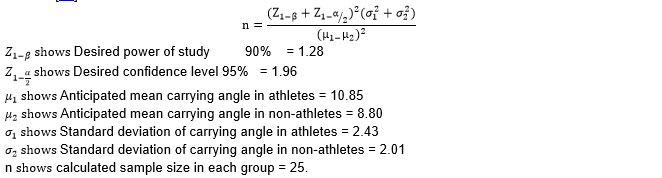
Sampling technique selected was non-probability convenient sampling. Healthy male and female medical students, both athletes and non-athletes, with normal built, 18-21 years of age, participants who were willing to participate. Exclusion included, the history of upper or lower limb fracture or surgery, presence of congenital anomaly and refusal to participate.
Written informed consent was signed by all participants. The privacy of participants was respected,nd they were fully informed about the purpose and procedure of the study. After approval from the Ethical Review Board (ERB), data was collected from students. Carrying angle was measured with the help of a goniometer. The carrying angle was measured in subjects with elbow extended and forearm supinated. Data was compiled and analyzed using SPSS 26. Normality of data was assessed by Shapiro-Wilk test and mean. A p-value of 0.05 was used to establish statistical significance. The comparison of carrying angle and heights among the groups was measured by independent sample t-tests. For gender distribution chi-square test was applied. Multiple linear regression was done using carrying angle as dependent variable & athlete gender and height is taken as a predictor.
Results
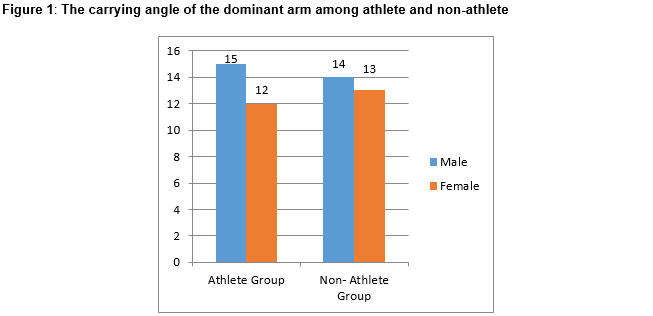
The current study compares the carrying angle of athletes and non-athletes among medical students. The Table 1 indicates the total number of participants included in the study, categorized by gender in athlete and non-athlete group. Both genders were included in our research (age ranging from 18 to 21 years). 19.5 ± 0.85 years was the mean age of participants with no significant difference among groups. Among the athlete group, 15 participants (51.7%) were male, and 12 (48%) were female. In the non-athlete group, 14 participants (48.3%) were male, and 13 (52%) were female as shown in the figure 1. The data indicates a balanced gender distribution across groups, with a slightly higher percentage of males in the athlete group and females in non-athlete group. This improves the validity of contrasts among athlete & non-athlete group.
Table 2 compares height and dominant carrying angle between athletes and non-athletes, along with their p-values. The mean height of athletes (mean 167.8 ± 7.10 cm) and non-athletes (mean 167.4 ± 6.14 cm), showed no significance difference with a p-value of 0.832. This indicates height has no significant relationship with carrying angle between two groups. However, the dominant carrying angle was significantly greater in athletes (11.55 ± 2.6) as compared to non-athletes (9.40 ± 2.25) leading to a statistically significant difference with a p-value of 0.002. The results indicate that athletic activities and repetitive arm use influences carrying angle. The greater carrying angle in athletes indicates a potential impact of sports on elbow joint biomechanics.

Discussion
In a fully extended and supinated elbow joint, bones in the forearm are not aligned in the straight line with bone of arm. The anatomical reasons responsible for the development of carrying angle includes the distal location of trochlea relative to the capitulum of humerus. The lateral deviation of ulna’s trochlear notch in relation to humeral shaft is also contributing towards development of carrying angle. Various studies reported that carrying angle varies with various factors including age, gender, dominant hand side and body modifications like obesity and physical activities [12].
The current study was conducted to evaluate the variation in carrying angle among athlete and non- athlete groups of both genders. The results of the present study depicted significant differences in carrying angle of the athletes and non-athletes with statistically significant P- value. This variation in the carrying angle can be explained by the “muscular theory’’ that was supported by Hubscher [11]. In a detailed analysis it was shown that the lateral deflection of the forearm is produced by action of extensor carpi radialis longus and brachioradialis. These muscles are anatomically present along the radial aspect of forearm so these muscles are responsible to abduct the forearm and contributes to angulation in the carrying angle. This action is counter balanced by the flexor muscles present along the ulnar side of the forearm [11,13].
This ‘‘muscular theory’’ also proposed that when the forearm is extended, the radial head and ulnar coronoid process move in the same direction to the distal end of the humerus. In a semi flexed forearm, extensor carpi radialis longus and brachioradialis exerts greater force than the flexor muscles of ulnar side. This observation is due to the anatomical fact that the radial muscles have higher origin from the shaft of the humerus. The resultant radial deflection of forearm forms the carrying angle [13,14]. This theory also supports the fact that this angle is more evident in athletes that have well developed muscular system. Additionally, the angle is more prominent on the right side in right dominant individuals and on the left side in left dominant individuals [4,15].
The findings of this study concluded that in athletes the combined repetitive movements of flexor, extensor, supination and pronation exerts mechanical forces to produce lateral deviation of the joints. All these movements are observed during the running with swinging arms, hitting, receiving and throwing [16].
In sports medicine, that is very important to emphasize on the variables of anthropometric features which can have impact on carrying angle [17,18]. However, results of this research, clearly identify the correlation between carrying angle of athletes and their anthropometric dimensions. Carrying angle changes, need special consideration in sports to reduce the risks of injuries and joint dislocation [19]. Various international studies have reported the increased carrying angle in females is due to the hormonal influences and joint laxity [10]. Our findings aligned with these observations indicating decreased muscle tone and ligamentous support in non-athletic females. However, carrying angle is more in male athletes as compared to non-athletes due to muscle hypertrophy and repetitive stress.
Many previous researchers have noted the association between recurrent physical activities and various patterns of movement to specific injuries. The findings of the current study align with the local findings conducted by Jan et Al. [6] who examined carrying angle changes in Kashmiri students and Kushwaha et al. [14] who addressed pediatric population but none of them relate it with physical activity. Such studies lack the knowledge on anthropometric characteristics of athletes that tends to develop abnormalities [6,14]. So that it is more important to measure the carrying angle and focus on its impact on the athletic skill. Its related secondary pathological abnormalities will be investigated more with beneficial results. These findings indicate the possibility that the greater carrying angle among athlete males as compared to non-athlete males is affected by their relatively more physical activities and muscle development in accordance with their athletic requirements as compared to females. Surprisingly, female non-athletes showed a greater carrying angle as compared to female athletes which is contrary to the pattern seen in males. These findings suggest the effect of physical activity on joint biomechanics is based on gender specific patterns.
Conclusion
The study concluded that male athletes exhibit a significantly greater carrying angle as compared to non-athlete males attributed due to repetitive physical activities. However, female non-athletes showed greater carrying angle as compared to athletes due to joint laxity and hormonal factors. The findings suggested that the well-developed musculature in athletes affects the bio-mechanics of the elbow joint, leading to increased carrying angle. Future research can investigate the long-term effects of athletic training on carrying angle considering types of sports, intensity and duration of training. Further studies maybe carried out to explore the effect of physical activity on the carrying angle and joint stability in athlete versus non-athletes. For athletes there should be personalized training programs to enhance joint stability. For non-athletes there should be educational programs focusing on joint strengthening exercises to prevent mechanical injuries. Moreover, including students from other disciplines and various age groups would enhance the generalizability of the results.
References
- Acikgoz AK, Balci RS, Goker P, Bozir MG. Evaluation of the elbow carrying angle in healthy individuals. Int J Morphol. 2018;36(1):135–9.https://doi.org/10.4067/S0717-95022018000100135
- Nayak, S., Kumar, P. & Oraon, A.K. Relationship of carrying angle with grip strength and anthropometric measurements in young adults. Bull Fac Phys Ther 28, 16 (2023). https://doi.org/10.1186/s43161-023-00129-8
- Przyklenk A, Hackl M, Iuga AI, Leschinger T, Maintz D, Harbrecht A, Müller LP, Wegmann K. Computed tomography-based angle measurements of the sagittal capitulum and trochlea position in relation to the humeral shaft. Surgical and Radiologic Anatomy. 2023 May;45(5):571-80. https://doi.org/10.1007/s00276-023-03118-7
- Beigh IA, Bhat TA, Mantoo SA, Bhat SA, Mohammad J, Lone ZA. Carrying angle variations between dominant and non-dominant limb in Jammu region of North India. J Med Sci Res. 2019;7(11):936–9 https://dx.doi.org/10.18535/jmscr/v7i11.163
- Balasubramanian P, Madhuri V, Muliyil J. Carrying angle in children: a normative study. J Pediatr Orthop B. 2006 Jan;15(1):37-40. https://doi.org/10.1097/01202412-200601000-00008
- Kushwaha NS, Verma V, Singh A, Sharma Y, Singh A. A Study of Factors Associated With Carrying Angle of the Human Elbow in Pediatric Age Group. Cureus. 2022 May 30;14(5):e25478.https://doi.org/10.7759/cureus.25478
- Chang CW, Wang YC, Chu CH. Increased carrying angle is a risk factor for nontraumatic ulnar neuropathy at the elbow. Clin Orthop Relat Res. 2008;466:2190–2195https://doi.org/10.1007/s11999-008-0308-2
- Lim, V., Jacob, N.A., Ghani, M.F.S., Wang, D.L.C. and Devi, K.A., 2014. An anthropometric study on the carrying angle of elbow among young adults of various ethinicities in Malaysia. Natl J Integr Res Med, 5, pp.20-23.https://doi.org/10.70284/njirm.v5i6.822
- Robinson PM, Griffiths E, Watts AC. Simple elbow dislocation. Shoulder Elbow. 2017 Jul;9(3):195-204https://doi.org/10.1177/1758573217694163
- Nayak S, Kumar P, Oraon AK. Relationship of carrying angle with grip strength and anthropometric measurements in young adults. Bulletin of Faculty of Physical Therapy. 2023 May 24;28(1):16.https://doi.org/10.1186/s43161-023-00129-8
- Hassan D, Hossein S, Rahmani P, Hossein NS. The study of predictor’s anthropometric parameters of upper limb with elbow carrying angle in athletes. J Roman Sports Med Soc. 2014;10(4):2447–51https://www.researchgate.net/publication/284601724_The_study_of_predictor's_anthropometric_parameters_of_upper_limb_with_elbow_carrying_angle_in_athletes
- Verma V, Singh A, Kushwaha NS, Sharma Y, Singh A. Correlation Between Morphometric Measurements and Carrying Angle of Human Elbow. Cureus. 2022 Jul 27;14(7):e27331. https://doi.org/10.7759/cureus.27331
- Kothapalli J, Murudkar P, Seerla LD. The carrying angle of elbow- a correlative and Comparative study. Int J Cur Res Rev, 2013 Apr 05 (07):71-76
- Jan SS, Shah BA, Shahdad S, Saleem SM, Sobiya. Morphometric measurements of carrying angle of elbows and its association with gender and height among Kashmiri population: a cross-sectional study. J Med Sci Clin Res. 2018;6(9):1092–8.https://dx.doi.org/10.18535/jmscr/v6i9.190
- Mehmet H, Yang AW, Robinson SR. Measurement of hand grip strength in the elderly: a scoping review with recommendations. J Bodywork Movement Ther. 2020;24(1):235–43.https://doi.org/10.1016/j.jbmt.2019.05.029
- Bobos P, Nazari G, Lu Z, Mac Dermid JC. Measurement properties of the hand grip strength assessment: a systematic review with meta-analysis. Arch Phys Med Rehabil. 2020;101(3):553–65.https://doi.org/10.1016/j.apmr.2019.10.183
- Patel MR, Verma S. Effect of varying carrying angle on grip strength in normal young individuals. Int J Health Sci Res. 2018;8(8):159–66 https://www.ijhsr.org/IJHSR_Vol.8_Issue.8_Aug2018/23.pdf
- Bari W, Alam M, Omar S. Goniometry of elbow carrying angle: a comparative clinical study on sexual dimorphism in young males and females. Int J Res Med Sci. 2017;3:3482–3484. http://dx.doi.org/10.18203/2320-6012.ijrms20151242
- Ansari MA, Bhagat PS, Thokal D, Ganvir SD. Evaluation of the carrying angle of the elbow joint in adolescents and its correlation with BMI, gender and dominant side. Int J Sci Res. 2021;10:1321–1324http://dx.doi.org/10.21275/SR21620144356