Abstract
Background: Gastroesophageal reflux disease (GERD) is a prevalent disorder, often leading to hiatal hernia (HH), which further complicates clinical outcomes. The association between demographic factors such as body mass index (BMI) and the presence of HH in GERD patients, especially within the Pakistani population, where dietary habits may contribute, remains underexplored.
Objectives: To determine the frequency of HH in GERD patients and to assess its association with BMI, age, and weight.
Method: This cross-sectional study was conducted at the Department of Gastroenterology, MTI Hayatabad Medical Complex, Peshawar, from July 2022 to January 2023. A total of 141 GERD patients aged 16–75 years who underwent esophagogastroduodenoscopy (EGD) were included. Ethical approval and informed consent were obtained. Data regarding age, gender, BMI, symptom duration, and HH presence/type were collected using a structured questionnaire. Associations were analysed using chi-square tests, with p < 0.05 as significant.
Results: HH was identified in 67.4% of GERD patients. Sliding HH was most common (34.0%), followed by rolling HH (31.9%). Elevated BMI (≥25) showed a significant association with HH (p = 0.007), while no significant association was found between HH and GERD-related complications (p = 0.072).
Conclusion: There is a high frequency of HH among GERD patients, particularly those with elevated BMI. Early identification and targeted management in at-risk individuals may improve outcomes. Further research should explore the impact of local dietary habits and preventive strategies.
Keywords: Hiatal Hernia, Gastroesophageal Reflux Disease, Esophagogastroduodenoscopy, Body Mass index.
Introduction
Gastroesophageal Reflux Disease (GERD) is a common condition encountered in hospital and clinic settings, characterized by troubling symptoms of heartburn and regurgitation due to the reflux of acidic stomach contents into the esophagus, occasionally reaching the throat. In addition to classic symptoms, GERD may present with extra-esophageal manifestations such as chronic cough, hoarseness, sore throat, asthma-like symptoms, or dental erosions [1]. Due to its repetitive nature, GERD significantly affects patients’ overall quality of life [2]. The pathophysiology of GERD is complex, involving genetic and environmental factors that lead to increased pressure on the gastroesophageal junction, resulting in pathophysiological regurgitation of acidic stomach contents [3]. Multiple risk factors have been identified, with obesity considered the most important. Other contributing factors include the use of non-steroidal anti-inflammatory drugs, poor sleeping position, body mass index, smoking, and consumption of soft drinks, coffee, tea, and alcohol [4]. GERD complications range from mild symptoms (e.g., persistent dry cough, poor sleep, and weakness) to serious outcomes such as esophageal stricture, Barrett’s esophagus, hiatal hernia, and even esophageal adenocarcinoma [5]. During esophagogastroduodenoscopy (EGD), the squamocolumnar junction is typically aligned with the gastroesophageal junction (GEJ). However, in hiatal hernia (HH), there is a visible separation of the GEJ from the crura, with the top of the rugal folds observed to be ≥ 2cm above the pinch of the diaphragmatic crura. HH can be of four types, but type IV is better diagnosed using CT. Type I (sliding HH) involves the GEJ migrating superiorly into the posterior mediastinum, while type II (rolling HH) involves the gastric fundus migrating superiorly into the mediastinum. Type III combines both type I and II findings [6].
In Pakistan, a study revealed that the prevalence of GERD is around 26.6% in the general population [7]. Additionally, the gender prevalence of GERD is higher in women (16.7%) compared to men (15.4%) [8]. It has also been reported that GERD is more likely to be non-erosive in females, while in men, erosive esophagitis is more likely [9]. Studies indicate that GERD patients frequently undergo EGD. A study reported the frequency of GERD patients undergoing EGD to range from 4.6% to 8% [10]. Another study reported that in GERD patients undergoing EGD, HH was as frequent as 12.5% [11]. Despite its high prevalence, limited local literature exists on the demographic and dietary factors contributing to GERD in Pakistan. Recent studies report GERD prevalence in Pakistan ranging from 24% to 64%, with spicy and oily foods, as well as obesity, being key contributors (1,2). However, the specific impact of these factors especially the link between GERD and hiatal hernia (HH), remains underexplored in our population. The association between BMI and HH in GERD patients, particularly in local settings like Hayatabad Medical Complex, Peshawar, has not been adequately studied. Most available research focuses on international populations, with little data on the frequency of HH and its relationship with demographic variables in Pakistani GERD patients (2,3). Addressing this gap will help inform prevention and management strategies tailored to our context. This study aims to determine the frequency of HH in GERD patients undergoing esophagogastroduodenoscopy (EGD) at Hayatabad Medical Complex, Peshawar, and to assess its association with BMI, age, and weight.
Method
This cross-sectional study was conducted in the Department of Gastroenterology, MTI Hayatabad Medical Complex, Peshawar, from 30th July 2022 to 15th January 2023. A non-probability consecutive sampling technique was used. The sample size of 277 was calculated using the WHO sample size calculator, with a 95% confidence level, a 5% margin of error, and an expected HH frequency of 6.96% [11]. Due to reduced number of eligible patients visiting the department during the data collection period, the sample size collected was 141.Participants included both male and female patients aged 16-75 years who presented with a clinical diagnosis of GERD or extra-esophageal symptoms such as chronic cough, hoarseness, asthma-like symptoms, or chest pain of non-cardiac origin. The Olympus EGD system GIF 160 was used for all endoscopic procedures. All participants underwent esophagogastroduodenoscopy (EGD) performed by either a consultant or a trainee under consultant supervision for diagnostic purposes. The endoscopist was blinded to the participants’ clinical symptoms to minimize observer bias. GERD-related complications were identified using a standard grading system during EGD, while hiatal hernia was diagnosed based on a separation of the gastroesophageal junction from the diaphragmatic crura with gastric fold ≥2 cm above the crura, classified into sliding, rolling, or mixed types, with all findings reviewed, discussed and verified by the supervising consultant for consistency between consultants and trainees. Patients with a history of hiatal hernia, previous diaphragmatic, hiatal or laparotomy surgery, or past gastrointestinal condition, including esophageal or gastric malignancy and peptic ulcer disease, were excluded.
Patients presenting with GERD and extra-esophageal symptoms were identified, and informed consent was obtained prior to endoscopy. Conscious sedation was administered using topical lignocaine spray. During the endoscopy, the presence of hiatal hernia and GERD–related complications was assessed.
The normality of data was assessed using the Shapiro-Wilk test before statistical analysis. The data collection questionnaire included sections on demographics (age, gender, BMI), clinical symptoms (duration and severity of GERD symptoms), endoscopic findings (grading of esophagitis and hiatal hernia), and the grading system of HH (sliding, rolling, or mixed). Data was analyzed using SPSS version 26. Descriptive statistics, including mean and standard deviation, were calculated for continuous variables (e.g., age, BMI, duration of symptoms). Categorical variables were analyzed using frequencies and percentages. Data was grouped by age, gender, and BMI to address potential effects modifier. Chi-square tests were conducted to assess the association between HH presence and variables such as BMI, age, and GERD-related complications, with a significance level set at p < 0.05. Ethical approval (Ref. No. 728/HEC/B&PSC/2022, dated 24-05-22) for the study was obtained from the Hayatabad hospital’s ethical review board.
Results
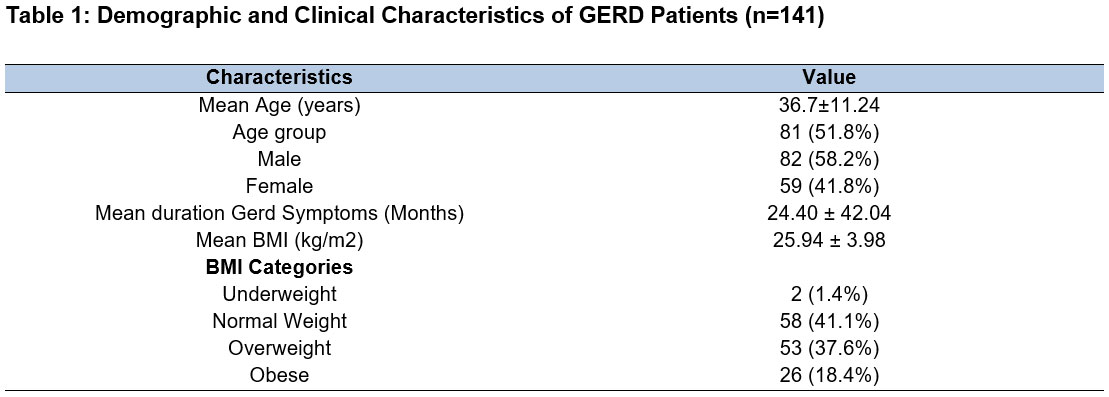
The mean age of the patients was 36.7 ± 11.24 years, with the majority (57.8%, n=81) falling in the 41-55 years age group. Of the total participants, 58.2% (n=82) were males and 41.8%% (n=59) were female, resulting in a male-to-female ratio of 1.38: 1. The mean duration of GERD symptoms prior to seeking medical care was 24.40 ± 42.04 months. The mean body mass index (BMI) of the patients was 25.94 ± 3.98 kg/m2. As shown in Table 1, a significant proportion of patients were either overweight or obese, with 37.6% 9n=53) being overweight and 18.4% (n=26) being obese. Only 1.4% (n=2) were underweight, and 41.1% (n=58) had a normal BMI.
The prevalence of HH in patients with BMI ≥ 25 was 65.8% of which 49.3 % were overweight and 16.04% were obese; however, no hiatal hernia (HH) was observed in the two morbidly obese patients.
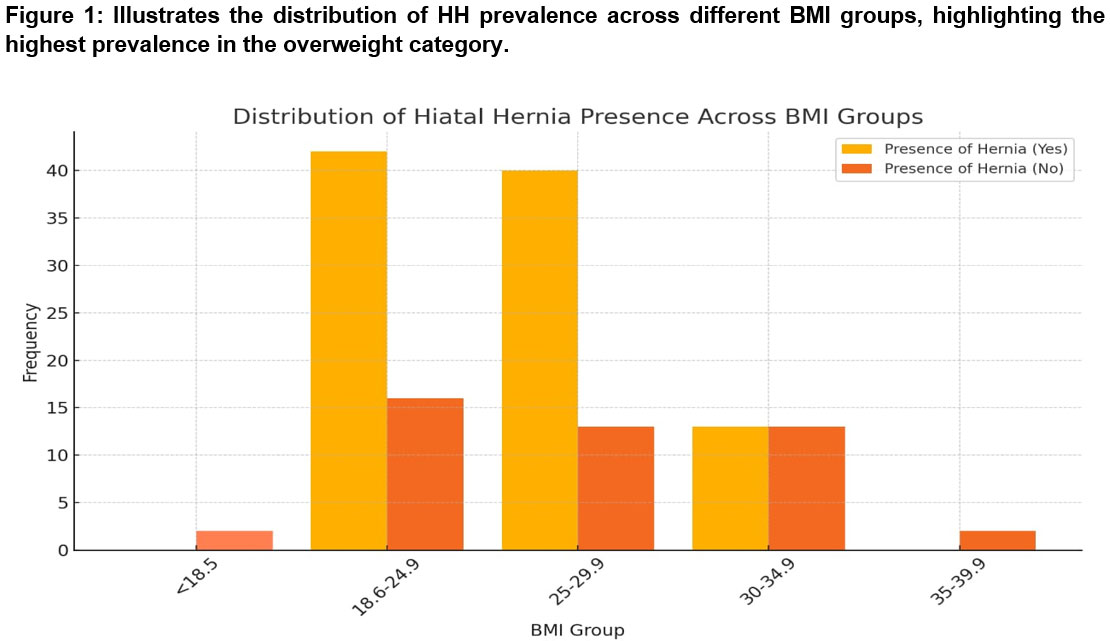
These findings indicate a higher prevalence of HH among overweight and obese GERD patients. The majority of HH cases were observed in the overweight group (73.6%), followed by the obese group (50%). The absence of HH in morbidly obese patients may be attributed to the small sample size (n=2) of this subgroup.
Out of the 141 patients, 67.4% (n=95) were diagnosed with hiatal hernia, while 32.6% (n=46) did not present with HH. Among those with HH, sliding hiatal hernia was the most prevalent type (34.0%, n=48), followed by rolling hiatal hernia (31.9%, n=45). Two cases remained unclassified (1.41%, n=2) due to ambiguous endoscopic findings, where the gastroesophageal junction and crura alignment couldn’t be clearly visualized.

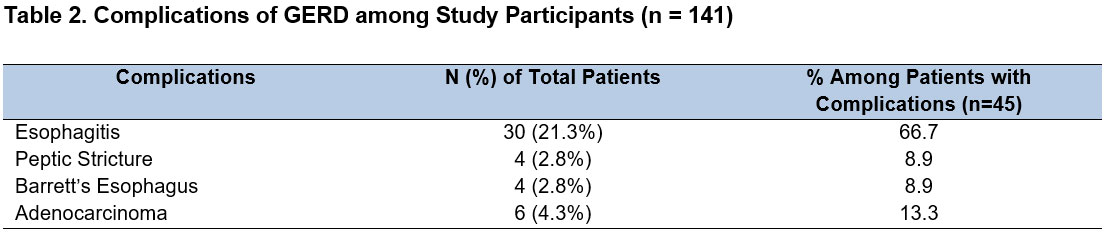
As shown in table 2, complications of GERD were observed in 31.4% (n=45) of the patients, while 68.6% (n=97) had no complications. The most common complication was esophagitis, observed in 21.3% (n=30) of the patients with complications and accounted for 66.7% of GERD-related complications. Other observed complications included peptic stricture 2.8% (n=4), Barrett’s esophagus 2.8% (n=4) and adenocarcinoma 4.8% (n=6). The Maximum of the patients 39.7% (n=56) presented no extra-GERD symptoms. However, among patients with extra-GERD symptoms the most common complaint was Dental Caries 27.0% (n=38), followed by chronic cough/ asthma like symptoms in 19.1% (n=27). Only 7.8% (n=11) of the patients presented with history of recurrent pharyngitis.
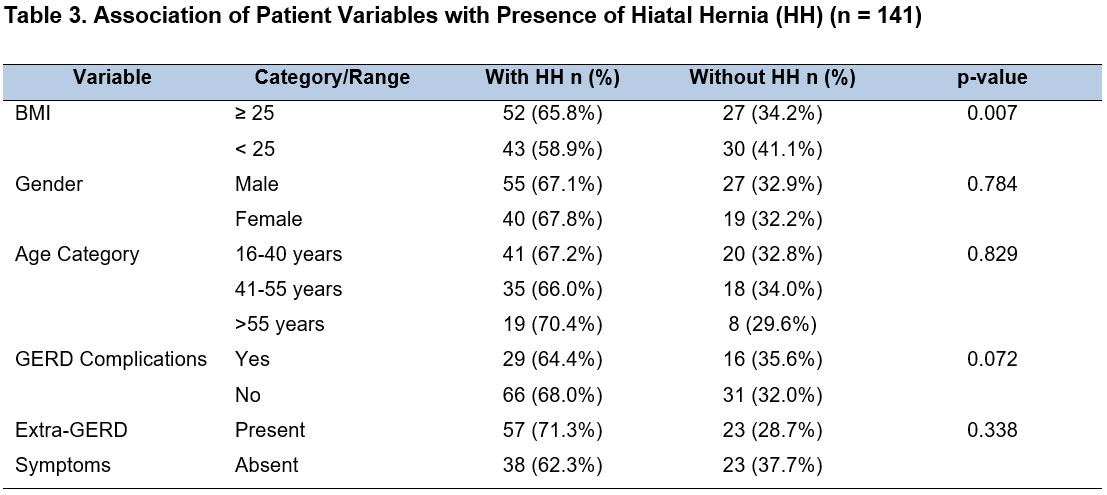
Chi-square tests were used to examine association between of this study variables, and the presence of HH as shown in table 3, A significant association was found between BMI and the prevalence of HH (p=0.007), indicating a higher likelihood of developing HH among patients with elevated BMI. No significant association of this study observed between HH and gender (p=0.784), age categories (p=0.829), GERD-related complications (p=0.072), or extra-GERD symptoms (p=0.0338).
Discussion
The results of this study indicate that 67.4% of GERD patients had hiatal hernia (HH), with sliding HH being the most common type (34.0%), followed by rolling HH (31.9%). The significant association between GERD and the presence of HH may be influenced by lifestyle and dietary factors.
Current study reported a higher prevalence of HH (67.4%) compared to previous studies, such as Al Sahafi et al., who reported a prevalence of 48.6% among GERD patients undergoing EGD [15]. Similarly, Weissman et al. and Savas et al., reported prevalence of 45.4% and 22% respectively [16,17]. These discrepancies may stem from varying diagnostic criteria for GERD, differences in EGD practices, and regional lifestyle factors, including higher consumption of oily and high-fat diets known to exacerbate GERD symptoms. Notably, the high prevalence of sliding HH in our study aligns with other research, reinforcing it as the most common HH type in GERD patients [17].
The mean age of our study population was 36.57 ± 11.24 years, which is comparable to the findings by Assakran et al. [18]. However, our population skews younger compared to Al Sahafi et al.’s study [15]. Additionally, our study had a higher proportion of male patients (58.2%) compared to female patients (41.8%), consistent with Al Sahafi et al. ‘s findings but differing from Assakran et al., where females were more predominant [15,18].
Obesity is a well-known risk factor for both GERD and HH, primarily due to increased intra-abdominal pressure compromising the function of the lower esophageal sphincter [19]. In our study, a significant association was found between high BMI (≥ 25) and the presence of HH (p = 0.007), with 65.8% of patients in this BMI category exhibiting HH. These findings align with previous research indicating a higher prevalence of HH among overweight and obese individuals [20,21]. For instance, one study reported that obesity is associated with an increased risk of HH and esophagitis [22], while another highlighted the challenge obesity poses to esophagogastric junction integrity, increasing the risk of GERD and HH [23]. Additionally, research has shown a notably higher prevalence of HH in morbidly obese patients undergoing bariatric surgery [24]. El-Serag et al. also emphasized a strong link between obesity and GERD prevalence, supporting our findings [25]. Collectively, these studies support a strong link between obesity and HH, though variability in study design and populations contributes to some inconsistency in findings. For example, Savas et al. found no significant effect of high BMI on HH presence, possibly due to differences in study populations or methodologies.
No significant association was observed between HH and GERD-related complications (p=0.072), suggesting that while HH may exacerbate GERD symptoms, it does not necessarily predict progression to severe complications such as esophagitis, Barrett’s esophagus, or adenocarcinoma. This finding is consistent with wright et al., who also found no significant link between HH and GERD complications [26]. Similarly, a study reported in The American Journal of Gastroenterology indicated that although HH is associated with increased acid exposure, it does not independently predict the development of Barret’s esophagus or esophageal adenocarcinoma [27]. Additionally, research published in Clinical Gastroenterology and Hepatology found that HH contributes to GERD pathophysiology but is not a standalone risk factor for severe esophageal complications [28]. However, it contrasts with Li et al.’s findings which reported a correlation between HH and both the severity of GERD symptoms and complications like asthma [29]. These conflicting results highlight the need for further research to elucidate the role of HH in GERD progression.
The high frequency of HH in GERD patients in our study suggests that physicians should maintain a high index of suspicion for HH in patients presenting with refractory GERD symptoms. Early detection and management of HH may improve patient outcomes and quality of life.
The strengths of this study include a well-defined patient population with a confirmed clinical diagnosis of GERD and the use of EGD for precise detection of HH. However, limitation include potential selection bias due to the non-probability sampling method, a relatively small sample size limited to a single tertiary care center, and future longitudinal studies are recommended to explore the causal relationship between the GERD and HH and the emergence of GERD-related complications.
Conclusion
This study demonstrates a high prevalence of hiatal hernia among patients with gastroesophageal reflux disease, particularly among those with elevated BMI. These findings underscore the importance of considering HH in the clinical evaluation and management of GERD patients. Given the significant association between high BMI and HH, addressing obesity through targeted weight management strategies may be crucial in mitigating the risk of HH development and improving GERD-related outcomes.
Early identification of HH in GERD patients, coupled with proper interventions, could enhance clinical management and potentially lead to improved patients’ outcomes.
References
- Hungin AP, Molloy-Bland M, Scarpignato C. Revisiting Montreal: new insights into symptoms and their causes, and implications for the future of GERD. Am J Gastroenterol. 2019;114(3):414-21. https://doi.org/10.1038/s41395-018-0287-1
- Isshi K, Furuhashi H, Koizumi A, Nakada K. Effects of coexisting upper gastrointestinal symptoms on daily life and quality of life in patients with gastroesophageal reflux disease symptoms. Esophagus. 2021;18:684-92. https://doi.org/10.1007/s10388-020-00801-1
- Samo S, Qayed E. Esophagogastric junction outflow obstruction: Where are we now in diagnosis and management? World J Gastroenterol. 2019;25(4):411-417. https://doi.org/10.3748/wjg.v25.i4.411
- Nirwan JS, Hasan SS, Babar ZU, Conway BR, Ghori MU. Global prevalence and risk factors of gastro-oesophageal reflux disease (GORD): systematic review with meta-analysis. Sci Rep. 2020;10(1):5814. https://doi.org/10.1038/s41598-020-62795-1
- Fontan FM, Carroll RS, Thompson D, Lehmann RK, Smith JK, Nau PN. Current management of gastroesophageal reflux disease in the obese population: a review of the literature. Mini Invasive Surg. 2020;4:29. https://doi.org/10.20517/2574-1225.2020.09
- Hennig A, Kurian AA. Flexible endoscopy and hiatal hernias. Ann Laparosc Endosc Surg. 2021;6:—. https://doi.org/10.21037/ales-20-48
- Rasool MF, Sarwar R, Arshad MS, Imran I, Saeed H, Majeed A, et al. Assessing the frequency and risk factors associated with gastroesophageal reflux disease (GERD) in Southern Punjab, Pakistan. Risk Manag Healthc Policy. 2021;14:4619-25. https://doi.org/10.2147/RMHP.S335142
- Eusebi LH, Ratnakumaran R, Yuan Y, Solaymani-Dodaran M, Bazzoli F, Ford AC. Global prevalence of, and risk factors for, gastro-oesophageal reflux symptoms: a meta-analysis. Gut. 2018;67(3):430-40. https://doi.org/10.1136/gutjnl-2016-313589
- Kim SY, Jung HK, Lim J, Kim TO, Choe AR, Tae CH, et al. Gender-specific differences in prevalence and risk factors for gastro-esophageal reflux disease. J Korean Med Sci. 2019;34(21):e158. https://doi.org/10.3346/jkms.2019.34.e158
- Adanir H, Baş B, Pakoz B, Günay S, Camyar H, Ustaoglu M. Endoscopic findings of gastro-esophageal reflux disease in elderly and younger age groups. Front Med (Lausanne). 2021;8:606205. https://doi.org/10.3389/fmed.2021.606205
- Meira ATDS, Tanajura D, Viana IDS. Clinical and endoscopic evaluation in patients with gastroesophageal symptoms. Arq Gastroenterol. 2019;56(1):51–4. https://doi.org/10.1590/S0004-2803.201900000-16
- Naseem J, Arshad S, Sheikh A, et al. Frequency and risk factors of GERD among women in Punjab. Rawal Med J. 2018;43(2):260-4. https://doi.org/10.2147/RMHP.S335142
- Ahmed S, Jamil S, Shaikh H, Abbasi M. Effects of lifestyle factors on the symptoms of gastroesophageal reflux disease: a cross-sectional study in a Pakistani population. Pak J Med Sci. 2020;36(2):115-120. https://doi.org/10.12669/pjms.36.2.1371
- Bhatia SJ, Abraham P, Hingorani LL, et al. Epidemiology of GERD in the Indian subcontinent: a review. Indian J Gastroenterol. 2011;30(6):231-5. https://doi.org/10.1007/s12664-011-0142-1
- Alsahafi MA, Alajhar NA, Almahyawi AO, Alsulami HH, Alghamdi WA, Alharbi LA, et al. The prevalence and risk factors for hiatal hernia among patients undergoing endoscopy: A retrospective analysis. Saudi Med J. 2023;44(5):509. https://doi.org/10.15537/smj.2023.44.5.20220903
- Weissman S, Chris-Olaiya A, Weber AT, Mehta TI, Doherty B, Nambudiri V, et al. Real-world prevalence of endoscopic findings in patients with gastroesophageal reflux symptoms: a cross-sectional study. Endoscopy Int Open. 2022;10(4):E342-6. https://doi.org/10.1055/a-1756-4594
- Savas N, Dagli U, Sahin B. The effect of hiatal hernia on gastroesophageal reflux disease and influence on proximal and distal esophageal reflux. Dig Dis Sci. 2008;53:2380-6. https://doi.org/10.1007/s10620-007-0158-x
- Assakran BS, Alrakbi K, Alharbi MA, Almatroudi MA, Alshowaiman A, Alromaih AH, et al. Prevalence of asymptomatic hiatal hernia in obese patients during preoperative upper gastrointestinal endoscopy assessments and correlation with body mass index. Cureus. 2021;13(2):e13396. https://doi.org/10.7759/cureus.13396
- Sfara A, Dumitrascu DL. The management of hiatal hernia: an update on diagnosis and treatment. Med Pharm Rep. 2019;92(4):321-7. https://doi.org/10.15386/mpr-1323
- El-Serag HB, Graham DY, Satia JA, Rabeneck L. Association of obesity with Barrett's esophagus and esophageal adenocarcinoma: A systematic review and meta-analysis. Am J Gastroenterol. 2005;100(6):1246-55. https://doi.org/10.1111/j.1572-0241.2005.41703.x
- Pandolfino JE, El-Serag HB, Zhang Q, Shah N, Ghosh SK, Kahrilas PJ. Obesity: a challenge to esophagogastric junction integrity. Gastroenterology. 2006;130(3):639–649. https://doi.org/10.1053/j.gastro.2005.12.016
- Kahrilas PJ, Kim HC, Pandolfino JE. Approaches to the diagnosis and grading of hiatal hernia. Best Pract Res Clin Gastroenterol. 2008;22(4):601-16. https://doi.org/10.1016/j.bpg.2007.11.005
- Hillman L, Yadlapati R, Whitsett M, Pandolfino JE. Examining the relationship between hiatal hernia size and severity of reflux disease. Clin Gastroenterol Hepatol. 2021;19(2):357-64. https://doi.org/10.1016/j.cgh.2020.04.034
- De Vries DR, Van Herwaarden MA, Smout AJ. The role of obesity in GERD and Barrett's esophagus. Dig Dis. 2008;26(1):30-3. https://doi.org/10.1159/000109382
- Frezza EE, Shebani KO, Robertson AG. Hiatal hernia and obesity: are there surgeons’ indications for repair? Obes Surg. 1999;9(6):465-8. https://doi.org/10.1381/096089299765553648
- Carpentier AC, Taylor DC, Zeitels SM. Obesity, bariatric surgery, and gastroesophageal reflux disease. Surg Obes Relat Dis. 2009;5(1):1-5. https://doi.org/10.1016/j.soard.2008.09.009
- El-Serag HB, Ergun GA, Pandolfino J, Fitzgerald S, Tran T, Kramer JR. Obesity increases oesophageal acid exposure. Gut. 2007;56(6):749-55. https://doi.org/10.1136/gut.2006.100263
- Wright AS, Kaliappan A, Zogg CK, Urbach DR, Al-Refaie WB, Halverson AL, et al. Hiatal hernia repair: when does it benefit GERD symptoms? J Am Coll Surg. 2019;228(3):359-66. https://doi.org/10.1016/j.jamcollsurg.2018.12.028
- Li ZT, Ji F, Han XW, Gu LX, Wang L, Yue YQ, et al. Contribution of hiatal hernia to asthma in patients with gastroesophageal reflux disease. Clin Respir J. 2018;12(5):1858-64. https://doi.org/10.1111/crj.12748