Abstract
Background: Unintended pregnancy is defined as either unwanted or mistimed. It poses a significant global public, clinical and social health challenge particularly in resource limited settings.
Objective: To assess the frequency and determinants of unintended pregnancy in pregnant women with short interpregnancy interval(<6months).
Method: A cross-sectional descriptive study was done in obstetrics and gynecology department of Khawaja Muhammad Safdar Medical College/Allama Iqbal Memorial Teaching Hospital, Sialkot from April 2024 to September 2024. A total of 170 pregnant women with an interpregnancy interval of less than 6 months were enrolled through non-probability consecutive sampling. All women were interviewed for unintended pregnancy using London Measure of Unplanned Pregnancies. A pregnancy was labelled unintended when score was 0-3 on the London measure of unplanned pregnancies. Frequency and percentage were computed for qualitative variables such as education, economic status, and unintended pregnancy. Mean ±SD was determined for quantitative variables including age, gestational age, and birth interval. Determinants of unintended pregnancy like age, parity, gestational age, education, residential status and economic status were measured. The Chi-square test was used, and a p-value of ≤0.05 was regarded as statistically significant.
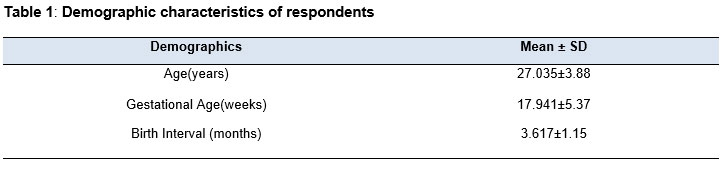
Results: Unintended pregnancy was seen in 49.4% of the pregnant women. Mean age 27.035±3.88 years, mean gestational age 17.941±5.37 weeks and mean birth interval was 3.617±1.15 months. Majority 78% of pregnant women have parity 2 and 76% were residing in urban area. Educated respondents were 75% and 28% had poor socioeconomic status. Education and socioeconomic status were the main determinants of unintended pregnancy. A significant difference was observed between unintended pregnancy and participants with no formal education (p<0.001) and those with poor economic status (p<0.001).
Conclusion: High rate of unintended pregnancy was observed among pregnant women who lacked education and belonged to a lower economic class.
Keywords: Pregnant women, Short interpregnancy interval, Unintended pregnancy
Introduction
Approximately, 40% of pregnancies are unintended globally and about half of these result in termination [1]. Unintended pregnancies are defined as those that occur without planning or are not desired at the time of conception and can be divided into two categories: mistimed and unwanted. A mistimed pregnancy happens when a woman wishes to have children but conceives earlier than intended, while an unwanted pregnancy happens when a woman with existing children no longer wishes to have more [2]. According to the World Health Organization, a two-year interval is required between subsequent pregnancies to minimize the likelihood of negative perinatal outcomes. A short interpregnancy interval (IPI) refers to a period of less than two years between pregnancies, although the exact definition varies, with studies suggesting intervals from 3 to 24 months. Unintended pregnancies are particularly common within the first two years following childbirth. In the United States, recent data shows that around 30% of women had an IPI of less than 18 months [3].
Unintended pregnancies are notably common in low- and middle-income countries (LMICs), accounting for approximately 88 million out of 99 million cases. Women in LMICs who experience unintended pregnancies often face challenges such as low education, poor socioeconomic conditions, and negative feelings toward their pregnancy. More likely the short birth intervals, undernutrition, more children and prior experience of complications due to unintended pregnancy are major contributors towards repetition of this condition. Globally, out of an estimated 210 million pregnancies annually, about 70 to 80 million are unintended, mistimed, or unplanned, with up to 45 million resulting in abortion. In countries such as Iran, Nepal, Japan, and the United States, the proportion of unintended pregnancies is significant having 35%, 35%,46% and 49% respectively [4].
In Pakistan, around 46% of the approximately nine million annual pregnancies are unintended and 54% of these ends in abortion. Despite efforts to promote family planning, the contraceptive prevalence rate remains low at 34%, while the total fertility rate is 3.6 in Pakistan. A 2017-18 survey revealed that 42% of married women in Pakistan did not want more children, yet only 25% used family planning methods. Lowering unintended pregnancies could decrease the total fertility rate in Pakistan to 3.1 births per woman [5]. Unintended pregnancy combined with a short interpregnancy interval is a worldwide public health concern that adversely affects women, families, and society. It raises the likelihood of unsafe abortions, maternal deaths, negative child outcomes, mental health problems, and mother-to-child transmission of HIV. Adolescents, unmarried women, and women of reproductive age are especially vulnerable, with many resorting to unsafe abortions due to stigma or fear [6].
In developing countries, unintended pregnancies account for nearly 49% of pregnancies in women aged 15-19 years. Studies show that unintended pregnancies are associated with negative maternal and child health outcomes, including malnutrition, poor development, cognitive delays, behavioral issues and higher rates of morbidity and mortality among children [7]. Unintended pregnancies result in maternal stress and shock when revealed to women and psychosomatic issues are also faced by them in decision making during and after the pregnancy [8]. Unintended pregnancy is driven by multifactorial determinants such as limited access to contraception, low educational attainment, economic challenges and social factors including age, marital status, and previous unintended pregnancies in resource limited settings. These pregnancies are associated with adverse maternal outcomes and in many cases, unsafe abortions that contribute significantly to maternal mortality. Although numerous studies have examined the prevalence and factors associated with unintended pregnancy in the general population, including young married women [9,10].
There is a lack of focused research examining unintended pregnancies that occur within short interpregnancy interval (<6months). This subgroup may face compounded risks due to both the unintended nature of the pregnancy and insufficient recovery time between pregnancies. Therefore, identifying the factors contributing to unintended pregnancy in this specific context is crucial for guiding targeted interventions. The objectives of our study are to assess the frequency of unintended pregnancy and its determinants in pregnant women with short interpregnancy interval(<6months) visiting obstetrics and gynecology department, Khawaja Muhammad Safdar Medical College/Allama Iqbal Memorial Teaching Hospital, Sialkot.
Method
A descriptive cross-sectional study was carried out through non-probability consecutive sampling in the Department of Obstetrics and Gynecology at Khawaja Muhammad Safdar Medical College/Allama Iqbal Memorial Teaching Hospital, Sialkot. from April 2024 to September 2024 after the approval of Research Ethics Committee (27/REC/KMSMC, dated 21-10-24). A sample of 170 was calculated by following formula: n = z2pq/d2, Where expected proportion (unintended pregnancy) p= 46% [5] q= 1-p and d= 7.5% and Confidence level = 95%. Pregnant women aged 18–40 years with a singleton pregnancy confirmed by ultrasound, parity between 0 and 4, and a short interpregnancy interval of less than 6 months were included in the study. While those pregnant women having no medical record available, previous birth outside country and refused to give informed consent were excluded.
A short interpregnancy interval was defined as a gap of less than 6 months between the delivery of the previous infant and the conception of the current pregnancy, as documented in the medical record. Unintended pregnancy was labelled when London Measure of Unplanned Pregnancies score was 0-3 while uneducated participants were those where the pregnant women cannot read and write. Poor economic status was considered when total income was less than Rs.15000 per month.
A written informed consent was obtained. Demographics like age, parity and interpregnancy interval was noted. All participants were interviewed for unintended pregnancy using London Measure of Unplanned Pregnancies. Data was analyzed on IBM-SPSS 26. For qualitative variables such as education, economic status and unintended pregnancy, frequency and percentage were calculated. Mean ±SD was computed for quantitative variables including age, gestational age, and birth interval. Determinants of unintended pregnancy like age, parity, gestational age, education, residential status and economic status were measured. Chi square test was applied to qualitative variables, and a p-value ≤0.05 was regarded as statistically significant.
Results
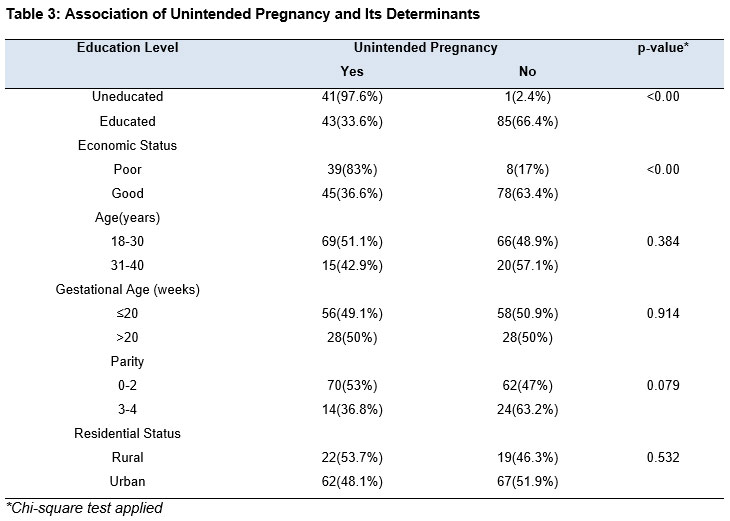
A total of 170 pregnant women were enrolled in the study after meeting the inclusion criteria. The participants' ages ranged from 18 to 40 years, with a mean age of 27.035±3.88 years and a mean gestational age of 17.941±5.37 weeks and mean birth interval between the previous pregnancy and current pregnancy was 3.617±1.15 months as shown in Table-I. The unintended pregnancy was reported by 84 (49.4%) of the respondents while 86(50.6%) reported their pregnancy as planned pregnancy. Frequencies and percentages of determinants of unintended pregnancy are shown in Table-II. Distribution of unintended pregnancy in relation to age, gestational age, parity, education, residential area, and economic status is presented in Table-III.
Chi-square test indicated a significant association between education level and unintended pregnancy at P<0.001, with uneducated participants having a higher likelihood of experiencing unintended pregnancy compared to educated ones. An association was depicted among poor economic status and unintended pregnancy when Chi square was applied. Participants with poor economic status had more tendency of unintended pregnancy (p<0.001). There was no significant difference among age groups and unintended pregnancy (P=0.384), gestational age and unintended pregnancy (P=0.914), parity and unintended pregnancy (P=0.079), residential status and unintended pregnancy (P=0.532) when Chi square test was applied on these categorical variables.

Discussion
Unintended pregnancy is a global threat to the health of the mother as well as her child. In our study 49% of the respondents reported unintended pregnancy, this percentage is higher than a study carried out in Quetta, Pakistan where 28.4% of the respondents have unintended pregnancy [11]. Studies conducted in Ethiopia [2] and Kenya [6] also revealed that unintended pregnancy was reported 31% and 29.9% respectively among respondents emphasizing on different social and cultural factors associated with unintended pregnancies.
Age is considered one of the major determinants of unintended pregnancy in developed as well as in developing countries. The mean age of the study participants was 27.035 years which is like a study conducted in Oromia Region, Ethiopia in which the respondents belonged to the same mean age [7]. This refers that women in their twenties are in transitional phase of their education, decision making and relationship leading to inconsistent use of contraceptives. Furthermore, these years are the peak fertility years of a woman and cause unintended pregnancy due to contraceptive failure. Parity refers to the number of times a woman has delivered a foetus at a gestational age of 24 weeks or more, irrespective of whether the baby was born alive or stillborn. Majority of the respondents in our study had 2 children. A study in Kenya also showed the same findings [6].
Some other studies revealed that majority of the participants had urban backgrounds as compared to rural population and the proportion of educated population was also higher [6,7]. Findings of our study were also similar to these studies. This means educated women have sufficient knowledge regarding the health issues related to unintended pregnancies and their consequences. Urban population has issues of accessibility and availability of health services as compared to rural population. Statistics related to perinatal mortality are alarming in developing countries like Pakistan. Short interpregnancy interval is among the leading causes of perinatal mortality and an important determinant of unintended pregnancy [12]. World Health Organization recommends at least an interval of two years among subsequent pregnancies to prevent the ill health consequences of mother and child. In our study, the inter pregnancy interval was less than 6 months. Contrary to our study, conducted in Berhan Town, Ethiopia had findings in which 40.9% participants reported interpregnancy interval less than 24 months and among them 5% had less than 12 months interval [12].
The association between unintended pregnancy and the respondents’ education and economic status was significant in our study. These results align with an Indian study that reported a significant association between unintended pregnancy and both the education level and economic status of the participants [13]. This reveals that respondents who are not educated and having poor socioeconomic status will report more unintended pregnancy and this is the situation most common in developing countries like Pakistan and India. Some studies in Patna and six South Asian countries also reported a significant association between unintended pregnancy and age of the respondents [14,15] but it was not the situation in our study where there was no notable association between unintended pregnancy and the age groups of the participants. This may be due to the relatively narrow age range (18-40 years) and younger mean age (27 years) in our study population which could have limited the variability needed to detect an age-related association. Our study revealed no association among unintended pregnancy and parity and residential status of the participants. A study contrary to our findings reported significant association among unintended pregnancy and these variables [7].
A key limitation of this study was that it was conducted at a single centre and limited to one government sector tertiary care hospital. The private sector is also providing health care services to enough people so inclusion of data from this sector was also required. The study lacks generalizability to a larger proportion of such females in Pakistan. Social desirability bias may also limit the women’s response about labeling pregnancy as unintended, which can be an underestimation of the burden of unintended pregnancy.
Conclusion
In conclusion, despite a high percentage of educated respondents, the majority residing in urban areas and not experiencing poor socioeconomic status, the prevalence of unintended pregnancy remains notably high. It is essential to raise awareness and ensure the availability of modern contraceptive methods. A well implemented national family planning program offering contraceptive services before and after conception can significantly help to prevent unintended pregnancies and their negative impacts.
References
- Väisänen H, Batyra E. Unintended pregnancy resolution among parous women in twelve low-and middle-income countries. Journal of Biosocial Science. 2022 Jul;54(4):698-724. https://doi.org/10.1017/S0021932021000225
- Merga J, Wirtu D, Bekuma TT, Regasa MT. Unintended pregnancy and the factors among currently pregnant married youths in Western Oromia, Ethiopia: A mixed method. Plos one. 2021 Nov 4;16(11) https://doi.org/10.1371/journal.pone.0259262
- İmamoğlu M, Şimşek D, Dinçgez B, Ünal S, Demirci A, İlhan O, İmamoğlu AG, Özçeltik G. Short interdelivery interval in modern obstetrics: maternal and neonatal outcomes. Turkish Journal of Obstetrics and Gynecology. 2022 Dec;19(4):295 https://doi.org/10.4274/tjod.galenos.2022.50576
- Khan MN, Islam MM. Women’s experience of unintended pregnancy and changes in contraceptive methods: evidence from a nationally representative survey. Reproductive health. 2022 Sep 1;19(1):187. https://doi.org/10.1186/s12978-022-01492-w
- Razzaq S, Jessani S, Rizvi N, Saleem S. Unintended pregnancy and the associated factors among pregnant females: Sukh Survey-Karachi, Pakistan. JPMA. The Journal of the Pakistan Medical Association. 2021;71(11 (Suppl 7)):S50. https://ecommons.aku.edu/pakistan_fhs_mc_chs_chs/962/
- Ojuok R, Nyamongo D, Mutai J. Determinants of unintended pregnancy among women attending antenatal clinic at Kenyatta National Hospital. F1000Research. 2022;11. https://doi.org/10.12688/f1000research.108815.1
- Bekele H, Dheressa M, Mengistie B, Sintayehu Y, Fekadu G. Unintended pregnancy and associated factors among pregnant women attending antenatal care at Bako Tibe District Public Health Facility, Oromia Region, Ethiopia. Journal of pregnancy. 2020;2020(1) https://doi.org/10.1155/2020/3179193
- Dalmijn EW, Visse MA, van Nistelrooij I. Decision-making in case of an unintended pregnancy: an overview of what is known about this complex process. Journal of Psychosomatic Obstetrics & Gynecology. 2024 Dec 31;45(1) https://doi.org/10.1080/0167482X.2024.2321461
- Nigussie K, Degu G, Chanie H, Edemealem H. Magnitude of unintended pregnancy and associated factors among pregnant women in Debre Markos Town, East Gojjam Zone, Northwest Ethiopia: a cross-sectional study. International journal of women's health. 2021 Jan 28:129-39. https://doi.org/10.2147/IJWH.S275346
- El-shrqawy E, El-Nemer A. Unintended Pregnancy: Associated Factors and outcomes among pregnant women. Mansoura Nursing Journal. 2020 Jul 1;7(2):227-40. https://mnj.journals.ekb.eg/article_179791.html
- Muhammad SF, Umar F, Baloch NS, Saif K, Batool U, Ehsan N. Prevalence of unplanned pregnancies and factors leading to it among married females visiting tertiary care hospital. J. Health Sci,2022; 6(S7), 4465–4472. https://doi.org/10.53730/ijhs.v6nS7.12912
- Mamo H, Dagnaw A, Sharew NT, Brhane K, Kotiso KS. Prevalence of short interpregnancy interval and its associated factors among pregnant women in Debre Berhan town, Ethiopia. Plos one. 2021 Aug 2;16(8). https://doi.org/10.1371/journal.pone.0255613
- Dehingia N, Dixit A, Atmavilas Y, Chandurkar D, Singh K, Silverman J, Raj A. Unintended pregnancy and maternal health complications: cross-sectional analysis of data from rural Uttar Pradesh, India. BMC Pregnancy and Childbirth. 2020 Dec;20:1-1. https://doi.org/10.1186/s12884-020-2848-8
- Roy P, Ahmad S, Kumar P. Determinants of unintended pregnancy among women attending antenatal clinic at AIIMS Patna–a cross-sectional study. Indian J Community Med.2024 Apr;49(Suppl 1):S7 https://doi.org/10.4103/ijcm.ijcm_abstract24
- Sarder A, Islam SM, Maniruzzaman, Talukder A, Ahammed B. Prevalence of unintended pregnancy and its associated factors: evidence from six south Asian countries. PLoS One. 2021 Feb 1;16(2) https://doi.org/10.1371/journal.pone.0245923