Abstract
Background: Many clinical trials support the role of inhaled amikacin when combined with IV antibiotics in eradication of bacterial infections, reduce mortality and improve cure in ICU patients. Local contextual data is limited, leaving research gap.
Objective: To assess the effect of inhaled amikacin as an add-on adjunct to the intravenous antibiotics in ventilator-associated pneumonia ICU patients on clinical outcomes.
Methodology: This group randomized controlled add-on trial was conducted to assess the clinical outcomes of inhaled amikacin in VAP treatment. 180 ventilated patients with VAP were recruited from the two Intensive Care Units of Lahore General Hospital Surgical between January to December 2024. Patients were divided into two groups: one received empirical intravenous antibiotics (group N), and the other was administered inhaled amikacin along with empirical intravenous antibioticsgroup A). Clinical variables including the duration of mechanical ventilation, length of stay in the ICU and symptom resolution, were compared between the two groups using t-tests and chi-square tests.
Results: Group A had a statistically significant shorter mean duration of mechanical ventilation than patients in Group N (6.8 days vs. 9.36 days, p<0.05). However, there was no significant difference in the mean duration of ICU stay between the two groups (13.9 days vs. 14.3 days, p=0.290). Group A had a higher percentage of symptom resolution compared to Group N (88% vs. 57%, p<0.0001), with an odds ratio of 4.31 (95% CI: 2.13-8.72, p<0.00I) indicating significantly higher odds of symptom resolution with inhaled amikacin.
Conclusion: By using inhaled amikacin as an additional treatment for ventilator-associated pneumonia clinical outcome was improved and the duration of mechanical ventilation was reduced. Ventilator-associated pneumonia (VAP) is a hospital-acquired infection that is linked to high morbidity, mortality, and healthcare expenses. Inhaled amikacin may serve as an adjunctive therapy for VAP, offering targeted delivery and reducing systemic toxicity.
Keywords: Ventilator-Associated Pneumonia, inhaled amikacin, mechanical ventilation, adjunctive therapy, clinical improvement.
Introduction
Ventilator-associated pneumonia (VAP) is a parenchymal lung infection that develops in patients who have been on mechanical ventilation for 48 hours or more [1]. It remains one of the most common and serious nosocomial infections in critical care settings, contributing significantly to patient morbidity, mortality, and healthcare expenditures. Among the diverse pathogens implicated, multidrug-resistant gram-negative bacteria—particularly Acinetobacter species and extended-spectrum beta-lactamase (ESBL) producers—pose substantial therapeutic challenges due to limited antibiotic options and high resistance rates [2, 3]. Clinical failure to adequately manage VAP can result in severe complications such as acute respiratory distress syndrome (ARDS), sepsis, septic shock, and failure to wean from the ventilator [4, 5]. Although established treatment guidelines provide a structured framework for managing VAP, the rising prevalence of resistant organisms often renders empirical regimens inadequate, prompting a search for alternative or adjunctive therapies [6]. One such adjunctive strategy under investigation is the use of inhaled antibiotics. Inhaled amikacin, a broad-spectrum aminoglycoside, has gained interest due to its ability to deliver high local concentrations directly to the lungs while minimizing systemic toxicity [7]. Preclinical and clinical studies suggest its potential effectiveness against resistant gram-negative organisms frequently implicated in VAP [8]. However, despite these promising attributes, there remains limited evidence assessing the clinical efficacy of inhaled amikacin in real-world ICU populations.
In the context of the growing burden of multidrug-resistant ventilator-associated infections in ICUs, this study evaluating the role of adjunctive use of amikacin (inhaled) is needed to fill the population and evidence gap. The present study investigates the impact of inhaled amikacin, used in conjunction with intravenous antibiotics, on clinical outcomes in patients with ventilator-associated pneumonia. By evaluating its effect on symptom resolution and duration of mechanical ventilation, this study aims to contribute to the growing body of evidence on inhaled therapies and support future guideline development, especially in regions burdened by antimicrobial resistance.
Method
A group randomized controlled add-on trial was conducted at the Surgical Intensive Care Units of Lahore General Hospital over a one-year period from January to December 2024. The primary objective was to evaluate the effect of inhaled amikacin as an adjunctive therapy for ventilator-associated pneumonia (VAP), with clinical improvement as the primary outcome. The sample size was calculated assuming a 20% improvement in clinical outcomes with adjunctive therapy, using a two-sided test with 80% power and a 5% level of significance. Based on this, and accounting for a 10% dropout rate, a total of 180 patients were required, and the sample size calculation was based on standard formulas for comparing proportions in two independent groups [9]. The non-probability sampling method was used to recruit the patients. Patients on mechanical ventilation who were 18 years of age or older with a diagnosis of VAP, not requiring vasopressors, stable hemodynamics, and normal renal function tests were included in the study. The exclusion criteria were cystic fibrosis, bronchiectasis, severe renal impairment, renal replacement therapy, known hypersensitivity, or contraindication to amikacin. Diagnosis of VAP was based on both clinical criteria, including fever, leukocytosis, increased oxygen requirement, purulent sputum, and respiratory distress, and radiological findings such as new infiltrates on chest X-ray or consolidation on lung ultrasound. After receiving their relatives' informed consent, all patients were included in the research. Participants were randomized using a computer-generated sequence into two equal groups of 90 patients each. Stratified randomization was employed based on age, gender, and illness severity using SOFA scores to ensure balanced allocation. Group N received empirical IV antibiotics only, i.e., Meropenem and Moxifloxacin, depending upon the body weight of the patients, following collection of tracheal and blood cultures. Group A received nebulization of amikacin at a dose of 20 mg per kg per day divided into two doses along with empirical IV antibiotics, i.e., Meropenem and Moxifloxacin, depending upon body weight, after sending tracheal and blood cultures.
Data about demographic information, SOFA score, day of ventilation, ICU admission day, comorbidities, VAP diagnosis criteria, microbiological characteristics, treatment regimens, and clinical outcomes related to VAP improvement were collected on a proforma. Symptom improvement was measured across five predefined domains, i.e., fever resolution, reduced oxygen requirement, leukocyte count normalization, radiographic improvement, and ventilator weaning. Composite clinical improvement was defined as achieving improvement in at least three of these five domains.
The age, days of mechanical ventilation, and days of hospital stay were among the quantitative variables, and their means and standard deviations were reported. For qualitative information such as gender and the state of clinical improvement, frequency and percentage were computed. For continuous variables, such as the duration of mechanical ventilation and ICU stay, independent t-tests were used to compare means between the two groups. Continuous variables were compared using independent sample t-tests. Categorical variables were analyzed using chi-square tests or Fisher’s exact tests where appropriate. A p-value < 0.05 was considered statistically significant. The odds ratio was calculated to quantify the strength of association between treatment type and symptom resolution. The OR was reported with a 95% confidence interval to provide an estimation of the precision and reliability of the effect size. An OR > 1 indicated a higher likelihood of symptom resolution in the inhaled amikacin group. All statistical analyses were conducted using SPSS version 26.0. Assumptions for each statistical test were verified prior to analysis, and any deviations were addressed using appropriate corrections. Approval was obtained from the Institutional Review Board of PGMI (IRB Reference No. 100/24, dated 03-Jan-2024) prior to study initiation.
Results
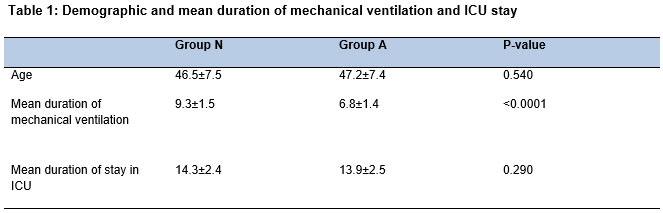
The mean age in Group N was 46.5 ± 7.5 years and in Group A was 47.2 ± 7.4 years, with no statistically significant difference (p = 0.540). Both groups had a comparable gender distribution. The duration of mechanical ventilation was significantly shorter in patients receiving inhaled amikacin (Group A: 6.8 ± 1.4 days) compared to the control group (Group N: 9.3 ± 1.5 days), with a highly significant p-value (< 0.0001). However, the mean ICU length of stay showed no significant difference between groups (Group A: 13.9 ± 2.5 days vs. Group N: 14.3 ± 2.4 days; p = 0.290).
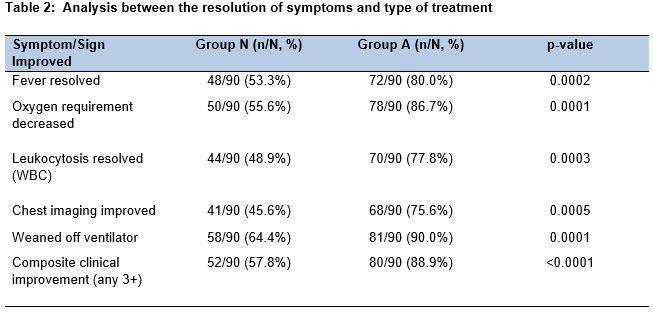
Symptom-wise analysis demonstrated significantly greater improvement across all measured domains in the group receiving inhaled amikacin:
- Fever resolution in 80.0% of Group A vs 53.3% of Group N (p = 0.0002)
- Oxygen requirement reduction in 86.7% vs 55.6% (p = 0.0001)
- Leukocyte count normalization in 77.8% vs 48.9% (p = 0.0003)
- Radiographic improvement in 75.6% vs 45.6% (p = 0.0005)
- Successful ventilator weaning in 90.0% vs 64.4% (p = 0.0001)
Composite clinical improvement (defined as ≥3 domains) occurred in 88.9% of Group A versus 57.8% of Group N (p < 0.0001). This difference was statistically significant (p < 0.0001), with an odds ratio of 4.31 (95% CI: 2.1–8.7), suggesting that patients in the inhaled amikacin group were over four times more likely to experience symptom resolution. These findings are summarised in Tables 1 and 2.
Discussion
This study reinforces the clinical utility of inhaled amikacin as an adjunctive treatment in ventilator-associated pneumonia (VAP), particularly in the context of multidrug-resistant gram-negative infections—a major challenge in critical care units globally and in Pakistan. Our findings demonstrate a statistically significant improvement in symptom resolution and a reduction in the duration of mechanical ventilation among patients receiving inhaled amikacin, supporting its role as a targeted therapeutic strategy in high-burden ICU settings.
The mean age of patients in both groups was approximately 47 years, consistent with prior ICU studies in South Asia by Ahmed et al. (2021) in Karachi [10]. It similarly reported a peak incidence of VAP in the 40–50-year age group, reflecting high community and hospital exposure to multidrug-resistant pathogens at a younger age compared to high-income countries. This demographic pattern implies a substantial burden on ICU resources and highlights the urgency of early and effective therapeutic interventions. A pilot study by Levchenko et al. found that younger ICU patients with VAP experienced high antimicrobial resistance, likely due to earlier and more frequent exposure to empirical antibiotics in both hospital and community settings [1]. This age distribution contrasts with Western cohorts, where older populations dominate ICU admissions, further emphasizing the unique resistance landscape in our region. Consistent with these studies, our findings revealed an 88% symptom resolution rate in the intervention group compared to 72% in the control group. This is comparable to results observed in the AMIKINHAL trial protocol by Tavernier et al., which demonstrated the preventive potential of inhaled amikacin in mechanically ventilated patients [11]. Motos et al. also reported favorable outcomes in preclinical models with the same agent [12]. Importantly, our study extends this evidence to real-world ICU settings in South Asia, where multidrug-resistant organisms such as Acinetobacter and ESBL-producing pathogens are common [2], [3].
The clinical efficacy observed in our study is consistent with the findings of Qin et al., who conducted a meta-analysis demonstrating that nebulized amikacin significantly improved clinical cure rates and bacterial eradication in patients with gram-negative VAP [7]. Similarly, Tang et al. showed that adjunctive inhaled antibiotics reduced mechanical ventilation duration and improved overall outcomes in ICU patients [8]. Our results also corroborate those of Motos et al., who demonstrated that inhaled amikacin achieved effective lung deposition and reduced bacterial dissemination in an experimental pneumonia model [12].
Despite improvements in clinical outcomes, ICU length of stay did not differ significantly between groups in our study. This mirrors the findings of Stokker et al. in the VAPORISE trial, where early clinical responses did not translate into shorter ICU stays, likely due to confounding factors such as comorbidities, systemic complications, or administrative discharge delays [13]. In resource-limited settings like Pakistan, prolonged ICU admissions are often influenced by non-clinical factors including bed availability, cost concerns, and the need for rehabilitation, which may obscure treatment-related benefits.
From a pharmacological perspective, the benefits of inhaled amikacin lie in its ability to achieve high local concentrations at the infection site while minimizing systemic toxicity. Motos et al. highlighted the superior pulmonary pharmacokinetics of nebulized aminoglycosides in targeting Pseudomonas aeruginosa infections [12]. Desgrouas and Ehrmann also emphasized the rationale for inhaled delivery in critically ill patients, particularly when systemic antibiotic penetration into the lungs is suboptimal [14], [15]. Boisson et al. reinforced this by demonstrating that nebulized antibiotics like amikacin achieve bactericidal epithelial lining fluid levels with minimal nephrotoxicity [16].
Our study reported no significant adverse events related to inhaled amikacin, supporting its safety in the ICU setting. These findings align with the multicenter trial by Ehrmann et al., which documented a favorable safety profile for inhaled amikacin in preventing VAP [14]. Nevertheless, regular monitoring of renal and auditory function is recommended, especially in patients with borderline kidney function or concurrent nephrotoxic drugs.
In light of emerging antimicrobial resistance, our findings contribute to the ongoing dialogue regarding stewardship strategies.
In conclusion, our findings demonstrate that inhaled amikacin, when used alongside standard IV antibiotics, significantly improves clinical outcomes in VAP without increasing ICU complications or adverse effects. These results are consistent with both regional epidemiology and international evidence and suggest that inhaled amikacin may play a vital role in optimizing care for critically ill patients facing resistant pulmonary infections. Further multicenter trials and cost-effectiveness analyses are warranted to guide national policy and implementation in low- and middle-income countries.
Conclusion
The results of this study suggest that inhaled amikacin is a promising adjunctive therapy for VAP, particularly in the context of infections caused by multidrug-resistant pathogens. While it improves symptom resolution and reduces ventilator dependency, its impact on ICU stays duration remains inconclusive, likely due to the multifactorial nature of ICU management. Future research should focus on long-term outcomes, cost-effectiveness, and the role of inhaled amikacin in specific patient subgroups to further elucidate its therapeutic potential.
References
- Levchenko B, Nazarchuk O, Dmytriiev D, Bahniuk N, Melnychenko M, Dmytriiev K. An adjunctive inhaled amikacin in infants with ventilator-associated pneumonia optimizes the complex antimicrobial therapy: pilot study. Acta Bio Medica. 2023;94(2). https://doi.org/10.23750/abm.v94i2.13910
- Rathbun KP, Bourgault AM, Sole ML. Oral microbes in hospital-acquired pneumonia: practice and research implications. Crit Care Nurse. 2022;42(3):47–54. https://doi.org/10.4037/ccn2022672
- Lynch JP, Zhanel GG. Pseudomonas aeruginosa pneumonia: evolution of antimicrobial resistance and implications for therapy. Semin Respir Crit Care Med. 2022;43(2):191–218. https://doi.org/10.1055/s-0041-1741019
- Sakti PP, Anjarwani S. Weaning failure in mechanical ventilation: a literature review. Heart Sci J. 2023;4(4):5–9. https://doi.org/10.21776/ub.hsj.2023.004.04.2
- Mecklenburg A. Failure to wean from mechanical ventilation. In: Intensive Care Fundamentals: Practically Oriented Essential Knowledge for Newcomers to ICUs. Cham: Springer; 2023. P. 241–6. https://doi.org/10.1007/978-3-031-21991-7_18
- Kalil AC, Metersky ML, Klompas M, Muscedere J, Sweeney DA, Palmer LB, et al. Management of adults with hospital-acquired and ventilator-associated pneumonia: 2016 clinical practice guidelines by the Infectious Diseases Society of America and the American Thoracic Society. Clinical Infectious Diseases. 2016;63(5):e61–e111. https://doi.org/10.1093/cid/ciw353
- Qin JP, Huang HB, Zhou H, Zhu Y, Xu Y, Du B. Amikacin nebulization for adjunctive therapy of gram-negative pneumonia in mechanically ventilated patients: a systematic review and meta-analysis of randomized controlled trials. Sci Rep. 2021;11(1):6969. https://doi.org/10.1038/s41598-021-86342-8
- Tang R, Luo R, Wu B, Wang F, Song H, Chen X. Effectiveness and safety of adjunctive inhaled antibiotics for ventilator-associated pneumonia: a systematic review and meta-analysis. J Crit Care. 2021;65:133–9. https://doi.org/10.1016/j.jcrc.2021.06.004
- Xu F, He L-L, Che L-Q, Li W, Ying S-M, Chen Z-H, et al. Aerosolized antibiotics for ventilator-associated pneumonia: a pairwise and Bayesian network meta-analysis. Critical Care. 2018;22(1):301. https://doi.org/10.1186/s13054-018-2106-x
- Moeed A, Bilal Z, Batool F, Batool Zaidi A, Arsalan Jamil M, Surani S. Role of Amikacin in the Management of Ventilator-Associated Pneumonia [Internet]. Recent Updates in Intensive Care Medicine. IntechOpen; 2024. Available from: http://dx.doi.org/10.5772/intechopen.1005446
- Tavernier E, Barbier F, Meziani F, Quenot JP, Herbrecht JE, Landais M, et al. Inhaled amikacin versus placebo to prevent ventilator-associated pneumonia: the AMIKINHAL double-blind multicentre randomised controlled trial protocol. BMJ Open. 2021;11(9):e048591. https://doi.org/10.1136/bmjopen-2020-048591
- Motos A, Yang H, Li Bassi G, Yang M, Meli A, Battaglini D, et al. Inhaled amikacin for pneumonia treatment and dissemination prevention: an experimental model of severe monolateral Pseudomonas aeruginosa pneumonia. Crit Care. 2023;27(1):60. https://doi.org/10.1186/s13054-023-04331-x
- Stokker J, Karami M, Hoek R, Gommers D, van der Eerden M. Effect of adjunctive tobramycin inhalation versus placebo on early clinical response in the treatment of ventilator-associated pneumonia: the VAPORISE randomized-controlled trial. Intensive Care Med. 2020;46:546–8. https://doi.org/10.1007/s00134-019-05914-5
- Ehrmann S, Barbier F, Demiselle J, Quenot JP, Herbrecht JE, Roux D, et al. Inhaled amikacin to prevent ventilator-associated pneumonia. N Engl J Med. 2023;389(22):2052–62. https://doi.org/10.1056/NEJMoa2310307
- Desgrouas M, Ehrmann S. Inhaled antibiotics during mechanical ventilation—why it will work. Ann Transl Med. 2021;9(7):1–3. https://doi.org/10.21037/atm-20-3686
- Boisson M, Bouglé A, Sole-Lleonart C, Dhanani J, Arvaniti K, Rello J, et al. Nebulized antibiotics for healthcare- and ventilator-associated pneumonia. Semin Respir Crit Care Med. 2022;43(2):255–70. https://doi.org/10.1055/s-0041-1740340