Abstract
Background: Tutors are one of the most important stakeholders in medical and dental institutes. Future doctors depend upon how good he is taught, and it depends upon the tutor who teaches them. We conducted this study to explore the undergraduate students’ perception regarding the teaching of junior and senior tutors in basic sciences of medicine and dentistry at the University College of Medicine and Dentistry (UCMD) in Pakistan.
Objective: We conducted this study to explore the undergraduate medical and dental students’ perception regarding teaching of junior and senior tutors/faculty members in basic sciences at the University College of Medicine and Dentistry in Pakistan.
Method: An exploratory qualitative study design was conducted at UCMD by performing one-to-one interviews with six dental students and nine medical students regarding their perceptions of the teaching by senior and junior tutors, specifically for undergraduate BDS and MBBS students. Recorded data was transcribed, and thematic analysis was done through Atlas Ti. Themes and codes were taken out.
Results: Strengths of senior tutors included experience, mentorship & guidance, community engagements, research excellence, and ethics & professionalism, while strengths of senior tutors included teaching enthusiasm, communication & presentation skills, and growth potential. Whereas, teaching can be improved by working on professional development, assessment & feedback, mentorship, and self-reflections.
Conclusion: The current study provides an idea that senior and junior tutors have their own abilities and strengths for teaching their specific subjects. It showed that both senior and junior tutor possess unique strengths and weaknesses which can be improved by working on their professional, communication, teaching, and mentorship skills. Teaching can be improved by polishing those strengths and minimizing the weaknesses.
Keywords: Tutor, Junior, Senior, Facilitator, Lecturer, Teacher, Effective teaching
Introduction
In Pakistan, the most wanted career choice is Medical and Dental Education [1]. Medical and Dental education both include basic science knowledge and clinical skill acquisition [2,3]. A clerkship is a special kind of immersion learning that takes place in hospital environments such as the operating theater, inpatient department, and outpatient department. In basic sciences, theoretical and practical knowledge, along with clinical correlation of anatomy, Physiology, biochemistry, pharmacology, pathology, etc., is provided [4].
The majority of Pakistani colleges operate tradition curriculum (Flexner model) in which clinical exposure begins in the third year [5]. Few universities offer an integrated curriculum that offers early clinical exposure and better integrated courses to enhance clinical representation [6,7]. The last year of these programs is devoted entirely to clinical clerkships as a comprehensive education with practical application [8].
“Teaching should be intended toward learning” [9]. There is a connection between what students learn and how teachers teach it. Literature suggests that a teacher's specific style of instruction can help students perform to the highest level. The idea of responsive teaching also comes into play, describing how a teacher perceives and responds to students' ability to reason [7]. A teacher must have a firm grasp of the subject, be able to organize content, and convey ideas clearly, have strong communication skills, professionalism, and enthusiasm for their area of expertise [8]. However, in medical schools, teachers are divided into two groups in basic sciences: “senior” or “junior” as demonstrator, Sr. Demonstrator, Assistant Professors, Associate Professors, and Professors [10].
Tutors (also known as faculty members) are one of the most important stakeholders in a medical institute for teaching and learning [11]. Future doctors depend upon how good he is taught, and it depends upon the tutor who teaches them [12,13]. Each tutor has some qualities and also some shortcomings. There are a few tutors whom students like more than others. It is perceived that junior tutors are more enthusiastic and easier to approach, whereas senior faculty members are more knowledgeable and experienced.
Therefore, within the field of medical education, students, parents, teachers, and administrators are engaged in discussion about whether a senior tutor is superior in teaching or a junior tutor. It's common knowledge that seniority equals expertise, meaning that seasoned teachers inherently perform better than their less experienced peers in the classroom. Such presumptions, however, ignore the dynamic interaction among educational efficacy, experience, and creativity. To evaluate the effectiveness of teaching of senior and junior faculty members and to analyze the distinct abilities and input of both novice and experienced teachers.
Method
In our study, a qualitative study design was used to explore the undergraduate students’ perception regarding the teaching of junior and senior tutors in basic sciences. This study was conducted at University College of Medicine and Dentistry for 6 months’ duration from October 2023 to March 2024. In our study, a total of fifteen interviews were conducted. One-to-one interviews were conducted with six dental students (two high- achievers, two mid-achievers, and two low-achievers) and nine medical students (three high-achievers, three mid-achievers, and three low-achievers) regarding their perceptions of senior and junior tutors. For this activity, purposive sampling was done in order to get a diverse perspective.
At the University College of Medicine and Dentistry integrated modular curriculum is running both in medicine and dentistry, in which students are exposed to different strategies like interactive lectures, small group discussions, team-based learning, problem-based learning, etc., in the first three years (Pre-clinical years) of BDS and MBBS. Both in medicine and dentistry, students were taught by demonstrators, senior demonstrators, assistant professors, associate professors, and Professors. At UCMD, assistant professors and senior demonstrators are considered junior, associate professors, and Professors considered senior faculty members. For this study, purposive sampling was done by interviewing three students from each class 1st, 2nd, and 3rd year of MBBS, while three students were interviewed from each class 1st and 2nd year of BDS. So, a total of fifteen students were interviewed after obtaining ERB from the university’s ethical review committee, i.e., ERC/22/23/02 dated01/02/2023. The interview guide, along with the consent form were developed and validated by our research team. First of all, consent for study, interview, and recording was taken from students through a written consent form, and an interview guide was shared with the participants through email. Four open-ended Interview questions were carved out, which were later validated by two medical educationists. The following were the four interview questions,
- How will you define senior and junior tutors?
- What do you think the strengths of senior tutors are?
- What do you think are the strengths of junior tutors?
- What do you think faculty members can improve in their teaching?
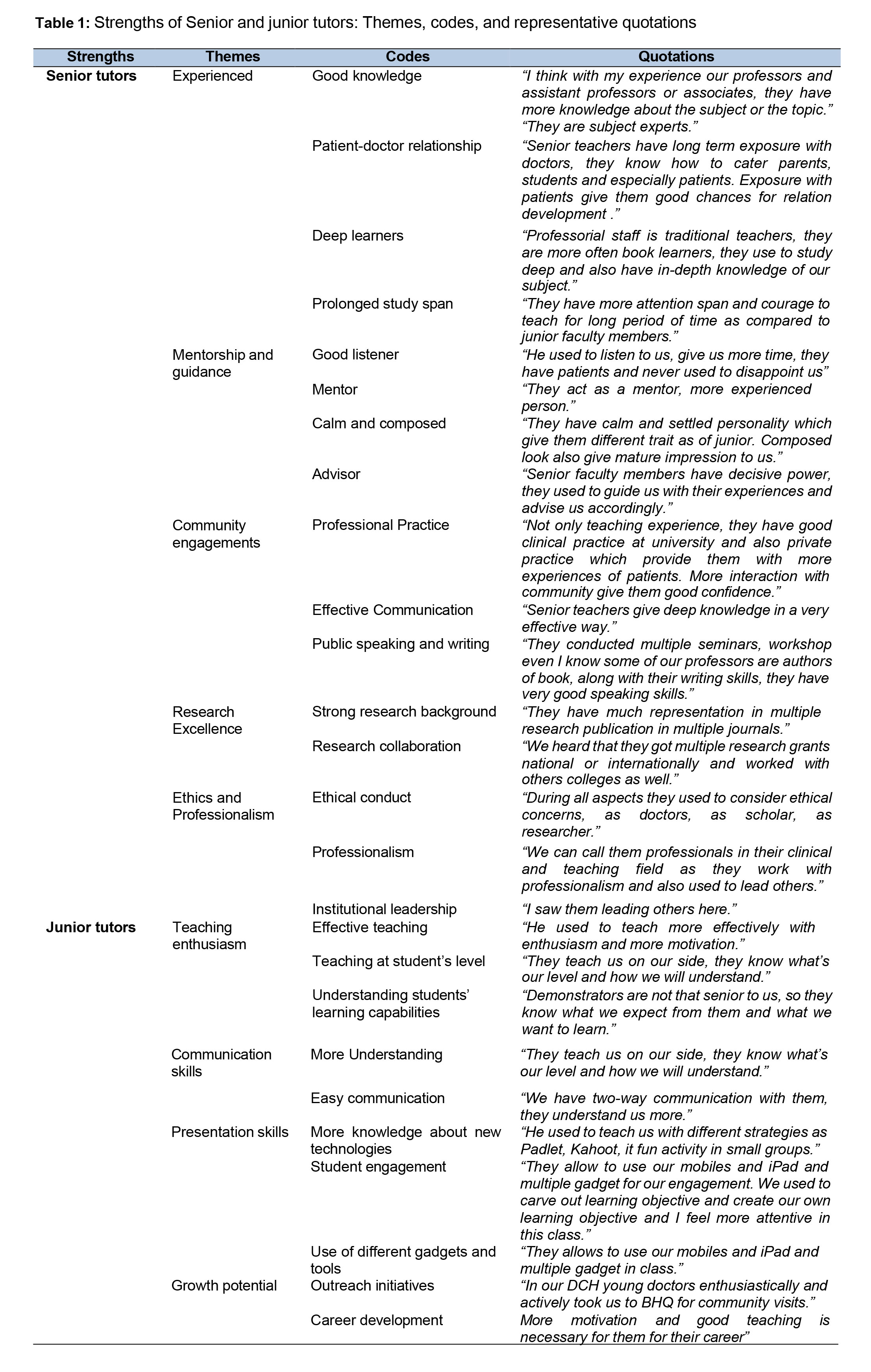
Then, one to one interview was conducted on ZOOM starting with verbal consent till the data got saturated and yielded the same responses. All interviews were transcribed using Otter Ai which were then shared with the respective participants for member checking. Then, the data were transferred to Atlas Ai for thematic analysis (compiling, disassembling, reassembling, and interpretation). Thematic analysis was performed, and different themes and codes were carved out as shown in Table 1. Those themes and codes were shared with other authors and two medical educationists in order to ensure dependability and transferability.
Results
Strengths of senior and junior tutors (faculty members) were taken out as themes and codes by performing thematic analysis. Five themes were developed for senior tutors, while four themes were carved out for junior tutors. The theme, along with respective codes and quotations, is shown in Table 1.
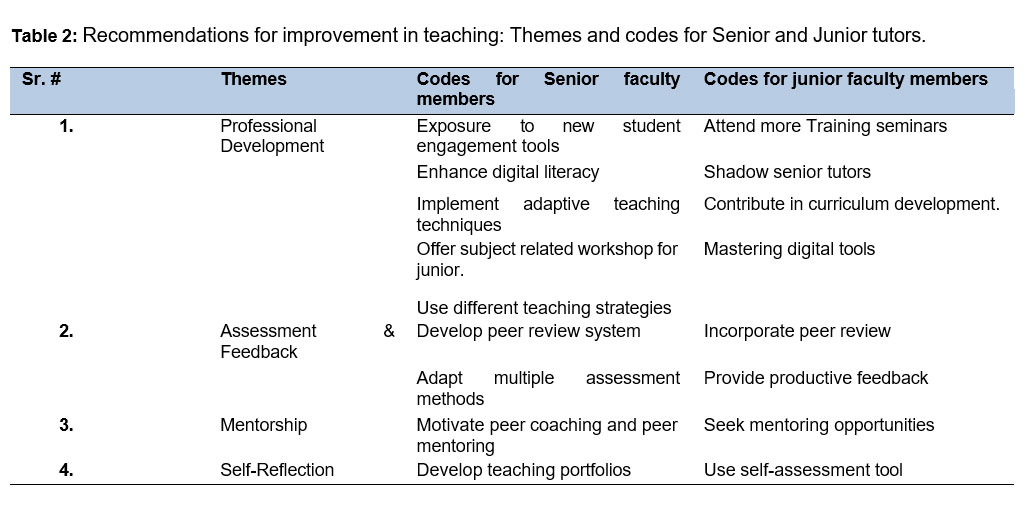
A total of four major themes with respective codes for junior and senior faculty members for improvement in teaching are created, which can be shown in Table 2.
Strength of senior tutors:
Students were of the opinion that senior tutors have more exposure to teaching, learning, and assessment. Along with this, they have more exposure to patients, parents, students, and colleagues. Because of this experience, they know how to cater to students, how to communicate with them, and how to teach them. Senior faculty members have in-depth knowledge of the subject also why they provide deep knowledge while teaching.
Strength of junior tutors:
According to students of BDS and MBBS, junior teacher teaches on the students’ level, and their teaching methodologies are more advanced. They used to teach with multiple gadgets and different application which is more engaging for students.
Recommendation for improvement in teaching:
Both medical and dental students at UCMD were of the opinion that senior and junior faculty have to work on professional development, assessment & feedback, mentorship & guidance, and self-reflection for the improvement in teaching students.
Discussion
This study focuses on the strengths of senior and junior faculty members and also provides recommendations to improve teaching. This study interprets the perspective of students of medicine and dentistry regarding the teaching of demonstrators, senior demonstrators’ assistant professors, associate professors, and Professors. Assistant professors, senior demonstrators considered as junior, associate professors, and Professors considered as senior faculty members.
This study shows that senior faculty being experienced one has command of their subject and have in-depth knowledge about each topic taught. In literature, it is also proven that the knowledge used gets enhanced with continuous exposure and experience [14]. They have more experience in the clinical field, that give more relationship development chances and is socially sound, which provides them with confidence. They have good communication skills and listening skill which were also seconded by an article written by Enright, 2023, that “skilled interpersonal relations are crucial for effective teaching and learning” [15].
According to medical and dental students at university college of Medicine and Dentistry, senior faculty members have more publications in renowned journals and also have authorship in books, that’s they can teach and supervise students’ research projects more easily and systematically while junior faculty members have difficulty providing guidance about research, study design, data collection, data interpretation, and paper writing [16]. As per interviews with students, senior faculty members have more professional and leadership experience that will lead to a more respectful relationship between teacher and student, which is also proven by Hammad in his article [14]. Students of UCMD were of the opinion that According to students of BDS and MBBS, junior teacher teaches on the students’ level and their teaching methodologies are more advanced. They used to teach with multiple gadgets and different application which is more engaging for students, which is also proven in literature that online students’ engagement tools have a positive impact on teaching and learning. The presence of asynchronous teaching material on LMS offers “personalized learning”, students also find it a positive experience as they can decide their pace of learning [17].
Junior faculty members are on the time where they are developing their career and are more motivated toward professional and personal development. This motivation allows them to actively participate in different academic activities and also helps them with career progression [18, 19].
In this study, by taking students’ perception, it is recommended that the teaching of senior and junior faculty members can be improved as shown in Table 2, by working on their professional development, self-assessment, mentorship, and self-reflection [20]. By working on student assessment processes and effective feedback, teachers can improve their relationship with students [21].
Conclusion
The current study provides an idea that senior and junior faculty have their own abilities and strengths for teaching their specific subjects. It showed that both senior and junior faculty member possess unique strengths and weaknesses which can be improved by working on their professional, communication, teaching, and mentorship skills.
References
- Adnan S, Lone MM. Factors affecting specialty choice of postgraduate dental residents in Karachi, Pakistan. J Pak Med Assoc. 2022;72(1). https://doi.org/10.47391/JPMA.AKU-05
- Allouch S, Ali RM, Al-Wattary N, Nomikos M, Abu-Hijleh MF. Tools for measuring curriculum integration in health professions’ education: a systematic review. BMC Med Educ. 2024;24(1):635. https://doi.org/10.1186/s12909-024-05618-5
- Bandiera G, Boucher A, Neville A, Kuper A, Hodges B. Integration and timing of basic and clinical sciences education. Med Teach. 2013;35(5):381–387. https://doi.org/10.3109/0142159X.2013.769674
- Mehboob M, Zubair M, Jabeen S, Khosa AZ, Khosa ARZ. Approach and view of medical students towards basic medical science subjects: a study at Bolan Medical College, Quetta, Pakistan. 2023. https://doi.org/10.51273/esc23.2519112
- Shinkaruk K, Carr E, Lockyer JM, Hecker KG. Exploring the development of interprofessional competence and professional identity: a situated learning theory study. J Interprof Care. 2023;37(4):613–622. https://doi.org/10.1080/13561820.2022.2140129
- Makoni F, Mafi Z, Ray S. Faculty development for supervisors of medical student rural attachments in Zimbabwe. Afr J Prim Health Care Fam Med. 2024;16(1):1–9. https://doi.org/10.4102/phcfm.v16i1.4641
- Jardine H, Frome G. Undergraduate teaching and learning assistants provide feedback as part of a formative assessment system. J Coll Sci Teach. 2025;54(2):137–145. https://doi.org/10.1080/0047231X.2024.2400333
- Hayat AA, Shateri K, Fard SK, Babak ESS, Dehsorkhi HF, Keshavarzi MH, et al. Teaching self-efficacy and its effects on quality of bedside teaching: findings from a multi-center survey. J Adv Med Educ Prof. 2022;10(2):105. https://doi.org/10.30476/JAMP.2021.91264.1438
- Blitz J, De Villiers M, Van Schalkwyk S. Designing faculty development: lessons learnt from a qualitative interpretivist study exploring students’ expectations and experiences of clinical teaching. BMC Med Educ. 2019;19(1):49. https://doi.org/10.1186/s12909-019-1480-7
- Iqbal MA, Ashfaq M, Riaz B, Khan DH, Ahmed N, Shahid S. Impact of abolishment of PMDC on basic medical and dental sciences faculty career path of a federally chartered public sector medical university: a questionnaire validation study. Pak Biomed J. 2021;4(1). https://doi.org/10.52229/pbmj.v4i1.57
- Burgess A, van Diggele C, Roberts C, Mellis C. Introduction to the peer teacher training in health professional education supplement series. Springer; 2020. p. 1–4. https://doi.org/10.1186/s12909-020-02279-y
- Grasl MC, Kremser K, Breckwoldt J, Gleiss A. Does the tutors' academic background influence the learning objectives in problem-based learning? GMS J Med Educ. 2020;37(1):Doc8. https://doi.org/10.3205/zma001301
- Razali NF, Noor HM, Yunus FW. Emotional intelligence in creative process: enhancing values in KOMSAS drama. Sains Insani. 2021;6(1):155–161. https://doi.org/10.33102/sainsinsani.vol6no1.268
- Hammad W, Abu Shindi Y, Morad H, Al-Mahdy YFH, Al-Harthi K. Promoting teacher professional learning in Egyptian schools: the contribution of learning-centered leadership. Int J Leadersh Educ. 2024;27(6):1209–1227. https://doi.org/10.1080/13603124.2021.1969038
- Enright CJ. An investigation into the effects of tootling for instruction-following and on-task student behaviour in a New Zealand primary school. University of Waikato; 2023. https://hdl.handle.net/10289/15759
- O'Donnell D, Dickson C, Phelan A, Brown D, Byrne G, Cardiff S, et al. A mixed methods approach to the development of a person-centred curriculum framework. Int Pract Dev J. 2022;12(3):1–14. https://doi.org/10.19043/ipdj.12Suppl.003
- Komócsi A, Csaba G, Csöngei EV, Fischer K, Filipánits K, Czopf L, et al. Academic performance and progression among near-peer tutors: a comparative analysis in undergraduate medical education. Med Teach. 2025:1–11. https://doi.org/10.1080/0142159X.2025.2553658
- Pratamana FA, Ardianto IA, Alwi M. The effect of career development and job satisfaction on employee retention at CV Sido Hidup Makmur. Al Tijarah. 2025;11(1):59–74. https://eprints.ugj.ac.id/id/eprint/1911
- Kumari K, Ali SB, Abbas J. Examining the role of motivation and reward in employees' job performance through the mediating effect of job satisfaction. Int J Organ Leadersh. 2021;10(4). https://doi.org/10.33844/ijol.2021.60606
- Helalat A, Sharari H, Qawasmeh R, Bani-Mustafa A, Alkhazali Z. Revisiting the relationship between transformational leadership and employee psychological empowerment. Cogent Bus Manag. 2023;10(3):2254023. https://doi.org/10.1080/23311975.2023.2254023
- Cervera-Gasch A, González-Chordá VM, Ortiz-Mallasen V, Andreu-Pejo L, Mena-Tudela D, Valero-Chilleron MJ. Student satisfaction level, clinical learning environment, and tutor participation in primary care clinical placements. Nurse Educ Today. 2022;108:105156. https://doi.org/10.1016/j.nedt.2021.105156