Abstract
Background: Ulcerative colitis is a chronic inflammatory disease of the GIT that mainly affects the colon and rectum. Its prevalence depends upon various genetic, and environmental factors, and geographic locations. If left untreated it can lead to colorectal cancer which can be fatal.
Objective: The current study is designed to determine the frequency, socio-demographic and presentation pattern of Ulcerative Colitis in patients visiting gastroenterology
Method: Study was conducted at Gastroenterology Department of Lahore General Hospital, Lahore, Pakistan, from July 2024 to December 2024. Secondary data related to demographics, history, examination, laboratory and endoscopic findings of the patients was extracted using Data Extraction Form. SPSS version 23 was used for data entry and analysis. Data was presented using frequency tables and bar chart.
Results: Only 33 (1.67%) patients who mainly presented with diarrhea were diagnosed as ulcerative colitis with higher frequency in females (60.6%) than in males (39.4%). The most common presenting complaints of the patients were chronic diarrhea, rectal bleeding, and anemia and stool incontinence. Endoscopic findings vary from patient to patient depending upon the severity of the disease. Joint pain represented the most frequently reported extra-intestinal symptom within the patient cohort.
Conclusion: Ulcerative Colitis affects individuals across all age groups with a higher frequency in females. The peak age of diagnosis is within 15-35 years age interval. Diarrhea is the typical presentation for Ulcerative colitis in our population. Most patients present an aggressive pattern that extends beyond the rectum and sigmoid colon posing increased risk and complications.
Keywords: Ulcerative colitis, severity of ulcerative colitis, inflammatory bowel disease, endoscopic findings.
Introduction
Ulcerative colitis (UC) is one of the inflammatory bowel diseases [1] has been considered as a global burden [2, 3]. This chronic inflammatory disease of gastrointestinal tract [4] has a lower life expectancy and increased risk for colectomy and colorectal cancer [5]. It has both Extrinsic and Intrinsic factors like Genetic predisposition (The Genome), Environmental Influences (The Exposome), Alerted composition of the intestinal microbial flora (The Microbiome) and Reactivity of the intestinal immune System (The Immunome) that interact and act as causative factor [6]. Ulcerative colitis presents with bloody diarrhea, frequency, abdominal pain, fatigue and fecal incontinence [7]. The three forms according to Montreal classification of the extent of ulcerative colitis are E1: Ulcerative Proctitis, E2: Left-sided UC (Distal UC), E3: Extensive UC (Pancolitis) [8]. The severity of UC can be classified as mild, moderate or severe depending on Clinical, Biochemical and Endoscopic findings. The Proposed American College of Gastroenterology ulcerative colitis activity index categorized UC into Remission, mild, moderate to severe and fulminant categories based on variables like Stools/d (n), Blood in Stools, Urgency Hemoglobin, ESR, CRP (mg/L), FC (μg/g), Endoscopy (Mayo subscore) and UCEIS [9, 10]. The prevalence of ulcerative colitis was estimated to be 5 million cases globally in 2023 [11]. People of all ages get affected by inflammatory bowel disease, one of the most common gastrointestinal diseases [12]. UC prevalence is exceeding 400 per 100,000 in North America [5]. Ulcerative colitis (UC) listed as a modern refractory disease by the World Health Organization [13] is a major form of inflammatory bowel disease [14] with a rise in incidence globally [15]. Affecting millions of people worldwide with the highest reported in developed [16] countries and variably affecting Asians ranging from 5.3 to 63.6 per 100,000 population [17]. Higher incidence of UC was reported from Hungary similar to high-incidence areas in Western Europe [18]. Higher incidence and prevalence reported in western countries pediatric population, but it has affected the pediatric population of eastern Asia with an Incidence 0.1 to 0.6 per 100,000 person-years and Prevalence of 15.0 per 100,000 [19]. This long-term inflammatory disorder [20] accounts for a quarter- million provider visits annually in the United States and the estimated disease related medical costs exceed four billion dollars annually [21]. This idiopathic systemic disorder has higher incidence and prevalence in Pakistan, [22] affecting all age groups with highest prevalence in females. In a study conducted at a private clinic in Lahore, among 998 patients who underwent sigmoidoscopy 11.52% had ulcerative colitis. Study reported that Ulcerative colitis was prevalent in all age groups and female gender was more affected in our population. Majority patients had diseases not limited to only rectum and sigmoid colon, rather than possess aggressive disease pattern associated with more risks and hazards [17]. It is important to know the presentation pattern of ulcerative colitis in patients with GI complaints visiting a tertiary care hospital in Lahore. Hence the study aimed to assess the frequency, socio-demographic and disease presentation pattern of ulcerative colitis among patients visiting gastroenterology department in a tertiary care hospital in Lahore.
Method
This descriptive cross-sectional study was conducted at department of Gastroenterology, Lahore General Hospital from July to December, 2024. Secondary data collection was done from 1st January, 2023 to 31st May, 2024 to determine the frequency of patients with ulcerative colitis. Total number of patients who were admitted to the gastroenterology ward during previous 17 months period from 1st January, 2023 to 31st May, 2024 were 1971. Data gathered from the discharge register provided detailed information on all ulcerative colitis patients, including their contact information and medical record (MR) numbers. Using these MR numbers, serology, hematology, and C-reactive protein (CRP) reports were retrieved from the Pathology department situated on the first floor of Punjab Institute of Neurosciences (PINS) Lahore. Endoscopy data of all patients was gathered from the Endoscopy Unit situated on the third floor of LGH. Demographic details, history, examination, and laboratory and endoscopic findings of the patients along with reported severity or malignant transformation were recorded in the Performa by the investigator. Data was entered and analyzed by SPSS version 23. For quantitative variables, mean and standard deviation were measured. For qualitative variables, frequency and percentages were calculated. Data presented using frequency tables and Bar Graph. Approval from “Institutional Ethical Committee” was obtained from Ameer ud Din Medical College/ PGMI (Letter number: 00-38-A-2024, dated 06-06-24)
Results
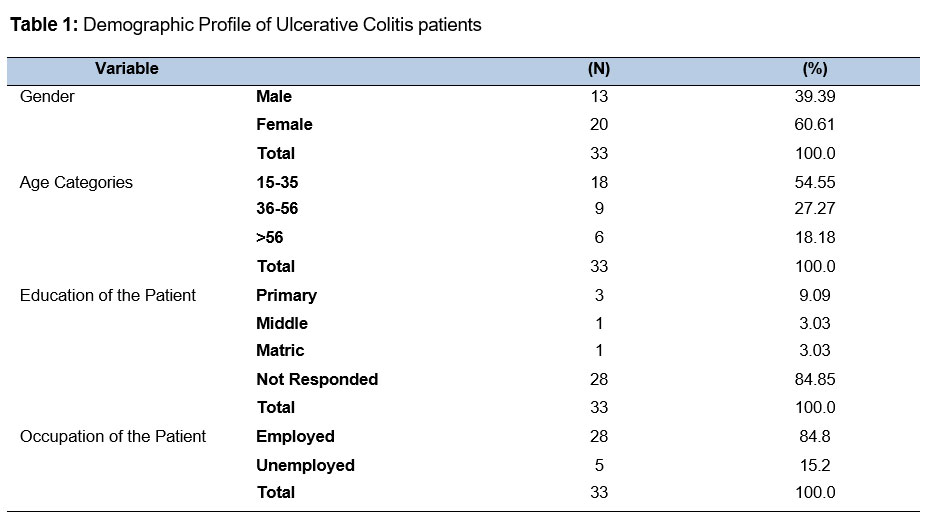
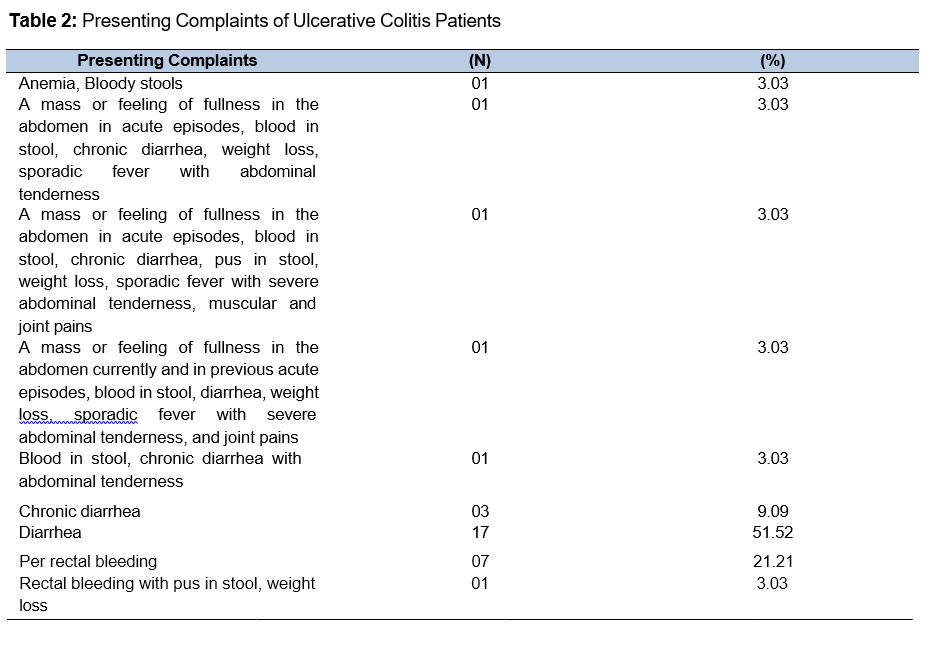
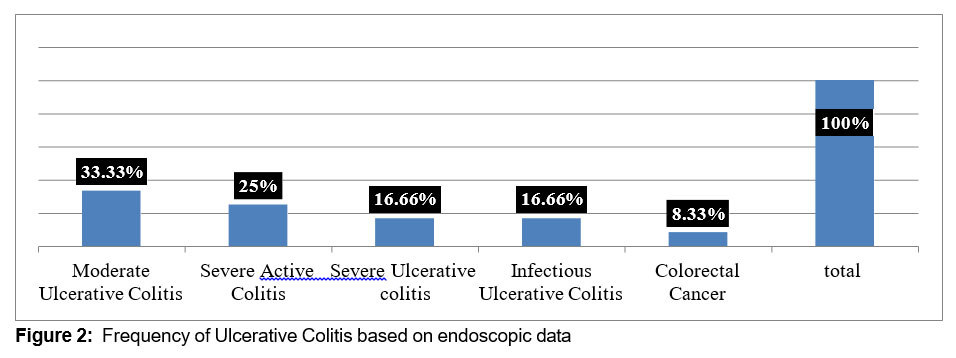
Only 33 out of 1971 patients, who were mainly presented with diarrhea, were diagnosed as ulcerative colitis in gastroenterology ward of Lahore General Hospital constituting 33/1971(1.67%) of the morbidities reported in that specific duration. Mean age of the patients was 37.7 years with an age range of 15- 73 years. Out of total 33 patients, 60.61% of patients were female. A predominance 54.5%, of the Ulcerative Colitis Cohort was situated within 15-35 years age interval. Only 15.2% of patients were educated while 84.85% of patients were employed. (Table 01) Only 2 patients had stress history with 1(3%) facing study stress, anger issues and 1 (3%) had stress due to unemployment of her husband and 31(93.9 %) hasn’t reported any stress issues. The duration of illness exhibited significant variability as one of the cohort had two months, four years, six years and nine years duration each. One patient expired after one month of diagnosis. And 28 (84.8 %) were not sure of duration of their problem. Most Common presenting complaint was diarrhea reported by 51.52% followed by blood in stools and weight loss. Endoscopic data of only 12 patients was found while data for remaining 21 patients was missing (Table 02). 90.9% (10/11) of patients had an ESR > 20 mm/hr, with a median of 30 mm/hr. While data points for CRP were limited, the values (54 and 128 mg/L) were markedly elevated, often correlating with extensive disease or a high risk of colectomy in acute severe colitis. (Table 03). The endoscopic findings in ulcerative colitis cases reveal the following frequencies: moderate ulcerative colitis was reported in one-third of cases (33.33%), while severe active colitis in a quarter of cases (25%). Infectious ulcerative colitis and sever ulcerative colitis each account for 16.66% of cases, and colorectal cancer was present in 8.33% of cases. (Figure 01)
Discussion
The frequency of ulcerative colitis is increasing in most countries of the world. This study is about the frequency of ulcerative colitis amongst patients reporting in gastroenterology department, LGH, Lahore. This study included 33 patients, 39.9% were male while 60.61% were female. In our study, most common age of diagnosis is between 30 and 40 years. International statistics indicate that ulcerative colitis is uncommon in pediatric populations, with the majority of diagnosis occurring in adults, typically between 30 to 40 years in accordance with the current study findings [23]. According to the results of Asian and European countries, nearly equal distribution of ulcerative colitis was observed among male gender and female gender [24]. Current findings have shown that frequency of UC is more in females than in males; comparative to a study conducted in 2020 in Pakistan population reported the frequency of UC is higher in females than in males [17].
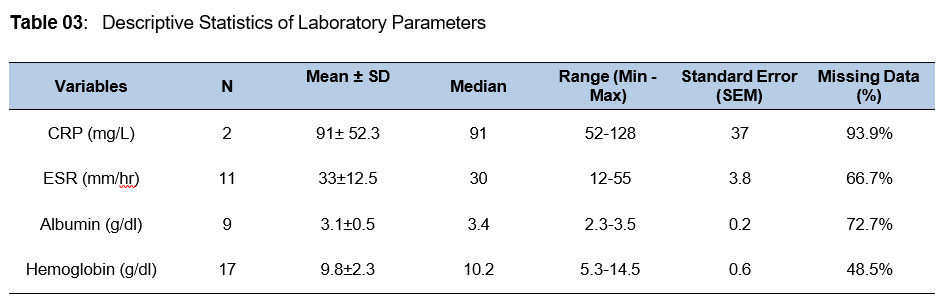
The following table summarizes the biochemical profile based on the available data (N=33 total patients). Given the nature of the data, the Mean for general trends and the Median for a more robust measure of the typical patient, especially where outliers (like the CRP value of 128 mg/L) may skew the average.
While another study conducted in 2017 in Örebro, Sweden reported frequency of UC is more among males than in females [2]. A study in Pakistan found that mucous diarrhea was the primary symptom in ulcerative colitis patient [25], whereas in our study, main symptoms were chronic diarrhea and blood in stool. In another study, most common symptom of ulcerative colitis was bloody diarrhea [17]. On endoscopic view, there was different extent of disease in every patient. The endoscopic findings in ulcerative colitis cases reveal the following frequencies: moderate ulcerative colitis was present in one-third of cases (33.33%), while severe active colitis was observed in a quarter of cases (25%). Infectious ulcerative colitis and severe ulcerative colitis each account for 16.66% of cases, and colorectal cancer is present in 8.33% of cases. A large-scale Asian study on the extent of ulcerative colitis found the most common subtype was Proctitis (37%), followed by distal colitis (32%), and extensive colitis (31%) [26]. However, a study conducted in Pakistan revealed a different distribution, with the majority of cases (59.1%) involving the colon up to the splenic flexure, while Proctitis and proctosigmoiditis accounted for 19.1% and 21.7%, respectively [17]. Ulcerative colitis also shows extra- intestinal involvement depending upon the severity of the disease. In this study, reported extra-intestinal manifestations was joint pain while a study conducted in 2023 in Pakistan population showed that the most common extra-intestinal manifestations were joint pain, sacroilitis and peripheral arthritis [22].
The study has many limitations like it was a single centered study, statistical associations were not calculated due to limited number of patients.
Conclusion
In our population, ulcerative colitis affects individuals across all age groups, with a higher frequency in females. The peak age range for diagnosis is between 30 to 40 years. Diarrhea is the typical presentation of ulcerative colitis in our population. Notably, most patients exhibit an aggressive pattern that extends beyond the rectum and sigmoid colon, posing increased risk and complications.
References
- Aniwan S, Limsrivilai J, Pongprasobchai S, Pausawasdi N, Prueksapanich P, Kongtub N, et al. Temporal trend in the natural history of ulcerative colitis in a country with a low incidence of ulcerative colitis from 2000 through 2018. Intest Res. 2021;19(2):186-93. https://doi.org/10.5217/ir.2020.00028
- Eriksson C, Cao Y, Rundquist S, Zhulina Y, Henriksson I, Montgomery S, et al. Changes in medical management and colectomy rates: a population‐based cohort study on the epidemiology and natural history of ulcerative colitis in Örebro, Sweden, 1963-2010. Aliment Pharmacol Ther. 2017;46(8):748-57. https://doi.org/10.1111/apt.14268
- Pravda J. Can ulcerative colitis be cured? Discovery Medicine. 2019;27(149):197-200. https://pubmed.ncbi.nlm.nih.gov/31361982/
- Vermeire S, Lukas M, Magro F, Adsul S, Lindner D, Rosario M, et al. Vedolizumab efficacy, safety, and pharmacokinetics with reduced frequency of dosing from every 4 weeks to every 8 weeks in patients with Crohn's Disease or Ulcerative Colitis. J Crohns Colitis. 2020;14(8):1066-73. https://doi.org/10.1093/ecco-jcc/jjaa027
- Gros B, Kaplan. Ulcerative colitis in adults: a review. JAMA. 2023;330(10):951-65. https://doi.org/10.1001/jama.2023.15389
- Kucharzik T, Koletzko S, Kannengiesser K, Dignass. Ulcerative colitis—diagnostic and therapeutic algorithms. Dtsch Ärztebl Int. 2020;117(33-34):564. https://doi.org/10.3238/arztebl.2020.0564
- Segal JP, LeBlanc J-F, Hart. Ulcerative colitis: an update. Clin Med. 2021;21(2):135. https://doi.org/10.7861/clinmed.2021-0080
- Pabla BS, Schwartz. Assessing severity of disease in patients with ulcerative colitis. Gastroenterol Clin. 2020;49(4):671-88. https://doi.org/10.1016/j.gtc.2020.08.003
- Matthias AISMM, Ferranteb LM. Assessment of endoscopic disease activity in ulcerative colitis: is simplicity the ultimate sophistication? 2021. https://doi.org/10.1159/000518131
- Rubin DT, Ananthakrishnan AN, Siegel CA, Sauer BG, Long MD. ACG Clinical Guideline: Ulcerative Colitis in Adults. Am J Gastroenterol. 2019;114(3):384-413. https://doi.org/10.14309/ajg.0000000000000152
- Catherine Le Berre SH, Laurent Peyrin-Biroulet. Ulcerative colitis. Lancet. 2023;402(10401):571-84. https://doi.org/10.1016/s0140-6736(23)00966-2
- Nambu R, Arai K, Kudo T, Murakoshi T, Kunisaki R, Mizuochi T, et al. Clinical outcome of ulcerative colitis with severe onset in children: a multicenter prospective cohort. J Gastroenterol. 2023;58(5):472-80. https://doi.org/10.1007/s00535-023-01972-1
- Li C, Tang Y, Ye Y, Zuo M, Lu Q. Potential of natural flavonols and flavanones in the treatment of ulcerative colitis. Front Pharmacol. 2023;14:1120616. https://doi.org/10.3389/fphar.2023.1120616
- Mortlock S, Lord A, Montgomery G, Zakrzewski M, Simms LA, Krishnaprasad K, et al. An extremes of phenotype approach confirms significant genetic heterogeneity in patients with ulcerative colitis. J Crohns Colitis. 2023;17(2):277-88. https://doi.org/10.1093/ecco-jcc/jjac121
- Jiang S, Miao Z. High-fat diet induces intestinal mucosal barrier dysfunction in ulcerative colitis: emerging mechanisms and dietary intervention perspective. Am J Transl Res. 2023;15(2):653-. https://pubmed.ncbi.nlm.nih.gov/36915785/
- Selvaratnam S, Gullino S, Shim L, Lee E, Lee A, Paramsothy S, et al. Epidemiology of inflammatory bowel disease in South America: a systematic review. World J Gastroenterol. 2019;25(47):6866. https://doi.org/10.3748/wjg.v25.i47.6866
- Khan IA, Yousaf S, Anwar T, Ali MR, Sarfraz M, Mohsin. Characteristics and associations of ulcerative colitis in Pakistani population. Prof Med J. 2020;27(05):1079-84. https://doi.org/10.29309/TPMJ/2020.27.05.4446
- Kurti Z, Gonczi L, Lakatos L, Golovics PA, Pandur T, David G, et al. Epidemiology, treatment strategy, natural disease course and surgical outcomes of patients with ulcerative colitis in Western Hungary - a population-based study between 2007 and 2018: data from the Veszprem County Cohort. J Crohns Colitis. 2023;17(3):352-60. https://doi.org/10.1093/ecco-jcc/jjac142
- Kuenzig ME, Fung SG, Marderfeld L, Mak JW, Kaplan GG, Ng SC, et al. Twenty-first century trends in the global epidemiology of pediatric-onset inflammatory bowel disease: systematic review. Gastroenterology. 2022;162(4):1147-59.e4. https://doi.org/10.1053/j.gastro.2021.12.282
- Kashef SM, Yassien RI, El-Ghazouly. The possible effect of lycopene in ameliorating experimentally induced ulcerative colitis in adult male albino rats (a histological, immunohistochemical, and ultrastructural study). Ultrastruct Pathol. 2023;47(3):172-87. https://doi.org/10.1080/01913123.2023.2185718
- Lynch WD, Hsu. Ulcerative Colitis. StatPearls. Treasure Island (FL)2023. https://www.ncbi.nlm.nih.gov/books/NBK459282/
- Ali U, Jahangir Anjum SA, Erum H, Hamid S, Mir. Demographic profile and extra intestinal manifestations of ulcerative colitis in Pakistani population. Pakistan J Med Health Sci. 2023;17(01):559-. https://doi.org/10.53350/pjmhs2023171559
- Cosnes J, Gower-Rousseau C, Seksik P, Cortot A. Epidemiology and natural history of inflammatory bowel diseases. Gastroenterology. 2011;140(6):1785-94.e4. https://doi.org/10.1053/j.gastro.2011.01.055
- Ghione S, Sarter H, Fumery M, Armengol-Debeir L, Savoye G, Ley D, et al. Dramatic increase in incidence of ulcerative colitis and Crohn's disease (1988–2011): a population-based study of French adolescents. Am J Gastroenterol. 2018;113(2):265-72. https://doi.org/10.1038/ajg.2017.228
- Qureshi M, Abbas Z. Clinical presentation of ulcerative colitis in Pakistani adults. Euroasian J Hepato-Gastroenterol. 2015;5(2):127. https://doi.org/10.5005/jp-journals-10018-1151
- Ng SC, Tang W, Ching JY, Wong M, Chow CM, Hui A, et al. Incidence and phenotype of inflammatory bowel disease based on results from the Asia-Pacific Crohn's and Colitis Epidemiology Study. Gastroenterology. 2013;145(1):158-65.e2. https://doi.org/10.1053/j.gastro.2013.04.007