Abstract
Background: Delonix regia, commonly known as Gulmoharگلموہر, is a tropical flowering tree from the pea family, widely found in tropical regions. In traditional folk medicine, its leaves have been employed to cure numerous diseases. In contemporary times, there is an emergent trend among individuals to prioritize their health, often looking for new products derived from nature whereas avoiding synthetic alternatives. Plants are primary source of bioactive compounds, including natural antioxidants, which are essential in drug development and the formulation of healthcare products.
Objective: To assess the antioxidant property of leaf extract of D. regia in acetone and n-Hexane using in-vitro method.
Method: The experimental study was carried out at University of Karachi and Pharmacology Department of Baqai Medical University, using in-vitro methods for a period of six months from November 2023 to May 2024.The antioxidant property of leaf extracts of D. regia in polar and non-polar solvent i.e. acetone and hexane respectively, was evaluated by using DPPH radical scavenging assay. Gallic acid serves as the reference compound. Statistical analysis was based on Mean ± SEM because data was obtained in technical triplicates. The IC50 (Inhibitory concentration 50) was calculated from dose response curve.
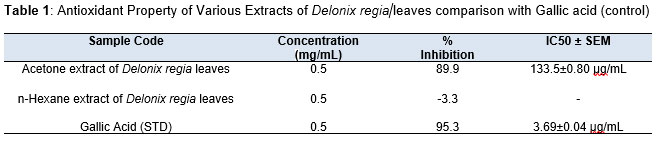
Results: Acetone extract of D. regia leaves exhibited 89.9% inhibition at 0.5 mg/mL concentration and had IC50 of 133.5 μg/mL, indicating significant antioxidant property. However, no activity was detected in the hexane extract of D. regia leaves. At the concentration of 0.5 mg/mL, its antioxidant potential is unclear. Comparatively, Gallic acid exhibited strong antioxidant activity with 95.3% inhibition at 0.5 mg/mL.
Conclusion: In conclusion, this study showed that leaf extracts of D. regia in polar solvent (acetone) exhibited significant antioxidant potential. This emphasizes that leaves extract of D. regia is a promising source of antioxidants.
Keywords: Delonix regia, Antioxidant, Acetone, n-Hexane, DPPH, Gallic Acid.
Introduction
Currently, there is a prominent surge to develop interest towards natural drugs and excipients. With the steady decline in overall health, individuals are increasingly looking for antioxidants from natural sources and searching healthier option. Nutraceuticals have appeared as an important market segment, gather attention for their potential health benefits. Food fortification is a feasible approach that involves enriching deficient food products with essential nutrients, such as vitamins and minerals, either from natural sources or through artificial synthesis. D. regia stands out as a natural specie plentiful in antioxidants and carotenoids. This flowering plant is with many names, for example flamboyant, Peacock, flame tree, Gulmohar, and Royal Poinciana, is widely present in regions including Mexico, Australia, India, the Caribbean, Northern Mariana Islands, South Floridaand, UAE [1,2,3].
Significantly investigated, D. regia exhibits various biological activities, including antioxidant [4], anti-arthritic, antidiarrheal [5], hepato-protective, cytotoxic [1], gastro-protective [6], antimicrobial [4, 7], anthelmintic, anti-cancer, anti-rheumatic, anti-malarial, anti-diabetic properties [8], and pest control [9]. Rich in a spectrum of pigments including anthocyanins, flavonol glycosides [3,10], carotenoids, phenolic acids [11], tannins, alkaloids, saponins, steroids, and β-sitosterol [12]. D. regia leaf extracts have showed remarkable anti-inflammatory and anti-oxidant properties. The buildup of reactive oxygen species (ROS) in cells and tissues results in oxidative stress, which poses substantial harm to the human body. This process is implicated in the development of numerous chronic conditions such as diabetes, cancer, and metabolic disorders. On the other hand, the detrimental effects of oxidative stress can be alleviated through the intervention of antioxidant compounds. These compounds have the capacity to diminish or prevent cellular damage caused by free radicals. As a result, the examination and application of antioxidants offer promising strategies for mitigating the progression and severity of oxidative stress-related diseases, thereby enhancing health outcomes [5].
The abundance of antioxidants emphasizes the various applications of natural ingredients across different products. D. regia emerges as a vital source of antioxidants, helping to mitigate the formation of ROS within the body. In present study, we evaluated the antioxidant potential of D. regia leaf extracts to explore the potential healthcare benefits of this plant.
Method
The study was carried out experimentally at University of Karachi (UoK) and Pharmacology Department of Baqai Medical University, using in-vitro approaches for a period of six months from November 2023 to May 2024. This study was permitted by the Institutional Review and Ethical Board (IREB) of Baqai Medical University, Ref. No. BMU-IREB-03-2023 dated 02-08-2023. The leaves of D. regia were acquired from the garden of UoK. Subsequently, identification and authentication of leaves of D. regia was performed at the herbarium of Department of Botany, UoK, receiving the voucher no. 97626.
The freshly picked leaves of D. regia were collected and carefully separated. They underwent a thorough cleaning procedure with tap water for removing any attached dirt, followed by rinsing with water to remove impurities. Afterward, these were dried in air, then chopping was carried out, and at last leaves were grinded in the blender. The extraction was performed on final powdered product using different solvents (acetone and hexane) in a Soxhlet apparatus. Rotary vacuum evaporator was used to concentrate the resulting solutions and then it was stored in a desiccator to maintain its integrity and prolong its shelf life, ensuring its suitability for further analysis and potential applications [13,14,15,16].
DPPH Radical Scavenging Assay: DPPH (2, 2-diphenyl-1-picrylhydrazyl radical) is a dark-color crystalline powder comprising of stable free-radicals. It possesses wide application in laboratory research, especially in antioxidant assay. In its radical form, DPPH dissolved in ethanol appears deep violet and exhibits greater absorbance at 517 nm. Upon reaction of DPPH with antioxidant like vitamin C, it is reduced to its molecular form (DPPHH), causing a change in colour to pale yellow and a decline in absorbance. This change in absorbance is used to assess the radical scavenging ability of the tested samples.
Pure sample: 0.5 mM in DMSO
Crude Sample: 0.5 mg/mL in DMSO
DPPH solution: 0.3 mM in Ethanol
Solution of DPPH (95µl, 300µM) in ethanol was combined with a test solution (5µl, 500µM). This mixture was kept at 37ºC for half hour to allow the reaction then the absorbance was measured using a Spectra Max340 multiplate reader at 517 nm. As the reaction progresses, the color of the solution changed from violet to pale yellow, indicating reduction. The percentage of radical scavenging activity (%RSA) was determined by comparing the results with a control having DMSO. The IC50 value was the concentration that reduced initial DPPH concentration by 50%. EZ-Fit Enzyme kinetics software program (Perrella Scientific Inc. Amherst, MA, USA) was used for determining IC50 values of compounds. Gallic acid was used as the reference standard [17].
Results
The results of DPPH scavenging activity of acetone and n-hexane extracts, respectively are represented in Table 1. The results of the antioxidant properties estimation for numerous extracts derived from D. regia provide insight into their efficacy.
Discussion
Reactive oxygen species, which encompass the superoxide and hydroxyl radicals, peroxynitryl, and hydrogen peroxide, undergo continuous synthesis within living systems due to metabolic reactions18.These ROS are known for their role in contributing to various diseases linked to oxidative stress. As a result, it becomes crucial to detoxify or scavenge such ROS utilizing natural products to strengthen the host defense system against oxidative damage and associated ailments. Previous research, such as that by Chhabra and Gupta, reported that acetone and water extracts of flower petals of D. regia showed more than 90% DPPH scavenging property, and water extract has more antioxidant effect19. Vivek et al., (2013) reported that methanolic extract of leaves and flower of D. regia had antioxidant properties7. Study by Shabir et al., showed that leaves extract of D. regia in absolute acetone and 80% acetone exhibited moderate antioxidant activity 48% and 52% respectively20. Khan et al., (2020) also reported that methanolic aerial part extract of D. regia had hypoglycemic, antioxidant, and hypolipidemic activities21. We determined the antioxidant activity of leave extract in acetone and n-hexane and found that acetone extract had 89.9% radical scavenging activity, however, n-hexane extract showed no activity. In our previous study, we identified the presence of phytochemicals such as Vitamin E, α-Amyrin, Lupeol, and Squalene in the acetone extract22, which contributed to its strong antioxidant activity observed in current study. Although the acetone extract of D. regia shows promising results, the n-Hexane extract seems to lack significant antioxidant potential. The data suggests that extract of polar solvent (acetone extract) has antioxidant activity which may be due to water or polar solvent soluble constituents like phenolic acid. This may be the reason of better antioxidant potential of acetone extract. Future studies should investigate the specific antioxidant compounds present in the extract of D. regia in different types of solvents and its potency should be optimized. Moreover its potential therapeutic applications in managing oxidative stress and formulation of pharmaceutical and nutraceutical products should be explored.
Conclusion
In conclusion, our assessment of the antioxidant activity of extracts of Delonix regia leaf in acetone and hexane revealed distinct outcomes. The acetone extract of D. regia leaves demonstrated a significant 89.9% inhibitory activity at a concentration of 0.5 mg/mL, indicating a substantial level of antioxidant property. This finding highlights the potential of above-mentioned extract as a source of antioxidants.
References
- El-Sayed AM, Ezzat SM, Salama MM, Sleem AA (2011). Hepatoprotective and cytotoxic activities of Delonixregia flower extracts. Pharmacog J. 3(19):49-56.https://doi.org/10.5530/pj.2011.19.10
- Adje F, Lozano YF, Meudec E, Lozano P, Adima A, N’zi GA, Gaydou EM (2008). Anthocyanin characterization of pilot plant water extracts of Delonixregia flowers. Molecules., 13(6): 1238-45.https://doi.org/10.3390/molecules13061238
- Shah Neel M, Meghan M, Alfredo G, Chapman James M (2009). Characterization of anthocyanins and flavonol glycosides from D. regia and Ixora casei hance by LC-ESI-MS-MS. Abstract 508, Presented at. In: The American Chemical Society 44th Midwest Regional Meeting Lowa City., 21-24.
- Aqil F, Ahmad I (2003). Broad-spectrum antibacterial and antifungal properties of certain traditionally used Indian medicinal plants. World J MicrobiolBiotechnol., 19: 653-7.https://doi.org/10.1023/A:1025128104056
- Shiramane RS, Biradar KV, Chivde BV, Shambhulingayya HM, Goud V (2011a). In-vivo antidiarrhoeal activity of ethanolic extract of Delonixregia flowers in experimental induced diarrhoea in wistar albino rats. Int J Res in Pharm Chem., 1(3):2231-781.https://www.researchgate.net/publication/267784606_In-vivo_antidiarrhoeal_activity_of_ethanolic_extract_of_Delonix_regia_flowers_in_experimental_induced_diarrhoea_in_Wistar_Albino_rats
- Shiramane R, Chivde B, Kamshetty M, Biradar KV, Khan A (2011b). Gastroprotective activity of ethanolic extract of Delonixregia flowers in experimental induced ulcer in wistar albino rats [J]. Int J Res in Pharm Chem., 2(5):234-8.
- Vivek MN, Sachidananda Swamy HC, Manasa M, Pallavi S, YashodaKambar, Asha MM et al (2013). Antimicrobial and Antioxidant activity of leaf and flower extract of Caesalpinia pulcherrima, D. regia and Peltaphorumferrugineum. J Appl Pharm Sci., 8:64-071.https://dx.doi.org/10.7324/JAPS.2013.3811
- Patil PS (2014). Natural excipients: Uses of pharmaceutical formulations. Int J Pharm Tech Res., 6:21-8.
- Alves DT, Vasconcelos IM, Oliveira JT, Farias LR, Dias SC, Chiarello MD, Maria-Neto S, Franco OL (2009). Identification of four novel members of Kunitz-like α-amylase inhibitors family from Delonixregia with activity toward Coleopteran insects. PesticBiochem Phys., 95(3):166-72.DOI:10.1016/j.pestbp.2009.08.011
- Ebada D, Hefnawy HT, Gomaa A, Alghamdi AM, Alharbi AA, Almuhayawi MS, Alharbi MT, Awad A, Al Jaouni SK, Selim S, Eldeeb GS (2023). Characterization of Delonixregia flowers’ pigment and polysaccharides: evaluating their antibacterial, anticancer, and antioxidant activities and their application as a natural colorant and sweetener in beverages. Molecules., 28(7):3243. https://doi.org/10.3390/molecules28073243
- Adjé F, Lozano YF, Lozano P, Adima A, Chemat F, Gaydou EM (2010). Optimization of anthocyanin, flavonol and phenolic acid extractions from Delonixregia tree flowers using ultrasound-assisted water extraction. Ind Crops Prod., 32(3): 439-44.DOI: 10.1016/j.indcrop.2010.06.011
- Sumitra S, Kumar SN (2014). A review: introduction to genus Delonix. World J Pharm Pharm Sci., 23(6):2042-55.http://www.wjpps.com/wjpps_controller/abstract_id/1527
- Doughari JH (2012). Phytochemicals: extraction methods, basic structures and mode of action as potential chemotherapeutic agents. Rijeka, Croatia: INTECH Open Access Publisher, pp. 1-33. http://dx.doi.org/10.5772/26052
- Pandey A, Tripathi S (2014). Concept of standardization, extraction, and pre-phytochemical screening strategies for herbal drug. J PharmacognPhytochem., 2:115–9.
- Azwanida NN (2015). A review on the extraction methods use in medicinal plants, principle, strength, and limitation. Med Aromat Plants., 4:196. http://dx.doi.org/10.4172/2167-0412.1000196
- Ingle KP, Deshmukh AG, Padole DA, Dudhare MS, Moharil MP, Khelurkar VC (2017). Phytochemicals: Extraction methods, identification, and detection of bioactive compounds from plant extracts. J PharmacognPhytochem., 6:32–6.
- Thadhani VM, Choudhary MI, Ali S, Omar I, Siddique H, Karunaratne V (2011). Antioxidant activity of some lichen metabolites. Nat Prod Res., 25(19):1827-37.https://doi.org/10.1080/14786419.2010.529546
- Torres CA, Pe´rez Zamora CM, Nuñez MB, Gonzalez AM (2018). In vitro antioxidant, antilipoxygenase and antimicrobial activities of extracts from seven climbing plants belonging to the Bignoniaceae. J Integr Med., 16(4): 255–262.http://dx.doi.org/10.1016/j.joim.2018.04.009
- Chhabra D, Gupta RK (2015). Fortification of curd using D. regia flower petal extract and estimation of its phytochemical, antibacterial & antioxidant activity. J PharmacognPhytochem., 4(3):299-307.
- Shabir G, Anwar F, Sultana B, Khalid ZM, Afzal M, Khan QM, Ashrafuzzaman M (2011). Antioxidant and antimicrobial attributes and phenolics of different solvent extracts from leaves, flowers and bark of Gold Mohar [Delonixregia (Bojer ex Hook.) Raf.]. Molecules., 16(9):7302-19.https://doi.org/10.3390/molecules16097302
- Khan D, Sharif A, Zafar M, Akhtar B, Akhtar MF, Awan S (2020). Delonixregia a folklore remedy for diabetes; attenuates oxidative stress and modulates type II diabetes mellitus. Curr Pharm Biotechnol., 21(11):1059-69.https://doi.org/10.2174/1389201021666200217112244
- Sheikh SA, Asadullah, Ahmed A, Ahmed SN, Jahan F, Nawaz S, Dawood S (2024). Phytocomponents analysis of Delonixregia (Gulmohar) leaves extracts: exploring bioactive compounds and potential health benefits. J PopulTherClinPharmacol.,https://doi.org/10.53555/jptcp.v31i6.6432 31(6):7–17.