Abstract
Background: Bell’s palsy (idiopathic facial nerve paralysis) can lead to incomplete recovery and sequelae in a significant minority of patients. While corticosteroids are the mainstay early treatment, the role of adjunct physiotherapy (facial exercises and related rehabilitation) in improving outcomes remains under-investigated, especially in resource settings like Pakistan.
Objective: To compare the degree of recovery in Bell’s palsy patients managed with standard medical therapy alone versus
those receiving additional physiotherapy, in a quasi-experimental hospital-based study.
Methods: A quasi-experimental study was conducted at a tertiary care hospital after approval from the Institutional Review Board. A total of 126 patients with acute unilateral Bell’s palsy were allocated to two groups (63 each). Group A received conventional medical therapy (corticosteroids ± antivirals), while Group B received the same plus structured physiotherapy. Outcomes were the House–Brackmann (H-B) grading and the Facial Disability Index (FDI), assessed at baseline and 3 months. Data were analyzed in SPSS v25 using t-tests, Mann–Whitney U, and chi-square tests; effect sizes and 95% confidence intervals were reported, with p<0.05 considered significant.
Results: Of 126 enrolled patients (mean age 40.3±12.5 years; 54% male), 120 completed the 3-month follow-up (6 lost to follow-up, evenly from both groups). Baseline characteristics (age, sex distribution, side of palsy, and initial H-B severity) were comparable between groups (p>0.2 for all). At 3 months, complete or near-complete recovery (H-B grade I or II) was achieved in 53 patients (84.1%) in Group B, versus 42 patients (66.7%) in Group A (p=0.014). No serious adverse events were noted; all patients tolerated the interventions well.
Conclusion: Adjunct physiotherapy significantly enhanced facial nerve recovery and functional outcomes in Bell’s palsy compared to medical therapy alone, supporting its integration into standard care. Further randomized studies are recommended to confirm these benefits and to optimize physiotherapy protocols for Bell’s palsy.
Keywords: Bell’s palsy, facial paralysis, corticosteroids, physiotherapy, facial exercises, quasi-experimental
Introduction
Bell’s palsy is an acute idiopathic peripheral facial paralysis and represents the most common cause of lower motor neuron facial palsy. Reported annual incidence varies from 11.5 to 53.3 cases per 100,000 individuals, with global estimates of 11–40 cases per 100,000 person-years in adults and 11.5–30 in children [1, 2]. In Pakistan, a cross-sectional study at a tertiary care hospital in Lahore reported that 68.29% of 246 patients were diagnosed with facial palsy [3]. The etiology remains uncertain; however, reactivation of latent herpes simplex virus type 1 (HSV-1) is widely regarded as a major mechanism, producing acute unilateral facial weakness often accompanied by postauricular pain, dysgeusia, hyperacusis, and ocular or oral dryness [4, 5]. Prognosis in Bell’s palsy is variable. While about 70% of patients recover fully within six months without intervention, up to 30% experience incomplete recovery, with half of these developing moderate to severe sequelae such as synkinesis, hemifacial spasm, and facial contractures, which significantly impair quality of life [6]. Early effective therapy is therefore critical to optimize nerve regeneration and functional recovery [7].
Corticosteroid therapy, especially high-dose prednisolone initiated within 72 hours, is the standard of care and has strong evidence of efficacy. Antiviral drugs are often added due to suspected HSV-1 involvement, but their additional benefit remains uncertain [8, 9]. Current guidelines discourage antivirals as monotherapy, and even in combination with steroids, results have been inconsistent [8].
Beyond pharmacological management, physiotherapy is frequently employed to facilitate recovery and minimize maladaptive reinnervation. Modalities such as massage, electrostimulation, facial exercises, Kabat rehabilitation, and acupuncture have been widely applied [10]. While physiotherapy is considered safe and potentially beneficial, evidence from randomized trials has been limited and mixed [5, 11]. A 2011 Cochrane review reported insufficient data to recommend routine use, though more recent analyses, including Vaughan et al. (2020), suggest improvements in facial function but note significant heterogeneity across studies [12].
Local studies provide encouraging evidence. In Pakistan, Ghous et al. (2018) demonstrated that Kabat exercises plus conventional physiotherapy improved Facial Disability Index (FDI) scores compared to taping techniques [13]. Similarly, Avaid et al. (2022) found that patients receiving proprioceptive neuromuscular facilitation (PNF)-based exercises showed greater improvements in physical and social FDI subscales than those on general neuromuscular re-education [14].
Taken together, these findings suggest that adjunct physiotherapy may enhance outcomes when combined with standard medical therapy. However, physiotherapy referrals are not consistently integrated into routine care in Pakistan, possibly due to limited awareness or resources. This study objective was to compare recovery in Bell’s palsy patients treated with standard medical therapy alone versus those receiving additional structured physiotherapy, in a quasi-experimental hospital-based design.
Method
This quasi-experimental, two-group comparative study was conducted at the Department of Neurology and Rehabilitation, a tertiary care hospital in Karachi, Pakistan, from October 2022 to March 2025. Adults (≥18 years) presenting within 14 days of onset of acute unilateral Bell’s palsy were eligible for inclusion. Diagnosis was based on clinical assessment after excluding other causes such as stroke, otologic disorders, or Lyme disease. Only patients with moderate to severe involvement (House–Brackmann [H-B] grade III–VI) were enrolled. Exclusion criteria included recurrent or bilateral palsy, other facial nerve disorders, uncontrolled diabetes or hypertension, and contraindications to corticosteroid therapy.
A total of 126 patients were recruited and allocated equally into two groups. Group A received standard medical therapy comprising oral prednisolone (1 mg/kg, maximum 60 mg daily) for 7–10 days with tapering, initiated ideally within 72 hours of symptom onset. Ocular protection (artificial tears and eye patching) was provided for incomplete eye closure. Antiviral therapy (Acyclovir 400 mg five times daily for 7 days, or Valacyclovir 1000 mg three times daily for 7 days) was administered in severe cases or when a vesicular rash suggested viral reactivation; approximately 60% of patients in both groups received antivirals. No surgical decompression was required. All patients received education regarding gentle facial movement exercises (e.g., attempting to wrinkle the forehead or pucker lips gently).
Group B received the same standard medical therapy in addition to a structured physiotherapy program delivered by neuro-rehabilitation specialists. Physiotherapy commenced within 1–2 weeks of onset and included the following components: Facial Exercise Therapy, Massage and Stretching, Neuromuscular Re-education, Home Exercise Program, and Electrical Stimulation (as needed). Therapy sessions were conducted three times weekly for four weeks, followed by twice-weekly sessions for the next two weeks (total 12–14 sessions, each lasting approximately 45 minutes). Patients were advised to continue the home exercise program until the 3-month follow-up.
The primary outcome was recovery at 3 months, defined as achieving H-B grade I or II. The H-B scale is a six-point measure of facial nerve function, where higher grades indicate greater impairment. Recovery was assessed at baseline and 3 months by a neurologist blinded to group allocation. Outcomes were also categorized as favorable (H-B I/II) or unfavorable (III–VI).
Secondary outcomes included the Facial Disability Index (FDI), a validated tool comprising two subscales—Physical Function and Social/Well-being Function—each scored from 0 to 100 (higher scores indicating better function). The Urdu version of the FDI was administered at baseline and 3 months [15]. Synkinesis was evaluated at 3 months using the Synkinesis Assessment Questionnaire (SAQ; scored 0–100, with higher scores indicating worse symptoms) and clinical observation. Adverse events related to therapy were also recorded.
The sample size (n = 126; 63 per group) was calculated using a two-proportion power analysis, assuming a 20% absolute improvement in recovery with adjunct physiotherapy (65% vs. 85%), with α = 0.05 and 80% power [16].
Data analysis was performed using SPSS version 25. Continuous variables were expressed as mean ± standard deviation (SD) and compared using independent t-tests or Mann–Whitney U tests, depending on data normality. Categorical variables were analyzed using the chi-square test. Effect sizes and 95% confidence intervals (CIs) were reported, and a p-value <0.05 was considered statistically significant.
Ethical approval was obtained from the Ethical Review Committee of Liaquat Medical University Hospital, Hyderabad and Jamshoro (Approval No. LUMHS/REC-179 dated 03-10-2022). Written informed consent was obtained from all participants prior to enrollment.
Results
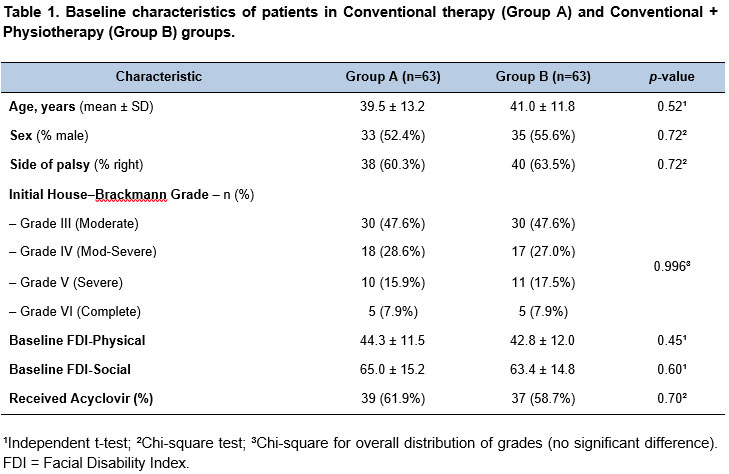
A total of 140 patients with new-onset Bell’s palsy were screened; 14 were excluded, leaving 126 patients enrolled (63 per group). Baseline demographic and clinical characteristics were comparable between groups (Table 1). The mean age was approximately 40 years, with a gender distribution (52% male, 56% male) in both groups. The side of palsy and initial H-B grades were similar, as were baseline FDI scores and proportion receiving antivirals.
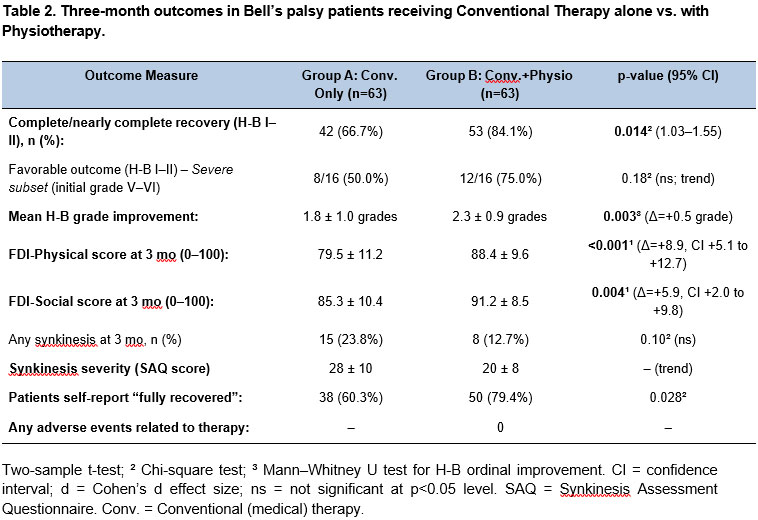
At the 3-month follow-up, complete or near-complete recovery (H-B grade I/II) was achieved in 84.1% of patients in Group B compared with 66.7% in Group A (p=0.014) (Table 2). The mean H-B grade improvement was also greater in Group B (2.3 ± 0.9 vs. 1.8 ± 1.0 grades, p=0.003). Functional outcomes measured by the Facial Disability Index demonstrated significant between-group differences. The mean FDI-Physical score at 3 months was 88.4 ± 9.6 in Group B versus 79.5 ± 11.2 in Group A (p<0.001), while FDI-Social scores were 91.2 ± 8.5 and 85.3 ± 10.4, respectively (p=0.004) (Table 2).
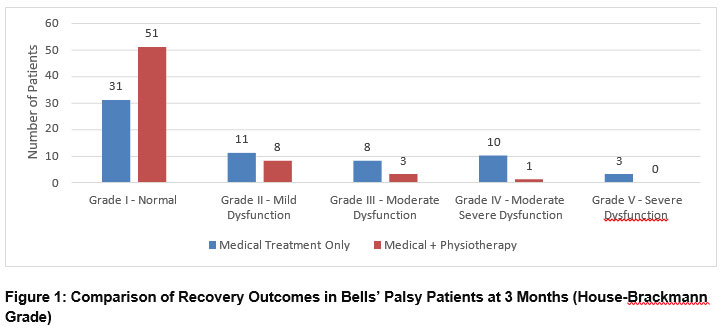
Synkinesis was less frequent in the physiotherapy group, affecting 12.7% compared with 23.8% of patients in the conventional therapy group, although this difference did not reach statistical significance (p=0.10). Mean SAQ scores also favored Group B (20 ± 8 vs. 28 ± 10), indicating milder synkinetic symptoms. Patient-reported recovery was higher with physiotherapy, with 79% of Group B reporting their face as “fully recovered” compared to 60% in Group A (p=0.028). No therapy-related adverse events occurred, and expected steroid side effects (e.g., mild insomnia, transient hyperglycemia in diabetic patients) were comparable in both groups. Figure 1 further illustrates the distribution of H-B grades, showing a higher proportion of patients reaching Grade I in the physiotherapy group.
Overall, patients receiving adjunct physiotherapy achieved significantly higher recovery rates, better functional outcomes, and fewer complications than those receiving medical therapy alone.
Discussion
This quasi-experimental study examined whether adding a structured physiotherapy regimen to standard medical management could enhance recovery in patients with Bell’s palsy. The results clearly indicate that adjunct physiotherapy conferred significant benefits. Patients who received facial exercises and related therapies alongside pharmacologic treatment had higher odds of complete recovery (84% vs 67% reached near-normal function) and greater improvements in functional disability scores, compared to those who received medical treatment alone. These findings support our hypothesis and are consistent with emerging evidence that combined multidisciplinary care leads to better outcomes in Bell’s palsy [5,11].
Our recovery rates in the control group (67% H-B I/II at 3 months) are in line with historical data on the natural course with steroid treatment, where roughly 60–70% recover fully in a few months [16,17]. The addition of physiotherapy in our study raised this rate by ~17 percentage points. In absolute terms, for every ~6 patients treated with physiotherapy, one additional patient achieved complete recovery who otherwise would have had residual weakness (number needed to treat ≈6). This magnitude of effect is clinically meaningful, as it can translate to a substantial improvement in quality of life.
Our findings resonate with prior smaller trials and network analyses. A recent Bayesian network meta-analysis by Shi et al. (2022) found that regimens combining medications with physical therapies (notably steroid + antiviral + Kabat exercise therapy) were among the top-ranked treatments for facial nerve recovery [5]. This aligns with our observation that medical therapy alone, while effective for many, is further enhanced by rehabilitative exercises. Similarly, the updated systematic review by Khan et al. (2022) concluded that new research reinforces the benefit of facial exercise therapy initiated early in the course of Bell’s palsy [11]. Our study provides concrete evidence from a quasi-experimental design that early physiotherapy indeed improves outcomes at 3 months. Moreover, the improvement we observed in FDI scores echoes the results of local RCTs: Ghous et al. [13] reported significantly better Facial Disability Index outcomes with an intensive PNF exercise program compared to an alternative therapy, and Avaid et al. [14] also demonstrated superior FDI improvements with PNF vs conventional exercises.
It is noteworthy that our intervention not only improved motor recovery but also tended to reduce synkinesis incidence. While our sample was underpowered to definitively prove synkinesis reduction, the trend (12.7% vs 23.8%) is important. Other studies have also suggested that guided exercises can modulate nerve regeneration [12]. A prior systematic review by Cardoso et al. noted that evidence was insufficient to fully endorse facial exercises, partly because of heterogeneous methods [18].
One interesting aspect is the role of severity. We observed that patients with more severe initial palsy (grades V–VI) particularly benefited from physiotherapy (75% vs 50% fully recovered). Although the interaction was not statistically significant due to sample size, it mirrors clinical recommendations that severe cases should receive rehabilitation [19]. Importantly, no adverse effects on outcomes were seen with physiotherapy – addressing some earlier concerns that exercises might cause fatigue or interfere with nerve recovery. On the contrary, our patients in Group B often reported feeling more confident and in control of their facial movements. The safety profile was excellent, consistent with the literature that physical therapy is low risk in facial palsy [5]. Minor issues like skin irritation were easily mitigated. Training programs can equip physiotherapists with the skills for facial neuromuscular retraining [20]. Adhering to the facial exercise regimens is a very important part of recovery [21].
A key limitation of this study was that it was conducted at a single center with a specialized physiotherapy team, which may limit generalizability. The 3-month follow-up could miss late recovery or sequelae like synkinesis. Additionally, reliance on patient-reported outcomes and unverified home exercise adherence may introduce reporting variability.
Conclusion
This study shows that adding physiotherapy to standard medical treatment significantly enhances recovery in Bell’s palsy patients, with higher complete recovery rates and improved functional outcomes. Given its safety and effectiveness, early physiotherapy should be considered, especially in moderate to severe cases. These findings support a comprehensive, multidisciplinary approach to optimize facial nerve recovery. Training programs should be developed to equip physiotherapists with the skills to deliver facial neuromuscular retraining. Patients should be educated that adhering to facial exercise regimens is an important part of their recovery.
References
- Translation and Reliability of the Facial Disability Index (FDI) in Bell’s Palsy Grohol B, Reno D, Jennings TJ, Fortin GT, Rolfs M: Back to play considerations in a patient with Bell's palsy: a case report and review. Cureus. 2023, 15:e35739. https://doi.org/10.7759/cureus.35739
- Karlsson S, Arnason S, Hadziosmanovic N, Laestadius Å, Hultcrantz M, Marsk E, Skogman BH: The facial nerve palsy and cortisone evaluation (FACE) study in children: protocol for a randomized, placebo-controlled, multicenter trial, in a Borrelia burgdorferi endemic area. BMC Pediatr. 2021, 21:220. https://doi.org/10.1186/s12887-021-02571-w
- Ahmad F, Saeed M, Hashmi IR, Ilyas MK, Haroon NF, Abdullah S, et al. Incidence of Facial Palsy and its Impact on Quality of Life of Patients. Pakistan Journal of Medical Health Sciences. 2022;16(07):508. https://doi.org/10.53350/pjmhs22167508
- Zhang W, Xu L, Luo T, Wu F, Zhao B, Li. The etiology of Bell's palsy: a review. J Neurol. 2020 Jul;267(7):1896-1905. https://doi.org/10.1007/s00415-019-09282-4
- Shi J, Lu D, Chen H, Shu M, Xu Y, Qian J, Ouyang K, Huang H, Luo Z, Wang C, Zhang. Efficacy and Safety of Pharmacological and Physical Therapies for Bell's Palsy: A Bayesian Network Meta-Analysis. Front Neurol. 2022;13:868121. https://doi.org/10.3389/fneur.2022.868121
- Hohman MH, Warner MJ, Varacallo. Bell Palsy. [Updated 2024 Oct 6]. In: StatPearls [Internet]. Treasure Island (FL): StatPearls Publishing; 2025 Jan-. Available from: https://www.ncbi.nlm.nih.gov/books/NBK482290/
- Choi SY, Kim JM, Jung J, Park DC, Yoo MC, Kim SS, Kim SH, Yeo SG. Review of Drug Therapy for Peripheral Facial Nerve Regeneration That Can Be Used in Actual Clinical Biomedicines. 2022 Jul 12;10(7):1678. https://doi.org/10.3390/biomedicines10071678
- Gagyor I, Madhok VB, Daly F, Sullivan. Antiviral treatment for Bell's palsy (idiopathic facial paralysis). Cochrane Database Syst Rev. 2019 Sep 5;9(9):CD001869. https://doi.org/10.1002/14651858.CD001869.pub9
- Gronseth GS, Paduga R; American Academy of Neurology. Evidence-based guideline update: steroids and antivirals for Bell palsy: report of the Guideline Development Subcommittee of the American Academy of Neurology. Neurology. 2012 Nov 27;79(22):2209-13. https://doi.org/10.1212/WNL.0b013e318275978c
- Seemal P, Arshad J, Hameed S, Shafique S, Majeed M. Current Practice Patterns in the Management of Bell's Palsy Among Physiotherapists of Sargodha, Pakistan. Iranian Rehabilitation Journal. 2024;22(4):639-644. https://irj.uswr.ac.ir/article-1-1590-en.html
- Khan AJ, Szczepura A, Palmer S, Bark C, Neville C, Thomson D, Martin H, Nduka C. Physical therapy for facial nerve paralysis (Bell's palsy): An updated and extended systematic review of the evidence for facial exercise therapy. Clin Rehabil. 2022 Nov;36(11):1424-1449. https://doi.org/10.1177/02692155221110727
- Vaughan A, Gardner D, Miles A, Copley A, Wenke R, Coulson S. A Systematic Review of Physical Rehabilitation of Facial Palsy. Front Neurol. 2020 Mar 31;11:222. https://doi.org/10.3389/fneur.2020.00222
- Ghous M, Yaqoob I, Kanwal M, Malik AN. Effects of Kabat rehabilitation versus taping to reduce facial disability and synkinesis in Bell’s palsy. RMJ. 2018;43(3):543-546. https://rmj.org.pk
- Avaid A, Majeed S, Naseem N, Sheraz Z, Tariq K, Nida Bukhari S. Comparison Between Proprioceptive Neuromuscular Facilitation and Neuromuscular Re-Education in Patients with Bell’s Palsy: Proprioceptive Neuromuscular Facilitation and Neuromuscular Re-Education in Patients with Bell’s Palsy. PJHS. 2022;3(04):171-4. https://thejas.com.pk/index.php/pjhs/article/view/269
- Tariq F, Heera SA, Safdar M, Sarwar A, Nasir U. JHRR. 2024;4(3):1-8. https://doi.org/10.61919/jhrr.v4i3.1309
- Kafle DR, Thakur. Evaluation of prognostic factors in patients with Bell's palsy. Brain Behav. 2021 Nov;11(11):e2385. https://doi.org/10.1002/brb3.2385
- Heckmann JG, Urban PP, Pitz S, Guntinas-Lichius O, Gagyor I. The diagnosis and treatment of idiopathic facial paresis (Bell's Palsy). Dtsch Arztebl Int. 2019;116:692–702. https://doi.org/10.3238/arztebl.2019.0692
- Cardoso JR, Teixeira EC, Moreira MD, Fávero FM, Fontes SV, Bulle de Oliveira. Effects of exercises on Bell's palsy: systematic review of randomized controlled trials. Otol Neurotol. 2008 Jun;29(4):557-60. https://doi.org/10.1097/MAO.0b013e31816c7bf1
- Dalrymple SN, Row JH, Gazewood. Bell Palsy: Rapid Evidence Review. Am Fam Physician. 2023;107(4):415. Erratum in: Am Fam Physician. 2024 Feb;109(2):105. https://www.aafp.org/pubs/afp/issues/2023/0400/bell-palsy.html
- Van Landingham SW, Diels J, Lucarelli. Physical therapy for facial nerve palsy: applications for the physician. Curr Opin Ophthalmol. 2018 Sep;29(5):469-475. https://doi.org/10.1097/ICU.0000000000000503
- Santiago S, Joshua AM, Nayak A, et al. Effectiveness of novel facial stretching with structured exercise versus conventional exercise for Bell’s palsy: a single-blinded randomized clinical trial. Sci Rep. 2024;14:13266. https://doi.org/10.1038/s41598-024-64046-z