Abstract
Background: Benign prostatic enlargement (BPE) is frequently observed in aging men. An association exists between lower urinary tract symptoms (LUTS) and sexual dysfunction resulting from BPE.
Objective: To compare the effect of Tamsulosin alone and Dutasteride in combination with Tamsulosin on men’s sexual function (ejaculatory function, libido) for managing LUTS secondary to BPE.
Method: This quasi-experimental study was carried out at department of Urology, Nishtar Hospital Multan (2021-22) on 138 BPE patients in 2 equal groups. Group A was given Tamsulosin (0.4mg) and group B received combination of Tamsulosin and Dutasteride (0.4mg/0.5mg) at bedtime. Patients were followed in OPD at 3, 6, 9 and 12 months of study and each patient filled questionnaires on every visit of international prostate scoring system (IPSS), International Index of Erectile Function (IIEF-5) and Premature Ejaculation diagnostic tool (PEDT) to assess the sexual adverse effects. Data was analyzed in SPSS v25 using t-test for quantitative and chi-square for qualitative variables; p ≤ 0.05 was considered significant. Ethical approval was obtained from institutional committee.
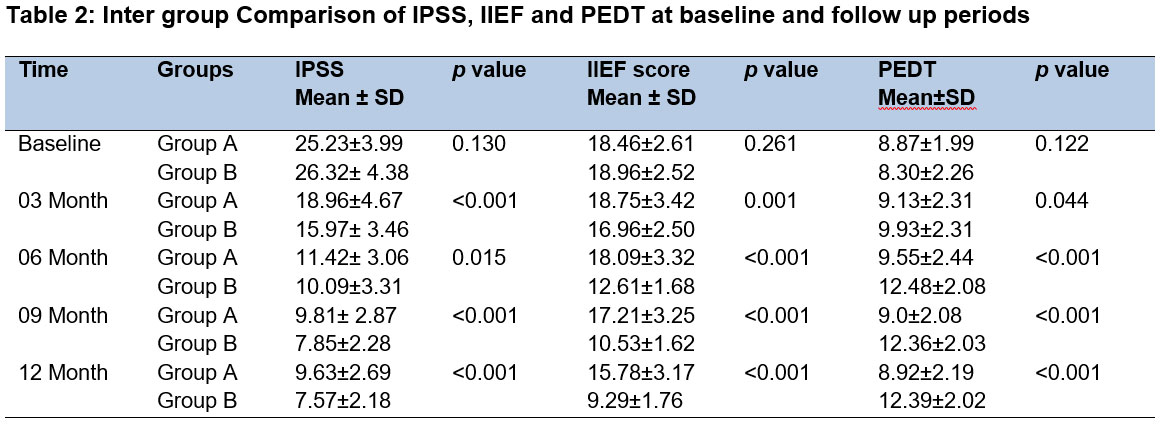
Results: Mean IPSS score in group A was 9.63±2.69 and in group B was 7.57±2.18 (p-value=<0.001). The mean Erectile dysfunction score in group A was 15.78±3.17 and in group B was 9.29±1.76 (p-value=<0.001). The mean ejaculation dysfunction score in group A was 8.92±2.19 and in group B was 12.39±2.02 (p-value=<0.001).
Conclusion: While treating LUTS in patients with BPE, although combination therapy of Tamsulosin and Dutasteride is better, it has significant adverse effects on sexual activity compared to Tamsulosin monotherapy.
Keywords: Tamsulosin, Dutasteride, Lower Urinary Tract Symptoms, Benign Prostatic Enlargement, Ejaculatory Dysfunction.
Introduction
Benign prostatic enlargement (BPE) is one of the most common conditions in older men [1]. It results from dihydrotestosterone acting on the aging prostate, causing changes in both stromal and epithelial components. This leads to uncontrolled proliferation of connective tissue, smooth muscle, and glandular epithelium within the transitional zone [2]. In men aged 50 years and older, the prevalence of BPE is estimated between 50% and 75%, rising markedly to about 80% in individuals over the age of 70 [3]. This condition commonly results in lower urinary tract symptoms (LUTS). Similarly, the frequency of LUTS ranges from 44% among men of 40 to 59 and rises to 70% in those over 80 [4]. LUTS may result in complications including urinary tract infections, urinary retention, bladder calculi, and even renal failure [5]. Tamsulosin is an α1A-selective blocker with a plasma half-life of approximately 15 hours. Its effectiveness is notably higher in inhibiting the contraction of prostate smooth muscle compared to other α1-selective blockers. This enhanced efficacy makes it a commonly preferred option for managing BPE symptoms over other drugs in the same class [6]. Dutasteride is a 5α-reductase inhibitor (5-ARI) that targets all three isoforms of the enzyme responsible for converting testosterone into dihydrotestosterone, a key contributor to prostate enlargement. Dutasteride undergoes hepatic metabolism and has a half-life measured in weeks [7]. The troublesome LUTS caused by BPE often lead patients to seek medical help. Multiple treatment options are available, including monotherapy with either Tamsulosin or Dutasteride, or a combination of both. Although these drugs substantially relieve LUTS associated with BPE, sexual dysfunction including decreased libido, erectile dysfunction, and premature ejaculation, remains a major concern for patients and can even lead to discontinuation of therapy [8, 9]. Despite both Tamsulosin and Dutasteride are well established in the management of LUTS due to BPE, their impact on sexual function is assessed in limited research from Pakistan. Comparative data on monotherapy versus combination therapy in sexually active men is limited too.
The purpose of this study is to compare Tamsulosin alone or Tamsulosin-Dutasteride combination therapy on sexual function outcomes in sexually active men with lower urinary tract symptoms attributed to benign prostatic enlargement.
Method
This quasi-experimental study was carried out in the Department of Urology, Nishtar Hospital Multan in 2021–22. Patients who had been sexually active within the past four weeks and expressed intent to remain sexually active for the next six months, aged ≥40 years, with diagnosed BPE, an IPSS ≥12 (at screening), prostate volume ≥40 grams (assessed by pelvic ultrasound), and a total serum PSA level ≤4 ng/ml (at screening) were included in this project. Patients with a total serum PSA level >4 ng/ml (at screening), diagnosed with prostate cancer, or suffering from chronic kidney disease, liver disease, diabetes mellitus, hypertension, or a history of prostate surgery, as well as those with preexisting erectile dysfunction, were excluded. The sample size was determined using expected mean difference of 3 in such groups, 0.05 significance level, 95% confidence level, and 80% power of the study, and the sample size came out to be 44 in each group (104 total) as a minimum sample size and we increased the sample size to 138 [11].
A non-probability convenience sampling technique was used to recruit participants for the project. Informed consent was obtained prior to their enrollment. They were divided into two groups as described in Table 1.

Patients were contacted telephonically to remind them of follow-up visits and were examined in the outpatient department in the 3rd, 6th, 9th, and 12th months of the study. Each patient completed the Urdu versions of the IPSS (International Prostate Symptom Score), IIEF-5 (International Index of Erectile Function – 5-item version), and PEDT (Premature Ejaculation Diagnostic Tool) forms at every scheduled visit to assess erectile dysfunction, ejaculatory disorders, and decreased libido in the combination therapy group (Group B) versus the Tamsulosin monotherapy group (Group A). Non-sexual side effects that include headache, orthostatic hypotension, asthenia, and cardiovascular effects were also recorded and had been managed symptomatically. Patients having non-sexual severe side effects were dropped from the study [13, 14]. Data was analyzed by using IBM SPSS version 25. Quantitative data was presented in the form of Mean ± S.D. Qualitative data was analyzed through chi-square test and quantitative data through t-test. P-value ≤ 0.05 was considered as significant. Ethical approval for the study was granted by the Institutional Ethics Committee (Letter #15226/NMU&H, Dated: 12-08-2020).
Results
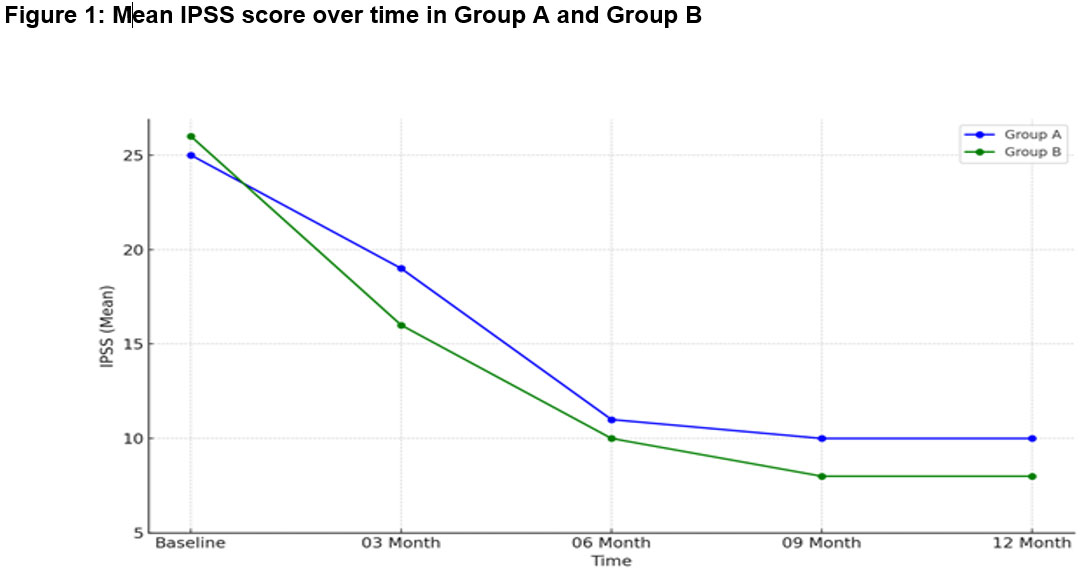
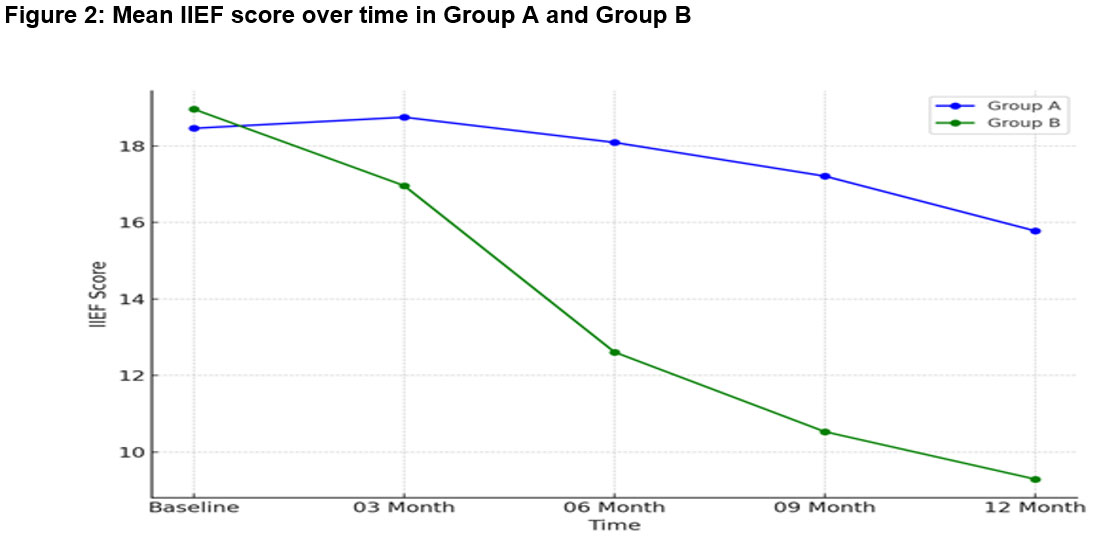
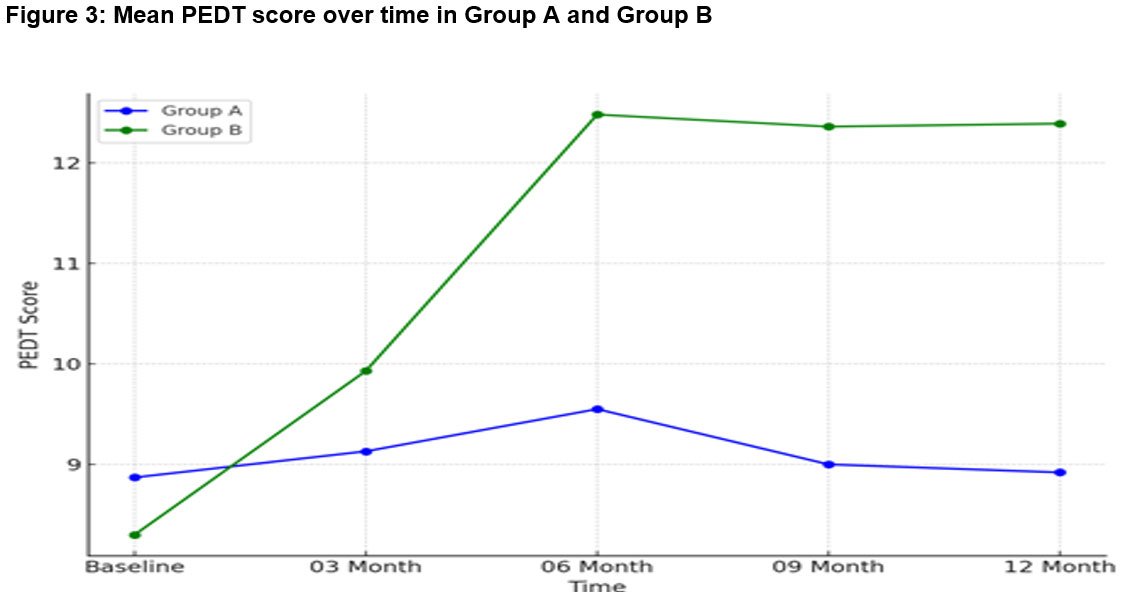
Each group consisted of 69 patients, with a mean age of 59.36 ± 8.00 years in Group A and 60.91 ± 10.61 years in Group B. No patient discontinued medication or missed scheduled follow-up visits. Data was recorded at baseline and at 3, 6, 9, and 12 months. Table 2 summarizes the inter-group comparison of IPSS, IIEF, and PEDT scores at baseline and follow up intervals. The corresponding trends in IPSS, IIEF, and PEDT are illustrated in Figure 1, Figure 2, and Figure 3, respectively.
Discussion
Due to BPE, LUTS are very prevalent in older men. Tamsulosin alone or in combination with Dutasteride is a common drug choice for these patients [15]. This study of the combination of Tamsulosin and Dutasteride (0.4 mg/0.5 mg) daily showed significantly better assessment using IPSS and ED scores compared to the Tamsulosin 0.4 mg daily group. However, in terms of ejaculatory dysfunction, the group receiving 0.4 mg of Tamsulosin daily experienced significantly fewer side effects compared to the combination of Tamsulosin and Dutasteride (0.4 mg/0.5 mg) daily. Similar results were found in the research by Zhongbao, which showed that combining Tamsulosin and Dutasteride had a better therapeutic impact for BPH while also increasing the risk of sexual adverse effects (OR, 0.56; p < 0.001) compared to the placebo group [16]. Likewise, the CombAT study led by Roehrborn et al. (2014) also strengthened the results of this project and highlighted the potential benefits of using a combination approach to manage BPH more effectively. Their study demonstrated that the combination therapy provided superior outcomes, including a significant improvement in clinical symptoms measured by the International Prostate Symptom Score (IPSS), with a difference of 4 points. Additionally, the combination therapy led to a remarkable 68% reduction in the incidence of acute urinary retention and a 71% reduction in the need for surgical intervention after eight months of treatment compared to Tamsulosin alone. These findings highlight the potential benefits of using a combination approach to manage BPH more effectively [17]. Moreover, the results of the research work by Abou Farha were also parallel to our findings: patients with BPE using the combination of Tamsulosin experienced more sexual side effects. Haque also confirmed that combining Tamsulosin and Dutasteride for patients having LUTS (moderate to severe) with larger prostate glands (>40 mL), high prostate-specific antigen levels (>1.6 ng/ml), and a reduced urine flow rate is a more effective therapeutic option (p < 0.001) in Asian people suffering from moderate-to-severe LUTS/BPH, as compared to Tamsulosin monotherapy [18]. On further exploration, it was found that the research project by Ajay Anand claimed that α-blocker monotherapy or add-on therapy with Dutasteride may also lead to failure, i.e., in cases of large-sized prostates, intravesical projection, and raised serum PSA, surgical treatment should be considered [19]. Their findings not only positively attribute to this project but also guide early switching to surgical options if medical therapy fails. In contrast to our findings, the 2021 research work of Lulic found that in patients of Korean origin, there is no difference in erection or ejaculation problems in either group—those using Tamsulosin monotherapy or in combination with Dutasteride [20]. Likewise, Hisanori evaluated 81 patients with BPE who were taking Dutasteride for one year and concluded that Dutasteride did not lead to sexual dysfunction [21]. These contrary findings open the debate and leave space for further research on the same subjects to publish a final conclusion. Our study has limitations. It was a single-centered study and was not blinded by adding placebo.
Conclusion
The study concludes that combining Tamsulosin with Dutasteride provides greater therapeutic benefit for managing lower urinary tract symptoms (LUTS) associated with benign prostatic hyperplasia (BPH) compared to Tamsulosin monotherapy; however, this improved efficacy is accompanied by a higher risk of sexual side effects.
References
- Charalampous I, Tsikopoulos I, Mitkani C, Samarinas M, Yuan Y, Vouros I, et al. Does Surgical Treatment for Benign Prostate Enlargement (BPE)-Related Bladder Outlet Obstruction (BOO) Benefit Patients with Central Nervous System Diseases? A Systematic Review. J Clin Med. 2024;13(19):5846-62. https://doi.org/10.3390/jcm13195846
- Sánchez-Fernández D, Eguibar A, López C, Cuesta ÁM, Albiñana V, Rogers-Ezewuike S, et al. Effect of 5β-dihydrotestosterone on vasodilator function and on cell proliferation. PLoS One. 2024 Oct 23;19(10):e0312080. https://doi.org/10.1371/journal.pone.0312080
- Wei H, Zhu C, Huang Q, Yang J, Li YT, Zhang YG, et al. Global, regional, and national burden of benign prostatic hyperplasia from 1990 to 2021 and projection to 2035. BMC Urol. 2025;25(1):34-45. https://doi.org/10.1186/s12894-025-01715-9
- Launer BM, McVary KT, Ricke WA, Lloyd GL. The rising worldwide impact of benign prostatic hyperplasia. BJU Int. 2021;127(6):722-8. https://doi.org/10.1111/bju.15286
- Lerner LB, McVary KT, Barry MJ, Bixler BR, Dahm P, Das AK, et al. Management of lower urinary tract symptoms attributed to benign prostatic hyperplasia: AUA guideline part II—surgical evaluation and treatment. J Urol. 2021;206(4):818-26. https://doi.org/10.1097/JU.0000000000002184
- Rajput HS, Shah N, Mehta K, Parsaniya J, Patel J, Hadia R. Alpha blockers in the management of acute urinary retention in prostatomegaly: a prospective observational study. Egypt Pharm J. 2025;24(1):17-28. https://doi.org/10.21608/epj.2025.402395
- Li Y, Ma J, Qin XH, Hu CY. The efficacy and safety of Dutasteride and Finasteride in patients with benign prostatic hyperplasia: a systematic review and meta-analysis. Transl Androl Urol. 2022 Mar;11(3):313-24. https://doi.org/10.21037/tau-22-58
- Abou-Farha M, Hagras A, Nagla S. Effect of dose reduction of Dutasteride in combination with alpha-blockers in patients with lower urinary tract symptoms/benign prostatic enlargement. Urol Ann. 2024;16(2):120-4. https://doi.org/10.4103/ua.ua_15_22
- Yang F, Hashim R, Philippou J. Tamsulosin and Dutasteride combination therapy for Asian men with moderate-to-severe lower urinary tract symptoms secondary to benign prostatic hyperplasia: a systematic review. J Clin Med Res. 2024 Sep 12;16(9):385-97. https://doi.org/10.14740/jocmr5255
- Mousavi SN, Nouri M, Yousefi Rad E, Kazemi R, Birjandi M, Coe S, et al. Association between dietary phytochemical index and risk of benign prostatic hyperplasia: a case-control study. J Health Popul Nutr. 2024;43(1):35-42. https://doi.org/10.1186/s41043-024-00531-5
- Singh I, Behera DP, TK A, Gupta S. Efficacy and safety of Tamsulosin vs its combination with Mirabegron in the management of lower urinary tract non‐neurogenic overactive bladder symptoms because of benign prostatic enlargement—an open label randomized controlled study. Int J Clin Pract. 2021 Jul;75(7):e14184. https://doi.org/10.1111/ijcp.14184
- Gravas S, Manuel-Palacios J, Chavan C, Roehrborn CG, Oelke M, Averbeck MA, et al. Modeling study of the effect of placebo and medical therapy on storage and voiding symptoms, nocturia, and quality of life in men with prostate enlargement at risk for progression. Prostate Cancer Prostatic Dis. 2024;27(3):469-77. https://doi.org/10.1038/s41391-023-00731-w
- Nnabugwu II, Anyimba SK, Amu OC, Nnabugwu CA, Okolie LT. Erectile function in men presenting with lower urinary tract symptoms from benign prostate enlargement: association with quality of life scores. Int J Med Health Dev. 2024 Oct 1;29(4):299-304. https://doi.org/10.4103/ijmh.ijmh_32_24
- Bitar Siqueira MH, Bhojani N, Meskawi M, Zorn KC, Chughtai B, Patel P, et al. The SUMMIT trial: evaluation of the Optilume BPH drug coated balloon for male LUTS. J Urol. 2025 May;213(5S):e986. https://doi.org/10.1097/01.JU.0001110064.72214.9d.07
- D’agate S, Chavan C, Manyak M, Palacios-Moreno JM, Oelke M, Michel MC, et al. Impact of early vs delayed initiation of Dutasteride/Tamsulosin combination therapy on risk of acute urinary retention or BPH-related surgery in LUTS/BPH patients. S Afr Gen Pract. 2024;5(2):63-71. https://hdl.handle.net/10520/ejc-mp_sagp_v5_n2_a3
- Zhou Z, Cui Y, Wu J, Ding R, Cai T, Gao Z. Meta-analysis of the efficacy and safety of combination of Tamsulosin plus Dutasteride compared with Tamsulosin monotherapy in treating benign prostatic hyperplasia. BMC Urol. 2019 Dec;19(1):1-12. https://doi.org/10.1186/s12894-019-0446-8
- Roehrborn CG, Barkin J, Tubaro A, Emberton M, Wilson TH, Brotherton BJ, et al. Influence of baseline variables on changes in International Prostate Symptom Score after combined therapy with Dutasteride plus Tamsulosin or either monotherapy in patients with benign prostatic hyperplasia and lower urinary tract symptoms: 4‐year results of the CombAT study. BJU Int. 2014 Apr;113(4):623-35. https://doi.org/10.1111/bju.12500
- Haque N, Masumori N, Sakamoto S, Ye Z, Yoon SJ, Kuo HC, Brotherton B, Wilson T, Muganurmath C, McLaughlin M, Manyak M. Superiority of Dutasteride 0.5 mg and Tamsulosin 0.2 mg for the treatment of moderate‐to‐severe benign prostatic hyperplasia in Asian men. Int J Urol. 2018 Nov;25(11):944-51. https://doi.org/10.1111/iju.13785
- Anand A, Gupta NP, Dogra PN, Seth A. Analysis of causes of failure of medical treatment in patients undergoing surgery for benign prostate enlargement. Urol. 2022 Nov;89(4):553-8. https://doi.org/10.1177/03915603211037603
- Lulic Z, Son H, Yoo SB, Cunnington M, Kapse P, Miller D, Cortes V, Park S, Bhak RH, Duh MS. Free combination of Dutasteride plus Tamsulosin for the treatment of benign prostatic hyperplasia in South Korea: analysis of drug utilization and adverse events using the National Health Insurance Review and Assessment Service database. BMC Urol. 2021 Dec;21(3):1-10. https://doi.org/10.1186/s12894-021-00941-1
- Taniguchi H, Inoue T, Kawa G, Murota T, Tsukino H, Yoshimura K, et al. Evaluation of sexual function after Dutasteride treatment in patients with once-negative prostate biopsy and benign prostate hyperplasia. Urologia J. 2023 May;90(2):295-300. https://doi.org/10.1177/03915603231163201