Abstract
Background: Acute watery diarrhea (AWD) remains a leading cause of death in children. Probiotics, when used alongside standard therapy, can improve clinical outcomes.
Objective: To compare the effectiveness of Bacillus clausii versus Saccharomyces boulardii, each combined with zinc and oral rehydration solution (ORS), in the management of AWD in children.
Method: This randomized controlled trial was conducted in the Department of Pediatric Medicine, Children’s Hospital Lahore, from April to September 2023. Sixty children aged 3 months to 5 years with AWD and mild to moderate dehydration were randomly assigned to Group A (Bacillus clausii + Zinc + ORS) or Group B (Saccharomyces boulardii + Zinc + ORS). Primary outcomes were stool frequency and consistency; secondary outcome was hospital stay duration.
Results: In a total of 60 children, 30 each group, 28 (46.7%) were male. Both groups showed decreased stool frequency from day 1 to day 5. Group A reduced from 4.43 ± 1.72 to 1.56 ± 0.57 stools per day, while Group B decreased from 4.96 ± 1.56 to 1.76 ± 0.63 stools per day. Group A had a higher efficacy rate (96.7%) compared to Group B (90%) and faster symptom improvement (2.48 ± 0.74 days vs. 3.14 ± 1.06 days, p = 0.007). Group A had a shorter mean hospital stay (34.86 hours vs. 48.40 hours, p=0.014).
Conclusion: Bacillus clausii in comparison to Saccharomyces boulardii is more effective in reducing the duration as well as frequency of diarrhea in children.
Keywords: Bacillus clausii, diarrhea, probiotic, saccharomyces boulardii, stool.
Introduction
In children, acute diarrhea ranks as the second most common illness after respiratory tract infections [1] . Diarrhea is marked by more frequent bowel movements (≥3 loose stools in 24 hours) and changes in stool consistency, often accompanied by symptoms such as fever, vomiting, and imbalances in electrolytes and pH levels [2]. The condition typically lasts less than two weeks and can be caused by various factors and pathogens.1 Acute watery diarrhea (AWD) is a major health issue for children under five years old globally, affecting around 1.7 billion cases and more than 0.5 million deaths every year. About 90% of these deaths occur in South Asia and sub-Saharan African regions [2]. If not promptly and effectively treated, AWD in children may progresss to severe dehydration and serious life-threatening complications [3].
Despite significant advancements in diarrhea management, such as early use of “oral rehydration solutions (ORS)”, continued feeding, oral zinc, and antibiotics (in case of bacterial diarrhea) [4] . In the recent decades, probiotics have emerged as popular choice for the prevention and treatment of various health conditions including AWD, though the concept being over a century old. According to WHO, probiotics are living microorganisms which confer health benefits when given in sufficient amount, “International Life Science Institute (ILSI)” and “European Food and Feed Cultures Association (EFFCA)” also endorse this definition [4]. In infectious diarrhea, probiotics combat pathogenic bacteria, producing various antimicrobial substances, acidifying the gut contents, and improving both specific and non-specific immune response [5,6].
Although, ORS is the primary choice of treatment in diarrhea, it does not stop the advancement of diarrhea, correct micro flora imbalance, clear pathogens, or address environmental enteric dysfunction. These issues may be managed by probiotics. Some experts have shown that probiotics could provide effective alleviation in the treatment of diarrhea when given in combination with the standard treatment [6,7]. The optimal probiotic for treating acute diarrhea in children remains debatable. Even the traditional pairwise, meta-analyses have typically focused on a single probiotic and have not identified the most effective one [8]. Choosing the appropriate probiotic for treating acute watery diarrhea is complex and depends on several factors, including the strain's ability to restore disrupted gut flora, the availability of high-quality probiotic products locally, and consensus on their efficacy and safety [9]. Recent literature highlights three effective probiotic strains—Saccharomyces boulardii (S. boulardii), Bacillus clausii (B. clausii), and Lactobacillus reuteri, for diarrheal diseases [10].
B. clausii is a resilient, spore-forming, Gram-positive bacterium known for its ability to survive stomach acidity and colonize the intestines effectively. It has been recommended for treating intestinal bacterial flora disturbances in both children and adults [11]. Research, including systematic reviews and clinical studies, demonstrates that B. clausii can reduce the duration of acute watery diarrhea, lower the frequency of stools, and decrease hospitalization compared to standard treatments like ORT alone or ORT with zinc supplementation [12] . These findings underscore B. clausii efficacy in managing acute diarrhea, making it a valuable option in clinical practice. S. boulardii, derived from the Saccharomyces cerevisiae species, is a yeast probiotic known for its anti-inflammatory and antibacterial properties [13]. Given the varying results and the importance of effective treatment for AWD in pediatric patients, this study aims to directly compare the effectiveness of zinc supplementation with ORS and B. clausii versus zinc with ORS and S. boulardii. The study will provide valuable insights into the optimal probiotic treatment for acute watery diarrhea, considering factors such as improvement in frequency, consistency of stool and total duration of stay at hospital diarrhea duration. This comparison is critical for establishing evidence-based guidelines and improving clinical outcomes for children with acute diarrhea.
Method
This randomized controlled trial was performed at “The Department of Pediatric Medicine, Children's Hospital, Lahore”, Pakistan from April 2023 to September 2023. The sample size of 60 (30 in each group) patients was estimated with 95% confidence level, 5% absolute precision (margin of error) taking mean duration of hospital stay14 in group-A (B. clausii + zinc+ ORS) as 3.66±1.31and that in group-B (S. boulardii +zinc+ ORS) as 1.08±0.80. The consecutive sampling method of patient fulfilling inclusion and exclusion criteria was used followed by randomization. Inclusion criteria included patients aged 3 months to 5 years with AWD of fewer than 14 days, confirmed by gross stool examination, and presenting with mild to moderate dehydration. Exclusion criteria encompassed a history of blood or pus in stools, recent antibiotic or probiotic treatment, immunodeficiency conditions, acute systemic illnesses, chronic diarrhea, and hypersensitivity to B. clausii or S. boulardii. After ethical approval from Institutional review board of Children’s Hospital Lahore, parents or guardians of eligible patients were counseled and provided with written informed consent. Using the lottery method, patients were randomly assigned to either Group A or Group B . Treatment was administered according to group assignment, and patients were monitored for 120 hours, with primary outcomes being improvements in stool frequency and consistency, and secondary outcomes being the total duration of hospital stay. After discharge, patients were followed up for an additional five days. Data on demographics and detailed history were collected, and outcome variables were recorded on a specially designed proforma. The duration of diarrhea was determined by measuring the time, in hours, from the first instance of an abnormal (loose or liquid) stool to the last one, before the return to a normal stool consistency. Efficacy was determined by considering patients recovered if they met any of the following criteria: no watery stool, ≤ two stools per day for two consecutive days, or two consecutive formed stools. Stool consistency was graded on a five-point scale: firm, soft, thick liquid, opaque watery, and watery. Data was analyzed using IBM-SPSS Statistics, version 26. Numerical variables were presented by mean ±SD. Categorical variables were presented as frequency and percentage. The chi-square test was applied to compare categorical data whereas independent sample or paired sample t-test were applied for comparing numeric data taking p <0.05 as statistically significant. Approval from “Institutional Ethical Committee” was obtained (Letter number: 521/CH/UCHS, dated 10-03-22). This randomized clinical trial was registered at ClinicalTrials.gov with ID NCT06540209.
Results
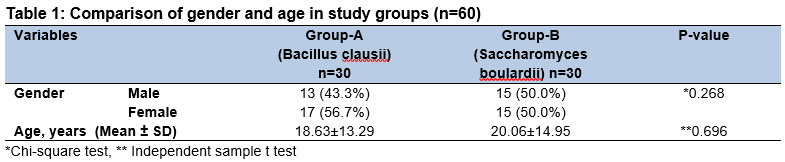
Out of total of 60 children, 28 (46.7%) were male. The gender (p=0.268), and age distribution (p=0.696) did not show any significant differences among children of both study groups (table 1).
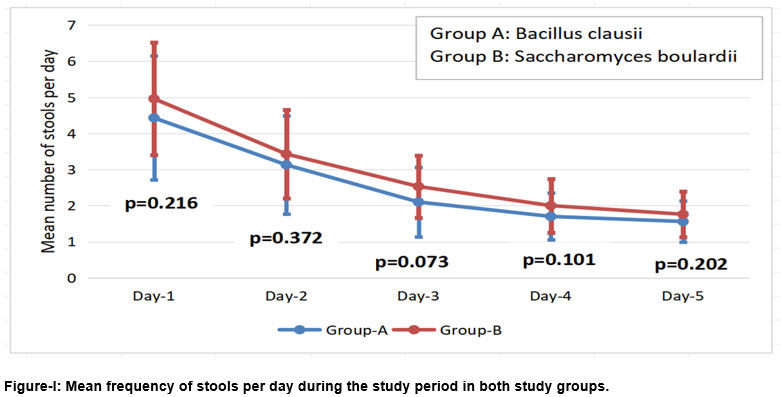
Both groups experienced a decrease in stool frequency from day-1 to day-5. In Group A, mean number of stools per day were reduced from 4.43±1.72 on day-1 to 1.56±0.57 on day-5 (p<0.001). In Group B, the number of stools per day decreased from 4.96±1.56 on day 1 to 1.76±0.63 on day-5 (p<0.001). Comparison of daily frequency of stools among study groups did not reveal any significant differences (p>0.05), as shown in figure-I.
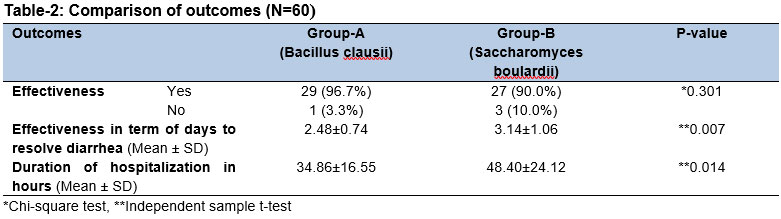
Overall, effectiveness was noted in 56 (93.3%) children. Both groups showed effectiveness in treating watery diarrhea, with efficacy rates of 96.7% in Group-A and 90.0% in Group-B (p=0.301). Patients in Group A (2.48 ± 0.74 days) experienced symptom improvement sooner than those in Group B (3.14 ± 1.06 days, 0.007). The mean duration of hospitalization was significantly shorter for Group A as B. clausii significantly reduced the mean hospital stay by 14.04 hours (p=0.014) (table 2).
Discussion
The selection of a suitable probiotic is complex due to variations in the availability, affordability, and effectiveness. International guidelines, including those in Pakistan, recommend the use of various probiotics [14]. In our study both probiotics were effective in treating watery diarrhea, however the B. clausii group (96.7%) was more effective compared to the S. boulardii group (90%). Morever, B. clausii group experienced symptom improvement sooner than those in S. boulardii group (p= 0.007) and had shorter hospital stay (P=0.014). Mahyar et al indicated that the S. Boulardii compared to placebo imparted significant decrease in the duration (p=0.03) and frequency (p=0.04) of diarrhea, but extent of hospitalization did not differ significantly. These findings support the use of S. Boulardii as a beneficial treatment for acute diarrhea in pediatric patients [13]. Fatima et al. [14]. showed that B. clausii with standard treatment was more efficacious. Conversely, a randomized trial in Argentina found that S. boulardii significantly reduced the mean duration of diarrhea when compared to B, clausii [15]. A randomized trial in Argentina showed that S. boulardii significantly reduced the mean duration of diarrhea when compared to B clausii, (64.6 hours vs. 78.0 hours, p = 0.04). Though in that study both probiotics had similar secondary outcome improved the frequency and severity of loose stools, increased the number of children without diarrhea by Day 6, and were well-tolerated [15] compared to our study in which where B. clausii group had faster resolution of symptoms. Another study conducted in India showed that S. boulardii group reflected significantly shorter duration of diarrhea in comparison to B. clausii group by 25.2 hours (p<0.001). Contrary to our study, Asmat et al. found that a higher percentage of children successfully treated with S. boulardii were 45% compared to 26% with B. clausii [16].
The male-to-female ratio in this study population was 1:1.14, consistent with previous studies indicating almost equal susceptibility to acute watery diarrhea across genders [17]. Group A had a mean age of 18.63 ± 13.30 months, while in Group B, it was 20.07 ± 14.95 months (p = 0.696), which is comparable to findings from other studies [18]. This research directly compared 2 common probiotics, providing valuable insights. Both probiotics are easily available in Pakistan, and the detailed outcome measures and comparable baseline characteristics between groups ensure that the observed differences are due to treatment effects, making the findings clinically relevant for guiding future treatment protocols.
This study had several limitations, including a small sample size, data from a single facility, and the exclusion of factors such as personal hygiene, and access to clean water. Overall evaluation period was short. We did not identify causal pathogens or consider vaccination status and feeding practices.
Conclusion
Bacillus clausii in comparison to Saccharomyces boulardii is more effective in reducing the duration as well as frequency of diarrhea in children. Further large-scale studies are recommended to validate these results and refine treatment protocols.
References
- Mulatya DM, Mutuku FW. Assessing comorbidity of diarrhea and acute respiratory infections in children under 5 years: evidence from Kenya’s demographic health survey 2014. Prim. Care Community Health. 2020 May;11:2150132720925190. doi:10.1177/2150132720925190
- Hartman RM, Cohen AL, Antoni S, Mwenda J, Weldegebriel G, Biey J, et al. Risk factors for mortality among children younger than age 5 years with severe diarrhea in low-and middle-income countries: Findings from the world health organization-coordinated global rotavirus and pediatric diarrhea surveillance networks. Infect. Dis. 2023 Feb 1;76(3):e1047-53. doi: 10.1093/cid/ciac561.
- Valencia-Rodríguez A, Aquino-Matus J, Vera-Barajas A, Qi X, Méndez-Sánchez N. New therapeutic options for bile acid malabsorption diarrhea. Transl. Med. 2019 Nov;7(22). doi: 10.21037/atm.2019.09.112
- Mosaddek AS, Rizvi M, Akter R, Islam S, Hossain N, Iqbal H. Effect of probiotics in the treatment of acute watery diarrhoea in children admitted to a tertiary care hospital in Bangladesh: a non-randomized prospective clinical trial. IJCRIMPH. 2022;14(2):1-7. doi: 10.35248/1840-4529.22.14.341
- Sharma H, Bajwa J. Potential role and mechanism of probiotics. Rom. Soc. Cell Biol. 2021 Feb 1:3616-24. http://www.annalsofrscb.ro/index.php/journal/article/view/472
- Collinson S, Deans A, Padua-Zamora A, Gregorio GV, Li C, Dans LF, Allen SJ. Probiotics for treating acute infectious diarrhoea. Cochrane Database Syst Rev. 2020(12). doi: 10.1002/14651858.CD003048.pub4
- Depoorter L, Vandenplas Y. Probiotics in pediatrics. A review and practical guide. Nutrients. 2021 Jun 24;13(7):2176. doi: 10.3390/nu13072176
- Li Z, Zhu G, Li C, Lai H, Liu X, Zhang L. Which probiotic is the most effective for treating acute diarrhea in children? A Bayesian network meta-analysis of randomized controlled trials. Nutrients. 2021 Nov 29;13(12):4319. doi: 3390/nu13124319
- Szajewska H, Guarino A, Hojsak I, Indrio F, Kolacek S, Salvatore S, et al. Use of probiotics for the management of acute gastroenteritis in children: an update. Journal of pediatric gastroenterology and nutrition. 2020 Aug 1;71(2):261-9. doi: 1097/MPG.0000000000002751
- Sniffen JC, McFarland LV, Evans CT, Goldstein EJ. Choosing an appropriate probiotic product for your patient: An evidence-based practical guide. PLoS One. 2018 Dec 26;13(12):e0209205. doi: 1371/journal.pone.020920
- Acosta-Rodríguez-Bueno CP, Abreu y Abreu AT, Guarner F, Guno MJ, Pehlivanoğlu E, Perez III M. Bacillus clausii for gastrointestinal disorders: a narrative literature review. Adv Ther. 2022 Nov;39(11):4854-74. doi: 1007/s12325-022-02285-0
- Ianiro G, Rizzatti G, Plomer M, Lopetuso L, Scaldaferri F, Franceschi F, et al. Bacillus clausii for the treatment of acute diarrhea in children: a systematic review and meta-analysis of randomized controlled trials. Nutrients. 2018 Aug 12;10(8):1074. doi: 10.3390/nu10081074.
- Mahyar A, Ayazi P, Pashaei H, Arad B, Oveisi S, Esmaeili S. The effect of the yeast probiotic Saccharomyces boulardii on acute diarrhea in children. J Compr Ped. 2021;12(4). doi:10.5812/compreped.117391
- Fatima M, Kauser S, Fatima B, Mudassir K, Siddiqua S, Reddy UN, et al. Comparison of effectiveness of zinc supplementation with ors and bacillus clausii vs zinc supplementation with ORS and saccharomyces boulardii in acute watery diarrhoea in paediatric patients. IJAM. 2018;2(4):3–5. https://journals.indexcopernicus.com/publication/2210565
- Altcheh J, Carosella MV, Ceballos A, D’Andrea U, Jofre SM, Marotta C, et al. Randomized, direct comparison study of Saccharomyces boulardii CNCM I-745 versus multi-strained Bacillus clausii probiotics for the treatment of pediatric acute gastroenteritis. Medicine. 2022 Sep 9;101(36):e30500. doi: 10.1097/MD.0000000000030500
- Asmat S, Shaukat F, Asmat R, Bakhat HF, Asmat TM. Clinical efficacy comparison of Saccharomyces boulardii and lactic acid as probiotics in acute pediatric diarrhea. J Coll Physicians Surg Pak. 2018 Mar 1;28(3):214-7. doi: 10.29271/jcpsp.2018.03.214
- Sudha MR, Jayanthi N, Pandey DC, Verma AK. Bacillus clausii UBBC-07 reduces severity of diarrhoea in children under 5 years of age: a double blind placebo controlled study. Benef microbes. 2019 Mar 13;10(2):149-54. doi: 3920/BM2018.0094
- Szajewska H, Kołodziej M, Zalewski BM. Systematic review with meta‐analysis: Saccharomyces boulardii for treating acute gastroenteritis in children—a 2020 update. Aliment Pharmacol Ther. 2020 Apr;51(7):678-88. doi: 10.1111/apt.15659