Abstract
Background: Rabies is a fatal but vaccine-preventable zoonotic disease that remains a major public health concern in developing countries. In Pakistan, thousands of deaths occur annually due to inadequate awareness, prevention, and control measures.
Objectives: This study aimed to assess the perceptions of medical students about rabies in a medical college in Lahore, Pakistan.
Method: A cross-sectional analytical study was conducted on 350 medical students through stratified random sampling. The study was conducted during November 2022 to July 2023. At University College of Medicine at University of Lahore, Pakistan. Data was described and analyzed using SPSS version 24. Ethical approval was obtained from institutional IRB.
Results: Among 350 medical students (50% male, 50% female, mean age 21.63), 94% correctly identified rabies as a central nervous system disease, 87.7% recognized dogs as potential rabies carriers, but only 10.86% had awareness of other animals involved in transmission. Approximately 62.85% had knowledge of animal vaccination, while 5.71% were aware of sterilization of dogs as a measure to prevent rabies. Only 63.14% were informed of a rabies vaccine for humans. Knowledge of correct doses for pre-exposure prophylaxis (PrEP) was known to 8% and post-exposure prophylaxis (PEP) to 10%. Awareness of Rabies Control and Trap-Neuter-Vaccinate-Return (TNVR) programs was regrettably low (3.42% and 1.42% respectively). Responses pertaining to attitude were moderate, with 29.4% considering aggressive wound washing immediately after a stray dog bite. Furthermore, about 36.6% had attended a rabies awareness workshop but only 1.4% had seen a dog bite center in Lahore. Analysis of associations revealed that knowledge was significantly associated with gender (χ²=6.84, p=0.009), class year (χ²=10.21, p=0.037), and age (χ²=8.15, p=0.017), with male, senior, and older students showing better knowledge. Similarly, practice was significantly associated with gender (χ²=7.22, p=0.007), class year (χ²=12.35, p=0.015), and age (χ²=9.48, p=0.009), where male, senior, and older participants demonstrated better preventive practices.
Conclusion: Significant gaps in medical students' perception about rabies exist. Improving education and awareness among future healthcare providers is crucial to effectively prevent and manage rabies in the community. Both knowledge and practice were found to be significantly associated with gender, class year, and age, with male, senior, and older students performing better.
Keywords: Rabies, Perception, Awareness, Prevention, Control, Medical students
Introduction
Rabies, a viral zoonotic disease caused by the Rabies virus, has been recognized since ancient times, dating back to around 2000 BC. It belongs to the class of Lyssa viruses and is known to affect the central nervous system [1]. Human transmission occurs through bites, scratches, and mucous secretions (e.g., saliva) of infected animals [2]. While various wild animals, including bats, raccoons, skunks, and foxes, serve as reservoir species for rabies globally, domestic dogs are the most common carriers [3]. Although there is no known medical cure for rabies, it can be completely prevented with good management. Standing out as a global threat, it carries a fatality rate of almost 100%, in both humans and animals, killing around 59,000 people every year [4]. It is extremely significant to highlight that the World Health Organization has repeatedly brought into public notice that Rabies is a 100% vaccine-preventable disease and therefore, it is imperative to vaccinate
dogs and other animals to prevent the causation of the infection. Moreover, timely vaccination of the exposed individuals can render help in preventing a deadly consequence [5].
Despite being a vaccine-preventable disease, rabies remains endemic in over 150 nations and territories, causing approximately 59,000 human deaths annually, with Pakistan accounting for over 6,000 (10.1%) of these cases, signifying significant economic losses [2].
The substantial burden of rabies-related deaths in developing countries like Pakistan indicates the presence of inadequate human and animal rabies prevention and control programs. Factors contributing to rabies-related fatalities in Pakistan include a lack of knowledge about the nature of the disease and prophylactic measures, inadequate healthcare facilities, reluctance to seek medical attention after suspected dog bites, and the high cost of rabies immunoglobulin (RIG) [6]. Recognizing the urgency of the situation, the Global Alliance for Rabies Control (GARC) has set a target to eliminate deaths from canine rabies by 2030. However, more than 80,500 cases of dog bites are reported annually across Pakistan, leading to the adoption of controversial measures such as culling dogs using shooting or poisoning in many major cities. On the other hand, animal rights advocates advocate for more humane alternatives, such as vaccination and spaying programs [7]. In 2018, the Indus Hospital Research Center initiated Rabies Free Pakistan (RFP) in Karachi, launching a mass dog vaccination and animal birth control program targeting the large stray dog population. This program, Pakistan's first Trap-Neuter-Vaccinate-Return (TNVR) initiative, aims to reduce the number of stray dogs, vaccinate them for rabies, and train them to be less aggressive, making them safer for the community [8]. However, despite these efforts, there remains a significant knowledge gap among medical professionals, as evidenced by a study conducted at Aga Khan University assessing family physicians’ knowledge and attitudes towards rabies and tetanus. The study highlighted a deficiency in knowledge and correct practices, with only a quarter of physicians having received formal education on these topics during medical school and a mere 10% attending related seminars and lectures in the past year [9].
Given the significant gaps in medical students' perception about rabies, it becomes crucial to address this issue by improving education and awareness among medical students to effectively prevent and manage rabies in the community. Therefore, the objective of this study is to assess the perception of medical students about rabies; its transmission, prevention and control measures at University College of Medicine, Lahore. This study can serve as a reference to policymakers and stakeholders to create targeted awareness programs and management strategies to effectively control and reduce human rabies-related deaths in Pakistan.
Method
A Cross-Sectional Analytical Study was conducted at the University College of Medicine (UCM), University of Lahore (UOL), Lahore, Pakistan during November 2022 to July 2023. The calculated sample size was 350, with confidence level of 95%, significance level of 0.05 and using expected percentage as 65% of students having knowledge about rabies among physicians in a study conducted at Aga Khan Hospital [9].
The study participants were recruited through stratified random sampling. The total sample size was stratified according to years of MBBS into 5 strata (350/5=70). Consequently, 70 students were taken from each year of an MBBS, and it was further sub-stratified into half of the males and females (70/2=35). Therefore, data was collected from 35 males and 35 females from each year of MBBS. Within each sub-strata convenient sampling was done. First Year to Final Year medical students at UCM, who were willing to participate and present on the day of study were included, while First Year to Final Year medical students who had a history of rabid animal bites, most commonly dogs were excluded.
The data was collected through a self-administrated questionnaire. The Questionnaire was developed after a thorough literature review, which contained questions to collect socio-demographic information of the participants and questions to assess the perception of medical students regarding epidemiology, prevention and control of rabies. It was pilot tested on 35 MBBS students. The data was collected over a period of one week. The data collected was analyzed using SPSS (Statistical Package for Social Sciences, 25th version). The results are presented with frequencies, percentages and tables.
The study was reviewed by the Ethical Committee of University College of Medicine and Dentistry (UCMD), University of Lahore and approved under the IRB letter no. ERC/124/22/10 dated 14-10-22.
Results
The study included 350 medical students from first year to final year MBBS; 50% were male and 50% were female. The medical students from each class were 20%. The mean age of the students was 21.63 ± 7.06 which ranged from 18 to 35.
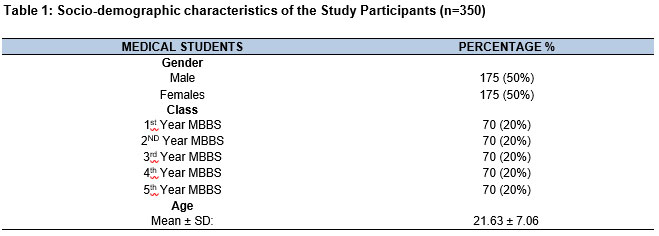
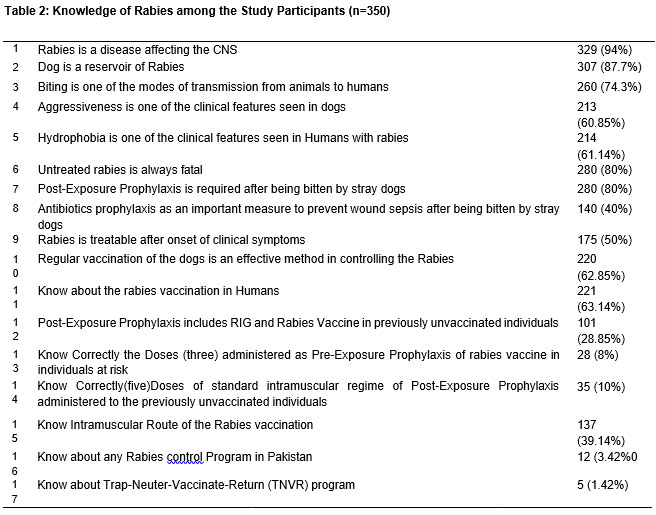
Table 2 depicts the knowledge of rabies among medical students. Many of the medical students (94%) agreed with the fact that ‘rabies is a disease affecting the central nervous system.’
While 88% of the students had knowledge of ‘dog as a reservoir of rabies’, strangely, only about 11% were familiar with ‘animals other than dogs that can transmit rabies’. Biting was recognized by around 74% as one of the different modes of transmission of rabies besides saliva contact with open wounds, scratch and inhalation. A significant proportion of students, approximately 60% recognized ‘hydrophobia in humans’ and ‘aggressiveness in dogs’ infected with rabies as the main clinical features seen respectively.
Moving on, majority (80%) of the students are of the opinion that untreated rabies is always fatal. Adding on, about 40% of the students considered antibiotics prophylaxis as an important measure to prevent wound sepsis after being bitten by stray dogs.
With respect to rabies vaccination, only about 29% students knew that ‘Rabies Immunoglobulin and Rabies vaccine’ both were administered as post-exposure prophylaxis in previously unvaccinated individuals. Unfortunately, only 8% of the students knew the ‘correct doses of Pre-Exposure Prophylaxis of Rabies vaccine’ in the individuals at risk and 10% knew the ‘doses of standard intramuscular regime of post-exposure prophylaxis of rabies’.
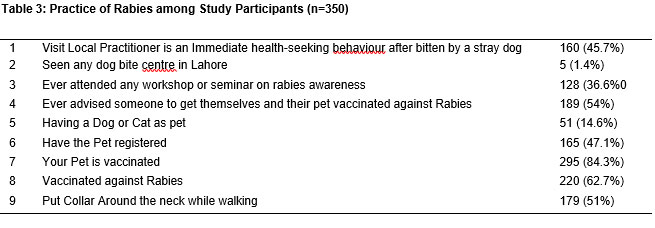
As shown in Table 3, about 46% of medical students agreed that ‘Visiting Local Practitioner’ is an immediate health seeking behavior after being bitten by a stray dog’. Moreover, about 37% of the students had ‘ever attended a workshop or seminar on rabies awareness.’ Despite 15% of students being cat or dog owners, only about 1% had ‘ever seen a dog bite center in Lahore.’ Pertaining to vaccination, about 63% were themselves vaccinated whereas 84% had their pets vaccinated too.
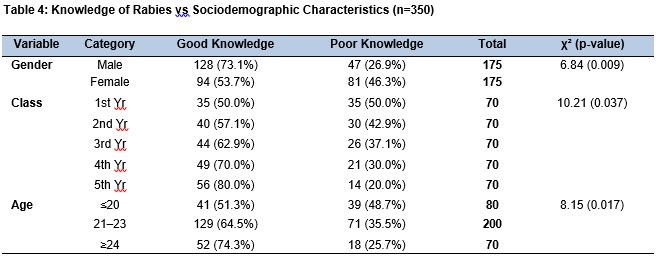
A statistically significant association as shown in Table 4, is found between knowledge of rabies and gender (χ²=6.84, p=0.009), with males demonstrating better knowledge compared to females. Class level (χ²=10.21, p=0.037) and age (χ²=8.15, p=0.017) were also significantly associated, indicating that higher academic year and older age groups had greater rabies-related knowledge.
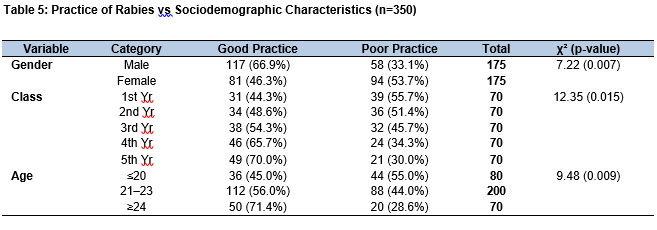
Preventive practices regarding rabies as shown in Table 5 are significantly associated with gender (χ²=7.22, p=0.007), with males reporting better practices than females. Similarly, academic year (χ²=12.35, p=0.015) and age group (χ²=9.48, p=0.009) showed significant associations, with senior students and older participants more likely to follow appropriate preventive practices.
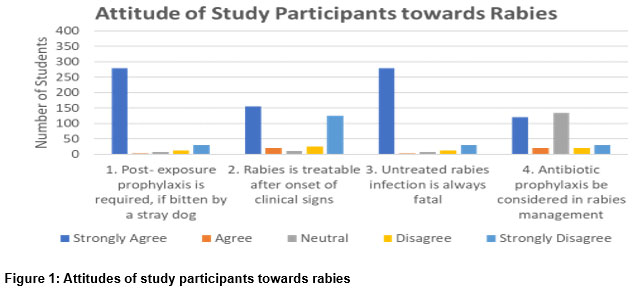
Fig. 1 shows that the majority (80%) of the students strongly agreed that untreated rabies is always fatal. Majority of them agreed that Post-Exposure Prophylaxis is required after being bitten by stray dogs. About 40% of the students considered antibiotics prophylaxis as an important measure to prevent wound sepsis after being bitten by stray dogs. However, about 50% of the students think that rabies is treatable after onset of clinical symptoms.
Discussion
Globally, Rabies is a serious health concern. Medical students, who are future medical professionals, can play a fundamental role in the reduction of this deadly disease through timely measures. The findings from this research project shed light on rabies knowledge, attitude, and practice among medical students, which is vital to acknowledge, for designing programs that can strongly assist in lowering its mortality. In the current study, out of 350 participants, 94% had awareness of the fact that rabies is a disease affecting the central nervous system. Regarding the reservoir of rabies, 88% of the participants recognized dogs, coinciding, at 80.9% in pharmacy students [2] and at 98% in another study conducted among final year medical students and interns [1]. Besides dog, 11% participants were familiar with bats, jackals, pigs, mongoose and cats as reservoirs in our study. The same was known by 19% and 54% in previously mentioned studies [1], [2].
Furthermore, a community-based study also reported that 37.6% were conscious about other animals other than dogs in the causation of rabies [10].
In our cross-sectional study, about 74% of participants were conscious about that biting being the primary mode of transmission. However, only about 21% recognized saliva contact with open wounds and 2% acknowledged scratch and inhalation as additional modes of rabies transmission. This finding was consistent with findings of a prior KAP survey in Khyber Pakhtunkhwa and Punjab where 78.6% knew that an infected dog bite can cause rabies [6]. Similarly, in another study conducted in Indonesia, 95.4% were aware of the same [11]. In our present research, Hydrophobia was recognized by 61.14% participants as the clinical feature seen in humans infected with rabies while 67.1% of pharmacy students had identical knowledge [12]. Important to mention is that awareness scored to 74.3% in another study conducted in India on medical students [13]. In the current study, about 63% participants were informed about vaccination of the animals whereas only around 6% knew that the sterilization of dogs can also be an important measure in the prevention of rabies. Regarding rabies vaccination, only 63.14% participants were familiar with a vaccine for preventing rabies in humans. Only 28.85% participants knew that Rabies immunoglobulin and rabies vaccine, both are administered as post-exposure prophylaxis in previously unvaccinated individuals. It is worth emphasizing that individuals exposed to awareness campaigns were 1.4 times more convinced in vaccinating their pets, highlighting the crucial role of educational initiatives in promoting educational practices [14].
Moreover, alarmingly, in our study, only 8% participants knew the correct doses of Pre-Exposure prophylaxis of rabies vaccine in the individuals at risk while only 10% of the participants knew correctly about the doses of standard intramuscular regime of post-exposure prophylaxis of rabies. The intramuscular route of administration was known by about 39.14%, while only 5% of participants were informed of the intradermal route. In contrast, 50.8% of pharmacy students precisely knew that deltoid was the recommended site while intradermal route was also known by 20.8% [12]. These are more favorable results as compared to our study.
Compellingly, a case study in Chicago emphasized that active participation and awareness within the community are fundamental for the success of the Trap-Neuter-Vaccinate-Return programs [15]. Disturbingly, only about 3% participants in the current study were familiar with Rabies Control programs in Pakistan while only 1.42% accurately knew about Trap-Neuter-Vaccinate-Return (TNVR) programs. With that said, 59.9% of respondents preferred awareness creation among dog owners, as stated by a community-based study conducted in Ethiopia [16]. Regarding attitude, most of the participants agreed that post-Exposure prophylaxis is required after being bitten by stray dogs. Moreover, strangely, approximately 50% of the participants who were medical students believed that rabies is treatable after the onset of clinical symptoms. In contrast, a cross-sectional study conducted in the rural community of Ethiopia revealed that only 34% believed rabies was treatable [17]. This indicates a higher misconception rate among medical students.
Pertaining to fatality, about 80% of the participants believed that untreated rabies is always fatal. Similarly, a cross-sectional study conducted in Mozambique also reported resembling belief concerning fatality of rabies [18]. However, only 63.5% of urban community members shared this belief [10].
Only 40% of the participants considered antibiotics prophylaxis as an important measure to prevent wound sepsis after being bitten by a stray dog while 38.6% were neutral suggesting lower levels of information among our participants regarding management. Disturbingly, 33.4% of respondents from an urban community declared they would neglect the incident upon being bitten [10]. Nonetheless, 82.1% of pharmacy students were willing to get medical attention in case of being bitten [12].
Response of the participant’s regarding practice was also found to be appallingly low in the current study. Only about 29% of the participants think that washing the wound aggressively with soap will be their immediate health seeking behavior if bitten by a stray dog. Meanwhile, 35.5% of university students in an endemic region of Algeria also shared the same perspective [19]. However, our findings were contrary to the study among pharmacy students in which many of the participants agreed with the measure of washing the wound as the most appropriate step [20]. This reflects the lack of information among our students.
Moreover, only about 37% of the participants had attended a workshop on rabies awareness and approximately 1% of the participants had seen a dog bite center in Lahore suggesting the lack of practice and interest regarding this fatal disease in the current study. About 15% participants are dog or cat owners and about 63% participants are vaccinated against rabies while about 84% have their pet vaccinated. These findings were consistent with the findings of the study among pharmacy students [20]. In the present study, knowledge about rabies was found to be significantly associated with gender, age, and class year. Male students, senior classes, and older participants demonstrated better awareness regarding prevention and treatment of rabies compared to their counterparts. This indicates that greater educational exposure and maturity contribute to improved rabies-related knowledge. Similarly, the practice of rabies prevention also showed significant associations with gender, age, and class. Male students, senior-year participants, and those in the older age group reported safer practices, including vaccination and responsible pet care. These findings suggest that better knowledge translates into improved preventive behaviors, highlighting the importance of awareness programs to strengthen both knowledge and practice in younger and female students [20].
The findings from this study reveal significant gaps in the knowledge, attitude, and practice of rabies among medical students. These gaps can render serious consequences in public health as medical professionals are considered as true pioneers of disseminating accurate information. They play an integral role in promoting preventive measures. Therefore, these deficiencies must be addressed, and rabies awareness should be actively enhanced among medical students. It is essential to integrate comprehensive education on rabies epidemiology, prevention, and management into the medical curriculum. Moreover, timely post-exposure prophylaxis must be repeatedly emphasized. For the promotion of rabies control programs, there must be collaboration between medical institutes and public health authorities. These initiatives are essential in reducing the burden of rabies in our country.
Conclusion
The findings of this study demonstrate significant gaps in medical students' perception regarding rabies, emphasizing the need for targeted interventions. Improving education and awareness among future healthcare providers is essential to effectively prevent and manage rabies in the community. Ultimately, enhancing medical students' understanding of rabies will contribute to safeguarding the health of the public community.
References
- Bonaparte SC, Adams L, Bakamutumaho B, Barbosa Costa G, Cleaton JM, Gilbert AT, et al. Rabies post-exposure healthcare-seeking behaviors and perceptions: Results from a knowledge, attitudes, and practices survey, Uganda, 2013. PLoS One [Internet]. 2021;16(6):e0251702. Available from: https://doi.org/10.1371/journal.pone.0251702
- Rana MS, Jahan AA, Kaisar SMG, Siddiqi UR, Sarker S, Begum MIA, et al. Knowledge, attitudes and perceptions about rabies among the people in the community, healthcare professionals and veterinary practitioners in Bangladesh. One Health [Internet]. 2021;13(100308):100308. Available from: https://doi.org/10.1016/j.onehlt.2021.100308
- Kankya C, Dürr S, Hartnack S, Warembourg C, Okello J, Muleme J, et al. Awareness, knowledge, and perceptions regarding rabies prevention among rural communities in Masaka district, central Uganda: A qualitative study. Front Vet Sci [Internet]. 2022 [cited 2022 Sep 28];9:863526. Available from: https://doi.org/10.3389/fvets.2022.863526
- Rabies [Internet]. WOAH - World Organisation for Animal Health. Available from: https://www.woah.org/en/disease/rabies/
- The silent bites: a wake-up call for rabies awareness [Internet]. WHO. Available from: https://www.who.int/news-room/feature-stories/detail/the-silent-bites--a-wake-up-call-for-rabies-awareness
- Ahmed T, Hussain S, Zia U-U-R, Rinchen S, Yasir A, Ahmed S, et al. Knowledge, attitude and practice (KAP) survey of canine rabies in Khyber Pakhtunkhwa and Punjab Province of Pakistan. BMC Public Health [Internet]. 2020 [cited 2022 Sep 28];20(1):1293. Available from: https://doi.org/10.1186/s12889-020-09388-9
- Working to eliminate human deaths from dog rabies by 2030. Available from: https://rabiesalliance.org/country/pakistan
- Islamabad animal sanctuary launches Pakistan’s first dedicated trap-neuter-vaccinate-return program. Available from: https://www.arabnews.pk/node/1948411/pakistan
- Siddiqui SJ, Jehan F, S AS, Wasay. Knowledge, attitude and perceptions about tetanus and rabies among family physicians; results of a survey at a teaching hospital in Karachi, Pakistan [Internet]. eCommons@AKU. 2016 [cited 2025 Feb 5]. Available from: https://ecommons.aku.edu/pjns/vol9/iss3/5/
- Sivagurunathan C, Umadevi R, Balaji A, Rama R, Gopalakrishnan. Knowledge, attitude, and practice study on animal bite, rabies, and its prevention in an urban community. J Family Med Prim Care. 2021;10(2):850–858. Available from: https://doi.org/10.4103/jfmpc.jfmpc_1674_20
- Rehman A, Rantam FA, Rehman A, Effendi MH, Shehzad A. Knowledge, attitudes, and practices toward rabies in three provinces of Indonesia. Vet World. 2021;14(9):2518–2526. Available from: https://doi.org/10.14202/vetworld.2021.2518-2526
- Spehar DD, Wolf A. Case study in citizen science: The effectiveness of a trap-neuter-return program in a Chicago neighborhood. Animals (Basel). 2018;8(1):14. Published 2018 Jan 18. Available from: https://doi.org/10.3390/ani8010014
- Ahmed T, Hussain S, Zia U-U-R, Rinchen S, Yasir A, Ahmed S, et al. Knowledge, attitude and practice (KAP) survey of canine rabies in Khyber Pakhtunkhwa and Punjab Province of Pakistan. BMC Public Health [Internet]. 2020 [cited 2022 Sep 28];20(1):1293. Available from: https://doi.org/10.1186/s12889-020-09388-9
- Yilhal G, Vet A, Husb. Assessment of knowledge, attitudes and practices of the community towards rabies in East Dembiya District, Central Gondar Zone, Northwest Ethiopia. 2024 [cited 2025 Feb 5];11(4). Available from: https://austinpublishinggroup.com/veterinary-science-research/fulltext/avsah-v11-id1150.pdf
- Sivagurunathan C, Umadevi R, Balaji A, Rama R, Gopalakrishnan. Knowledge, attitude, and practice study on animal bite, rabies, and its prevention in an urban community. J Family Med Prim Care. 2021;10(2):850–858. Available from: https://doi.org/10.4103/jfmpc.jfmpc_1674_20
- Lounis M, Zarif M, Zeroug Z, Brahimi SSF, Meddour Z. Rabies in the endemic region of Algeria: Knowledge, attitude and practice (KAP) survey among university students. Animals (Basel). 2024 Jul 27;14(15):2193. Available from: https://doi.org/10.3390/ani14152193
- Siddiqui SJ, Jehan F, S AS, Wasay. Knowledge, attitude and perceptions about tetanus and rabies among family physicians; results of a survey at a teaching hospital in Karachi, Pakistan [Internet]. eCommons@AKU. 2016 [cited 2025 Feb 5]. Available from: https://ecommons.aku.edu/pjns/vol9/iss3/5/
- Choudhary PK, Singh B. A study on knowledge, attitude and practice about rabies among pharmacy students in a tertiary care hospital. Int Arch Biomed Clin Res [Internet]. 2020 [cited 2025 Feb 5];CM1–3. Available from: https://iabcr.org/index.php/iabcr/article/view/175?articlesBySimilarityPage=2
- Hasanov E, Zeynalova S, Geleishvili M, Maes E, Tongren E, Marshall E, Banyard A, McElhinney LM, Whatmore AM, Fooks AR, Horton DL. Assessing the impact of public education on a preventable zoonotic disease. Epidemiol Infect. 2018 Jan;146(2):227–235. Available from: https://doi.org/10.1017/S0950268817002850
- Mapatse M, Sabeta C, Fafetine J, Abernethy D. Knowledge, attitudes, practices (KAP) and control of rabies among community households and health practitioners at the human–wildlife interface in Limpopo National Park, Massingir District, Mozambique. PLoS Negl Trop Dis. 2022 Mar 7;16(3):e0010202. Available from: https://doi.org/10.1371/journal.pntd.0010202