Abstract
Background: Acute Kidney Injury is a frequent illness, commonly observed in children admitted to intensive care units. Risk of AKI increases with requirement of mechanical ventilation, use of nephrotoxic drugs, need of ionotropic support. The children developing renal failure have higher risk of mortality and morbidity.
Objective: This study was conducted to determine the frequency and outcomes of AKI among critically ill children.
Method: It is a descriptive observational study, and it was done at PICU of Pediatric Medicine Department, Mayo Hospital Lahore in 6 months from October 13, 2023 – April 13, 2024. It was started after approval from Institutional Review Board. 240 children aged 1 month to 12 years of either gender, were enrolled considering 95% confidence level, 5% absolute precision and prevalence of AKI as 19.28%. Children with underlying congenital renal disorder, metabolic disorder or birth defect were excluded. AKI was diagnosed by considering KDIGO classification which included measurement of urine output and serum creatinine (1.5cc serum sample was sent for biochemistry). Outcomes were measured as mortality (death within 7 days of hospital stay), duration of stay or complete recovery of the patient. Data analysis was done using SPSS; the test applied for AKI and outcome was chi-square, while other variables were analysed using t-test or Mann-Whitney U test as per normality of data.
Results: The frequency of AKI was 17.1% (41) in critically ill children. Mechanical ventilation was required in 29.6% (71) patients and exposure to nephrotoxic drugs was reported in 33.3% (80) cases. Mechanical ventilation was independently related to the development of AKI (45.1% vs. 5.3%, p < 0.001). Nephrotoxic drug exposure was also a risk factor, with 43.8% (35) of exposed patients developing AKI compared to 18.1% (29) in the non-exposed group (p = 0.002). Death was significantly high (26.7%), and an alarming 85.9% of ventilated patients died. An all-cause mortality was observed in PICU, nephrotoxic drugs’ exposure being most significant cause. (43.8% vs. 18.1%, p < 0.001).
Conclusion: AKI is a frequent and severe illness observed in critically ill children, and is associated with multiple factors, most frequent being mechanical ventilation, use of nephrotoxic drugs, and higher mortality. An all-cause mortality was considered, AKI being the significant one.
Keywords: Acute kidney injury, Pediatric intensive care unit, Mechanical ventilation, renal dysfunction
Introduction
A sudden failure in kidney function that resulted to a sharpen decline in glomerular filtration rate (GFR), the accretion of waste material such as creatinine and blood urea nitrogen (BUN), and abnormal regulation of extracellular volume and electrolyte hemostasis is referred to as acute kidney injury (AKI) [1]. Since 2004, the criteria for diagnosing AKI have changed. Kidney Disease Improving Global Outcome (KDIGO), which is newly implemented, utilizes urine output (UOP) and serum creatinine to identification and phasing AKI. Several other plasma and urine signs have been recognized to identify AKI early. Neutrophil Gelatinase-Associated Lipocalin (NGAL) in the urine and plasma, serum cystatin C, Kidney Injury Molecule-1 (KIM-1), Liver Fatty Acid Binding Protein (L-FABP), and Interleukin-18 (IL-18) are some of these indicators. Despite being highly sensitive and specific than serum creatinine, these indicators are not frequently employed in clinical settings [2, 3].
In a study conducted in a tertiary care setting, Bajracharya et al. identified that AKI was developed among 19.28% children admitted in the PICU occurs, and within this group 15.78% advanced to 3rd stage AKI [4]. In accordance with a UK study, 10.8% of the children hospitalized eventually developed AKI [5].
In accordance with a retrospective cross-sectional study carried out in Pakistan, 14.9% of children acquire AKI; within this group 19.6% were not given any nephrotoxic drugs, 36.6% get one, 34.8% get two, and 8.9% get three or more [6]. Similarly, AKI was the cause of 19% of all cases of abnormal renal function tests in children and was the third most common cause [7]. Children with AKI who were hospitalized had poor outcomes, such as longer hospital/intensive care unit stays, more mechanical ventilation needs, higher rates of death and morbidity and a greater likelihood of developing chronic kidney disease or other long-term complications [4]. The etiology of AKI is renal hypoperfusion leading to hypoxic injury. Hence, hypoxic/ischemic damage can be avoided with early treatments [6].
Data regarding AKI and mortality associated with it is very limited especially in our country i.e. Pakistan. The rationale, therefore, of our research is to know the frequency of AKI and associated outcome related to AKI or other causes.
Method
This study was Descriptive observational study done in six months after approval of synopsis [October 13, 2023 – April 13, 2024] at Pediatric ICU, Mayo Hospital, Lahore. Data was collected using non-probability consecutive sampling. A minimum sample size of 240 children was estimated by using a 95% confidence level, 5% absolute precision with an expected percentage of AKI as 19.28. [4]. Children of age 1 month to 12 years of either gender, admitted to pediatric ICU were included. Children with the underlying congenital renal disorder, nephrotic syndrome, or chronic kidney disease (based on previous history, or previous medical record) and children with genetic metabolic defects or born with congenital malformations or birth defects were excluded. Ethical approval was taken from the Institutional Review Board; data was collected after taking informed consent. All admitted patients fulfilling the inclusion criteria were evaluated by the post-graduate resident trained in the use of tool. Patient demographic information and other relevant details were recorded in a pre-designed data collection form. Information regarding diagnosis, risk factors leading to AKI, any cardiovascular event, need for ionotropic or ventilatory support, nephrotoxic drugs, duration of stay, and eventual outcome was recorded. AKI was diagnosed by taking laboratory investigations as standard (elevated serum creatinine 48 hours after admission and oliguria). A 1.5cc serum sample was taken under aseptic measures and sent for biochemistry. Initially a baseline sample was taken and then patient was followed up and evaluated for development of AKI during their stay in the ICU.
AKI was defined as increase in serum creatinine by ≥0.3mg/dl from baseline within 48 hours or increase in serum creatinine to ≥1.5 times from baseline within the last 7 days, or Urine output ≤0.5ml/kg/hour for 6 hours. As per KDIGO classification, based on serum creatinine and urine output AKI is classified into three stages.
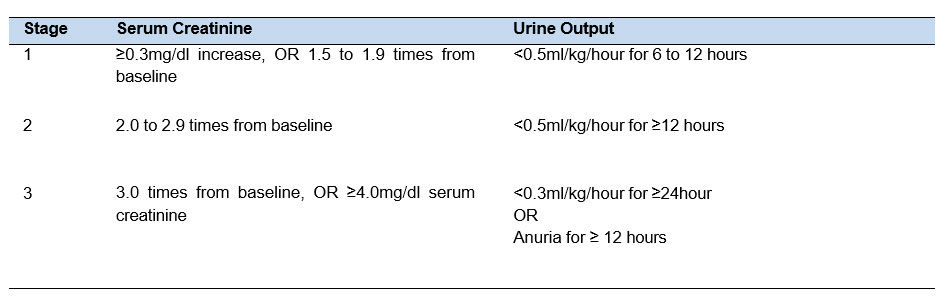
Outcomes were measured as mortality, duration of stay or complete recovery of the patient. Mortality was defined as all-cause death within 7 days of admission. Recovery was considered as improvement of renal function (serum creatinine falling to baseline) during stay in the ICU (assessed after 7 days). Duration of stay in ICU was measured as days until the outcome i.e. renal function returns to baseline or mortality. All information was recorded on a Performa. SPSS version 23 was used to analyse the data. Quantitative variables like age, duration of stay, serum creatinine and urine output being non-normally distributed were presented as median, Interquartile Range (IQR). Qualitative variables like gender, diagnosis at presentation, requirement of mechanical ventilation, exposure to nephrotoxic drugs, AKI (measured as elevation in serum creatinine), and outcomes (recovery, mortality) were presented as frequency and percentages. A p-value of ≤0.05 was considered significant. Outcomes like mortality, duration of stay, and recovery were recorded in patients developing renal failure during their ICU stay. Data was stratified for age, gender, mechanical ventilation, exposure to nephrotoxic drugs, and underlying disease. Post-stratification, Chi-square test was applied for AKI and mortality and recovery in AKI patients, while the t-test was applied for duration of stay. The approval of the study was taken from the Institutional Review Board (letter no. 892/KEMU dated: 31/10/2022).
Results
The median age was 9 months (inter quartile range [IQR] range: 3-24 months). Age distribution showed that 144 (60.0%) participants were under 12 months, 69(28.8%) were aged 12 to 60 months, and 27(11.2%) were over 60 months to 12 years. Median urine output was 2.2 ml/kg/hr (IQR: 1.3-3.0 ml/kg/hr) while in patients with AKI median urine output was 0.9 ml/kg/hr (IQR: 0.6-1.4 ml/kg/hr). The median serum creatinine level was 0.4 mg/dl (IQR: 0.4-0.6 mg/dl) while in AKI patients median creatinine level was 1.5 mg/dl (IQR: 1.2- 2.5 mg/dl). Median duration of hospital stay was 5 days (IQR: 3-7 days). Majority of participants were males 137(57.1%), and females constituted 103(42.9%). Among clinical diagnoses, pneumonia was the most common 53(22.1%), followed by meningitis 30(12.5%) and measles with complications 18(7.5%).
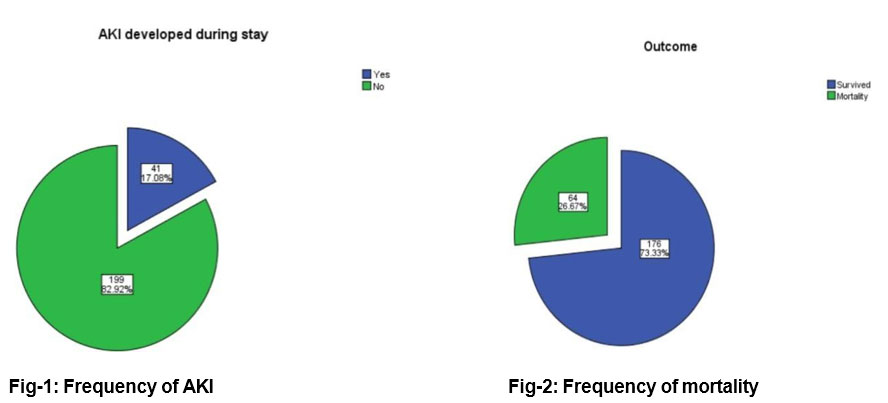
Mechanical ventilation was required in 71(29.6%) patients, while 169(70.4%) did not require ventilatory support. Exposure to nephrotoxic drugs was reported in 80(33.3%) cases and 41(17.1%) patients developed AKI during hospitalization. Overall mortality rate was 26.7%.
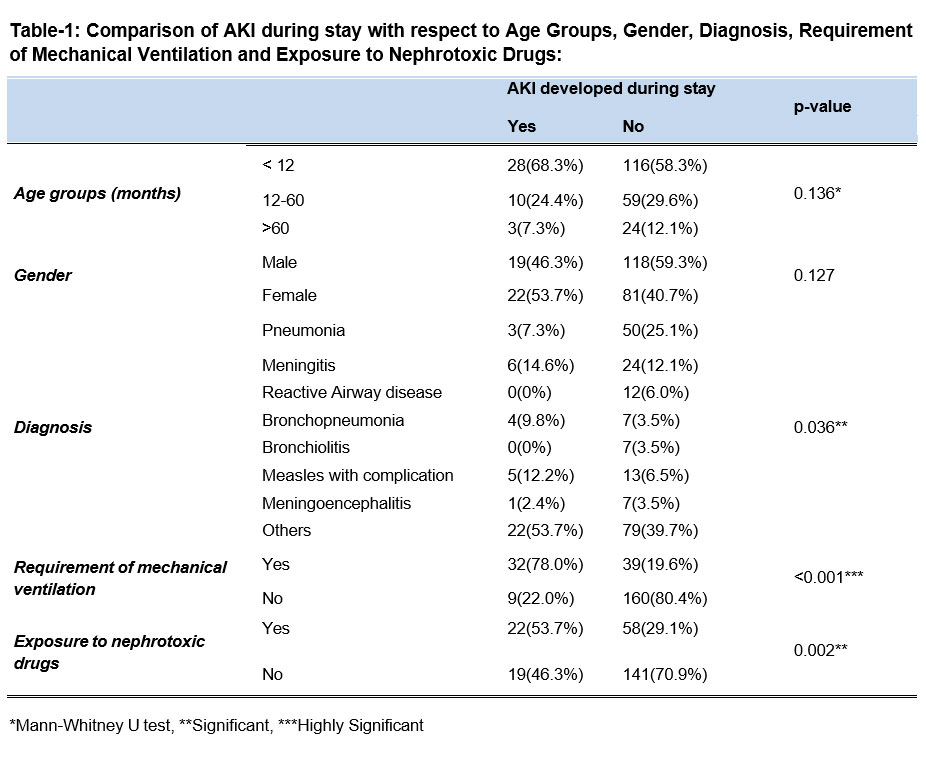
When comparing AKI development with clinical characteristics, AKI was significantly more frequent among patients requiring mechanical ventilation (32/71, 45.1%) compared to those who did not (9/169, 5.3%), showing a strong association (χ² = 55.755, p < 0.001). Similarly, AKI was more common among those exposed to nephrotoxic drugs (22/80, 27.5%) compared to non-exposed (19/160, 11.9%) (χ² = 9.192, p = 0.002). Diagnosis was also significantly associated with AKI development (p = 0.036), with higher proportions among those diagnosed with measles with complications (5/18, 27.8%) and bronchopneumonia (4/11, 36.4%).
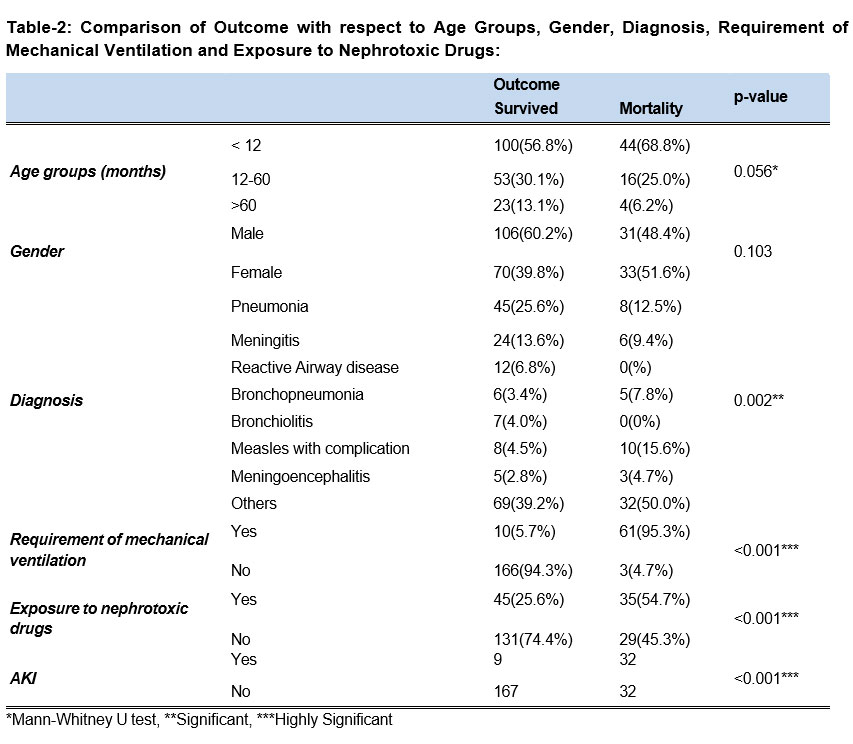
Regarding mortality, patients who required mechanical ventilation had a substantially higher mortality rate (61/71, 85.9%) compared to those who did not (3/169, 1.8%) (χ² = 181.0, p < 0.001). Exposure to nephrotoxic drugs was also associated with increased mortality (35/80, 43.8%) (χ² = 17.908, p < 0.001). AKI was strongly associated with mortality (p < 0.001). Diagnosis significantly influenced outcomes (p = 0.002), with higher mortality observed in patients with measles with complications (10/18, 55.6%) and bronchopneumonia (5/11, 45.5%). However, gender and age groups were not significantly associated with either AKI development or mortality (p > 0.05). Mann-Whitney U test showed no association of age and duration of stay with AKI development or mortality (p>0.05), while urine output and serum creatinine had strong association with AKI and mortality (P<0.05).
Discussion
Acute kidney injury is described as sudden onset of renal failure. About 20–30% of the general pediatric intensive care unit's patients suffer from AKI [8]. Pediatric AKI has been associated with morbidity, mortality and financial burden. Hypertension and chronic kidney disease (CKD) remain long term risks for children who survive AKI [9]. In our study, AKI developed in 17.1% of patients, which is lower as compared to previously reported incidents in similar studies. The discrepancy is attributed to sample sizes, variations across the geographical spread, and heterogeneity of the populations. A recent meta-analysis is published indicating a 26% incidence of AKI [10]. Other research provides the prevalence of AKD among children who were admitted into hospitals in China, India, and Egypt as 42.3%, 42.9%, and 56.6%, respectively [11-13]. On the other hand, Chisavu et al.'s 7-year cohort study in Romania reported that the AKI incidence rate was only 1.65% [14]. A local study by Lone et al. in Lahore reported that 36% of the children had AKI [15]. As per a prospective observational study at National Institute of Child Health's PICU Karachi, 46% of children had AKI [16]. In our study, the strongest correlation was found between AKI and the need for mechanical ventilation. While 5.3% of non-ventilated patients had AKI, more than half (45.1%) of ventilated patients had AKI. This agrees with a study that reported that acute kidney injury was significantly associated with mechanical ventilation (aOR = 2.25, 95% CI: 1.12, 4.51) [17].
In similar manner, another study showed that one of the variables associated with the onset of acute renal injury was found to be the requirement of ventilatory support [18]. Through mechanisms like ventilator-induced haemodynamic alterations, inflammatory responses, and hypoxic-ischemic renal injury, mechanical ventilation could be a causative factor to AKI. Nevertheless, Lone et al. established that development of AKI was not influenced by mechanical ventilation (p>0.05) [15].
A prospective observational study in Karachi by Gowa et al. showed that 46.5% patients were diagnosed with drug-induced AKI [16]. AKI incidence was vastly affected by the use of nephrotoxic medication (61.1% vs. 15.6%, P<0.001), as per Lone et al [15]. This variation is mostly due to differences between the AKI criteria, concomitant conditions, case mix, and severity of disease. A further recent investigation demonstrated that children in critical status were much more likely to acquire AKI if they were exposed to nephrotoxic drugs. 69.2% of the patients had received one or more of the 47 nephrotoxic drugs, and the incidence of AKI was 41.9%. Development of AKI was significantly associated with cumulative dose of nephrotoxic drugs (RR: 1.01 [1.00, 1.02]) and the severity of exposure (RR: 1.381 [1.101, 1.732]) [19]. This study highlights the need for therapeutic drug monitoring, careful use of these medications, and early renal protection strategy implementation among high-risk children.
Children who suffer with AKI in PICUs most often present with respiratory infections as underlying conditions, particularly lower respiratory infections [20]. Additionally, a high statistical correlation (p = 0.036) was identified between the development of AKI and some clinical conditions in our research. The highest rates of AKI were detected in patients with bronchopneumonia (36.4%) and measles (27.8%). These findings were supported by study result indicating AKI occurred in approximately 11% of patients hospitalized for viral bronchiolitis in a non-PICU setting, as reported by Marzuillo et al [21]. AKI development was highly correlated with respiratory syncytial virus (RSV) infection. Systemic inflammation, sepsis-induced renal damage, and dehydration due to excessive fluid loss are just a few of the mechanisms through which such diseases may cause renal failure.
Mortality in PICU is due to multiple causes and AKI was one of them, it was associated with increased mortality and occurred in 25% of the hospitalized children. Though sharing an equal burden of AKI, mortality rates in low and low-middle-income countries (LMICs) were higher as compared to the developed countries [10]. The mortality rate in our study was a high 26.7%, and both nephrotoxic drug exposure and mechanical ventilation were significant predictors of adverse outcomes. As the condition severity increases in this group, the mortality rate for those on ventilation increases upto 85.9%.
This is consistent with previous research that identified the use of nephrotoxic drugs and the need for mechanical ventilation as the two primary risk factors for PICU (P≤0.05). It also identified that the mortality rate among AKI patients was greater (47.5%) compared to that of non-AKI patients (25.56%) [12]. In the same manner, another study revealed that patients with acute renal injury and on mechanical ventilator had mortality of 22.4%, while the mortality rate of mechanically ventilated patients without acute kidney injury was 5% (p<0.01) [22]. Moreover, the exposure to nephrotoxic drugs was correlated with high mortality in the case group as compared with the control group (43.8% vs. 18.1%, p<0.001), implying that AKI and its consequences may be a cause of lower survival. In addition, another study proved that in children exposed to nephrotoxic drugs, the death rate was 17% in the AKI group and 4% in the non-AKI group (p=0.02) [16]. With the highest mortality rates for bronchopneumonia (45.5%) and measles with complications (55.6%), diagnosis also played an important role in outcomes. However, a previous study reported that the leading cause of pneumonia was not different in a statistical manner between the AKI and non-AKI groups (P<0.05) [23]. The findings represent the importance of renal-protective strategies, individualized treatment interventions, and most effective ventilatory strategies when managing critically ill children.
Notably, there was no association of gender or age groups with acute kidney injury or mortality (p>0.05), which suggests that these factors do not individually influence renal outcomes among pediatric critical care patients. This finding is supported by other studies revealing that clinical issues and the severity of illness are stronger predictors of AKI risk and survival than demographic factors [24].
The limitation of our study was that we only observed the short-term outcome of AKI children admitted to hospital. AKI children might also suffer from persistent renal injury over a prolonged period. Also, the frequency and outcome results were not further stratified by KDIGO staging to determine the prevalence and outcomes across different stages. Moreover, as the study was done in a teaching level hospital, referral bias could influence the clinical profile of the patients. The present study demonstrates the strong correlation between the development of acute kidney injury, the use of nephrotoxic medications, the presence of other illnesses such as measles or bronchopneumonia, and mechanical ventilation.
Conclusion
AKI, being a severe complication, is significantly determined by nephrotoxic drugs and invasive ventilation. Early recognition along with preventive strategies, like careful drug selection and lung- protective ventilation, must be implemented to reduce morbidity and mortality in PICU.
References
- Kliegman RM, Geme III JWS, Blum N, Shah SS, Tasker Nelson. Tratado de pediatría. Elsevier Health Sciences; 2020. https://jasu.kg/wp-content/uploads/2024/04/Nelson-essentials-of-pediatrics.pdf
- Hasson D, Menon S, Gist KM. Improving acute kidney injury diagnostic precision using biomarkers. Pract Lab Med. 2022;30:e00272. https://doi.org/10.1016/j.plabm.2022.e00272
- Ciccia E, Devarajan P. Pediatric acute kidney injury: prevalence, impact and management challenges. Int J Nephrol Renovasc Dis. 2017;10:77–84. https://doi.org/10.2147/IJNRD.S103785
- Bajracharya P, Kalra S, Dhingra S, Sood A, Yadav AK, Kanitkar M. Acute kidney injury in the pediatric intensive care unit at a tertiary care hospital of the Armed Forces: a cross-sectional observational study. Med J Armed Forces India. 2020;76(1):84–88. https://doi.org/10.1016/j.mjafi.2019.02.003
- Bhojani S, Stojanovic J, Melhem N, Maxwell H, Houtman P, Hall A, et al. The incidence of paediatric acute kidney injury identified using an AKI e-alert algorithm in six English centres. Front Pediatr. 2020;8:1–7. https://doi.org/10.3389/fped.2020.00388
- Ahmed R, Shahzad M, Umer A, Azim A, Jamil MT, Haque A. Frequency of exposure of nephrotoxic drugs and drug-induced acute kidney injury in pediatric intensive care unit: a retrospective review from a tertiary care centre in Pakistan. Cureus. 2020;12(12). https://doi.org/10.7759/cureus.11845
- Afridi M, Inayat S. Assessment of clinical spectrum of renal diseases in children: a descriptive study at Benazir Bhutto Hospital, Rawalpindi. J Rawalpindi Med Coll. 2021;25(1):1–6. https://doi.org/10.37939/jrmc.v25i1.1441
- Alobaidi R, Morgan C, Goldstein SL, Bagshaw SM. Population-based epidemiology and outcomes of acute kidney injury in critically ill children. Pediatr Crit Care Med. 2020;21(1):82–91. https://doi.org/10.1097/PCC.0000000000002128
- Robinson C, Hessey E, Nunes S, Dorais M, Chanchlani R, Lacroix J, et al. Acute kidney injury in the pediatric intensive care unit: outpatient follow-up. Pediatr Res. 2022;91(1):209–217. https://doi.org/10.1038/s41390-021-01823-5
- Meena J, Mathew G, Kumar J, Chanchlani R. Incidence of acute kidney injury in hospitalized children: a meta-analysis. Pediatrics. 2023;151(2). https://doi.org/10.1542/peds.2022-058823
- Deng YH, Yan P, Zhang NY, Luo XQ, Wang XF, Duan SB. Acute kidney disease in hospitalized pediatric patients with acute kidney injury in China. Front Pediatr. 2022;10:885055. https://doi.org/10.3389/fped.2022.885055
- Gupta S, Sengar GS, Meti PK, Lahoti A, Beniwal M, Kumawat M. Acute kidney injury in pediatric intensive care unit: incidence, risk factors, and outcome. Indian J Crit Care Med. 2016;20(9):526. https://doi.org/10.4103/0972-5229.190368
- Elkazaz A, Bazaraa HM, Salah D, El Nahas A, Sayed A. Acute kidney injury in children admitted in pediatric intensive care unit. Pediatr Sci J. 2022;2(2):178–192. https://doi.org/10.21608/cupsj.2022.128890.1047
- Chisavu F, Gafencu M, Stroescu R, Motofelea A, Chisavu L, Schiller A. Acute kidney injury in children: incidence, awareness and outcome—a retrospective cohort study. Sci Rep. 2023;13(1):15778. https://doi.org/10.1038/s41598-023-42262-z
- Lone Y, Chaudhry AR, Ayub R. Frequency and outcomes of acute kidney injury in pediatric intensive care unit. Prof Med J. 2024;31(12):1638–1643. https://doi.org/10.29309/TPMJ/2024.31.12.8355
- Gowa MA, Yamin R, Murtaza H, Nawaz H, Jamal G, Lohano PD, et al. Frequency of drug-induced acute kidney injury in pediatric intensive care unit. Cureus. 2021;13(11). https://doi.org/10.7759/cureus.19726
- Keneni M, Murugan R, Bizuwork K, Asfaw T, Tekle S, Tolosa G, et al. Risk factors associated with acute kidney injury in a pediatric intensive care unit in Addis Ababa, Ethiopia: case-control study. BMC Nephrol. 2023;24(1):279. https://doi.org/10.1186/s12882-023-04040-3
- Louzada CF, Ferreira AR. Evaluation of the prevalence and factors associated with acute kidney injury in a pediatric intensive care unit. J Pediatr. 2021;97:426–432. https://doi.org/10.1016/j.jped.2020.08.003
- Chan VPY, Hui WF, Lok VKW, Tse HHK, Wong RC, Wong SSM, et al. Acute kidney injury in relation to nephrotoxic medication use among critically ill children in the paediatric intensive care unit. J Pharm Pract. 2025;38(1):107–114. https://doi.org/10.1177/089719002512345
- De Zan F, Amigoni A, Pozzato R, Pettenazzo A, Murer L, Vidal E. Acute kidney injury in critically ill children: a retrospective analysis of risk factors. Blood Purif. 2020;49(1–2):1–7. https://doi.org/10.1159/000503979
- Marzuillo P, Di Sessa A, Golino R, Tirelli P, De Lucia M, Rivetti G, et al. Acute kidney injury in infants hospitalized for viral bronchiolitis. Eur J Pediatr. 2023;182(8):3569–3576. https://doi.org/10.1097/CCE.0000000000000720
- Vemuri SV, Rolfsen ML, Sykes AV, Takiar PG, Leonard AJ, Malhotra A, et al. Association between acute kidney injury during invasive mechanical ventilation and ICU outcomes and respiratory system mechanics. Crit Care Explor. 2022;4(7):e0720. https://doi.org/10.1097/CCE.0000000000000720
- Harsha GN. Incidence and outcome of acute kidney injury in children admitted in pediatric intensive care unit. Int J Acad Med Pharm. 2022;4(4):296–299. https://doi.org/10.47009/jamp.2022.4.4.58
- Sadeghi-Bojd S, Noori NM, Mohammadi M, Teimouri A. Clinical characteristics and mortality risk prediction in children with acute kidney injury. Niger Med J. 2015;56(5):327–332. https://doi.org/10.4103/0300-1652.169710