Abstract
Background: Electrolyte abnormalities are common in critically ill children, resulting in morbidity and mortality irrespective of primary problem.
Objective: To determine the frequency of normal and deranged/ abnormal serum electrolyte levels among critically ill pediatric patients admitted to the Pediatric Intensive Care Unit (PICU), and to assess the association between electrolyte abnormalities and morbidity and mortality outcomes.
Method: This Prospective Cross-sectional Study was conducted in PICU, Department of Paediatrics, Mayo Hospital, Lahore, Pakistan, from August 2024 to January 2025. Written informed consent was obtained from the parents or guardians of the patients. Blood samples were drawn at admission and sent for serum levels of sodium, potassium, and chloride. The frequency of electrolyte abnormalities and their association with outcome variables was determined. Data from all cases were subjected to statistical analysis through SPSS version 26. The Chi-square test was applied in two groups of patients, and Mann–Whitney U test was applied to compare hospital stay. Statistical significance was defined as a p-value ≤ 0.05. Results: Out of the 93 enrolled children, 54 were male (58.1%), 39 were female (41.9%), and electrolyte imbalance was found in 29 (31.2%). The most common electrolyte abnormality was hyponatremia. Potassium and chloride levels were significantly lower in the imbalance group (p = 0.007 and p = 0.030, respectively), with 95% CIs of –1.1 to –0.2 and –5.0 to –1.5 mmol/L. Sodium showed a trend toward lower values (p = 0.060; 95% CI: –3.5 to –0.5). Patients with electrolyte imbalance had significantly longer PICU stays (6.0 vs 3.0 days; 95% CI: 1.0–5.0; p = 0.017). Mortality was higher in the imbalance group (41.4% vs 25.0%) but was not significant (p = 0.090).
Conclusion: Children admitted to the PICU with electrolyte imbalances experience significantly higher mortality rates and longer PICU stay compared to those with normal electrolyte levels.
Keywords: Critical Illness, Nonparametric, Intensive Care Units, Pediatric, Chlorides, Hyponatremia, Morbidity
Introduction
Electrolyte abnormalities are common in critically ill children [1, 2]. These disturbances occur frequently in the Pediatric Intensive Care unit (PICU) setting and pose a significant clinical challenge. The maintainance of proper electrolyte balance is essential for sustaining organ function and homeostasis in critically ill patients [3].
Among the major electrolytes, sodium, potassium, and chloride play critical roles in cellular physiology. In case of their imbalance, cellular processes are disrupted, leading to increased morbidity and mortality. Approximately 30% of ICU patients develop hypernatremia or hyponatremia during their stay, both of which are independent risk factors for poor prognosis [4]. Potassium, the primary intracellular cation, is crucial for cardiac conduction and neuromuscular activity. Hypokalemia occurs in about 15% of children admitted to the PICU, whereas hyperkalemia develops in approximately 3.3% of hospitalised patients [5]. Collectively, electrolyte abnormalities are associated with poor clinical outcomes in children [6].
A prospective study of critically ill children reported that 108 (60%) exhibited electrolyte abnormalities, while 72 (40%) maintained normal electrolyte levels. Mortality among children with electrolyte disturbances was 30.5%, significantly higher than the 4.1% observed in those with normal electrolyte levels [7]. A study from Pakistan reported the electrolyte imbalance in 84% (85 out of 101) children in the PICU. The mortality rate was 21 (24.7%) in children with electrolyte imbalance as compared to two (12.5%) in those without electrolyte imbalance [3]. The rationale of the study was to determine the outcomes in PICU patients with electrolyte abnormalities and to compare the findings with those of patients with normal serum electrolytes. This will highlight the adequacy and urgency in the management of these patients.
Method
This Prospective Cross-sectional Study was conducted at PICU, Department of Pediatric Medicine, KEMU/Mayo Hospital Lahore, over a period of six months between August 2024 and January 2025, after approval by the Institutional Review Board (IRB letter No.432/RC/KEMU, dated 31/03/2022). After informed consent from parents/guardians, children aged 1 month to 15 years, of either gender, admitted to the PICU were included in the study. The sample size of 93 was determined using the WHO sample size calculator, based on a 95% confidence interval, an expected prevalence of electrolyte imbalance of 60%, and a margin of error of 10% [6]. Patients with documented chronic or comorbid illness, referred from any other hospital after any form of treatment, and with severe malformations and significant congenital defects were excluded from the study. Non-probability consecutive sampling was used. Their detailed history was taken, and a thorough examination was done. A predesigned proforma was used to collect the detailed demographic and clinical history of each enrolled case. Blood samples were drawn at admission and sent to the Pediatric Laboratory, Mayo Hospital, Lahore. Electrolyte imbalance was defined as the presence of one or more abnormal serum an electrolyte value. Normal reference ranges were: serum sodium 135–145 mmol/L, potassium 3.5–5.5 mmol/L, and chloride 95–110 mmol/L. Values above or below these levels were labelled as abnormal. A child was labelled as having electrolyte imbalance if any one of the three serum electrolytes was abnormal. All enrolled patients were followed from admission till their stepdown or death in the PICU. The primary outcome was mortality in children with and without electrolyte imbalance, admitted to PICU, and the secondary outcome was duration of PICU stay. Data from all cases were subjected to statistical analysis through IBM SPSS version 26. Normality of the data was tested by the Shapiro-Wilk test. Quantitative data, such as age, weight, and serum electrolyte levels, were represented as Median (IQR). Qualitative variables, including gender, admission diagnosis, presence and type of electrolyte imbalance, and mortality outcomes, were presented as frequencies and percentages. Chi-square test was used to compare outcomes between the two groups of children, while the Mann–Whitney U test was used to compare hospital stay. Statistical significance was defined as a p-value ≤ 0.05.
Results
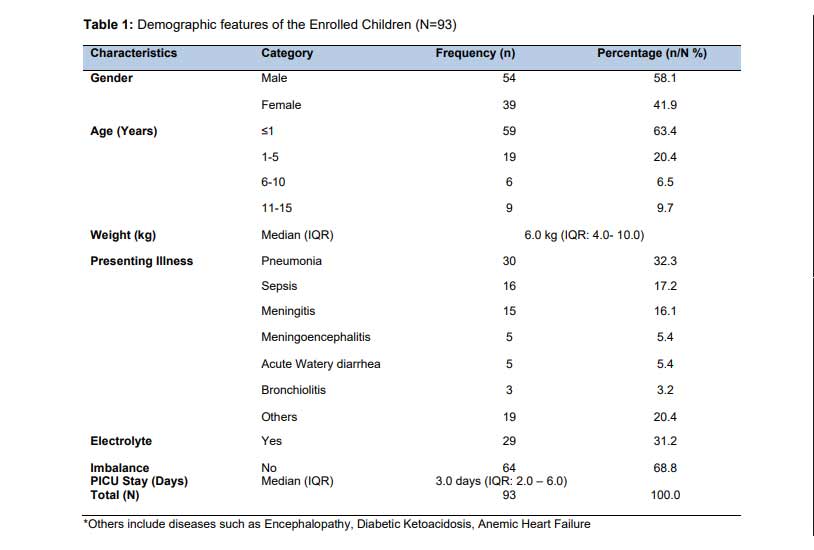
Of the 93 children, 54 (58.1%) were male and 39 (41.9%) were female. The median age was 0.83 years (IQR: 0.21–1.88; range: 0.08–14 years). The median weight was 6 kg (IQR: 4.0–10.0; range: 2–36 kg). Pneumonia was the most frequent diagnosis, observed in 30 (32.3%) children. The median hospital stay of the study participants was 4.0 days (interquartile range: 2.0–6.75 days). These demographic details are represented in Table 1.
The electrolyte imbalance was found in 29 (31.2%) patients, while 64 (68.8%) had normal serum electrolytes. Hyponatremia was the most common electrolyte abnormality observed in 11 (42%) children. Frequency and percentages of Electrolyte abnormalities are expressed in Figure 1.
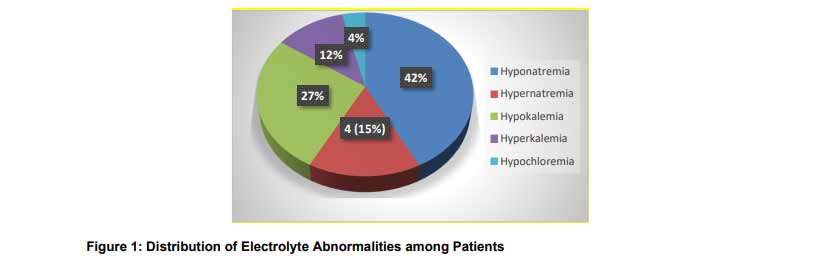
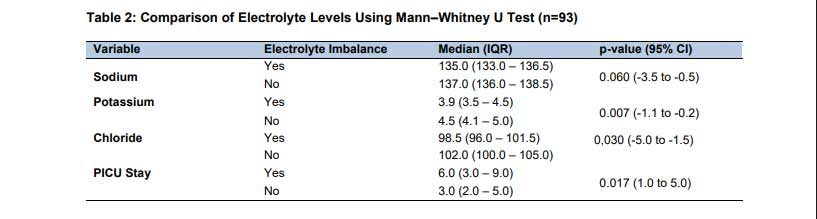
Table 2 shows a comparison of the serum sodium, potassium, and chloride levels between children with and without electrolyte imbalance. Potassium and chloride levels were significantly (p = 0.007 p = 0.030 respectively) lower in children with electrolyte imbalance, while sodium showed a trend toward lower values (p= 0.060). Children with imbalance had significantly longer (median 6.0 vs 3.0 days) PICU stays (p = 0.017).
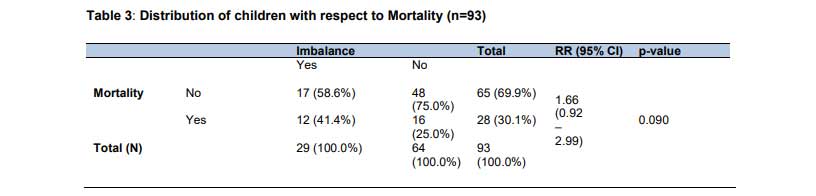
The mortality rate was higher in children with electrolyte imbalance, 41.4% (12/29) as compared to 25.0% (16/64) in the group without electrolyte imbalance. Overall, the mortality rate was 30.1% (28/93) of the children got expired during their PICU stay, as shown in Table 3.
Discussion
Maintenance of optimal electrolyte balance is fundamental for preserving physiological homeostasis [8, 9, 10]. Early identification of electrolyte disturbances is crucial for appropriate clinical management [11]. In critically ill pediatric patients, serum electrolyte abnormalities significantly influence outcomes and are linked with increased rates of PICU admission [12].
Of the total 93 children, Electrolyte imbalance was found in 29(31.2%) children, while 64(68.2%) had normal electrolyte levels. In a study, overall electrolyte abnormalities were found in 108 out of 180 children (60 %), and Haider et al where serum electrolyte abnormalities were observed in 57.3% of children [7, 13]. In another study from Pakistan, electrolyte abnormalities were present in 85% [3]. Another study showed 49.1% of the children had electrolyte disorders [14]. However, our results are comparable to those of Rao and Thomas, in which 32% children showed electrolyte abnormalities [15].
In our study, Hyponatremia was the most common electrolyte abnormality, observed in 11 (42.4%) patients while hypernatremia was observed in four (15.4%), Hypokalemia in seven (26.9%) children and hyperkalemia in three (11.5%) patients. Hypochloremia was seen in only one (3.8%) patient without any case of Hyperchloremia. Our findings are in accordance with other studies [9, 10, 13-18]. Studies by Agarwal et al. and Elala and Shimelis reported hyponatremia in 50.5% and 51.4% children, respectively [7, 19]. Ali et al found hyponatremia in 36% and hypokalemia in 64% [9]. Hyponatremia impairs cellular function by creating an osmotic gradient that draws water into cells. In the brain, this cerebral oedema can manifest as altered mental status, seizures, or increased intracranial pressure. This cellular dysfunction likely contributed to the higher mortality observed in children with electrolyte imbalances. Low potassium impairs skeletal muscle contractility and respiratory muscle function, potentially worsening respiratory failure and prolonging ventilatory dependence. Additionally, hypokalemia increases cardiac arrhythmia risk by prolonging repolarisation, which is especially dangerous in children with underlying cardiopulmonary compromise. Given that pneumonia was the most common illness, the combination of respiratory infection and hypokalemia likely created a cycle of worsening respiratory function.
In our study, the mortality was about 28 (30.1%). The mortality rate was higher in children with electrolyte imbalance, 41.4% (12/29), as compared to 25.0% (16/64) in the children without electrolyte imbalance. The overall mortality rate was 30.5% in a study in children having dyselectrolytemia [7].
PICU stay was longer in children with electrolyte imbalance: 6.0 (3.0–10.0) days, compared to 3.0 (2.0–5.0) days in those without electrolyte imbalance, which was statistically significant (p = 0.017). In another study, the median PICU stay was 4.0 (3.0-8.0) days, in children presenting with SEAs [20]. The significantly longer PICU stay in children with electrolyte imbalances likely reflects the physiological burden these imbalances impose. Hyponatremia-induced cerebral dysfunction, hypokalemia-related respiratory muscle weakness, and arrhythmia risk all require extended monitoring and treatment, delaying clinical recovery.
The limitation of our study was that it did not define various factors, like the nature and severity of underlying disease, which could have contributed to higher morbidity and mortality. Detailed analysis of other confounding factors and a possible multivariate analysis could provide a comprehensive assessment of the results of the
study. Another limitation was the smaller sample size; a study with large sample size, in multiple centres of Pakistan, should be conducted in future to validate the results.
Conclusion
Critically ill patients admitted to the PICU with electrolyte imbalances experience significantly higher mortality rates and longer PICU stay compared to those with normal electrolyte levels. These findings suggest that electrolyte abnormalities are important predictors of poor outcomes in paediatric age group. Timely recognition and management of electrolyte disturbances, besides the management of primary disease, will help in improving outcomes.
References
- Panda I, Save S. Study of association of mortality with electrolyte abnormalities in children admitted in pediatric intensive care unit. Int J Contemp Pediatr.2018 Apr,20;5(3):1097-103. http://dx.doi.org/10.18203/2349-3291.ijcp20181550
- Suryawanshi P, Dhaneria M, Chaturvedi A, Yadav A. Correlation of Electrolyte abnormalities with severity of illness in critically ill patients of NICU and PICU at CRGH and Associated Hospital of RD Gardi Medical College Ujjain (MP). Int. J. of Health Sci.2022 Sep, 13;6(S8):2602-10. https://doi.org/10.53730/ijhs.v6nS8.12674
- Naseem F, Saleem A, Mahar IA, Arif F. Electrolyte imbalance in critically ill paediatric patients. Pakistan journal of medical sciences. 2019;35(4):1093-98. https://doi.org/10.12669/pjms.35.4.286
- White KC, Nasser A, Chaba A, Bellomo R. Hypernatremia of critical illness. J Transl Crit Care Med. 2025;7(1):e24-00039. http://doi.org/10.1097/JTCCM-D-24-00039
- Sadeghi-Bojd S, Noori N, Zarifi E, Teimouri A. Prevalence of hypomagnesaemia in children admitted to the pediatric Intensive Care Unit and its related factors in Zahedan, Iran. Int J Pediatr. 2021;9(5):13539-49. https://doi.org/10.22038/ijp.2020.49643.3969
- Abouamer A, Soliman D, Shaban H, Anter N. Calcium, Magnesium and phosphate deficiency and their Effect on Clinical outcome in Critically Ill child. Benha j.appl. sci.2020;5(2 part (2)):317-22. https://doi.org/10.21608/bjas.2020.135723
- Agarwal N, Rao YK, Saxena R, Acharya R. Profile of serum electrolytes in critically ill children: A prospective study. Indian j.child health. 2018;5(2):128-32. https://doi.org/10.32677/IJCH.2018.v05.i02.014
- Canepa-Escaro F, Neyra JA. Is dyschloremia a marker of critical illness or euchloremia an interventional target to improve outcomes? Ann Transl Med.2019;7(Suppl 8):S264. http://dx.doi.org/10.21037/atm.2019.12.48
- Ali SH, Mohammed MM, Youssef RS. The Pattern of Electrolyte Imbalance in Critically Ill Children admitted in Pediatric Emergency Unit at Sohag University Hospital. Egypt J. Hosp Med.2021;82(2):276-81. https://doi.org/10.21608/ejhm.2021.143889
- Routray M, Kishore S, Champatiray J, Satpathy SK. Demographic variation of electrolyte imbalance in a tertiary care pediatric intensive care unit. Int J Contemp Pediatr. 2020;7(2):224-229. http://dx.doi.org/10.18203/2349-3291.ijcp20200095
- Lin J, Zhang Y, Chen M, Dai J, Song A, Chen J, et al. The Association Between Variability in Electrolytes and the In-Hospital Mortality in Critically Ill Children in Pediatric Intensive Care Units. Front. Pediatr. 2021;9:692894. https://doi.org/10.3389/fped.2021.692894
- Zeng X, Yu G, Lu Y, Tan L, Wu X, Shi S, et al. PIC, a paediatric-specific intensive care database. Sci Data. 2020;7(1):14. https://doi.org/10.1038/s41597-020-0355-4
- Haider M, Hameed A, Fatima S, Afroze M, Noor N, Arshad U. Frequency of Electrolyte Disorders and Its Effect On Mortality Among Children Admitted In Pediatric Intensive Care Unit. Journal of Bahria University Medical and Dental College. 2020;10(2):115-9. https://doi.org/10.51985/JBUMDC2020011
- Shah BK, Paudel N, Paudel A, Aryal S. Serum Electrolyte Abnormality in Children Admitted to Paediatric Emergency and ward: A Cross-Sectional Study.J.Nepal Paediatr.Soc. 2024 Oct 3;44(2):43-7. https://doi.org/10.60086/jnps1232
- SD SR, Thomas B. Electrolyte abnormalities in children admitted to pediatric intensive care unit. Indian Pediatr. 2000;37(12): 1348-53. https://indianpediatrics.net/dec2000/dec-1348-1353.htm
- Das A, Sil A, Biswas S, Gupta AK. Serum Electrolyte Level As A Marker Of Morbidity In Critically Sick Children: A Study From A Rural Tertiary Care Hospital. Int. J.Sci.Res. 2019;8(2):34-45. https://www.doi.org/10.36106/ijsr
- Farrukh R, Masood S, Shakoor I, Naseer A, Sultana S, Nasir F. Outcome and Incidence of Hypomagnesemia in Children Admitted in Pediatric Intensive Care Unit of a Tertiary Care Hospital. Pak. J.Med.Health Sci. 2021;15(5):1169-73. https://doi.org/10.53350/pjmhs211551169
- Barbance O, De Bels D, Honoré P, Bargalzan D, Tolwani A, Ismaili K, et al. Potassium disorders in pediatric emergency department: Clinical spectrum and management. Arch. Pédiatr. 2020;27(3):146-51. https://doi.org/10.1016/j.arcped.2019.12.003
- Elala G, Shimelis D. Patterns of electrolyte abnormalities in children 0-15 years of age admitted to pediatric emergency and intensive care units of a tertiary hospital. IOSR Journal of Dental and Medical Sciences. 2018;17(2):12-6. 10.9790/0853-1702091216
- Yen C-W, Yu M-C, Lee J. Serum electrolyte abnormalities in pediatric patients presenting to an emergency department with various diseases: Age-related differences. Pediatrics & Neonatology. 2022;63(6):575-81. https://doi.org/10.1016/j.pedneo.2022.04.008