Abstract
Background: Brain drain refers to the migration of highly skilled professionals from their home country to more developed nations. In Pakistan, an increasing number of dental healthcare workers are considering emigration, leading to a shortage of professionals in the field.
Objective: The objective of this study is to assess the key factors driving the emigration intentions of dental healthcare
workers in Pakistan.
Method: A cross-sectional study was conducted in dental colleges in Islamabad over a two-month period using convenience sampling. Data were collected from 361 dentists and dental students through a self-developed structured questionnaire distributed both physically and electronically. The tool comprised four domains: demographic characteristics, emigration intentions, push and pull factors, and retention strategies. Content validity was assessed through expert review, and reliability testing demonstrated a Cronbach’s alpha of 0.70. Data were analysed using SPSS version 26. Descriptive statistics were computed, and associations between categorical variables were assessed using the Chi-square test, with p≤0.05 considered statistically significant.
Results: A total of n=246 (68.1%) participants expressed intentions to move abroad, primarily due to economic factors (n=208, 56.8%), better living standards (n=203, 56.2%), and financial independence (n=188, 52.1%). Workplace challenges, including low salaries (n=203, 56.2%), limited career progression (n=184, 50.9%), and job insecurity (n=114, 31.6%), were significant push factors. Among those intending to stay in Pakistan (n=115, 31.9%), family commitments (n=70, 19.4%), a desire to serve the country (n=51, 14.1%), and difficulties adjusting abroad (n=48, 13.3%) were the primary reasons. Participants emphasized increased salaries (n=294, 81.4%), improved work environments (n=246, 68.1%), and enhanced postgraduate training opportunities (n=176, 48.8%) as crucial measures to mitigate brain drain.
Conclusion: The findings indicate that economic instability and limited career growth opportunities are the primary factors driving dental professionals to consider emigration. These issues must be addressed through financial reforms, better professional infrastructure, and clear career pathways to retain skilled professionals. Sustainable policies must be implemented to strengthen the healthcare system and ensure long-term national development.
Keywords: Career choice, Emigration, Employment, Work Environment.
Introduction
Brain drain refers to the migration of skilled professionals from their home countries to other nations in search of better living conditions, higher income, and improved professional opportunities. This phenomenon has become an increasing concern for healthcare systems, particularly in low- and middle-income countries, where the loss of trained professionals affects both the availability and quality of healthcare services. In Pakistan, a growing number of medical students and graduates have expressed intentions to pursue careers abroad, highlighting concerns regarding workforce retention 1. Similar trends have also been observed among dentists in Punjab, where dissatisfaction with professional prospects contributes to brain drain within the dental workforce 2. Comparable migration patterns have been reported in other settings, such as Nigeria, indicating that this issue reflects a broader global challenge 3.
The migration of healthcare professionals has important implications for national healthcare systems. Evidence from Pakistan suggests that medical students are aware of the adverse socio-medical impact of brain drain on the country 4. International studies have shown that postgraduate uncertainty and limited professional opportunities significantly influence emigration intentions among healthcare workers 5. A rapid review from West Africa also emphasized that structural and systemic challenges consistently drive physician migration 6. In addition to workforce shortages, migration can negatively affect healthcare delivery and patient safety by increasing the burden on the remaining workforce 7.
Within Pakistan, dissatisfaction with career structure and limited future opportunities has been identified as a major factor influencing migration decisions among junior doctors 8. Similar findings have been reported among young medical graduates in Lahore, reflecting an ongoing risk of brain drain 9. In dentistry, migration has also been linked to limited opportunities for professional development among oral health professionals 10. Evidence from Karachi further supports this trend, indicating that multiple factors influence migration intentions among dental practitioners in Pakistan 11.
Long-term evidence shows that the outflow of healthcare professionals from Pakistan has persisted over several decades, contributing to workforce challenges 12. Political instability and economic uncertainty further accelerate the migration of highly skilled professionals 13. International literature indicates that healthcare workers are attracted to high-income countries due to better financial incentives, working conditions, and career pathways 14. These findings suggest that migration is driven by a combination of push and pull factors.
Medical brain drain remains a critical challenge for Pakistan’s healthcare sector, where the loss of trained professionals further weakens an already strained system. Despite increasing attention to this issue, limited research has specifically examined emigration among dental professionals in Pakistan. Therefore, this study aimed to assess emigration intentions among dentists and dental students in Islamabad and to identify the factors influencing these intentions.
Method
A quantitative cross-sectional study was conducted over a two-month period (April–May 2025) in two dental colleges in Islamabad, Pakistan: Islamabad Medical and Dental College (IMDC) and Riphah International University. The study included dental students and practicing dentists affiliated with these institutions. Participants were recruited using convenience sampling. A total of 361 dentists and dental students participated in the study, exceeding the minimum calculated sample size of 342 participants. Data were collected using a self-developed structured questionnaire distributed both in printed form and electronically through an online survey. The questionnaire consisted of four domains. The first section collected demographic information, including age, gender, and professional designation, as well as participants’ intentions regarding migration. The second section included questions related to motivations for emigration. The third section explored reasons for remaining in Pakistan, while the fourth section assessed participants’ recommendations for reducing brain drain in the healthcare sector.
Content validity of the questionnaire was assessed through expert review by faculty members in dental education and public health. The questionnaire was pilot tested on 30 participants to assess clarity and internal consistency. Reliability analysis demonstrated acceptable internal consistency, with a Cronbach’s alpha value of 0.70. The inclusion criteria consisted of dental students and dentists currently enrolled or practicing in the selected institutions in Islamabad. Participants who declined to participate or submitted incomplete questionnaires were excluded from the analysis.
Ethical approval for the study was obtained from the Institutional Review Board of the respective institution (Approval No: 264; Date: 04-04-2025). Participation was voluntary, and informed consent was obtained from all participants prior to data collection.
Data were analyzed using the Statistical Package for the Social Sciences (SPSS), version 26. Descriptive statistics, including frequencies and percentages, were calculated for all variables. Associations between categorical variables were assessed using the Chi-square test, and a p-value ≤ 0.05 was considered statistically significant.
Results
The study population (n = 361) comprised predominantly female participants (n = 285, 78.9%), while male respondents accounted for n = 76 (21.1%). Regarding professional designation, dental students formed the majority (n = 204, 56.5%), while dentists accounted for n = 157 (43.5%) of respondents. Notably, n = 246 (68.1%) of participants reported plans to go abroad, compared with n = 115 (31.9%) who intended to remain in Pakistan.
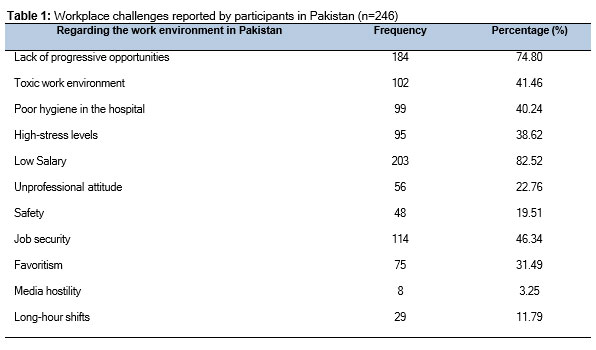
The study identified several workplace challenges affecting dental professionals in Pakistan. Low salary emerged as the most frequently reported issue, followed by limited career progression and job insecurity. Other concerns included toxic work environments, poor hospital hygiene, high stress levels, and workplace favouritism. Additional factors such as unprofessional behaviour, safety concerns, and long working hours were also reported, while media hostility was the least cited issue. Detailed distribution of these factors is presented in Table 1.
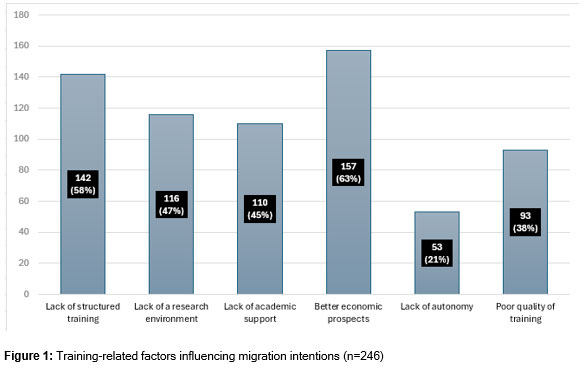
Challenges in training environments were also significant. Economic constraints were the most cited factor (63.82%, n = 157), followed by a lack of structured training (57.72%, n = 142), and the least frequently reported factor was limited autonomy in training (n = 53, 21.54%) as shown in Figure 1.
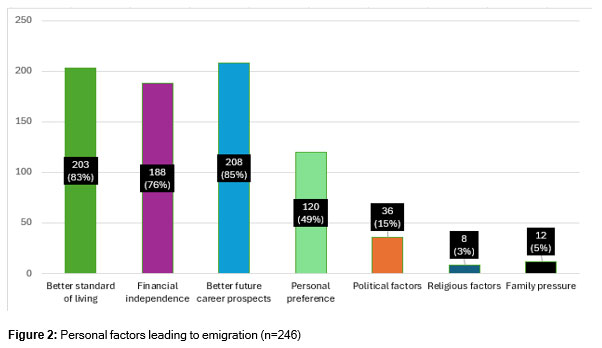
Personal motivations for emigration were primarily economic. Career prospects (84.55%, n = 208) and a better standard of living (82.52%, n = 203) were dominant factors, alongside financial independence (76.42%, n = 188) as shown in Figure 2.
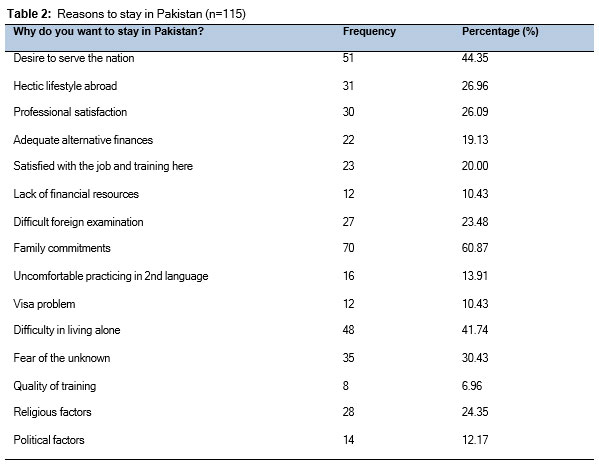
Despite emigration trends, 60.98% (n = 150) expressed intentions to return to Pakistan, suggesting that many participants maintained long-term ties to their home country. Among those choosing to stay in Pakistan (n = 115), family commitments (60.87%, n = 70) were the primary reason, followed by a desire to serve the nation (44.35%, n = 51) and difficulties adjusting to life abroad (41.74%, n = 48). The distribution of other factors is presented in Table 2.
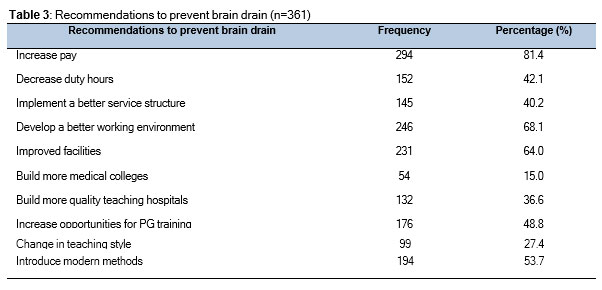
To mitigate the brain drain, professionals (n = 361) emphasized financial and systemic reforms. Increased salaries (81.4%, n = 294), better work environments (68.1%, n = 246), and improved facilities (64.0%, n = 231) were the top priorities. Other recommendations are summarized in Table 3.
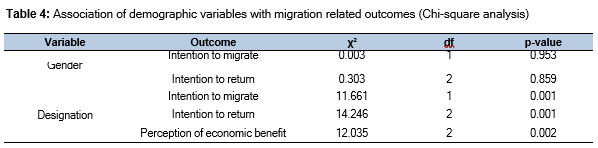
Chi-square analysis was performed to assess associations between selected demographic variables and migration-related outcomes (Table 4). No significant association was found between gender and intention to migrate abroad (χ² = 0.003, df = 1, p = 0.953). However, a statistically significant association was observed between professional designation and migration intention, with dental students more likely to express plans to migrate compared with practicing dentists (χ² = 11.661, df = 1, p = 0.001). Similarly, no significant association was found between gender and intention to return to Pakistan after migration (χ² = 0.303, df = 2, p = 0.859). In contrast, professional designation showed a significant association with return intentions (χ² = 14.246, df = 2, p = 0.001). A significant association was also observed between professional designation and perceptions of better economic prospects after training abroad (χ² = 12.035, df = 2, p = 0.002).
Discussion
The present study highlights a considerable intention among dental professionals and students in Pakistan to migrate abroad. Similar trends have been reported among medical students and graduates in Pakistan, where financial instability and limited career advancement opportunities were identified as key determinants of migration 1. Comparable concerns have also been reported among dentists in Punjab who expressed dissatisfaction with salary structures and professional growth opportunities 2. Similar patterns have also been observed in other low- and middle-income countries, including Nigeria, where inadequate pay and limited career progression strongly influence physicians’ migration decisions 3. These findings indicate that healthcare workforce migration is driven by systemic challenges common across developing healthcare systems. However, the magnitude and interaction of these factors may vary depending on local economic conditions and healthcare infrastructure.
Workplace challenges emerged as important contributors to migration intentions in the present study. Participants frequently reported concerns related to inadequate salaries, limited career progression, job insecurity, and unfavorable working conditions. Previous studies in Pakistan have similarly identified financial dissatisfaction and limited career development opportunities as major drivers of brain drain among healthcare professionals 4. Evidence from Nigeria also highlights job insecurity and lack of professional incentives as key push factors influencing physician emigration 5, while broader reviews from West Africa emphasize economic hardship and weak employment structures 6. In addition, healthcare workforce migration has been shown to adversely affect patient safety and system performance by increasing the burden on the remaining workforce 7. In Pakistan, dissatisfaction with training quality and limited career prospects has also been identified as a significant contributor to migration intentions among junior doctors 8, while concerns regarding career uncertainty have been reported among young medical graduates in Lahore 9. These findings collectively suggest that workplace dissatisfaction operates alongside systemic constraints to drive migration decisions.
Training-related factors also appear to influence migration decisions. Participants reported concerns regarding limited access to structured training programs and insufficient academic support. Similar findings have been observed among Iranian dentists who migrated to Canada, where dissatisfaction with training opportunities in their home country contributed to migration decisions 10. Studies conducted in Pakistan have likewise reported dissatisfaction with postgraduate training opportunities among dental professionals 11. Long-term analyses further indicate that Pakistan has experienced a sustained loss of healthcare professionals due to limited investment in professional training and career development programs 12. However, differences in training structures and accreditation systems across countries may influence the extent to which these factors contribute to migration. Strengthening training infrastructure and expanding postgraduate opportunities may therefore help reduce migration intentions among healthcare professionals.
Economic considerations were also prominent motivations for migration in the present study. Participants frequently identified improved career prospects, financial stability, and better standards of living as key factors influencing their migration intentions. Previous research has similarly reported that economic instability and limited professional security contribute significantly to the migration of healthcare professionals from Pakistan 13. Comparable evidence from Turkey highlights financial incentives and career security as major determinants of physician migration 14, while studies from Iran emphasize the role of economic stability in retaining healthcare professionals 15. These findings indicate that migration decisions are shaped by a complex interaction of financial, professional, and social factors, although their relative importance may differ across settings. Despite strong migration intentions, many respondents expressed a willingness to return to Pakistan in the future. Similar patterns have been reported among internationally trained nurses, who often view migration as a temporary strategy for gaining professional experience before returning to their home countries 16. Studies conducted among medical students in Pakistan have also suggested that some graduates intend to contribute to the national healthcare system after receiving training abroad 17. Among those choosing to remain in Pakistan, family commitments and a sense of social responsibility were important factors. Comparable findings have been reported among nursing students in Ghana, where strong family and cultural ties influenced decisions to remain in the home country 18. However, persistent financial and professional challenges may ultimately override these intentions, as suggested by studies reporting shifts toward migration over time 19, 20.
Participants in this study also emphasized the need for policy interventions to address healthcare workforce migration. Suggested measures included improving salary structures, strengthening working conditions, and expanding professional development opportunities. Previous studies have similarly recommended financial incentives, improved job security, and structured career pathways as strategies to reduce physician migration in developing countries 21. Evidence from Pakistan further highlights the need for comprehensive policy reforms aimed at strengthening professional infrastructure and career development opportunities for healthcare workers 22. However, the implementation of these strategies requires sustained financial investment and coordinated policy efforts, which may be challenging in resource-limited settings. Global evidence further indicates that healthcare workforce migration is a widespread phenomenon across developing regions 23. Studies from Nigeria have demonstrated that inadequate pay and limited career progression remain key drivers of physician migration 24. These findings reinforce that brain drain is influenced by systemic challenges shared across multiple low- and middle-income countries, although contextual differences must be considered when interpreting these comparisons.
This study has several limitations that should be considered when interpreting the findings. The use of convenience sampling and inclusion of only two dental colleges in Islamabad may limit the generalizability of the results to other regions of Pakistan. In addition, the reliance on self-reported responses may introduce response bias. The cross-sectional design also limits the ability to establish causal relationships between the identified factors and migration intentions. Furthermore, the relatively small pilot sample used to assess questionnaire reliability may affect the robustness of instrument validation. Differences in healthcare systems and socio-economic conditions across countries may also limit the direct comparability of international findings. Despite these limitations, the study provides valuable insights into the factors influencing migration intentions among dental professionals in Pakistan. Future research involving larger and more diverse samples across multiple institutions would help provide a more comprehensive understanding of healthcare workforce migration and support the development of effective, context-specific policy strategies.
Conclusion
This study identifies economic instability, limited career growth, and poor working conditions as key factors driving the emigration of dental healthcare professionals from Pakistan, with a majority expressing intentions to migrate. However, willingness to return highlights the potential for retention through targeted reforms. To curb brain drain and strengthen the healthcare sector, Pakistan must implement sustainable policies that enhance financial incentives, improve academic and professional opportunities, and
foster a supportive work environment. These measures are crucial for revitalising healthcare institutions, advancing medical education, and ensuring long-term national development.
Acknowledgements:
The authors extend their appreciation to the invaluable support of Miss Kanwal, our biostatistician, for her expert guidance in data analysis and statistical interpretation. Also, acknowledge the use of AI-based tools for language editing and clarity enhancement. The final content, interpretation, and conclusions remain the sole responsibility of the authors
References
- Tariq Z, Aimen A, Ijaz U, Kashif. Career intentions and their influencing factors among medical students and graduates in Peshawar, Pakistan: a cross-sectional study on brain drain. Cureus. 2023;15(11):e48445. https://doi.org/10.7759/cureus.48445
- Hassan AU, Muzamil N, Wajahat M, Iqbal Z, Bajwa O. Perception of dentists regarding brain drain in Punjab, Pakistan: a cross-sectional survey. J Univ Med Dent Coll. 2022;13(4):503–507. https://doi.org/10.37723/jumdc.v13i4.726
- Akinwumi AF, Solomon OO, Ajayi PO, Ogunleye TS, Ilesanmi OA, Ajayi AO. Prevalence and pattern of migration intention of doctors undergoing training programs in public tertiary hospitals in Ekiti state, Nigeria. Hum Resour Health. 2022;20(1):76. https://doi.org/10.1186/s12960-022-00772-7
- Nadir F, Sardar H, Ahmad H. Perceptions of medical students regarding brain drain and its effects on Pakistan’s socio-medical conditions: a cross-sectional study. Pak J Med Sci. 2023;39(2):496–501. https://doi.org/10.12669/pjms.39.2.7139
- Ezeike A, Ebong A. Postgraduate career and emigration intentions: a cross-sectional study of house officers in a north central, Nigerian tertiary hospital. Niger J Clin Med. 2021;30(5):561–566. https://doi.org/10.4103/njm.njm_95_21
- Ebeye T, Lee H. Down the brain drain: a rapid review exploring physician emigration from West Africa. Glob Health Res Policy. 2023;8(1):23. https://doi.org/10.1186/s41256-023-00307-0
- Peters A, Palomo R, Pittet D. The great nursing brain drain and its effects on patient safety. Antimicrob Resist Infect Control. 2020;9:57. https://doi.org/10.1186/s13756-020-00719-4
- Balouch MS, Balouch MM, Balouch MS, Qayyum W, Zeb Z. Career aspirations of junior doctors in Pakistan: exploring reasons behind the brain drain. J Ayub Med Coll Abbottabad. 2022;34(3):500–506. https://doi.org/10.55519/jamc-03-10549
- Riffat N, Mumtaz U, Qureshi Z, Jabeen S, Noor T, Shafiq M. Career preferences and brain draining threats among young medical graduates of services institute of medical sciences, Lahore. J Akhtar Saeed Med Dent Coll. 2020;2(1):4–8. https://doi.org/10.51127/jamdcv02i01oa01
- Hajian S, Jadidfard MP, Yazdani S, Randall G, Khoshnevisan MH. Understanding why oral health professionals migrate: a qualitative investigation of Iranian dentists who have moved to Canada. Glob Health Action. 2023;16(1):2215787. https://doi.org/10.1080/16549716.2023.2190652
- Hyder SN. Factors affecting migration abroad of dental practitioners from Karachi: a cross-sectional survey. J Pak Med Assoc. 2019;69(10):1492–1495. https://doi.org/10.5455/jpma.291597
- Meo SA, Sultan T. Brain drain of healthcare professionals from Pakistan from 1971 to 2022: Evidence-based analysis. Pak J Med Sci. 2023;39(4):921–925. https://doi.org/10.12669/pjms.39.4.7853
- Meo SA, Eldawlatly AA, Sultan T. Impact of unstable environment on the brain drain of highly skilled professionals in Pakistan. Saudi J Anaesth. 2024;18(1):48–54. https://doi.org/10.4103/sja.sja_549_23
- Bener A, Ventriglio A, Almas F, Bhugra D. Determinants of brain drain among physicians in Turkey. Int J Soc Psychiatry. 2025;71(1):179–187. https://doi.org/10.1177/00207640241285834
- Ghanbari-Jahromi M, Marzaleh MA. Factors affecting brain drain in Iran's health system. Arch Iran Med. 2024;27(8):427–438. https://doi.org/10.34172/aim.28863
- Ram FSF, McDonald EM, Kuttan A, Sudarsan I. Nursing brain drain and retention strategies. Policy Polit Nurs Pract. 2025;18(1):1–10. https://doi.org/10.1177/15271544251314338
- Sheikh A, Naqvi SHA, Sheikh K, Naqvi SHS, Bandukda MY. Physician migration at its roots. Global Health. 2012;8(1):1–11. https://doi.org/10.1186/1744-8603-8-43
- Laari CK, Sapak J, Wumbei D, Salifu I. Migration intentions among nursing students. BMC Nurs. 2024;23(1):1–8. https://doi.org/10.1186/s12912-024-02180-9
- Imran N, Azeem Z, Haider II, Amjad N, Bhatti MR. Brain drain among medical graduates in Lahore. BMC Res Notes. 2011;4:1–5. https://doi.org/10.1186/1756-0500-4-417
- Mohamed EY, Balla S, Abdulaal A, Yousif MAA, Alzahrani M, Medani KA, et al. Migration intentions of medical students in Sudan. World J Pharm Pharm Sci. 2015;4(4):26–33.
- Astor A, Akhtar T, Matallana MA, Muthuswamy V, Olowu FA, Tallo V, et al. Physician migration. Soc Sci Med. 2005;61(12):2492–2500. https://doi.org/10.1016/j.socscimed.2005.05.003
- Ahmed A, Aribah, Ibrahim M. Medical brain drain in Pakistan. J Pak Med Assoc. 2024;74(3):614. https://doi.org/10.47391/jpma.10024
- Adovor E, Czaika M, Docquier F, Moullan Y. Medical brain drain: how many, where and why? J Health Econ. 2021;76:102409. https://doi.org/10.1016/j.jhealeco.2020.102409
- Akafa TA, Okeke A, Oreh A. Push and pull factors of emigration among physicians in Nigeria. West Afr J Med. 2023;1(2):1–12. https://doi.org/10.54938/ijemdbmcr.2023.01.2.251