Abstract
Background: Medical students have been reported to experience stress due to various factors, of which the system of education plays a major role.
Objective: To compare the stress levels in medical students studying in conventional/Conventional (Annual) and integrated modular system of medical education in medical colleges affiliated with a government sector university in Lahore.
Method: This cross-sectional study was conducted on medical students of five medical colleges in Lahore. Two classes, MBBS second and fourth years. The duration of study was from November 2024 to March 2025. Data was collected using the 2020 version of student stress inventory (SSI), and was analyzed using R-language version 4.5.2.
Results: Among the students from Conventional system, 33% (n=31) students experienced low; 54% (n=51) students experienced moderate; whereas 14% (n=13) students experienced severe academic stress. Among students from the modular system, 52% (n=49) students experienced low; 47% (n=45) students experienced moderate; and 1% (n=1) students experienced severe academic stress (p value <0.001). Whereas, among the Conventional system students; 46% (n=44) students experienced low; 42% (n=40) students experienced moderate; and 12% (n=11) students experienced severe overall stress. And among the modular system students; 63% (n=60) students experienced low; 37% (n=35) students experienced moderate; whereas 0% (n=0) students experienced severe overall stress (p value = 0.001).
Conclusion: Stress levels are higher in medical students studying in Conventional system, as compared to those studying in modular system, in medical colleges, affiliated with the UHS.
Keywords: Stress, Medical students, Conventional system, Modular system.
Introduction
According to World Health Organization (WHO), mental health is a significant component of health. Stress is defined as a situation of worry or mental strain subjected to challenging situations. Stress is a natural part of being human—it compels us to respond to demanding situations that we face everyday life. We all experience stress to varying extent. The manner in which we react to stressful situations influences our overall well-being [1]. The first and most generic definition of stress is that proposed by Hans Selye: “Stress is the non-specific response of the body to any demand” [2].
Stress causes adaptive measures, which cause secretion of hormones, such as adrenocorticotropin from the anterior pituitary gland, catecholamines from adrenal medulla, and corticosteroids from adrenal cortex [3].
Conventional System is the conventional annual system which is a teacher-based educational system. According to this system, the examination commences at the end of a year with few formative assessments [4].
According to Harden, integration is the method of teaching in such an organized manner that helps link together subjects which are usually taught separately in different courses or departments [5]. Modular system brings together knowledge from different subjects and combines it into a complete, meaningful whole [6], [7]. This integration among the disciplines enables the student to deal with real-life situations and comprehend the patient as a whole [8]. The shift from Conventional teaching to an integrated system is meant to help medical students not just gain knowledge, but also learn how to apply it, think critically, and develop lifelong learning habits along with strong communication and teamwork skills [9].
There are many factors that lead to a stressful situation in human beings. Focusing on medical students, the major factor causing stress comes out to be academic pressure. Regarding the prevalence of stress in medical students, around 68.5% students suffer from stress due to wideness of curriculum academically [10].
On 17th February 2023, the academic council of University of Health Sciences (UHS) made a landmark decision by approving an integrated discipline-aligned curriculum, moving away from the old discipline-based system that separated preclinical and clinical studies. In UHS-affiliated medical colleges, integrated modular system of education has been introduced since 1st March, 2023. As of 2025, the MBBS First through Third Years follow the modular system, whereas the Fourth and Final Years follow the Conventional system of education [6].
Five UHS-affiliated colleges, whose students will be under study, are those colleges that have both modular and Conventional system of education going on. The colleges namely FMH College of Medicine and Dentistry, Lahore; Services Institute of Medical Sciences, Lahore; Akhtar Saeed Medical and Dental College, Lahore; Rashid Latif Medical College, Lahore; and Al-Aleem Medical College, Lahore are affiliated with University of Health Sciences. We will enroll the students of MBBS Fourth Year, representing the Conventional system and MBBS Second Year, representing the modular system. Second Year MBBS, which follows the modular system at present, teaches three blocks, each with two modules, which cover the subjects of Basic Sciences (Physiology, Anatomy, Biochemistry, Pathology, Pharmacology, Community Medicine and Behavioral Sciences) and Clinical Sciences (Surgery, Medicine and Gynecology). They are exposed to clinical ward rotations from the very start. Whereas, MBBS Fourth Year Medical Students study four subjects, namely Community and Preventive Medicine; Special Pathology; Otorhinolaryngology (ENT); and Ophthalmology [11].
A curricular alteration affects the way the students perceive the system. Hence, it is needed to identify the system that is more stressful for medical students. So, this study aims at comparing the stress levels in medical students from both the systems, and ultimately finding out, which system is more stressful, and needs alteration.
Method
This cross-sectional study was carried out at FMH College of Medicine and Dentistry, Lahore. Sample was collected from five UHS-affiliated medical colleges of Lahore, selected on convenience basis, from November 2024 to March 2025. The five medical colleges selected include FMH College of Medicine and Dentistry, Services Institute of Medical Sciences, Rashid Latif Medical College, Akhtar Saeed Medical and Dental College, and Al-Aleem Medical College. The study was performed on medical students from both Conventional and modular systems of education. The sample class selected to represent Conventional system, was MBBS fourth year, as at the time of sample collection, their annual result had been announced, and stress normally observed during the time when students wait for their results, could be omitted. Moreover, the class that represented the modular system was MBBS second year. This class was chosen, because MBBS third year, that was also a modular system-based class, was busy in annual exams, conducted by the UHS, and MBBS first year had just joined, so interpreting the results by sampling them would not result in a fair test.
The sample size, as calculated using the WHO sample size calculator, version 2.0.21, was 190. Sample was divided equally into two groups, Group A; the Conventional system, 95 students, and Group B; the modular system, 95 students. The enrolled students were equally taken from the above-mentioned colleges.
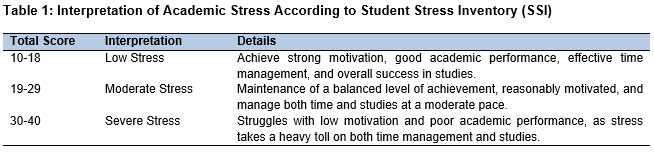
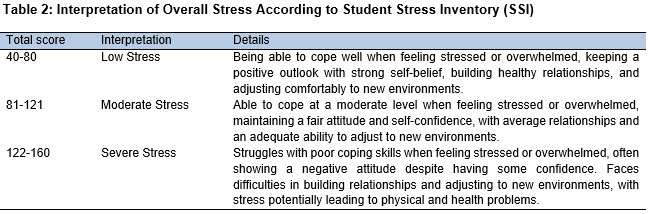
The questionnaire that was used, is called the Student Stress Inventory [12]. Permission was granted from the primary author. Before getting the inventory filled by sample students, they were explained the complete procedure, and informed consent was taken from each student beforehand. The questionnaire is based on 40 questions, that interpret the stress levels of an individual based on four parameters; physical; interpersonal relation; academic; and environmental stress. A key is provided along with the questionnaire, by the primary author of the inventory, that helps interpret the results, as given in (Tables 1 and 2). The data was collected by a trained researcher, and was verified by a research supervisor, a professor and a doctor of philosophy. The collected data and the identity of the students was kept extremely confidential. We interpreted overall stress of the individual, as well as the academic component (represented by questions 21–30 of the inventory), as academic stress is the most major contributor to stress in a medical student, especially in the case that’s under study. The collected data was analyzed by using R-language version 4.5.2. Frequencies and percentages were also calculated. Ethical approval was taken from the Institutional Review Board of FMH College of Medicine and Dentistry (Approval Number: FMH-25/02/2025-IRB-1610).
Results
Among the 190 students, 95 (50%) were from Conventional, and 95 (50%) were from modular system. Interpreting the academic stress, in group A, that included the students studying in Conventional system, 33% students experienced low stress; 54% students experienced moderate stress; whereas 14% students experienced severe stress. In group B, that included students from the modular system, 52% students experienced low stress; 47% students experienced moderate stress; and 1% students experienced severe stress (p value <0.001) (Table 3).
When interpreting the overall stress, it was seen that in group A, the Conventional system students; 46% students experienced low stress; 42% students experienced moderate stress; and 12% students experienced severe stress. In group B, the modular system students; 63% students experienced low stress; 37% students experienced moderate stress; whereas 0% students experienced severe stress (p value = 0.001) (Table 4).
The Chi-sq test at 5% level of significance shows that Education Systems are associated with Stress levels. Conventional methods are more likely to be associated with greater stress levels.


Discussion
It is observed that the academic schedule or timetable of students studying in Conventional system is quite boring. It is seen that the academic timetable of Conventional system mainly comprises of lecture-based learning, and tutorials, whereas the academic timetable of modular students comprises of many more interesting components like group projects, PERLS, research work, and field visits that proves to be quite interesting for students, and hence is a major cause of modular students experiencing lesser stress as compared to Conventional ones.
Students studying in Conventional system in UHS-affiliated medical colleges most probably experience more stress due to their examination system and academic schedule. Firstly, in the examination system of students from the Conventional system, each subject is equally important, and its weightage is huge in the overall result. Whereas in modular system, there are block exams, in which each block comprises of various subjects. In this way, the weightage is divided amongst the subjects, and it is easier to clear an exam with lesser academic pressure, compared to the prior system.
There are many factors that lead to a stressful situation in human beings. Literature shows much evidence that a major cause of stress in medical students is the lengthy course and challenging examinations [13,14]. Medical students have identified studies and examinations as major stressors, with an impact on their mental wellbeing and performance [15].
In the present study it is seen that majority of the students studying in Conventional system, experience either moderate or severe academic and overall stress, whereas majority of students studying in modular system experience low stress, which shows that overall as well as academic stress is more prevalent in students studying in Conventional system.
Most of the research work done so far is consistent to our findings. A study conducted in Pakistan, reveals that although modular system of teaching requires more experienced faculty but the rate of satisfaction in terms of benefits is much higher than that of conventional one. Moreover, teacher biasness is also very less and the students studying in modular system have a better clarity of concepts, as they correlate and integrate their subjects and concepts while studying along with clinical experience [16].
M Almansour observed that students valued teaching methods that efficiently bridged theoretical concepts with practical application, enhancing their relevance of learning [17].
It is also seen, as observed in a study conducted by Tariq M, et al. that students appreciated the modular system of education in medicine, as it provides holistic learning along with integration, clinical preparedness, examination efficiency and adaptability, global medical education compatibility, enhanced learning strategies, and a less stressful and more engaging curriculum [18].
Favouring our study, a research on stress level comparison in nursing students concluded that students taught through Conventional methods experienced higher academic stress compared to those taught using the blended method [19]. Whereas in terms of effectiveness of both system is concerned, the modern teaching methodology was proven to be more fruitful [20].
Contrary to ours, a study done in another UHS affiliated medical college at Lahore document that although integrated modular system enhances long-term retention, promotes frequent testing, and fosters student–teacher interaction, with small group discussions, presentations, and flipped classes further improving learning but students feel that the new system creates undue pressure, largely stemming from its assessment methods and curriculum design [21]. Still another study, while comparing stress among Conventional and modular system students, showed positive correlation between modular system and depression and anxiety; P=0.02 (Pearson’s correlate= 0.162, 0.178), whereas, negative correlation was seen between depression and anxiety (Pearson’s correlate= -0.162, -0.178) in Conventional system [22].
Both Conventional teacher-centered education and student-centered modern education have their own strengths and weaknesses. To fully leverage the benefits of each approach, the choice should be guided by the learning outcomes desired by the students. However, if properly applied, the modern teaching methodology is proven to be more beneficial as observed by various researchers around the world.
Conclusion
Stress levels are higher in medical students studying in Conventional system in medical colleges, affiliated with the UHS. Hence, the decision of the UHS to implement modular system in medical education has proved to be beneficial for students. But, the major stressors for the students of Conventional system need to be identified, and they are to be mitigated with the help of project work and co-curricular activities, to lower the stress levels in students.
References
- WHO, World Health Organization [Internet]. Geneva: World Health Organization; 2023 [cited: 2025 February 24] Available from: https://www.who.int/news-room/questions-and-answers/item/stress
- Fink G. Stress: Concepts, definition and history. Change. 2016 Jan. Available from: https://www.researchgate.net/.../Stress-Concepts-Cognition-Emotion-and-Behavior-Handbook-of-Stress.pdf
- Al-Joubour ZT, AlRufaei IA, Al-Khazaali IA, Assi MA, Al-Fahham AA. Hormonal Changes During Acute Stress Response. International Journal Of Health & Medical Research. 2024;3(06):266-71. https://doi.org/10.58806/ijhmr.2024.v3i06n02
- Mehboob B, Jehan AM, Rahim S, Khan N, Khattak HW, Raheem A, et al. Depression, anxiety, and stress among dental students studying in modular and Conventional curriculum. Journal of Khyber College of Dentistry. 2023 Dec 31;13(04):8-11. https://doi.org/10.33279/jkcd.v13i04.575
- Kasarla RR, Verma A, Pathak L. Methodologies and models for integration of medical curriculum for effective teaching and learning: a theoretical review. Journal of Universal College of Medical Sciences. 2022 Aug 9;10(01):77-80. https://doi.org/10.3126/jucms.v10i01.47250
- Ajmal A, Manzoor I. Shift of Conventional curriculum to integrated curriculum: a drastic step by University of Health Sciences (UHS), Lahore. JAMDC. 2023; 5(1): 1-3. https://doi.org/10.51127/JAMDCV5I1editorial
- UHS, University of Health Sciences [Internet]. Lahore: University of Health Sciences; 2024 [cited: 2025 February 24] Available from: https://www.uhs.edu.pk/downloads/2k23mbbscurriculumv20.pdf
- Quintero GA, Vergel J, Arredondo M, Ariza MC, Gómez P, Pinzon-Barrios AM. Integrated medical curriculum: advantages and disadvantages. Journal of Medical Education and Curricular Development. 2016 Jan;3: JMECD-S18920. https://doi.org/10.4137/JMECD.S18920
- Challa KT, Sayed A, Acharya Y. Modern techniques of teaching and learning in medical education: a descriptive literature review. MedEdPublish. 2021 Jan 21;10:18. https://doi.org/10.15694/mep.2021.000018.1
- Satpathy P, Siddiqui N, Parida D, Sutar R. Prevalence of stress, stressors, and coping strategies among medical undergraduate students in a medical college of Mumbai. Journal of Education and Health Promotion. 2021 Aug 31;10:318. https://doi.org/10.4103/jehp.jehp_1395_20
- FMHCMD [Internet]. Lahore: FMH College of Medicine and Dentistry; 2024 [cited: 2025 February 24] Available from: https://www.fmhcmd.edu.pk/wp-content/uploads/2024/07/Student-Handbook-2023-24_MBBS-BDS.pdf
- Arip MA. STUDENT STRESS INVENTORY (SSI) Development, Validity and Reliability of Student Stress Inventory [Internet]. 2016.
- Weber J, Skodda S, Muth T, Angerer P, Loerbroks A. Stressors and resources related to academic studies and improvements suggested by medical students: a qualitative study. BMC Medical Education. 2019 Aug 20;19(1):312. https://doi.org/10.1186/s12909-019-1747-z
- Ragab EA, Dafallah MA, Salih MH, Osman WN, Osman M, Miskeen E, et al. Stress and its correlates among medical students in six medical colleges: an attempt to understand the current situation. Middle East Current Psychiatry. 2021 Dec 10;28(1):75. https://doi.org/10.1186/s43045-021-00158-w
- Slimmen S, Timmermans O, Mikolajczak-Degrauwe K, Oenema A. How stress-related factors affect mental wellbeing of university students: A cross-sectional study. PloS One. 2022 Nov 7;17(11):e0275925. https://doi.org/10.1371/journal.pone.0275925
- ur Rahman I, Mansoor S, Meraj L, Ahmad M, Dodhy MA, Sattar H. Faculty Satisfaction Regarding Modular Teaching. Journal of Rawalpindi Medical College. 2022 Mar 31;26(1). https://doi.org/10.37939/jrmc.v26i1.1880
- Almansour M, Almoayad F. Exploring challenges and perceptions in the learning environment: an online qualitative study of medical students. BMC Medical Education. 2024 Feb 14;24(1):147. https://doi.org/10.1186/s12909-024-05116-8
- Tariq M, Ikram A, Farooq M, et al. Qualitative phenomenological exploration of perspectives of medical students regarding integrated modular system. Medical Science Educator. 2025;35:1605–1616. https://doi.org/10.1007/s40670-025-02364-1
- Kassem AH, Abo Habieb EE, El-Bastwese RM. Effect of Blended vs. Conventional Teaching Methods on Nursing Students’ Academic Stress and Their Achievement at Mansoura University. Egyptian Journal of Health Care. 2020 Jun 1;11(2):408-26. Available from: https://journals.ekb.eg/article_129135_084efbe8d5f185b5448205a44360c736.pdf
- Wang Y. A comparative study on the effectiveness of conventional and modern teaching methods. In: Proceedings of the 2022 5th International Conference on Humanities Education and Social Sciences (ICHESS 2022). 2022 Dec 30; Vol. 720, pp. 270-277. Paris: Atlantis Press SARL. https://doi.org/10.2991/978-2-494069-89-3_32
- Munawar F, Ahmed H, Munawar M. Determining the Perception of Medical Students Regarding the Advantages and Disadvantages of Integrated Modular System (IMS) at Central Park Medical College, Lahore: Medical Students' Perceptions of Integrated Modular System. Health Professions Educator Journal. 2025 Jun 30;8(1):22-5. https://journals.uol.edu.pk/medicaleducator/article/view/3149
- Mehboob B, Jehan AM, Rahim S, Khan N, Khattak HW, Raheem A, Tahir H. Depression, anxiety, and stress among dental students studying in modular and conventional curriculum. J Khyber Coll Dent. 2023 Dec 31;13(04):8-11. https://doi.org/10.33279/jkcd.v13i04.575