Abstract
Background: Preeclampsia is a complicated condition that commonly appears after 20 weeks of gestation and is manifested by hypertensive syndrome accompanied by proteinuria.
Objective: To determine the association between dyslipidemia and preeclampsia and evaluate its potential role as a predictive marker for earlier diagnosis and therapeutic management.
Method: This comparative cross-sectional study was conducted at Gulab Devi Teaching Hospital, Lahore, from June 26, 2024, to December 26, 2024. A total of 60 pregnant women were enrolled, including 30 cases with preeclampsia and 30 normotensive pregnant women as controls. Lipid profile parameters, including total cholesterol (TC), triglycerides (TG), LDL- C, and HDL-C, were measured and recorded using a structured questionnaire. Data was analyzed using SPSS version
27.0. An independent sample t-test was applied to compare mean lipid levels between cases and controls to assess the association between dyslipidemia and preeclampsia.
Results: Among the 60 pregnant women, the mean ± standard deviation (SD) of triglycerides (TG) was 175.70 ± 23.28 mg/dL in controls and 261.60 ± 84.55 mg/dL in preeclamptic cases. The mean ± SD of low-density lipoprotein cholesterol (LDL-C) was 188.10 ± 29.12 mg/dL in controls and 223.50 ± 59.32 mg/dL in cases. Total cholesterol (TC) and high-density lipoprotein cholesterol (HDL-C) showed no statistically significant difference between the groups. The severity of preeclampsia was also evaluated to assess its relationship with lipid profile parameters.
Conclusion: Elevated levels of low-density lipoprotein cholesterol (LDL-C) and triglycerides (TG) were observed in women with preeclampsia compared to normotensive pregnant women, while high-density lipoprotein cholesterol (HDL-C) and total cholesterol (TC) showed no statistically significant differences between the groups. These findings suggest a possible association between dyslipidemia and preeclampsia; however, preeclampsia is a multifactorial condition, and the role of potential confounding factors should be considered when interpreting the results.
Keywords: Dyslipidemia, preeclampsia, blood lipids, hypertension, proteinuria
Introduction
Preeclampsia, also referred to as “pregnancy-induced hypertension,” is characterized by high blood pressure and proteinuria, which leads to damage to various organs. Typically arises in the 20th week of gestation and can cause life threatening condition in both mother and baby. Blood vessels become more prone to constriction and important organs like the liver don’t get the blood flow they require which can lead to liver dysfunction [1]. Key risk factors to preeclampsia include first-time mothers, females with a family history of preeclampsia, females with a previous history of preeclampsia, and those with autoimmune disorder can complicate pregnancy [2],[3],[4]. Poor nutrition, age, kidney dysfunction, diabetes, either gestational or stress, low socioeconomic status, and inadequate prenatal care all play a dire role in the development of preeclampsia [5]. Diagnosing preeclampsia is not always straightforward, as it requires monitoring of specific changes over time. The main criteria incorporate blood pressure of 140/90 mm of Hg or higher, consistent over two checks at least four hours apart. Proteinuria hallmark of preeclampsia is the finding excess protein in urine due to kidney dysfunction. If the protein levels reach 300 mg or more in a 24 – hour urine collection, or show a protein -to -creatinine ratio of 0.3 or higher it suggests that the kidneys are under strain. Alternative signs involve blurring of vision, fluid retention (edema) due to endothelial damage, severe headache, upper abdominal pain, vomiting, shortness of breath, ruling out disease that mimic with preeclampsia which make diagnose tricky is also important like chronic hypertension or gestational hypertension, immune disorder can also resemble preeclampsia [6],[7],[8],[9].
Dyslipidemias refer to a group of conditions where there are abnormal levels of lipids in the blood, including cholesterol and triglycerides. Besides genetic factors, conditions like obesity, diabetes, hypothyroidism, and chronic kidney disease contribute to dyslipidemias. Certain medications, like beta-blockers and corticosteroids, also elevate lipid levels [10]. During pregnancy, a woman's body goes through a series of finely changes in lipid metabolism to support both her and the developing baby's energy. These changes are significant and are considered normal and necessary to support pregnancy. However, if lipid levels increase excessively, this can lead to complications particular in cases of pregnancy – related disorders like preeclampsia and gestational diabetes [11]. From improving clinical outcomes to increasing the scientific knowledge of the disease process, there are various benefits in studying lipid profiles in preeclampsia. When a woman develops preeclampsia during pregnancy, her body undergoes many changes, and an alteration in lipids metabolism is one of them. Assessment of lipids are helpful to uncover the contribution of abnormal lipid metabolism. Will also be helpful in predicting early identification of preeclampsia development. Enabling early intervention, risk prediction, enabling better prenatal care. Additionally, it highlights the long -term cardiovascular risk for affected women [12]. Knowledge about maternal lipid dynamics can help and prevent babies from complications such as macrosomia, preterm births, and newborn metabolic problems [13].
Fetal obesity and macrosomia have been linked to high levels of triglycerides and non – essential fatty acids in maternal circulation [14]. To determine potential biomarkers which may indicate increased preeclampsia risk [15]. Preeclampsia is a major pregnancy complication associated with maternal and fetal morbidity. Alterations in lipid profile have been suggested as a potential risk factor for pre-eclampsia, but evidence remains inconsistent. This study was conducted to evaluate the association between lipid profile parameters and preeclampsia in pregnant women. Based on potentially relevant studies published earlier, it is hypothesized that the lipid profile will be deranged in preeclamptic female on comparison with female without preeclampsia.
Method
It was a comparative cross-sectional study. In which individuals diagnosed with disease were taken as case and individuals without disease were taken as controls. The research spanned from June 26, 2024 to December 26, 2024, a period of six months. Females between the ages of 18-45 were included, females with preeclampsia were included, females without preeclampsia were also incorporated as controls, females below 18 years and above 45 years of age were eliminated, those suffering from renal disease, hepatic disease or critically ill were omitted, females not willing to participate were left out. The study was conducted at the Gulab Devi Educational Complex. The target population of our study comprised females with and without preeclampsia who had been admitted to the gynecology ward of Gulab Devi Teaching Hospital. A non – probability (purposive) sampling technique was used. A single 3 cc clotted fasting blood sample was collected from each pregnant woman with and without preeclampsia, who presented to the gynecology outpatient department (OPD) or gynecology ward of Gulab Devi Teaching Hospital. All samples were obtained after 20 weeks of gestation (range: 20–36 weeks) and processed in the Chemical Pathology Laboratory of Gulab Devi Educational Complex.

Where; r =1 (ratio between control and cases) Z 𝑎 2 = 1.96 Zβ = 0.84 P1 = 0.217 (21.7 %) P2 = 0.03 (3 %) (𝑝̅)= average of p1 and p2. Using these value we got a sample size of 50 for each case and control. Due to limited patient availability during the study period, a total of 60 participants were enrolled, including 30 cases and 30 controls. All statistical analyses were performed with a 95% confidence interval, and a p-value <0.05 was considered statistically significant. The current study included 60 females, both with and without preeclampsia Informed consent was obtained from them. Lipid profile (LDL, HDL, Triglycerides, Total cholesterol) was measured by the Lipid profile kit. The Microlab 300 automated analyzer was used based on the principle of Beer’s Law. The study protocol was approved by the Institutional Review Board (IRB) of Gulab devi educational complex, Allied Health Sciences on 15 May 2024 with approval number (GPMI/ AHS/IRB -11924) to ensure that the research was conducted ethically and in accordance with all relevant guidelines and regulations.
Variables include age, blood pressure, BMI, proteinuria, gestational age, gestational history, previous history of disease, risk factors like obesity, family history, Total Cholesterol, LDL-C, HDL-C, VLDL Triglycerides. The statistical tests that were applied to the results after they were collected from questionnaires included the independent sample t-test, chi-square test and descriptive statistics such as mean, median, mode, and standard deviation. All collected data were statistically analyzed by using SPSS version 26.
Results
Table 1 conveys the baseline characteristics and lipid parameters of the two comparing group. Mean± S.D of gestational age, systolic and diastolic BP of both normal and disease groups were statistically significant (p <0.05). While statistically, age, gravida and parity were not significant. The mean ± S. D of total cholesterol of the normal group was 199.73±28.914 and the disease group was 208.53±53.453 the (P>0.05). It was found to not be significantly different in both group of comparison. The mean ± S. D of HDL between the normal and disease group were statistically not significant. Mean ± S.D of LDL of both groups were 223.50±59.3224 and 188.10±29.1173, respectively (p <0.05) define the significance. Mean ± S.D of TG was 175.70±23.2751 in normal group while 261.6±84.5508 in the disease group (p<0.05) which shows the results are significant.
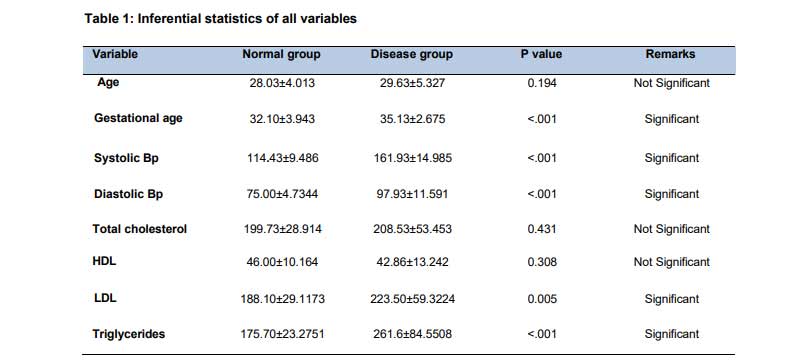
Results are expressed as mean± S.D. P-value was obtained from Independent ‘t’ test. P<0.05 is considered statistically significant.
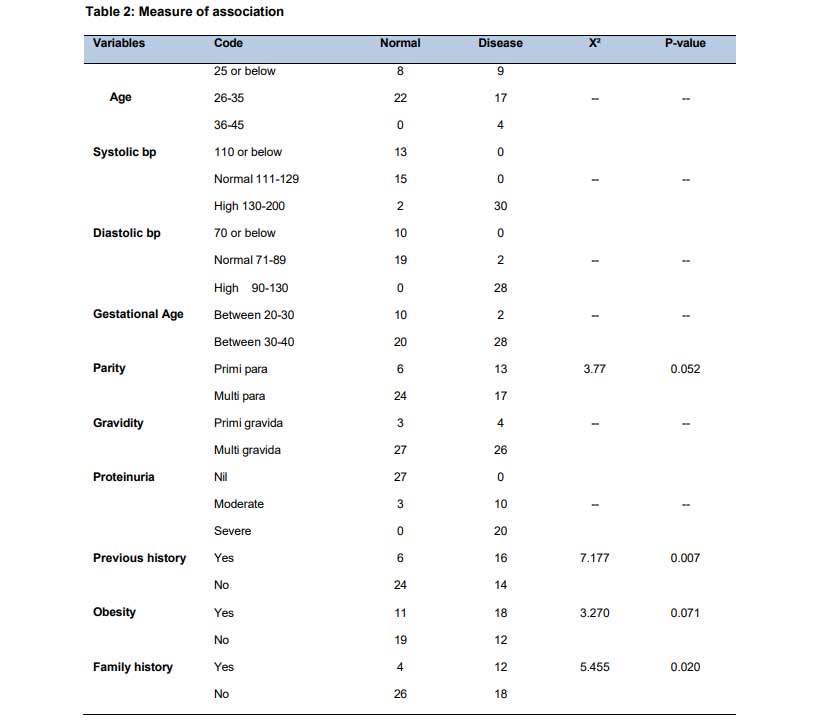
Table 2 shows that women with preeclampsia had significantly higher systolic and diastolic blood pressures, were more often in later stages of pregnancy, and had proteinuria, especially severe cases. The previous history of preeclampsia and family history were also more common among cases. In contrast, age, parity, gravidity, and obesity did not differ significantly between the groups. These results highlight that blood pressure, gestational age, proteinuria, and relevant personal or family history are closely associated with preeclampsia.
Discussion
The recent focus on the relationship between preeclampsia and lipid profile emphasizes how impairment in lipid profile can be a cause of preeclampsia. Inspired by this complicated relationship we set out to clarify the association between the lipid profile in pregnant females with and without preeclampsia. The relation of age with preeclampsia was found to be non- significant in our study. A previously reported study had shown that the altered lipid profile had the link with increased age [17],[18]. Meanwhile, gestational age showed statistically significant behaviour in our study [19]. Significant association between systolic and diastolic blood pressure of preeclamptic females compared to those without preeclampsia was noticed and the same significance was shown by other studies [20],[21].
Building on the findings of Md. Zakir Hossain and consistent results from other studies [High level of TGs and TC in preeclampsia women was found. Increased LDL in women with preeclampsia in contrast to normal. Decrease in HDL levels in preeclampsia women compared to normal. Our investigation showed unveiled different trends. Notably, lipid profile including TC, TG, LDL and HDL [ The TC among both groups showed the p >0.05 which was not statistically significant. But the TG’s among normal group and disease group was showing the p <0.05 which was significant. The LDL also showed significant relationship. HDL showed non- significant relation. High levels of TC encourage the production of free radicals which were considered uncertain to the development of preeclampsia. Raised levels of TG’s perhaps significant and considered as part of pathogenesis of preeclampsia, which was supported by our result. There was evidence that a rise in TG’s in preeclampsia has a relationship with systolic and diastolic blood pressure [22], which was also significant in our study. Fall in HDL might be due to insulin resistance in preeclamptic women [18]. These results lead to more through investigation of possible risk factors that could be the cause of preeclampsia. About 10% with normal pregnancy had the previous history of preeclampsia. In comparison to the disease about 26.67% of our patient had the previous history. There was not significance association found between them. Around 18.33% of normal had obesity and 31.67% had not in relation to the disease almost 30% patients had obesity, while 20% had not. The BMI in our study was shown to be non-significant in contrast to the normal which was oppositely reported in the mentioned study. Obesity may be the cause of endothelial dysfunction of placenta which may be the reason of preeclampsia. Study by Olalere et al and Md Zakir et al [18] revealed that TC was significantly higher compared to the other lipid panel or parameters in females with preeclampsia than those of without that opposes our study [23]. In our study, the difference in the mean and standard deviation of triglycerides of both normal and disease groups was statistically significant. Akter et al [24], Jaggannath Patar et al [25] also observed the significant rise in TG’s.
In the present study, the LDL of both the normal and disease was statistically significant, and the same observation of a significant rise in LDL in females with preeclampsia as compared to those without preeclampsia was illustrated by Kumari et al [26] and Taravati & Tohidi et al [27]. In the existing study, the HDL was not statistically significant. Mulder et al and Rajeshwari observed a significant fall in HDL levels in females with preeclampsia as compared to those without preeclampsia that is opposite to the findings of our study [28],[29]. This alteration potentially heightens the cardiovascular risk in long term. As HDL is known for its protective measures against Myocardial Infarction like cardiovascular diseases [30]. It highlights the need for regular assessment and management of lipid profiles in patients with preeclampsia. Implementing target interventions, including diet, good lifestyle, stress free life, exercise, can help to overcome these risks. It is important to note that pre-eclampsia is a multifactorial condition influenced by genetic predisposition, maternal comorbidities such as diabetes and chronic hypertension, and environmental factors. These potential confounding variables may affect lipid metabolism and preeclampsia outcomes, and were not controlled for in our study, limiting causal interpretations. Furthermore, the severity of preeclampsia (mild vs severe) and progression to eclampsia can influence lipid profile alterations, and stratifying patients by severity in future studies could provide more nuanced insights into these associations. Further research should be directed at a large population size towards understanding different mechanistic pathways and their probable risks their impact on patients health, thereby informing clinical guidelines for the early detection of dyslipidemia in pregnancy and preeclampsia and their management.
Conclusion
In our research setting the comparison of lipid profiles in females with and without preeclampsia, it is influential that those patients with preeclampsia exhibit a significant decline in HDL level along side increase in the other lipid profile parameters TC, TG’s, and LDL among which TG’s and LDL-c are more intensified.
References
- Khan AR, Faiza J, Saba A, Amina C, Saima I, Hamza Khan S. Cardio-Hepatic Interactions in Acute Heart Failure: A Study on Liver Function Test Abnormalities. Annals of King Edward Medical University. 2025;31(1):53-9.https://doi.org/10.21649/akemu.v31i1.5759
- Chappell LC, Cluver CA, Kingdom J, Tong S. Pre-eclampsia. Lancet. 2021;398(10297):341-54.https://doi.org/10.1016/s0140-6736(20)32335-7
- Nobles CJ, Mendola P, Mumford SL, Silver RM, Kim K, Andriessen VC, et al. Preconception Blood Pressure and Its Change Into Early Pregnancy: Early Risk Factors for Preeclampsia and Gestational Hypertension. Hypertension. 2020;76(3):922-9.https://doi.org/10.1161/hypertensionaha.120.14875
- Yang Y, Le Ray I, Zhu J, Zhang J, Hua J, Reilly M. Preeclampsia Prevalence, Risk Factors, and Pregnancy Outcomes in Sweden and China. JAMA Netw Open. 2021;4(5):e218401. https://doi.org/10.1001/jamanetworkopen.2021.8401
- Tessema KF, Gebremeskel F, Getahun F, Chufamo N, Misker D. Individual and Obstetric Risk Factors of Preeclampsia among Singleton Pregnancy in Hospitals of Southern Ethiopia. Int J Hypertens. 2021;2021:7430827.https://doi.org/10.1155/2021/7430827
- Tian Y, Liu M, Sun JY, Wang Y, Chen L, Sun W, et al. Diagnosis of preeclampsia using metabolomic biomarkers. Hypertens Pregnancy. 2024;43(1):2379386.https://doi.org/10.1080/10641955.2024.2379386
- Wiles K, Chappell LC, Lightstone L, Bramham K. Updates in Diagnosis and Management of Preeclampsia in Women with CKD. Clin J Am Soc Nephrol. 2020;15(9):1371-80.https://doi.org/10.2215/cjn.15121219
- August P, Sibai BM. Preeclampsia: Clinical features and diagnosis. Post TW, UpToDate Waltham, MA: UpToDate. 2017. DOI: 10.12691/ajnr-5-6-6
- Khosla K, Jin Y, Espinoza J, Kent M, Gencay M, Kunz LH, et al. Signs or symptoms of suspected preeclampsia– A retrospective national database study of prevalence, costs, and outcomes. Pregnancy Hypertension. 2024;36:101124. DOI: 10.1016/j.preghy.2024.101124
- Bezerra C. Dyslipidemia: what it is, how to identify, causes and treatment. Brazilian Journal of Implantology and Health Sciences. 2023;5(1):66-72. DOI: https://doi.org/10.36557/2674-8169.2023v5n1p66-72
- Wild R, Feingold KR. Effect of pregnancy on lipid metabolism and lipoprotein levels. Endotext [Internet]. 2023. DOI: https://www.ncbi.nlm.nih.gov/books/NBK498654/
- Charlton F, Tooher J, Rye K-A, Hennessy A. Cardiovascular risk, lipids and pregnancy: preeclampsia and the risk of later life cardiovascular disease. Heart, Lung and Circulation. 2014;23(3):203-12. DOI: 10.1016/j.hlc.2013.10.087
- Alahakoon TI, Medbury HJ, Williams H, Lee VW. Lipid profiling in Maternal and fetal circulations in preeclampsia and fetal growth restriction-a prospective case control observational study. BMC Pregnancy and Childbirth. 2020;20:1-10. DOI: 10.1186/s12884-020-2753-1
- Barbour LA, Hernandez TL. Maternal lipids and fetal overgrowth: making fat from fat. Clinical therapeutics. 2018;40(10):1638-47. DOI: 10.1016/j.clinthera.2018.08.007
- Stephenson DJ, MacKnight HP, Hoeferlin LA, Washington SL, Sawyers C, Archer KJ, et al. Bioactive lipid mediators in plasma are predictors of preeclampsia irrespective of aspirin therapy. Journal of Lipid Research. 2023;64(6):100377. DOI: 10.1016/j.jlr.2023.100377
- Wang H, Chow S-C. Sample Size Calculation for Comparing Proportions. Wiley Encyclopedia of Clinical Trials. https://doi.org/10.1002/9780471462422.eoct005
- Gratacos E. Lipid-mediated endothelial dysfunction: a common factor to preeclampsia and chronic vascular disease. European journal of obstetrics & gynecology and Reproductive biology. 2000;92(1):63-6. DOI: 10.1016/s0301-2115(00)00427-9
- Salma U. Relationship of serum lipid profiles in preeclampsia and normal pregnancy, Bangladesh. Afr Health Sci. 2022;22(2):475-9.https://doi.org/10.4314/ahs.v22i2.55
- Mostello D, Catlin TK, Roman L, Holcomb Jr WL, Leet T. Preeclampsia in the parous woman: who is at risk? American journal of obstetrics and gynecology. 2002;187(2):425-9. DOI: 10.1067/mob.2002.123608
- Kivioja A, Toivonen E, Tyrmi J, Ruotsalainen S, Ripatti S, Huhtala H, et al. Increased risk of preeclampsia in women with a genetic predisposition to elevated blood pressure. Hypertension. 2022;79(9):2008-15. DOI: 10.1161/HYPERTENSIONAHA.122.18996
- Gunderson EP, Greenberg M, Sun B, Goler N, Go AS, Roberts JM, et al. Early pregnancy systolic blood pressure patterns predict early‐and later‐onset preeclampsia and gestational hypertension among ostensibly low‐to‐ moderate risk groups. Journal of the American Heart Association. 2023;12(15):e029617. DI: 10.1161/JAHA.123.029617
- Winkler K, Wetzka B, Hoffmann MM, Friedrich I, Kinner M, Baumstark MW, et al. Triglyceride-rich lipoproteins are associated with hypertension in preeclampsia. The Journal of Clinical Endocrinology & Metabolism. 2003;88(3):1162-6. DOI: 10.1210/jc.2002-021160
- Olalere FDH, Okusanya BO, Oye-Adeniran BA. Maternal serum lipid in women with preeclampsia in Lagos: a case control study. J Matern Fetal Neonatal Med. 2020;33(5):794-8.https://doi.org/10.1080/14767058.2018.1505851
- Akter R, Haque N, Hosain N, Akter N, Islam F, Hasan T, et al. Association of Lipid Profile with Preeclampsia. Journal of Chittagong Medical College Teachers' Association. 2022;33(2):100-5. DOI: https://doi.org/10.3329/jcmcta.v33i2.67306
- Patar J, Acharjee N. Comparative Study of Serum Lipid Profile in Pre-Eclampsia and Normal Pregnancy. Sch J App Med Sci. 2022;12:2146-9. DOI: https://doi.org/10.24200/jogcr.10.9.673
- Kumari P, Chouhan M, Jakhar B, Sharma G. A comparative study of serum lipid profile in preeclampsia and normotensive pregnancy in third trimester and their fetomaternal outcome. International Journal of Reproduction, Contraception, Obstetrics and Gynecology.12(7):2178. DOI: https://doi.org/10.18203/2320-1770.ijrcog20231790
- Taravati A, Tohidi F. Comprehensive analysis of oxidative stress markers and antioxidants status in preeclampsia. Taiwan J Obstet Gynecol. 2018;57(6):779-90.https://doi.org/10.1016/j.tjog.2018.10.002
- Mulder J, Kusters DM, Roeters van Lennep JE, Hutten BA. Lipid metabolism during pregnancy: consequences for mother and child. Curr Opin Lipidol. 2024;35(3):133-40.https://doi.org/10.1097/mol.0000000000000927
- Rajeshwari K, Achala G, Swathi Nayak C, Pradeep M. A COMPARATIVE STUDY TO EVALUATE THE ASSOCIATION BETWEEN SERUM LIPID PROFILE OF WOMEN WITH HYPERTENSIVE DISORDER OF PREGNANCY AND NORMOTENSIVE PREGNANCY. DOI: https://doi.org/10.48047/
- McElwain CJ, Tuboly E, McCarthy FP, McCarthy CM. Mechanisms of endothelial dysfunction in pre-eclampsia and gestational diabetes mellitus: windows into future cardiometabolic health? Frontiers in endocrinology. 2020;11:655. DOI: 10.3389/fendo.2020.00655 <\ol>