Abstract
Background: Hepatitis B virus (HBV) and Hepatitis C virus (HCV) are still predominant public health issues in Pakistan. This is a significant cause of liver disease and death. Patients who undergo surgical operations are at a higher risk, mainly because of blood exposure during the surgery and a lack of proper infection control in settings where resources are limited. Objective: This research aimed to determine the frequency of HBV and HCV and their associations with socio-demographic and clinical factors such as residence, sex, marital status, and duration of hospital stay, among patients who underwent elective surgery at Pak Red Crescent Teaching Hospital, Lahore. Moreover, binary logistic regression was used to find out predictive factors for these infections.
Method: The study participants were 267 surgical patients admitted consecutively. Analysis was performed on 265 patients
with complete demographic data. It used a consecutive sampling approach. It extended from November 2024 to April 2025. The criteria for inclusion were age ≥18 years, elective surgery scheduling, and complete preoperative records. In contrast, emergency cases, minors, incomplete files, and known hepatitis patients were excluded. Preoperative HBsAg and anti-HCV tests were conducted on all the patients. Hospital records were utilized to obtain the data. It was then analyzed using SPSS version 26.0. The study received approval from the Regional Ethics Committee (IRB No: 27/2025), and full patient anonymization was maintained.
Results: On average, participants' age was 40.7 years (SD ± 17.5); males accounted for 55.4%. The HBV rate was 0.7% (2 people; 95% CI: 0.1-2.5%). The HCV rate was 6.4% (17 people; 95% CI: 3.8-10.0%). These were devoid of co-infections. No tangible association was found between the infection and age, sex, residence, marital status, or hospital stay duration (p > 0.05).
Conclusion: Although the rate of HBV infection was very minimal. The rate of HCV infection among surgical patients was moderate. Continuation of routine preoperative screening and strict adherence to infection control measures are still of utmost importance to protect both patients and health workers.
Keywords: Hepatitis B, Hepatitis C, Patients, Surgical Procedures, Operative, Cross-Sectional Studies, frequency.
Introduction
Viral hepatitis is one of the leading and profound public health issues in Pakistan. Hepatitis B virus (HBV) and hepatitis C virus (HCV) are among the major causes of liver-related morbidity and mortality 1. Chronic liver disease is one of the paramount concerns of death worldwide, dramatically increasing healthcare costs and significantly decreasing people's quality of life 2, 3. Liver infection with these viruses over a long period may cause cirrhosis, hepatocellular carcinoma, and liver failure. These conditions lead to a large number of deaths worldwide due to cancer. It is estimated that HBV and HCV are responsible for nearly 70% of HCC cases worldwide 4, 5. Coincidentally, HBV is the major cause of these cases in places where the disease is common, such as Asia and Africa, while in developed countries, HCV is more prevalent 6.
Nationally, it is estimated that rates of HBV and HCV in Pakistan are 1.98% and 7.44%, respectively, with most cases in Punjab and interior Sindh 7, 8. Major routes of transmission mainly include the use of infected needles during medical treatment, the reuse of syringes, tools for haircuts sterilized improperly, dental procedures, and other exposures to contaminated healthcare environments 9. The healthcare workers, including surgeons, nurses, and medical students, are considered to be at the highest and egregious risk of occupational exposure because they are frequently interacting and are mostly exposed to blood and other bodily fluids and injuries with needles, especially 10, 11.
Globally, approximately 40% of people infected with viral hepatitis do not know they have the disease, which enables the spread of the virus unconsciously within the community and even in healthcare settings 12. On the other hand, not screening for HBV or HCV among the surgical patients can put postoperative results at risk and also can be a potential source of infection to the operating staff and other patients when they come in contact with blood during the surgery 13.
Studies carried out in Pakistan indicate varying virus frequency among surgical patients across areas: 6.6% HCV in Swat 14. 3.6% HBV and 12.8% HCV in Sukkur 15. About the same amounts of viral hepatitis (4-10%) have also been found in hospitals of Lahore, Rawalpindi, and Muzaffarabad 16, 17. Further detailed information about a specific hospital in Lahore remains scarce.
The study assessed the burden of HBV and HCV and their frequencies among patients undergoing elective surgery at the Pak Red Crescent Teaching Hospital in Lahore. This analyzes the relationships between the disease burden and its socio-demographic and clinical factors. The findings will establish infection-control protocols that guide preoperative screening and create occupational safety measures to protect healthcare workers.
Method
This is a cross-sectional descriptive study executed to determine the frequency and associated risk factors of hepatitis B and C among patients undergoing elective surgical procedures.
The study was administered at the Pak Red Crescent Medical and Dental College Teaching Hospital, Lahore, Pakistan, using data retrieved from the hospital's medical records, surgical registers, and laboratory reports. The sample comprised all patients who met the inclusion criteria during the study period (November 1, 2024 – April 30, 2025). Consecutive sampling was used to enroll 267 eligible surgical patients. Data collection occurred from November 1, 2024, to April 30, 2025. Data analysis and manuscript preparation were completed between May and June 2025.
All patients who underwent elective surgical procedures at the hospital during the specified time frame were considered. The study included patients aged 18 years and above who underwent elective (non-emergency) surgical procedures. Only those who were preoperatively screened for hepatitis B surface antigen (HBsAg) and hepatitis C virus antibodies (anti-HCV) were considered eligible. Additionally, inclusion required complete patient records, including detailed medical history and laboratory results. Patients were excluded if they underwent emergency surgeries, were younger than 18 years, or had incomplete medical or laboratory documentation. Furthermore, individuals previously diagnosed and tested for hepatitis B or C before admission, without clear documentation of the source of infection or associated risk factors, were also excluded from the study.
Using a structured form, trained medical students and junior physicians collected data on demographics, surgical procedures, and hepatitis B and C status (HBsAg and anti-HCV). Various associated risk factors, such as blood transfusion, IVDU, surgery, and dental history, were also recorded. Following data entry into Microsoft Excel 2025, IBM SPSS version 26 was applied for analysis and evaluation. Descriptive statistics summarized the data, and a chi-square test was used to evaluate a plausible association between the risk factor and hepatitis status (p < 0.05 considered significant). The researchers used binary logistic regression to identify factors predicting rates of hepatitis B and C infections among surgical patients. Two separate models were developed in which HBV and HCV infection status served as dependent variables (positive or negative outcomes). Independent variables included urban or rural residence, sex (male or female), marital status (married or unmarried), and hospital stay duration (continuous variable). Urban residence, female sex, and unmarried status were established as reference categories. Ethical approval was obtained from the Institutional Review Committee of Pak Red Crescent Medical and Dental College, IRB No: 27/2025, dated 19-05-25. Patient confidentiality was maintained by anonymizing all records.
Results
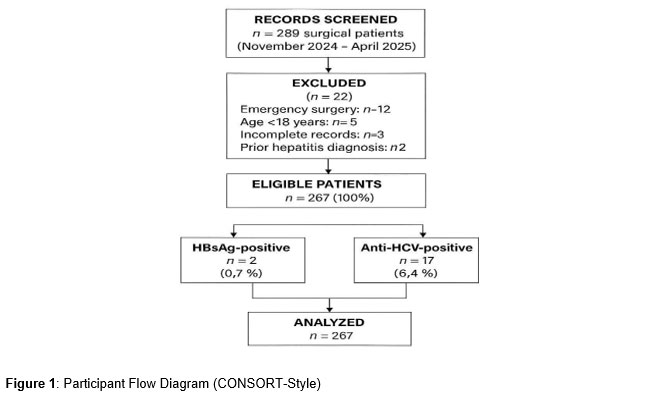
It examined 267 surgical patients. Demographic data were accessible for 265 patients. The participant flow diagram is delineated in Figure 1.
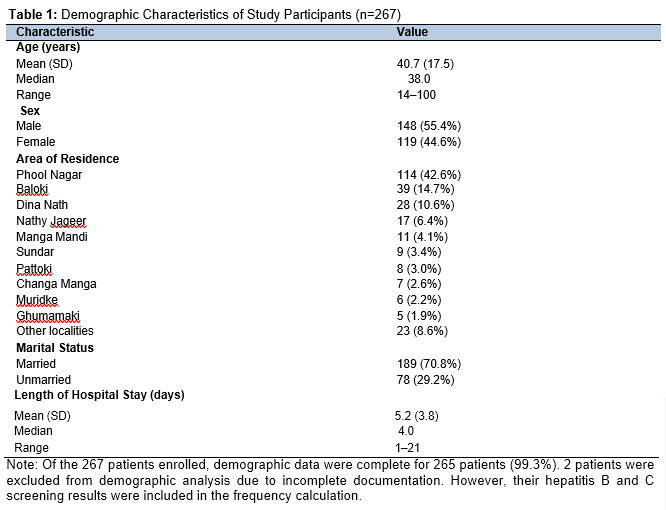
The mean age of the patients was around 40.7 years (SD = 17.5 years). The study sample covered ages of the individuals from 18 to 100. It primarily comprises 148 males (55.4%) and 119 females (44.6%). Table 1 exhibits the demographic data of the research participants. Rural and semi-urban areas accounted for the majority of patients who visited the hospital. The biggest portion was from Phool Nagar (42.6%). It was followed by Baloki (14.7%), Dina Nath (10.6%), and Nathy Jageer (6.4%). Combined, the other areas represented the smallest segment. Each one made 1–5% of the total (Table 1).
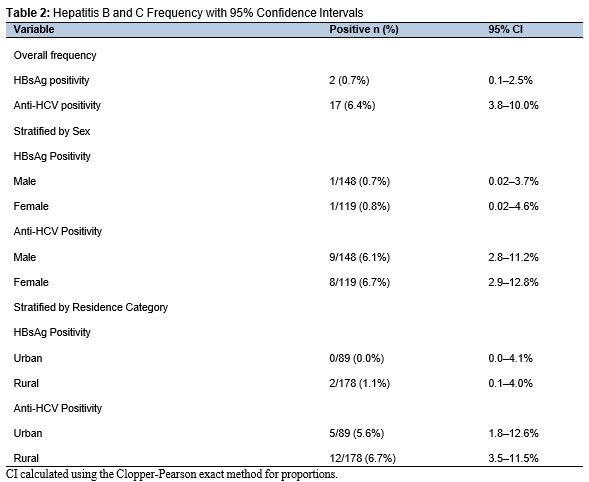
From the total evaluation, 2 (0.7%; 95% CI: 0.1–2.5%) were found positive for hepatitis B surface antigen (HBsAg). Seventeen (6.4%; 95% CI: 3.8–10.0%) were positive for anti-HCV antibodies. No patient had both viruses concurrently. The frequency figures, along with their confidence intervals, are depicted in Table 2. Only 2 patients tested positive for hepatitis B. One of them belonged to Phool Nagar, and the other one to Ghumamaki. The mapping of the cases did not show any clustering pattern (Fisher's exact test, p = 0.98). Hepatitis C patients were distributed almost equally across the different localities. No significant and more obvious association was found between anti-HCV and locality of residence (p = 0.42) (Table 2).
The results of the regression analysis for the HCV model are presented in Table 3; the HBV model failed the minimum events-per-variable criterion because there were only two positive cases. The hepatitis B infection model produced non-significant results with a chi-square value of 0.04 and a p-value of 0.98 (recommended ≥10 events per predictor) 18. The results were reported descriptively. No odds ratios are presented due to the statistical instability (Table 3).
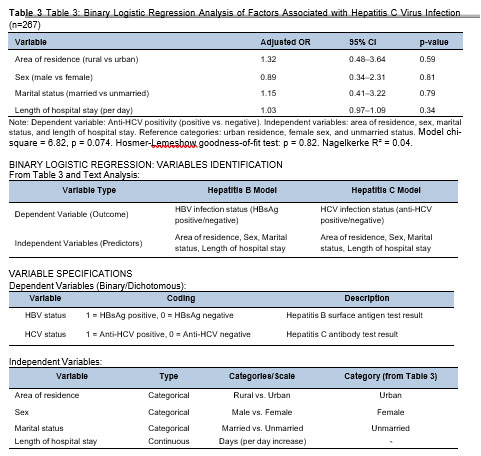
The hepatitis C infection model came close to significance but did not quite reach it (chi-square = 6.82, p = 0.074). None of the variables in the study could independently predict HCV infection. Living area (adjusted OR: 1.32; 95% CI: 0.48–3.64; p = 0.59), gender (adjusted OR: 0.89; 95% CI: 0.34–2.31; p = 0.81), marital status (adjusted OR: 1.15; 95% CI: 0.41–3.22; p = 0.79), and hospital stay (adjusted OR: 1.03; 95% CI: 0.97–1.09; p = 0.34) were not significantly associated (Table 3). All tests were two-sided comparisons with an alpha level of 0.05.
The HBV infection model had only two positive cases. The usual recommendation is at least 10 events per predictor variable to ensure model stability and valid inference 19. Our HBV model had four predictors, so it is statistically underpowered. Results for HBV should be treated as descriptive only. More extensive studies are required to identify independent predictors of HBV infection in this population.
Discussion
The observed HBV frequency of 0.7% is lower than that reported in similar studies of surgical patients in Pakistan. Previous research conducted indicates that the frequency of HBV is between 1% and 5% 20. In contrast, an HCV frequency of 6.4%, which matches existing research that shows HCV rates between 5% and 12% for Pakistani surgical patients 21. Studies from other regions, such as Ethiopia, showed that surgical patients had HBsAg positivity rates of 9% and anti-HCV positivity rates of 5.5% 22, suggesting that geographic variation, along with healthcare variability, leads to distinct approaches to managing infections and to the distribution of vaccines. The study demonstrates no evidence of HBV/HCV co-infection cases among the specified population. This is consistent and congruent with findings from other studies. Rates of positivity usually remain below 1%.
This might be a consequence of different modes of transmission and of well-conducted HBV vaccination programs. At present, there are no vaccines available against HCV. The reduced proportion of HBV cases may, to some extent, be attributed to Pakistan's Expanded Program on Immunization (EPI), which includes HBV vaccination. Other contributing factors include blood safety and improvements in surgical sterilization practices. On the other hand, the high level of HCV infection may be explained by continued transmission in the community through unsafe medical injections, dental procedures, and barber practices, as recognized and documented in previous epidemiological studies 23, 24.
Furthermore, the research did not reveal any statistically significant correlation between infection status and demographic factors, namely residence, sex, marital status, hospital stay, and language. This is consistent and relatively consistent with the results of small-scale surgical studies, in which demographic factors were also found to be non-predictors. Another reason for the lack of significant predictors could be the small number of positive cases (n=19), which limits the ability to perform a logical analysis.
Finally, the fairly even geographic distribution of HCV infection points towards widespread community-level transmission. Localized outbreaks were not detected. This eventually strengthens the case for implementing comprehensive public health awareness and screening campaigns. On the contrary, locality-specific interventions are hardly justifiable 25, 26. There are several limitations that we should rationally admit. Small numbers of positive cases hinder statistical power and the ability to generalize findings. The study design and overreliance on hospital records may have led to the omission of some patients or to incomplete data. Anti-HCV testing makes it quite challenging to differentiate between an active infection and a previously resolved case. However, to a great extent, our findings, notably the unexpectedly high HCV frequency among surgery patients, provide a very strong rationale for the effective implementation of universal infection control (UIC) measures. Screening before surgery and HBV vaccination among the medical personnel are two key components of infection prevention. It is the hospital's duty not only to ensure the ongoing heightening of the medical staff's awareness of standard precautions but also to pay particular attention to gloving practices and post-exposure prophylaxis protocols. Preoperative screening for hepatitis B and C should be the norm rather than the exception among surgical patients. The vaccination coverage for hepatitis B among staff members needs to receive higher priority because it requires stronger efforts beyond the existing universal infection control measures. Health education programs and awareness campaigns need to target rural and semi-urban populations, as these newly introduced safety measures aim to counter unsafe injection practices and barbering.
Conclusion
This study revealed a low frequency of HBV (0.6%) and a moderately high frequency of HCV (6.4%) among surgical patients at Pak Red Crescent Teaching Hospital, Lahore. While no demographic or clinical factors independently predicted infection, the findings highlight the continuing Public Health challenge of HCV in Pakistan's surgical population.
References
- Polaris Observatory Collaborators. Global prevalence, treatment, and prevention of hepatitis B and C, 2019: a modelling study. Lancet Gastroenterol Hepatol. 2021;6(10):924-43. https://doi.org/10.1016/S2468-1253(21)00170-3
- Asrani SK, Devarbhavi H, Eaton J, Kamath PS. Burden of liver diseases in the world. J Hepatol. 2019;70(1):151-71. https://doi.org/10.1016/j.jhep.2018.09.014
- Bruix J, Reig M, Sherman M. Evidence-based diagnosis, staging, and treatment of hepatocellular carcinoma. Gastroenterology. 2016;150(4):835-53. https://doi.org/10.1053/j.gastro.2015.12.041
- Sung H, Ferlay J, Siegel RL, Laversanne M, Soerjomataram I, Jemal A, Bray F. Global cancer statistics 2020. CA Cancer J Clin. 2021;71(3):209-49. https://doi.org/10.3322/caac.21660
- Balogh J, Victor D 3rd, Asham EH, Burroughs SG, Boktour M, Saharia A, et al. Hepatocellular carcinoma: a review. J Hepatocell Carcinoma. 2016;3:41-53. https://doi.org/10.2147/JHC.S61146
- Khan A, Afzal S, Yaqoob A, Fatima R, Haq MU, Junaid K, et al. Epidemiology of viral hepatitis B and C in Punjab, Pakistan. F1000Res. 2019;8:115. https://doi.org/10.12688/f1000research.20174.1
- World Health Organization Regional Office for the Eastern Mediterranean. Hepatitis B and C elimination in Pakistan: progress report 2023. Cairo: WHO EMRO; 2023. Available from: https://applications.emro.who.int/
- Mehmood S, Raza H, Abid F, Saeed N, Rehman HM, Javed S, et al. National prevalence rate of hepatitis B and C in Pakistan and its risk factors. J Public Health. 2020;28(6):751-64. https://doi.org/10.1053/j.gastro.2010.12.032
- Khan S, Attaullah S. Share of HBV and HCV infections in the general population of Pakistan and their risk factors. Hepat Mon. 2021;21(8):e9985. https://doi.org/10.1016/j.ijid.2008.06.019
- Shahzad MN, Iqbal M, Javed F, Khan MA. Frequency of needle stick injuries among healthcare workers. J Pak Med Assoc. 2016;66(11):1436-40. Available from: https://pubmed.ncbi.nlm.nih.gov/20392374/
- Rafique I, Saaiq M. Needle stick injuries amongst healthcare workers in Pakistan. J Pak Med Assoc. 2013;63(12):1553-6. Available from: https://www.researchgate.net/publication/262725865_Needle_stick_injuries_among_health_care
- World Health Organization. Global hepatitis report 2024. Geneva: WHO; 2024. Available from: https://www.who.int/publications/i/item/9789240092709
- Ilyas M, Alam S, Rehman A. Frequency of hepatitis B and C in patients undergoing surgical procedures. Pak Armed Forces Med J. 2011;61(3):317-20. Available from: https://www.pafmj.org/PAFMJ/article/download/1975/1715
- Jadoon Q, Jadoon M, Niazi S. Seroprevalence of hepatitis B and C among surgical patients. Pak J Surg. 2020;36(2):89-93. Available from: https://pakheartjournal.com/index.php/pk/article/view/49/46
- Waheed Y, Shafi T, Safi S. Hepatitis elimination by 2030: progress and challenges in Pakistan. World J Gastroenterol. 2017;23(21):4422-30. https://doi.org/10.3748/wjg.v23.i21.4422
- Ali M, Saeed S, Khan T. Prevalence of hepatitis B and C among preoperative surgical patients. Pak J Med Health Sci. 2021;15(11):3034-8. Available from: https://pjmhsonline.com/2021/nov/3034.pdf
- Rehman MU, et al. Prevalence and risk factors of HBV and HCV in Pakistan: systematic review. Int J Hepatol. 2018;2018:9607869. https://doi.org/10.1155/2018/9607869
- Peduzzi P, Concato J, Kemper E, et al. Simulation study of events per variable in logistic regression. J Clin Epidemiol. 1996;49(12):1373-9. https://doi.org/10.1016/0895-4356(96)00236-3
- Asrani SK, Devarbhavi H, Eaton J, Kamath PS. Burden of liver diseases in the world. J Hepatol. 2019;70(1):151-71. https://doi.org/10.1016/j.jhep.2018.09.014
- Umar M, Khaar H, Khokhar N. Hepatitis C in Pakistan: epidemiology and control measures. East Mediterr Health J. 2010;16(6):60-70. Available from: https://pmc.ncbi.nlm.nih.gov/articles/PMC3269085/
- Waheed Y, Shafi T, Safi S. Hepatitis elimination by 2030: progress and challenges in Pakistan. World J Gastroenterol. 2017;23(21):4422-30. https://doi.org/10.3748/wjg.v23.i21.4422
- Rafique I, Saeed S, Rehman A. Prevalence of hepatitis B and C in surgical patients. J Ayub Med Coll Abbottabad. 2010;22(2):157-9. Available from: https://ayubmed.edu.pk/JAMC/PAST/22-2/Rafique.pdf
- Khan S, Attaullah S. Share of HBV and HCV infections in Pakistan. Hepat Mon. 2021;21(8):e9985. https://doi.org/10.1016/j.ijid.2008.06.019
- Khan AA, Khan MS, Khan SA. Dentistry as a possible route of hepatitis C transmission in Pakistan. J Coll Physicians Surg Pak. 2003;13(6):324-7. Available from: https://pubmed.ncbi.nlm.nih.gov/12873110/
- Mehmood S, Raza H, Abid F, Saeed N, Rehman HM, Javed S, et al. National prevalence of hepatitis B and C in Pakistan. J Public Health. 2020;28(6):751-64. https://doi.org/10.1053/j.gastro.2010.12.032
- World Health Organization. Global hepatitis report 2024. Geneva: WHO; 2024. Available from: https://www.who.int/publications/i/item/9789240092709