Abstract
Background: Although surgical practice and prophylaxis have improved still sternum wound infection is an expensive and severe problem of coronary artery bypass (CABG). Diabetic patients are, however, a very high-risk group of this complication because they have a weakened immunity and a slow healing of wounds. Although systemic antibiotic prophylaxis has remained very popular, its shortcomings have created interest in the usage of topical methods. The effectiveness of topical vancomycin powder in high-risk diabetic patients needs to be studied to generate local evidence. Objective: To determine the effectiveness of topical vancomycin application to the edges of the sternum in decreasing the sternal wound contamination rate in diabetic post-CABG patients.
Methods: This quasi-experiment was done in a tertiary cardiac care institution. 100 eligible diabetic post-elective CABG patients were randomly assigned to two groups. The Vancomycin group (n = 50) received topical application of 1 gram of vancomycin powder on sternum while comparison group (n = 50) received standard care without the topical vancomycin. The incidence of sternal wound infection in 30 days was determined through the criteria of Jones. Data was entered on SPSS v23.0. Multivariate analysis was done.
Results: Overall, the occurrence of sternal wound contamination was 8% in Vancomycin group and 26% in Control group with p=0.016 while Infection of deep sternal wound was present in 2% and 12% respectively. Vancomycin group had a significantly lesser median hospital stay associated to the comparison group, 7 and 8 days respectively (p=0.026). Topical vancomycin was found an independent protection on multivariate analysis with an adjusted odds ratio of 0.25 and 95% Confidence Interval [0.07-0.84, p=0.025).
Conclusion: Topical vancomycin use is effective in preventing the occurrence of sternal wound infection as well as in the reduction of hospital stay in diabetic patients after CABG.
Keywords: Coronary Artery Bypass; CABG, Diabetes Mellitus; Surgical Wound Infection; Vancomycin; Cardiac Surgical Procedures.
Introduction
Coronary artery bypass (CAB) is a type of corner stone treatment of the advanced coronary disease which has impressive survival and symptomatic benefits [1]. Whereas the progress in the surgical procedure and prophylaxis is improved, sternal wound infections are still a significant issue. These diseases are linked to increased morbidity, mortality and general consumption of healthcare resources during the postoperative period [2]. Patients with diabetes are prone to contract sternal wound infection. Diabetic individuals due to faulty immunity, damage to the microvasculature and inadequate wound healing are twice or three times more prone to developing periodontal ailments in comparison with non-diabetic subjects [3,4]. Although the existing standard interventions like perioperative systemic antibiotics and strict glycemic regulation help in risk minimization, the development of infection is not entirely eradicated [5].
Systemic prophylaxis pitfalls, including suboptimal tissue penetration and emerging antibiotic resistance, have necessitated research into localized antibiotic administration [6]. Topical vancomycin is a contender under this approach owing to its tenacious in-vitro efficacy against Gram-positive organisms, including methicillin-resistant Staphylococcus aureus and coagulase-negative staphylococci, which dominate sternal wounds infection [7]. But the efficiency of topical vancomycin too remains variable in the literature of cardiac surgery, with newer studies contradictory to one another in conclusions [8]. This variability highlights the importance of context-rich evidence among diabetic individuals in populations with high prevalence of diabetes. Therefore, this study is considered to assess the effectiveness of topical vancomycin application to the edges of the sternum in decreasing the sternal wound contamination rate in diabetic post-CABG patients at a tertiary cardiac care center in Pakistan.
Method
This quasi-experimental study and conducted at the Department of Cardiac Surgery, Armed Forces Institute of Cardiology/National Institute of Heart Diseases, Rawalpindi, (9/2/R&D/2025/341) over a six- month period from March 2025. Recorded informed consent was acquired from all participants. One hundred adult diabetic patients arranged for elective CABG were enrolled via non-probability consecutive sampling. Patients were allocated to a Vancomycin group (n=50) that received topical vancomycin prophylaxis or a Control group (n=50) that received standard care alone. Diagnosed diabetes mellitus (Types 1 or 2) with a glycated hemoglobin level of 7 and above, the age of 30-65 years, BMI 20-35 kg/m2 and those who underwent elective CABG were included. The patients who underwent emergency surgery had active infections at the time of surgery, documented vancomycin allergy, immunocompromised state, or scheduled concomitant cardiac procedures were excluded from the study.
All patients were managed based on standardized institutional protocols. Pre-op prophylactic intravenous antibiotics (cephalosporin) were administered within one hour of skin incision. Glycemic control was maintained in the post-op period with intravenous infusion of insulin with a target of serum glucose under 180 mg/dL in the first 48-72 hours. There was a consistent operative approach with the use of cardiopulmonary bypass, median sternotomy, and internal mammary artery harvest. Closure of the sternum was done with interrupted stainless- steel wires. In the Vancomycin group, 1 gram of sterile vancomycin powder was sprinkled on the sternal edges before end. The comparison group received normal saline irrigation of the sternum as a standard protocol. This fixed dose was used for all patients in the intervention group, consistent with common clinical practice in existing studies [1,3]. Published literature suggests the Vancomycin dosage as 20-25 mg/kg of the body weight [9,10]. Occurrence of sternal wound contamination during 30 days after operation, classified as either superficial or deep based on Jones' criteria, was the main outcome measure. Secondary consequences were the requirement for surgical debridement, antibiotic up-gradation, surgery due to re-exploration, and lengths of ICU stay, mechanical ventilation, and in hospital stay.
The sample size was calculated using the world health organization sample size calculator. With the assumption that incidence in the intervention group as 4, and in the comparison group as 20, with 95 percent confidence level, power of study 80 percent and 5 percent margin of error, the minimum number of patients needed were 84 [21]. The sample population was taken as 100 patients to include the possible loss. The data was analyzed using SPSS version 23.0. Continuous variables were represented in terms of mean, standard deviation or median with interquartile range whilst categorical variables were represented in terms of frequencies and percentages. Appropriate between-group comparisons were made with independent t-tests, Chi-square tests and Fisher exact tests. Binary logistic regression was used to adjust confounders. p of less than 0.05 was counted as statistically significant. Institutional ethical review committee (Reference No: 9/2/R&D/2025/341 dated 5th Mar 2025) approved the research.
Results
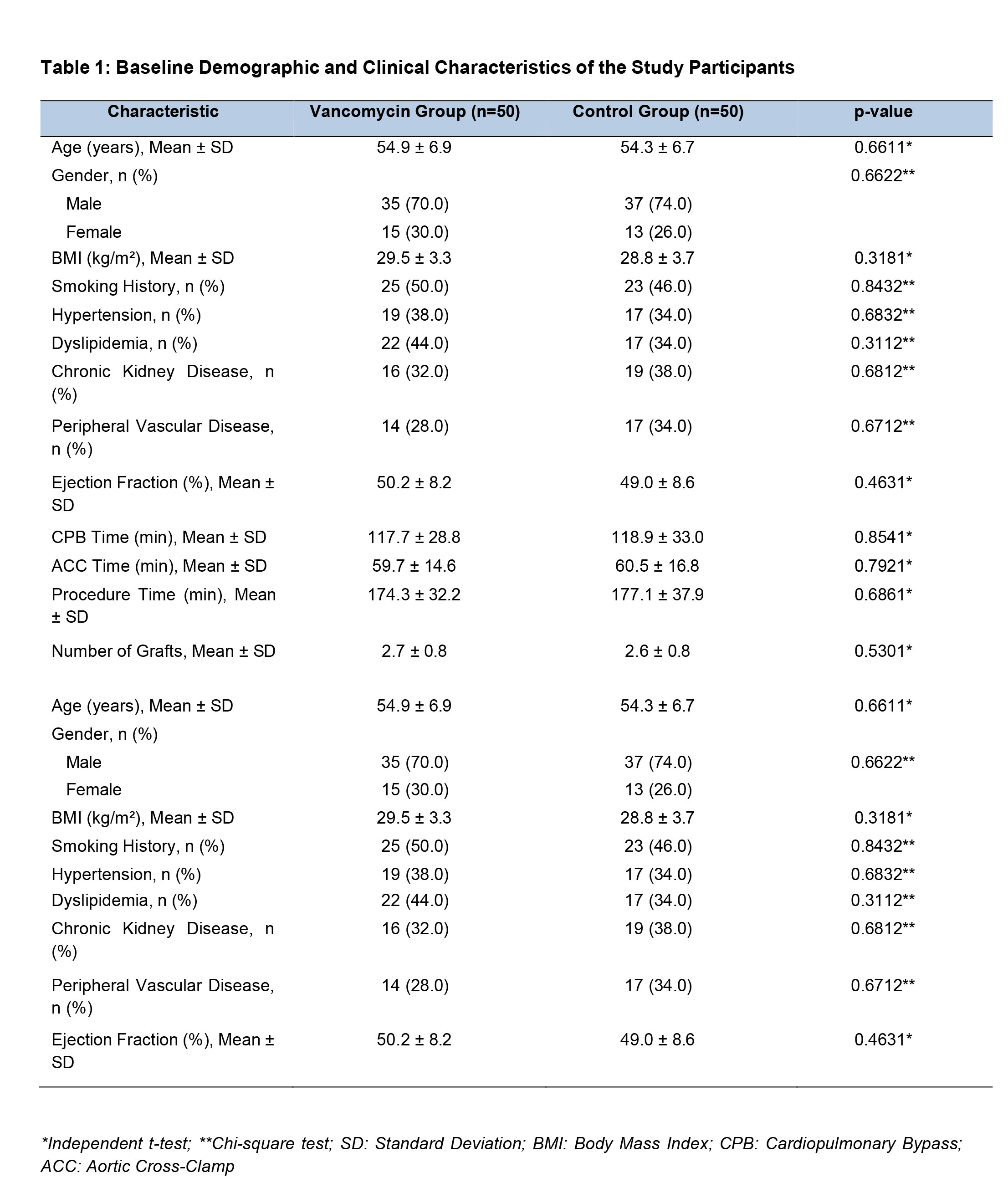
The baseline demographic, clinical, and intraoperative characteristics were similar among the Vancomycin and Control groups, as detailed in Table I. there were no observed statistically important differences in gender, age, body mass index, ejection fraction, comorbidities, or intraoperative parameters, such as aortic procedure time, number of grafts, cardiopulmonary bypass time, and cross-clamp time performed.
We observed a significant reduction in the primary outcome with topical vancomycin. The overall occurrence of sternal wound infection was 8% in the Vancomycin group compared to 26% in the Control group (p=0.016). Deep sternal wound infections occurred in 2% and 12% of patients, respectively (Table 2).
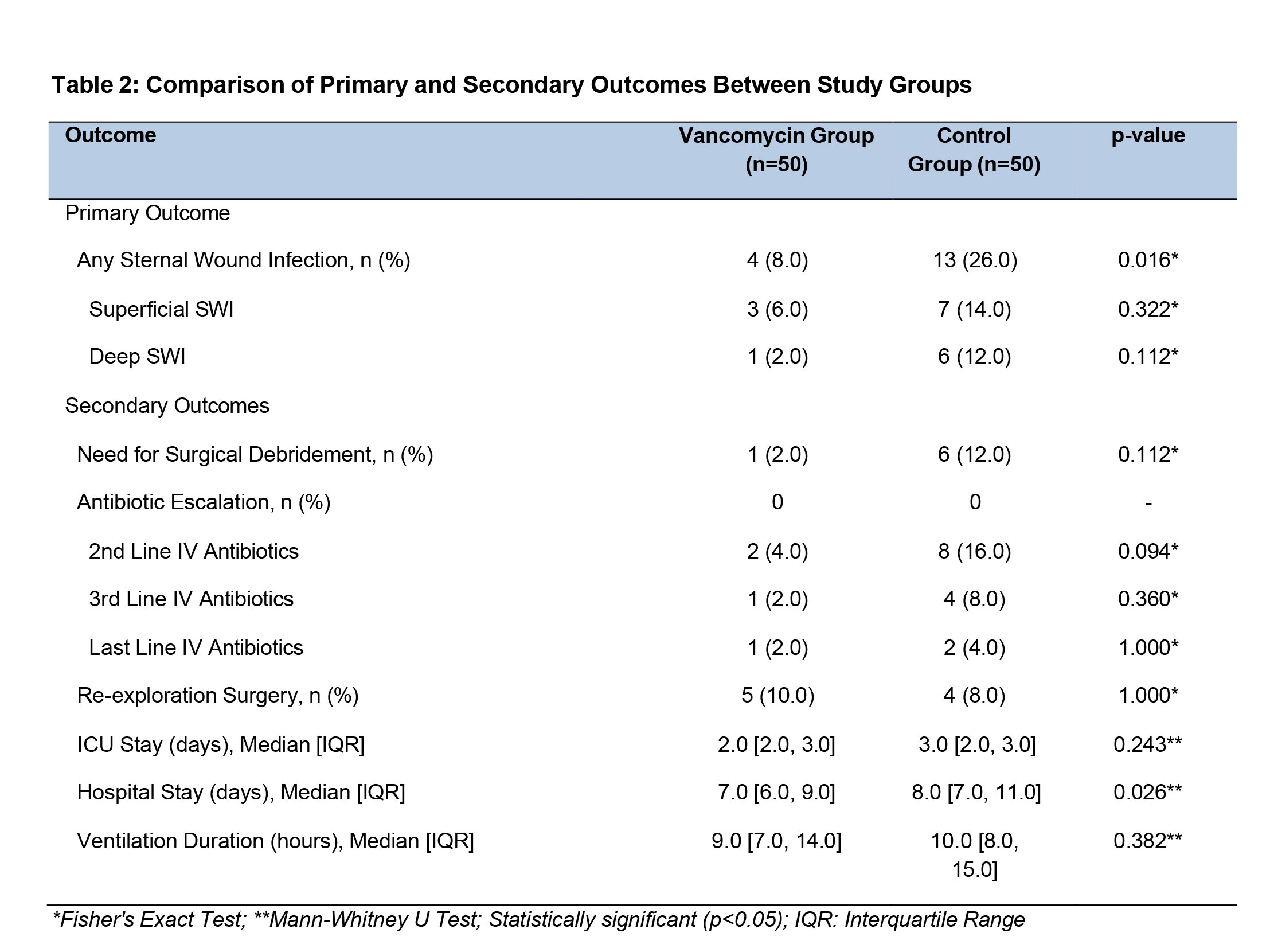
Upon analysis the secondary outcomes showed a lower need for surgical debridement in the Vancomycin group (2.0% vs. 12.0%). The median total hospital stay was observed to be significantly shorter for the Vancomycin group (7.0 days) as associated to the Control group (8.0 days, p=0.026). Other secondary outcomes like intensive care unit stay and the ventilation duration showed no significance difference. Upon adjusting for age, smoking status and BMI the binary logistic regression analysis confirmed the topical vancomycin as an independent protective factor against sternal wound infection (Adjusted Odds Ratio=0.25, 95% Confidence Interval [0.07-0.84], p=0.025).
Discussion
Our current study presents clear evidences that the therapeutic use of topical vancomycin to the sternal margins greatly lessens the occurrence of sternal wound infections among a high-risk population of diabetic patients who receive CABG. The observed decrease in the overall infection rates from 26.0% in the control to 8.0% in the intervention population was clinically as well as statistically significant. This preventive efficacy was strongest in the setting of deep sternal wound infections with high mortality and morbidity [11].
Our findings are reliable with the existing works on local antibiotic prophylaxis. A recent meta-analysis done by Kowalewski et al. reported that the regional antibiotic delivery reduced the odds of sternal wound infection by over 50% [1,12]. The more noticeable effect seen in our study may therefore be the result of the careful enrollment of diabetic patients, a subgroup with an inherently higher risk that stands to benefit more absolutely from enhanced prophylaxis [2,13]. Deep sternal wound infections in our series were significantly reduced, corroborating Lazar et al., who, in his study, reported a virtual elimination of such infections with a protocol similar to ours [3].
The mechanistic argument for this intervention is well supported. Topical therapy attains local tissue levels of vancomycin which significantly exceeds minimum inhibitory concentrations of typical pathogens such as methicillin-resistant Staphylococcus aureus and coagulase-negative staphylococci [4,14]. Thus, this practically avoids the notions of systemic therapy such as variable tissue penetration. The observed trend toward lower
antibiotic increase in the vancomycin group also supports its biological efficacy [15]. In our study the noteworthy reduction seen in total hospital stay with intervention has significant health economic implications. In the research studies performed earlier, researchers have estimated the increasing costs due to unnecessary hospitalization in order to treat deep sternal wound infections [5,16,17]. The topical vancomycin provides a cost-saving strategy to forego these complications.
It is important to note that the advantage of the intervention was apparently wound-orientated. Intensive care unit admission, ventilation length, and re-exploration rates showed no noteworthy variation, which shows a selective influence on the infection prevention and no significant impact on other postoperative recovery areas. The similar re-exploration rate also points to no obvious rise in bleeding risk, in favor of the procedure's safety. The encouraging findings of the study we performed need to be put into context with the rest of the scholarly literature. Servito et al. reported no considerable value of topical vancomycin in the double-blind randomized trial that he performed [6]. The methodological differences present in these studies, such as variation in the base risk profile in the population investigated or in the application technique itself, could explain these inconsistent results. Our single-center focus on diabetic individuals probably enhanced the population with individuals who get the most benefit from optimized local prophylaxis [18,19].
There are several limitations of our study which we have acknowledged. Firstly, the quasi-experimental design, though pragmatic, carries the integral risks of collection bias. Secondly, the single-center nature of our study may affect the generalizability of the findings to other settings [20]. Nevertheless, the use of standardized protocols and consecutive enrollment strengthens internal validity. We recommend that future multi-center RCTs be performed to approve these results and establish definitive clinical guidelines.
Conclusion
In the diabetic patients who are suffering CABG, the topical application of vancomycin to sternal edges previous to conclusion significantly reduces the occurrence of sternal wound contaminations. Our study demonstrated a marked protective effect against deep sternal infections. The intervention was also related with a significant lessening in the total duration of hospital stay.
References
- Kowalewski M, Kołodziejczak MM, Urbanowicz T, De Piero ME, Mariani S, Pasierski M, Makhoul M, Comanici M, Dąbrowski EJ, Matteucci M, Massimi G. Regional antibiotic delivery for sternal wound infection prophylaxis: a systematic review and meta-analysis of randomized controlled trials. Scientific Reports. 2024 Apr 27;14(1):9690. https://doi.org/10.1038/s41598-024-60242-z
- Spampinato SF, Caruso GI, De Pasquale R, Sortino MA, Merlo S. The treatment of impaired wound healing in diabetes: looking among old drugs. Pharmaceuticals. 2020 Apr 1;13(4):60. https://doi.org/10.3390/ph13040060
- Lazar HL, Ketchedjian A, Haime M, Karlson K, Cabral H. Topical vancomycin in combination with perioperative antibiotics and tight glycemic control helps to eliminate sternal wound infections. J Thorac Cardiovasc Surg. 2014 Sep 1;148(3):1035–40. https://doi.org/10.1016/j.jtcvs.2014.06.045
- Vander Salm TJ, Okike ON, Pasque MK, Pezzella AT, Lew R, Traina V, Mathieu M. Reduction of sternal infection by application of topical vancomycin. J Thorac Cardiovasc Surg. 1989 Oct 1;98(4):618–22. https://doi.org/10.1016/S0022-5223(19)34366-1
- Graf K, Ott E, Vonberg RP, Kuehn C, Haverich A, Chaberny IF. Economic aspects of deep sternal wound infections. Eur J Cardiothorac Surg. 2010 Apr 1;37(4):893–6. https://doi.org/10.1016/j.ejcts.2009.10.005
- Servito M, Khani-Hanjani A, Smith KM, Tsuyuki RT, Mullen JC. Topical vancomycin and risk of sternal wound infections: a double-blind randomized controlled trial. Ann Thorac Surg. 2022 Nov 1;114(5):1555–61. https://doi.org/10.1016/j.athoracsur.2021.11.012
- Patel PM, Arrington RL, Jonsson A, Wei JW, Binongo J, Devireddy C, Nicholson W, Jaber W, Rinfret S, Halkos ME. Advancing the treatment paradigm for multivessel coronary artery disease: hybrid coronary innovations. Innovations. 2025 Jan;20(1):57–64. https://doi.org/10.1177/15569845241311292
- Shah SJ, Jadhav UE. Efficacy of topical vancomycin application in cardiac surgery to reduce deep sternal wound infection: a randomised control trial at tertiary cardiac care hospital. Int Surg J. 2022 Feb 28;9(3):601–5. https://doi.org/10.18203/2349-2902.isj20220628
- Elrggal ME, Haseeb A, AlGethamy M, Ahsan U, Saleem Z, Althaqafi AS, Alshuail SS, Alsiddiqi ZA, Iqbal MS, Alzahrani AF, AlQarni A. Dose optimization of vancomycin in obese patients: a systematic review. Front Pharmacol. 2023 Mar 24;14:965284. https://doi.org/10.3389/fphar.2023.965284
- Blouin RA, Bauer LA, Miller DD, Record KE, Griffen WO Jr. Vancomycin pharmacokinetics in normal and morbidly obese subjects. Antimicrob Agents Chemother. 1982 Apr;21(4):575–80. https://doi.org/10.1128/aac.21.4.575
- Kowalewski M, Raffa GM, Szwed KA, Anisimowicz L. Meta-analysis to assess the effectiveness of topically used vancomycin in reducing sternal wound infections after cardiac surgery. J Thorac Cardiovasc Surg. 2017 Oct 1;154(4):1320–3. https://doi.org/10.1016/j.jtcvs.2017.06.004
- Pan L, Mo R, Zhou Q, Wang D. Deep sternal wound infection after cardiac surgery in the Chinese population: a single-centre 15-year retrospective study. J Thorac Dis. 2017 Sep;9(9):3031. https://doi.org/10.21037/jtd.2017.08.41
- Ozcan AV, Demir M, Onem G, Goksin I, Baltalarli A, Topkara VK, Kaleli S. Topical versus systemic vancomycin for deep sternal wound infection caused by methicillin-resistant Staphylococcus aureus in a rodent experimental model. Tex Heart Inst J. 2006;33(2):107. PMCID: PMC1524712. PMID: 16878608
- Friberg Ö, Svedjeholm R, Söderquist B, Granfeldt H, Vikerfors T, Källman J. Local gentamicin reduces sternal wound infections after cardiac surgery: a randomized controlled trial. Ann Thorac Surg. 2005 Jan 1;79(1):153–61. https://doi.org/10.1016/j.athoracsur.2004.06.043
- Bennett-Guerrero E, Ferguson TB, Lin M, Garg J, Mark DB, Scavo VA, Kouchoukos N, Richardson JB, Pridgen RL, Corey GR, SWIPE-1 Trial Group. Effect of an implantable gentamicin-collagen sponge on sternal wound infections following cardiac surgery: a randomized trial. JAMA. 2010 Aug 18;304(7):755–62. https://doi.org/10.1001/jama.2010.1152
- Speir AM, Kasirajan V, Barnett SD, Fonner E Jr. Additive costs of postoperative complications for isolated coronary artery bypass grafting patients in Virginia. Ann Thorac Surg. 2009 Jul 1;88(1):40–6. https://doi.org/10.1016/j.athoracsur.2009.03.076
- Furnary AP, Wu Y. Clinical effects of hyperglycemia in the cardiac surgery population: the Portland Diabetic Project. Endocr Pract. 2006 Jul 1;12(Suppl 3):22–6. https://doi.org/10.4158/EP.12.S3.22
- Umpierrez GE, Hellman R, Korytkowski MT, Kosiborod M, Maynard GA, Montori VM, Seley JJ, Van den Berghe G. Management of hyperglycemia in hospitalized patients in non-critical care setting: an Endocrine Society clinical practice guideline. J Clin Endocrinol Metab. 2012 Jan 1;97(1):16–38. https://doi.org/10.1210/jc.2011-2098
- Lola I, Levidiotou S, Petrou A, Arnaoutoglou H, Apostolakis E, Papadopoulos GS. Are there independent predisposing factors for postoperative infections following open heart surgery? J Cardiothorac Surg. 2011 Nov 14;6(1):151. https://doi.org/10.1186/1749-8090-6-151
- Filsoufi F, Castillo JG, Rahmanian PB, Broumand SR, Silvay G, Carpentier A, Adams DH. Epidemiology of deep sternal wound infection in cardiac surgery. J Cardiothorac Vasc Anesth. 2009 Aug 1;23(4):488–94. https://doi.org/10.1053/j.jvca.2009.02.007
- Lwanga SK, Lemeshow S. Sample size determination in health studies: a practical manual. Geneva: World Health Organization; 1991. Available from: https://iris.who.int/handle/10665/40062