Abstract
Background: Intrahepatic cholestasis of pregnancy (ICP) is most common pregnancy related disorder of liver, characterized by increase serum bile acid levels, associated with number of fetal complications e.g. preterm delivery, stillbirth, meconium-stained amniotic fluid and neonatal respiratory distress syndrome.
Objective: This study aimed to determine the frequency of perinatal complications of intra-hepatic cholestasis of pregnancy and its association with serum bile acids level.
Method: This prospective cohort study was conducted at Department of Gastroenterology, Fatima Memorial Hospital, Lahore in 2024-25. In this study, 129 pregnant patients with diagnosis of intrahepatic cholestasis of pregnancy were included. Serum bile acid levels were measured at admission. Clinical outcomes i.e. still birth, preterm delivery, neonatal respiratory distress syndrome and low birth weight were analyzed using statistical package for social sciences (SPSS) v26.
Results: In 129 patients, the mean age of the patients was 27.29±3.43 years, 94(72.9%) developed intrahepatic cholestasis of pregnancy during their first pregnancy. Most of the patients delivered via cesarean section (70.5%). Still birth was observed in 8(6.2%) cases and preterm delivery in 38 (29.5%). Neonatal respiratory distress syndrome, and low birth weight was seen in 23(17.8%) and 22(17.1%) newborns respectively. APGAR <7 at 1 min and 5min was noticed in 40 (31%) and 22(17.1%) respectively. Higher levels of serum bile acids were associated with increased risk of neonatal complications i.e. still birth (OR 1.476, CI 95 %, p-value 0.05) and preterm (OR 1.524, CI 95 %, p-value 0.00) in these patients.
Conclusion: This study showed that ICP had significant impact on the outcome of pregnancy, with higher levels of serum bile acid leading to increased risk of preterm baby, still birth and APGAR <7 at 1 min and 5 min.
Keywords: intrahepatic cholestasis, pregnancy, still birth, neonatal respiratory distress syndrome
Introduction
Intrahepatic cholestasis of pregnancy (ICP), also called cholestatic hepatosis or icterus gravidarum, is the most common pregnancy-related liver disease, characterized by pruritus that typically affects the palms and soles due to raised serum bile acid levels 1. While ICP classically presents in the late second or third trimester of pregnancy, studies have shown that it can manifest as early as the first trimester 1. Global prevalence of ICP has been reported between 0.1–2%, while in certain regions of America, higher incidence was cited (25%) 1, 2. Its prevalence in Pakistan was reported as 1.2–3.1% 3, 4. Females younger than 25 years and older than 35 years, high body mass index, insufficient pregnancy weight gain, multi-fetal pregnancy, history of ICP in previous pregnancy, history of miscarriages, history of cholecystectomy, and hepatitis B and/or C infection with or without chronic liver disease are at increased risk of developing ICP 5, 6.
After delivery, symptoms of ICP resolve completely and liver function returns to normal levels within 8 weeks postpartum 7. Considering maternal health, there is a higher risk of cesarean section and recurrence of ICP in the next pregnancy, but no long-term complications have been reported 8. Fetal complications are more severe, including low birth weight, intrauterine death (IUD) or stillbirth, spontaneous preterm labor, respiratory distress of the newborn, and meconium-stained amniotic fluid 1, 4, 5. The exact mechanism of how bile acid levels in ICP lead to poor perinatal outcomes is not fully understood. Higher bile acid peak levels have been associated with higher rates of adverse perinatal outcomes, including intrauterine growth retardation and preterm delivery 7, 8, 9. These bile acids may affect placental hormonal and transport functions or exert direct toxicity on the fetal heart, leading to arrhythmias 6, 10, 11.
Currently, there is no specific tool recommended to predict the impact of ICP on fetal growth. In high-risk pregnancies, such as those with a history of ICP and/or stillbirth and serum bile acid levels >40 µmol/L, it is recommended to terminate pregnancy at 36 weeks of gestation after treatment for fetal lung maturity 6, 12.
There is significant variation in the incidence of intrahepatic cholestasis of pregnancy and its related complications among pregnant patients. The relationship between the severity of ICP and maternal and neonatal complications is not well established in many settings. This study aims to evaluate the association between serum bile acid levels and neonatal outcomes, which will aid in risk stratification and guide clinical management in affected pregnancies.
Method
This was a prospective cohort study conducted at the Department of Gastroenterology, Fatima Memorial Hospital, a tertiary care hospital affiliated with FMH College of Medicine and Dentistry, Lahore, after approval from the ethical committee (IRB # FMH-18/03/2024-IRB-1371, dated May 13, 2024). Among pregnant females admitted to the hospital, 129 cases of intrahepatic cholestasis of pregnancy (ICP) from April 30, 2024, to October 30, 2025, were included in the study. Diagnosis of ICP was based on the presence of pruritus with elevated serum bile acid levels (>10 µmol/L), alanine transaminase (ALT >45 U/L), and aspartate transaminase (AST >40 U/L) 7. Pregnant women with other medical conditions such as cardiovascular, renal, endocrine, or autoimmune disorders, multi-fetal pregnancy, structural liver abnormalities on ultrasound, viral infections (hepatitis A, B, C, D, E or HIV), chronic liver disease, and pregnancy-related disorders (e.g., HELLP syndrome and preeclampsia) were excluded. Those who refused consent or failed to maintain proper follow-up were also excluded.
The sample size of 129 was calculated using the formula n = z² × P(1−P) / d², based on the frequency of low birth weight in ICP (9.2%) 13, with a 95% confidence level and a margin of error of 5%. Using non-probability consecutive sampling, cases were included in the study. Patients were further categorized into mild (≥10–39 µmol/L), severe (≥40–99 µmol/L), and very severe (≥100 µmol/L) ICP 6. All patients were followed until delivery, and outcomes were recorded.
Data was entered and analyzed using SPSS version 26. Frequencies and percentages were calculated for categorical variables (e.g., obesity, mode of delivery, stillbirth, preterm delivery, neonatal respiratory distress syndrome), while mean and standard deviation were determined for continuous variables (e.g., age, serum bile acid levels). Chi-square test was applied to determine the significance of each variable. A p-value ≤0.05 was considered statistically significant.
Results
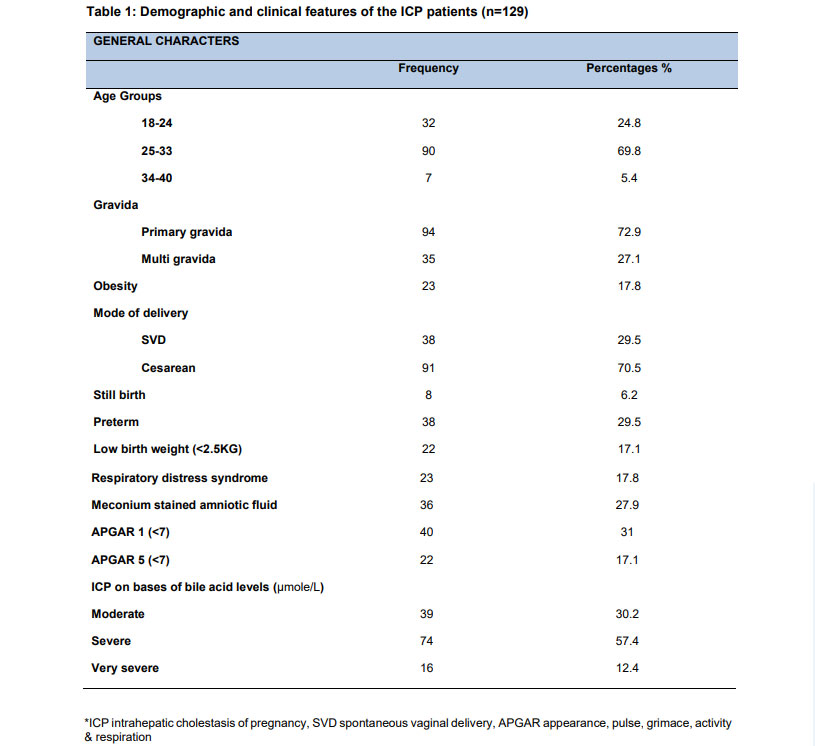
Of the 129 patients, the mean age was 27.29 ± 3.43 years. A majority, 94 (72.9%), developed intrahepatic cholestasis of pregnancy (ICP) during their first pregnancy. Only 17.8% of pregnant women were obese (BMI >27.5 kg/m² as per Asian BMI classification). Most patients delivered via cesarean section (70.5%), which was the preferred mode of delivery in females with their first pregnancy (p = 0.04). Stillbirth was observed in 8 (6.2%) patients with ICP. Meconium staining of amniotic fluid was noted in 36 (27.9%) cases. Preterm delivery (before 37 weeks of gestation) occurred in 38 (29.5%) patients. Neonatal respiratory distress syndrome (RDS) and low birth weight were seen in 23 (17.8%) and 22 (17.1%) newborns, respectively. Considering APGAR scores, 40 (31%) newborns had scores <7 at 1 minute, while 22 (17.1%) had scores <7 at 5 minutes. Bile acid levels were moderately elevated in 39 (30.2%), severely elevated in 74 (57.4%), and very severely elevated in 16 (12.4%) patients (Table 1).
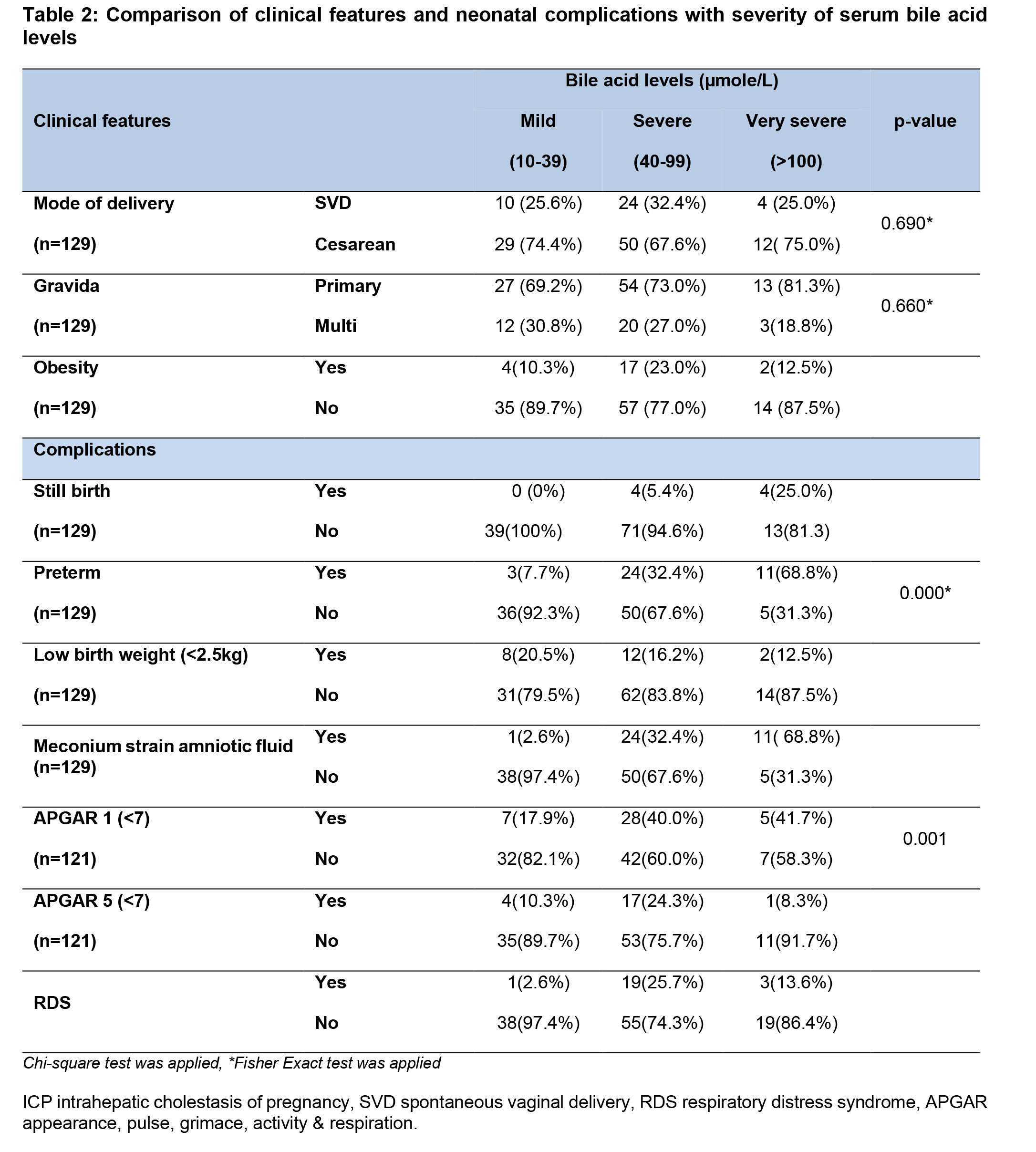
Comparison of neonatal complications with general patient features showed that low birth weight (<2.5 kg) was more common in younger females (<25 years) (p = 0.03), while other complications had no significant relationship with maternal age. Factors such as age, gravida, and weight had no effect on serum bile acid levels. Neonatal complications were significantly associated with serum bile acid levels in ICP patients (p <0.05). Serum bile acid levels >100 µmol/L increased the risk of stillbirth (OR 1.476, 95% CI, p = 0.05) and preterm delivery (OR 1.524, 95% CI, p = 0.00) (Table 2).
Abbreviations: ICP – intrahepatic cholestasis of pregnancy; SVD – spontaneous vaginal delivery; RDS – respiratory distress syndrome; APGAR – appearance, pulse, grimace, activity & respiration.
Discussion
Intrahepatic cholestasis of pregnancy (ICP) is the most common pregnancy-related liver disease, affecting 3.1% of pregnancies in Pakistan. Patients with ICP typically present with itching during the 2nd and 3rd trimester of pregnancy, accompanied by increased serum bile acid levels 3. Although symptoms resolve within 8 weeks postpartum with no significant residual effect on maternal health, ICP has been associated with poor neonatal outcomes 5. This study revealed a high rate of cesarean section deliveries among ICP patients, significantly impacting maternal health. Cesarean section was more common in primary gravida females (p = 0.04). Previous local and international studies have also reported increased risk of cesarean sections in ICP patients 7, 13, 14.
The findings of this study showed that ICP-complicated pregnancies were associated with higher rates of fetal complications, including stillbirth, preterm delivery, low birth weight, meconium-stained amniotic fluid, and neonatal respiratory distress syndrome. APGAR scores at 1 and 5 minutes were significantly lower in newborns of ICP-affected mothers. A study at the University Hospital of Messina reported similar perinatal complications, including preterm labor and meconium-stained amniotic fluid, in ICP pregnancies 7. A Swedish study involving 1.2 million pregnant women found that preterm delivery, respiratory distress, and low APGAR scores were significantly more common in ICP pregnancies 15. These studies emphasize the increased risk of adverse neonatal outcomes in ICP-complicated pregnancies.
A study conducted in Sargodha, Pakistan, also reported increased incidence of neonatal respiratory distress, preterm birth, low birth weight, and intrauterine death in ICP patients 13. Similarly, Shafqat et al. found frequent complications such as intrauterine fetal death, low birth weight, meconium-stained liquor, neonatal respiratory distress, and low APGAR scores in Pakistani women with ICP 16. The results of our study align with these findings.
Our study further demonstrated that these complications were significantly associated with the severity of cholestasis, defined by serum bile acid levels. Complications increased markedly when serum bile acid levels exceeded 40 µmol/L. Roberta Granese et al. also found that serum bile acid levels >40 µmol/L in ICP increased the risk of feto-maternal complications 7. A recent study at Rawalpindi Teaching Hospital reported that very severe ICP (serum bile acid levels >100 µmol/L) was significantly associated with intrauterine growth retardation and preterm delivery 12.
This prospective study conducted at a tertiary care hospital in Lahore provides valuable insight into fetal outcomes in ICP patients and highlights the importance of peak bile acid levels. However, the study had limitations: it was single-centered, based in an urban setting, and only immediate post-delivery complications were noted. Future multicenter studies including both urban and rural populations are needed to determine a broader picture of ICP burden, its complications, and to evaluate treatment benefits in preventing adverse neonatal outcomes.
Conclusion
This study show ICP is associated with increased risk of adverse outcome i.e. intrauterine death, preterm delivery, low birth weight and respiratory distress especially in severe cases. Thus, all the patients should be closely monitor and carefully treated to prevent these complications. Further studies to determine better evidence and the mechanism behind these complications and treatment benefits is the need of time.
References
- Odutola PO, Olorunyomi PO, Olatawura OO, et al. Intrahepatic cholestasis of pregnancy is associated with increased risk of hepatobiliary disease and adverse fetal outcomes: A systematic review and meta-analysis. ILIVER. 2023;2(4):219–226. doi:10.1016/j.iliver.2023.11.001
- Ovadia C, Seed PT, Sklavounos A, et al. Association of adverse perinatal outcomes of intrahepatic cholestasis of pregnancy with biochemical markers. Lancet. 2019;393(10174):899–910. doi:10.1016/S0140-6736(18)31877-4
- Hafeez M, Ansari A, Parveen S, et al. Frequency of intrahepatic cholestasis of pregnancy in Punjab Pakistan. J Pak Med Assoc. 2016;66(2):203–206
- Anwar R, Razzaq K, Shahid A, et al. Risk factors for intrahepatic cholestasis of pregnancy. Pak Armed Forces Med J. 2021;71(5):1852–1856. doi:10.51253/pafmj.v71i5.5310
- Sahni A, Jogdand SD. Effects of intrahepatic cholestasis on fetus during pregnancy. Cureus. 2022;14(10):e30657. doi:10.7759/cureus.30657
- Yu X, Yang H, Qi H. Clinical management guidelines for intrahepatic cholestasis of pregnancy. Matern Fetal Med. 2024;6:1. doi:10.1097/FM9.0000000000000207
- Granese R, Calagna G, Alibrandi A, et al. Maternal and neonatal outcomes in intrahepatic cholestasis of pregnancy. J Clin Med. 2023;12:4407. doi:10.3390/jcm12134407
- Kondrackiene J, Kupcinskas L. Intrahepatic cholestasis of pregnancy—current achievements and unsolved problems. World J Gastroenterol. 2008;14(38):5781–5788. doi:10.3748/wjg.14.5781
- Rafiq S, Khan S. Fetomaternal outcomes in pregnancies complicated by intrahepatic cholestasis. Biol Clin Sci Res J. 2025;6(6):398–402. doi:10.54112/bcsrj.v6i6.1982
- Vasavan T, et al. Fetal cardiac dysfunction in intrahepatic cholestasis of pregnancy. J Hepatol. 2021;74(5):1087–1096. doi:10.1016/j.jhep.2020.11.038
- Li P, Jiang Y, Xie M, You Y. Factors associated with intrahepatic cholestasis of pregnancy. Medicine (Baltimore). 2023;102(1):e32586. doi:10.1097/MD.0000000000032586
- Singh T, Rasheed M, Nagaraja N, et al. Adverse feto-maternal outcome in intrahepatic cholestasis. J Popul Ther Clin Pharmacol. 2024;31(4):1693–1699. doi:10.53555/jptcp.v31i4.6007
- Rehman S, Gulbaz S, Zafar S, et al. Frequency of fetomaternal complications due to intrahepatic cholestasis. Pak J Med Health Sci. 2023;17(6):222–224
- Jamsheed S, Samad A, Farah Khan Waleem N. Maternal and fetal outcome in intrahepatic cholestasis of pregnancy. J Soc Obstet Gynaecol Pak. 2024;14(3):310–315
- Wikström Shemer E, Marschall HU, Ludvigsson JF, Stephansson O. Intrahepatic cholestasis of pregnancy and adverse outcomes. BJOG. 2013;120(6):717–723. doi:10.1111/1471-0528.12174
- Shafqat H, et al. Perinatal outcome of intrahepatic cholestasis of pregnancy. Pak Armed Forces Med J. 2022;72(3):956–960. doi:10.51253/pafmj.v72i3.5346