Abstract
Background: Despite the prevalence of cardiac problems in Pakistan, the association of depression and anxiety amongst hospitalized heart patients is not well known. Mental health problems often turn out to be a hurdle in proper treatment and may lead to poor prognosis in cardiac. Proper assessment and interventions to deal with depression and anxiety are essential for better patient outcome.
Objective: The aim of this study is to assess the levels of depression and anxiety amongst patients hospitalized for heart disease in Lahore along with the factors affecting them.
Method: This was an analytical cross-sectional study conducted amongst cardiac patients hospitalized in Army Cardiac Center, Lahore from November to December 2024. The sample size was calculated to be 169. The technique employed was convenience sampling. The Hospital Anxiety and Depression scale by Zigmond and Snaith [9] was used to assess depression and anxiety levels in the patients. The association of gender, age occupation, education level and type of heart disease with levels of depression and anxiety was analyzed using SPSS version 29. Ethical approval was obtained from ORIC, CMH Lahore Medical College and IOD.
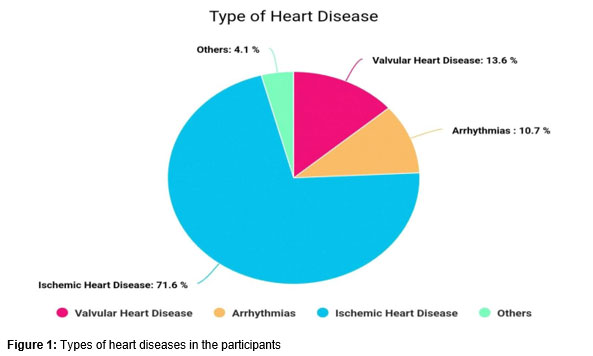
Results: A total of 169 results were utilized. 81.2% (137) of the respondents were male and 38%(32) were more than 60 years of age. Of all the patients, 68.8% (116) had normal levels of depression while 63% lied under normal levels of anxiety. 71.6%(121) of the patients had ischemic heart disease, 13.6%(23) had valvular disease while 10.7%(18) had arrhythmias. Sociodemographic factors like age, gender, occupation and education along with type of heart disease were found to be significantly associated with depression and anxiety levels in hospitalized cardiac patients. The association of levels of anxiety and depression were both independently found to be significantly associated with gender, age, occupation, and type of heart disease with p values of 0.000 using chi squared test.
Conclusion: A major proportion of hospitalized heart patients were found to be affected with borderline abnormal and abnormal levels of depression and anxiety. Thorough evaluation of patients for depression and anxiety levels is essential to provide them with proper care and for better patient outcomes.
Keywords: Heart disease, Depression, Anxiety, Hospitalization, Mental Health, Cardiac Patients
Introduction
Cardiovascular diseases (CVD) account for 32% of the total deaths globally. Of these, 85% were due to heart attack and stroke. About 75% of these occurred in middle to low-income countries 1. Cardiac patients often suffer from anxiety and depression. These are distinct risk factors for progression and deterioration in heart disease 2. Other risk factors included smoking, hypertension, dyslipidemias, diabetes mellitus and obesity 3. Major depressive disorder (MDD) is characterized by extensive depression, lack of enthusiasm in activities, suicidal thoughts amongst other symptoms 4. It is limited to depression only leading to non-compliance by the patient and limitation of effective management of disease. The high prevalence of association of depression in cardiac patients may indicate two possibilities: role of CVD in worsening depression or that of depression worsening CVD outcomes 5.
Although the connection between anxiety and cardiovascular disease has not been studied enough, chronic anxiety has been found to result in an elevated risk of myocardial infarction and heart failure 6. Anxiety has been considered as a standalone correlation that is separate from depression or other demographic factors like age, gender, occupation, education and residence 7, 8. Anxiety leads to increased sympathetic activation, high levels of inflammatory markers along with increased oxidative stress, platelet activation and endothelial dysfunction which may result in unsatisfactory cardiovascular prognosis 9.
Studies have reported a fair improvement in prognosis of heart diseases when treatment of depression and anxiety was given to affected patients 10, 11, therefore, the integration of mental health problems along with the cardiovascular diseases is essential.
Psychological problems are negatively perceived in Asian countries; thus, there is little evidence of incidence of anxiety and depression in cardiac patients in hospitals.
Similarly, there is a gap in knowledge of incidence of mental health issues in Pakistan which results in improper counselling by health care workers and lack of cooperation from the patients end 12.
The objective of this study is to assess the levels of depression and anxiety amongst patients hospitalized for heart disease in Lahore along with the factors affecting influencing them.
Method
This was an analytical cross-sectional study carried out from November to December 2024 in Army Cardiac Center, Lahore. All patients suspected of or diagnosed with angina, heart failure, cardiac arrhythmias, valvular dysfunction or any other heart problem requiring hospitalization but stable enough to give consent were invited to take part in the study. Medical records were used to confirm the diagnosis. Those patients who were suffering from mental retardation, clinically diagnosed mental health disorders other than depression and anxiety, presented in acute emergency or in the out-patient department for regular checkup were excluded. The sampling technique employed was convenience sampling. The sample size was calculated with 95% confidence interval and 5% error margin using the formula given below to be 169 using OpenEpi Version 3.
The data was collected after acquiring written informed consent from the patients. Sociodemographic data including age, gender, education, occupation and data for type of heart disease was collected. The levels of depression and anxiety were assessed by collecting data using the Hospital Anxiety and Depression Scale (HADS) by Zigmond and Snaith 13. This scale has HADS-A AND HADS-D subsets with seven items and highest score of 21 each. The respective levels of depression and anxiety have been divided according to the score with 0–7 showing no clinical symptoms, 8–10 indicating moderate levels while 11–21 showing diagnostic threshold. The value of reliability of this scale has been well tested in various medical settings (mean Cronbach’s alpha = 0.83 for HADS-A and mean Cronbach’s alpha = 0.82 for HADS-D) 13. This scale has been translated into various languages. Urdu version of the HADS scale was obtained from the author of previously conducted research in Pakistan 14.
The research participants were not subjected to any harm whatsoever. Full consent was obtained from each participant. The participants were included with complete anonymity and there was no identification of anyone participating in this study. All information obtained from participants will be kept confidential. Ethical approval was obtained from the Office of Research, Innovations and Commercialization (ORIC) CMH Lahore Medical College and IOD (Approval Number: Case#.72/ERC/CMH/LMC dated 19-09-24).
Data was analyzed using SPSS software (29.0 version). Chi-squared test was used for the associations between levels of depression and anxiety with age, gender, occupation, education and type of heart disease. A p value of less than 0.05 was counted as significant.
Results
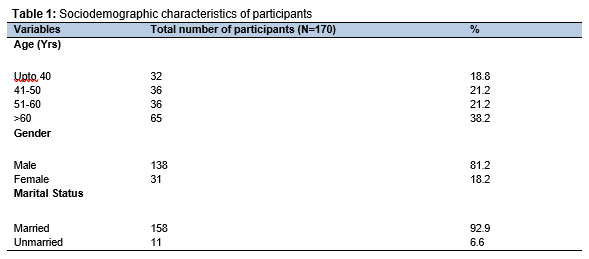
A total of 169 patients took part in the study. Sociodemographic variables are displayed in Table 1. Majority of our participants were male. 92.9% (158) of the respondents were married. 38.2% (65) of them were above 60 years of age. 10% (17) of them had no formal education while 33% (56) had received 6 to 10 grades of education. Based on occupation, 27.6% (30) had government jobs followed by 8% (14) who had private jobs.
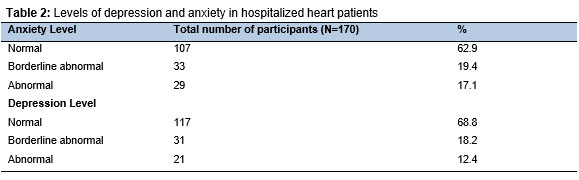
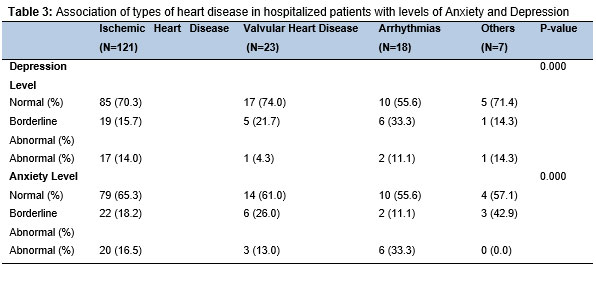
As mentioned in Table 2, anxiety levels in 19.4% (33) were borderline and 17.1% (29) were under the abnormal category. Depression levels were borderline in 18.2% (31) and abnormal in 12.4% (21). Most of our study participants suffered from ischemic heart disease (71.2%). 14% (17) had clinical symptoms of depression and 16.5% (20) were under abnormal levels of anxiety as given in Table 3. The association between heart disease and levels of anxiety and depression was found to be separately significant with a p value of 0.000.
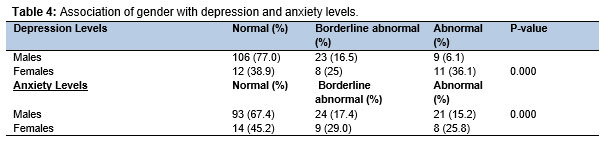
Table 4 showed that a greater number of females were experiencing symptoms of depression and anxiety as compared to males. The association of levels of anxiety and depression were both independently found to be significantly associated with gender, age, occupation, and type of heart disease with p values < 0.05 with a 95% confidence interval 15.
Discussion
Our research depicted that a major proportion of patients hospitalized with cardiovascular diseases suffered from anxiety and depression.
Clinical symptoms of anxiety and depression were classified under abnormal levels according to the Hospital Anxiety and Depression Scale and were found in a significant proportion of the patients. The high incidence in our region can be attributed to the lack of awareness amongst the patients, health care workers and improper provision of mental health services to them 15. Moreover, the stigma related to mental health diseases in Asian countries has led to an increase in undiagnosed cases of depression and anxiety.
Annie et al. have studied the evidence and underlying mechanisms that prove the poor prognosis of cardiac patients experiencing depression and anxiety. These include biological factors like development of a pro-inflammatory state, increased oxidative stress, platelet and endothelial dysfunction along with behavioral factors like a tendency of sedentary lifestyle, high cholesterol diet and smoking 16. It is, therefore, essential to ascertain levels of anxiety and depression in such patients, portraying the necessity of upholding both the physical and mental well-being of the patient.
In our study, we have found a higher percentage of female patients hospitalized for heart disease to be suffering from anxiety and depression. As proven by another study conducted in this region, women who are widowed or are stay-at-home spouses were more susceptible to these mental health disorders 17, 18.
The age group most susceptible to being affected by depression amongst the admitted patients was found to be greater than 60 years. An explanation for this can be social isolation, unemployment, socioeconomic distress, and restricted ability to perform daily activities 19. This depression can lead to non-compliance by the patient which serves as an obstacle in effective patient management.
As per our results and those proven by other studies, patients having ischemic heart disease were the most prevalent 20, 21. This is attributable to the presence of about all the risk factors associated with ischemic heart disease including obesity, hypertension, hypercholesterolemia, smoking and physical inactivity in our population 22. In our study, hospitalized patients diagnosed with arrhythmias were found to have the highest percentage with abnormal levels of anxiety. Peacock, J. et al., in her review outlines the numerous studies and elicited mechanisms demonstrating the role of anxiety in causing sympathetic overdrive and parasympathetic withdrawal leading to elevated risks of developing arrhythmic patients. Emotional response induced T wave alternations were also elicited 23. The highest proportion of patients having abnormal levels of depression were found to be diagnosed with cardiovascular diseases other than ischemic heart disease, arrhythmias and valvular heart disease. These included cardiomyopathies, myocarditis, and congenital heart diseases. Numerous studies have delineated an association between depression and cardiomyopathies and congenital heart diseases 24, 25. Essentially, all heart diseases have an impact on the mental health of the patient as it is associated with escalated fear of adverse outcomes so dealing with the psychological aspect of cardiovascular disease is essential for providing proper patient care.
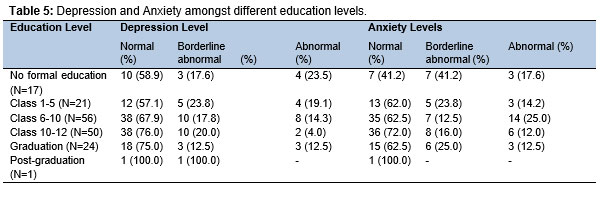
Individuals with no education or graduating with lower education levels appeared to have elevated levels of anxiety and depression amongst the patients as seen in Table 5. Consequently, these values reflect an inverse relationship between the level of education with depression and anxiety. Jain M. et al. also reported a trend showing a correlation between rising education levels and decreasing depression in the housewives in a rural community in Rajasthan, India 26. However, the type of education can vary on the impact of mental health; for example, a psychology major would offer more literacy on anxiety and depression over a fine arts degree 26. Nonetheless, a trend is present between increased years of education and decreased levels of anxiety and depression as shown in other studies 27. A study done in the UK noted the recent depressive symptoms (RDS) score for high school graduates was 13% lower than high school dropouts and may be due to schooling rescuing students from genetic propensities towards depression and anxiety 28.
In the study it was observed that the type of occupation carries a link with depression and anxiety, with a general trend seen where the housewives seemed to be the more abnormally depressed and unemployed individuals seemed to be the more abnormally anxious. Similar findings were shown in a study in Canada where unemployed individuals were 1.91 times more likely to show worse mental health compared to their employed counterparts. A positive feedback loop may exist, where worsening mental health and prolonged unemployment prolong each other in a cycle. Furthermore, the Canadian study suggested that the difference in employed and unemployed participants is owed to the lack of latent functions a job offers, which housewives lacked as well 29. One article from India specified that homemakers’ domestic responsibilities lead to self-worthlessness and boredom which ultimately lead to higher rates of depression compared to working women 30. Another study supports the latent model, which defines that a career offers external structure, collective collaboration, and status in an individual’s life: therefore, boosting one’s mental health 30. In the study, the latent model accounted for 19% of the discrepancy between the mental health of employed individuals and unemployed individuals 31.
A minority of studies were also, however, found to be contraindicatory to our results proving no association to be present between depression and anxiety with cardiovascular disease.
Our study limitation included the fact that the sensitivity and specificity of Hospital Anxiety and Depression scale is not 100% so cases may have been left out.
Conclusion
A major proportion of hospitalized heart patients were found to be affected with borderline abnormal and abnormal levels of depression and anxiety. Factors including age, gender, occupation and type of heart disease were found to be independently associated with levels of depression and anxiety in cardiac patients. A holistic approach to patient care is needed to ensure both mental and physical welfare of the patient.
References
- World Health Organization. Cardiovascular diseases [Internet]. Geneva: WHO; 2024 [cited 2025 Oct 11]. Available from: https://www.who.int/health-topics/cardiovascular-diseases
- Ryder AL, Cohen BE. Depression and anxiety as risk factors for heart disease and stroke. Fam Pract. 2021;38(3):365-7. https://doi.org/10.1093/fampra/cmab031
- Adhikary D, Barman S, Ranjan R, Stone H. Major cardiovascular risk factors: a systematic review. Cureus. 2022;14(10):e30119. https://doi.org/10.7759/cureus.30119
- Marx W, Penninx BWJH, Solmi M, Furukawa TA, Firth J, Carvalho AF, et al. Major depressive disorder. Nat Rev Dis Primers. 2023;9(1):44. https://doi.org/10.1038/s41572-023-00454-1
- Hare DL, Toukhsati SR, Johansson P, Jaarsma T. Depression and cardiovascular disease: a review. Eur Heart J. 2014;35(21):1365-72. https://doi.org/10.1093/eurheartj/eht462
- Peng B, Meng H, Guo L, Zhu J, Kong B, Qu Z, et al. Anxiety disorder and cardiovascular disease. ESC Heart Fail. 2024;11(2):1174-81. https://doi.org/10.1002/ehf2.14676
- Karlsen HR, Saksvik-Lehouillier I, Stone KL, Schernhammer E, Yaffe K, Langvik E. Anxiety as a cardiovascular risk factor. Psychol Health. 2021;36(2):148-63. https://doi.org/10.1080/08870446.2020.1779273
- Roest AM, Martens EJ, de Jonge P, Denollet J. Anxiety and coronary heart disease risk: meta-analysis. J Am Coll Cardiol. 2010;56(1):38-46. https://doi.org/10.1016/j.jacc.2010.03.034
- Dhar AK, Barton DA. Depression and cardiovascular disease. Front Psychiatry. 2016;7:33. https://doi.org/10.3389/fpsyt.2016.00033
- Gundugurti PR, Bhattacharyya R, Koneru A. Psychiatric disorders in cardiovascular disease. Indian J Psychiatry. 2022;64(Suppl 2):S355-65. https://doi.org/10.4103/indianjpsychiatry.indianjpsychiatry_42_22
- Tully PJ, Pedersen SS, Cosh SM, Foldes-Busque G. Treating anxiety disorders in cardiovascular patients. In: Smits JAJ, et al., editors. Clinical guide to exposure therapy. Cham: Springer; 2022. p. 151-70. https://doi.org/10.1007/978-3-031-04927-9_9
- Herrmann-Lingen C. Anxiety and depression in cardiology patients. Herz. 2001;26(5):326-34. https://doi.org/10.1007/s00059-001-2300-4
- Amin MA, Ahmed M, Nahin S, Kakoly NS. Depression and anxiety in heart disease patients. Front Psychiatry. 2022;13:895224. https://doi.org/10.3389/fpsyt.2022.895224
- Lodhi FS, Elsous AM, Irum S, Khan AA, Rabbani U. Urdu version of HADS validation. Gen Psychiatr. 2020;33(5):e100276. https://doi.org/10.1136/gpsych-2020-100276
- Dayani K, Zia M, Qureshi O, et al. Pakistan mental healthcare system evaluation. Int J Ment Health Syst. 2024;18(1):32. https://doi.org/10.1186/s13033-024-00646-6
- Dogar IA, Khawaja IS, Azeem MW, Awan H, Ayub A, Iqbal J, et al. Depression and anxiety in cardiac patients. Psychiatry (Edgmont). 2008;5(2):38-41. Available from: https://pubmed.ncbi.nlm.nih.gov/19727293/
- Sisay T, Mulate M, Hailu T, Belete TM. Depression and anxiety among cardiovascular patients. Heliyon. 2024;10(2):e24079. https://doi.org/10.1016/j.heliyon.2024.e24079
- Jafar TH, Jafary FH, Jessani S, Chaturvedi N. Heart disease epidemic in Pakistan. Am Heart J. 2005;150(2):221-6. https://doi.org/10.1016/j.ahj.2004.09.025
- Raheem A, Ahmed S, Kakar AW, Majeed H, Tareen I, Tariq K, et al. Cardiovascular disease burden in South Asia. Pak Heart J. 2022;55(1):15-21. Available from: https://www.pakheartjournal.com/index.php/pk/article/view/2264
- Jafar TH, Qadri Z, Chaturvedi N. Coronary artery disease in Pakistan. Heart. 2008;94(4):408-13. https://doi.org/10.1136/hrt.2007.121343
- Peacock J, Whang W. Psychological distress and arrhythmia. Prog Cardiovasc Dis. 2013;55(6):582-9. https://doi.org/10.1016/j.pcad.2013.03.001
- Hu HL, Chen H, Zhu CY, Yue X, Wang HW, Qian G, et al. Depression and hypertrophic cardiomyopathy outcomes. J Am Heart Assoc. 2021;10(8):e019071. https://doi.org/10.1161/JAHA.120.019071
- Kovacs AH, Luyckx K, Thomet C, Budts W, Enomoto J, Sluman MA, et al. Anxiety and depression in congenital heart disease. J Am Coll Cardiol. 2024;83(3):430-41. https://doi.org/10.1016/j.jacc.2023.10.043
- Jain M, Garg K, Jain M, Kumar V, Gupta P. Depression among housewives. Healthline. 2022;13(3):214-21. https://doi.org/10.51957/Healthline_391_2022
- Taple BJ, Chapman R, Schalet BD, Brower R, Griffith JW. Education and depression assessment. Assessment. 2022;29(2):272-84. https://doi.org/10.1177/1073191120971357
- Fernandes S, Angolkar M, Bagi GJ. Depression in working women vs homemakers. Int J Indian Psychol. 2020;8(1):829-35. https://doi.org/10.25215/0801.104
- Amin V, Fletcher JM, Lu Q, Song J. Education and mental health in the UK. Econ Educ Rev. 2023;93:102354. https://doi.org/10.1016/j.econedurev.2023.102354
- Li AKC, Nowrouzi-Kia B. Employment status and health in Canada. AIMS Public Health. 2024;11(1):236-57. https://doi.org/10.3934/publichealth.2024012
- Kondirolli F, Sunder N. Mental health effects of education. Health Econ. 2022;31(S2):22-39. https://doi.org/10.1002/hec.4565
- Paul KI, Scholl H, Moser K, Zechmann A, Batinic B. Employment status and mental health. Front Psychol. 2023;14:1017358. https://doi.org/10.3389/fpsyg.2023.1017358
- Khan QU. Salivary cortisol and severe depression. Cureus. 2020;12(11):e11548. https://doi.org/10.7759/cureus.11548