Abstract
Background: As traffic accidents continue to be a major global cause of injury and accidental death, road safety is a basic public health problem. In order to protect both drivers and pedestrians, strict respect to traffic laws, careful driving, and awareness of road conditions are essential. To lower accidents and make roads safer for everyone, it is crucial to promote road safety through enforcement and education.
Objective: To assess the level of awareness and behavior regarding road safety among university students.
Method: In partnership with the University of Lahore (UOL), the University College of Medicine and Dentistry (UCMD) carried out this cross-sectional analytical study during a 9-month period, from March 2023 to November 2023, which included two months of data gathering. 369 students, ages 17 to 24, who drive their own cars and are enrolled in medical and non-medical programs, including UCMD students and undergraduates from UOL's information technology, engineering, and law departments, were included in the study. The exclusion criteria include students who do not drive their own vehicles, are new drivers or who has recently any vehicle accident. The non-probability convenience sampling was used.
Results: The study depicts significant gap between awareness and safe driving behavior, with only 53.4% of university students wearing helmets and 67.5% wearing seatbelts, even though over 85% of them were aware of traffic rules, signs, and violations. Additionally, students who consistently practiced safe driving practices had significantly lower injury rates (p<0.05) than those who never followed traffic signals or skipped automobile maintenance.
Conclusion: This study revealed significant association between road safety practices and injury occurrence. Those who consistently followed traffic signals had notably fewer injuries highlighting the importance of compliance in reducing injury risk. Regular vehicle maintenance also showed a significant protective effect.
Keywords: Awareness, Knowledge, Behavior, Road safety, University students
Introduction
Road safety means methods and measures that are aimed to reduce the risk of people using the road network getting involved in an accident that may cause property damage, injuries or deaths [1]. Traffic rules and regulations contribute to road safety, that means any ordinance or resolution of the City Council passed for regulating or controlling any vehicle, bicycle or pedestrian traffic [2]. Road safety is a major public health issue because road traffic crashes are the 8th leading cause of global mortality. Majority of these deaths occur in children and young adults and in low- and middle-income countries (LMIC) [3].
Sustainable Development Goals (SDG) were introduced in 2015 by United Nation to get their targets in 2030. The third goal is “Health and Wellbeing”. Target of this goal “3.6” was related to reduce death rates due to accident / crashes to fifty percent by the year 2020. However, this target 3.6 did not meet [4]. According to the latest WHO report published in 2018, total deaths due to road traffic accidents in Pakistan are 2.42% of total deaths, emphasizing that road safety is a serious challenge to public health [5]. Traffic rule violations and traffic crashes are closely related to each other. Traffic rule violations and risky driving behaviors don’t always result in crashes, but they have the potential of crash occurrence. Various factors contribute to the violations of traffic rules. Among these factors, human errors, vehicles not working properly and environment are the most important [6]. According to a study conducted in all provinces of Pakistan highlighted that lack of education, awareness, law enforcement, and poor roads conditions lead to violation of traffic rules compliance [7]. Another study on professional drivers in Multan, Pakistan, highlighted that the risky practices and negative attitude towards traffic rules shown by many drivers, are a result of inadequate knowledge about traffic sign boards and less awareness which results in injuries and deaths of both drivers and pedestrians [8]. A ten year study (2006- 2015) conducted in Pakistan by highway and motor way police revealed that; major causes of accidents were careless driving (55%), involvements of pedestrians(15%), sleeping during driving (11%), mechanical issues of vehicles (9%) and other factors (10%) .This study also indicated that 65% road accidents were reported during day and 35% at night time and more accidents occur during weekends [9].Another study in Pakistan reflected that poor enforcement of traffic regulations is the main contributor to risky driving [10].
Study in University students of Malaysia who were young drivers (23- 27 years) and had a few years of driving experience showed moderate knowledge about road regulations, traffic signs and good road user habits [11]. A study among undergraduate dental students in India showed that the awareness regarding road safety measures was satisfactory but interpretation of traffic sign boards was poor and the behavioral patterns like wearing helmet, seat belt and following lane rules were also not satisfactory [12]. A study among the coastal population of Karnataka showed that there is insufficient knowledge and unsafe driving habits among many of participants whereas younger people and male gender were found to have a higher level of road safety knowledge [13]. Another study conducted in the Czech Republic also highlighted that, the driver's inattention is the most common factor in accidents, and it can be caused by a variety of factors, including monotonous driving, inattention, overloading and driver drowsiness etc. [14]. In rural population of Uttar Pradesh, A cross-sectional survey of adults over the age of 16 was carried out. This study also showed lack of knowledge and unfit driving practices among a fair number of participants [15]. The fact that road accidents account for approximately 2% of Pakistan's gross domestic product make it a burning issue [16].
The aim of our study is to evaluate the awareness and driving behavior of students, keeping in mind road safety. No data is available to assess driving behavior in the youth population, which is the most important and big chunk of the most populated cities of Pakistan. And also, no comparative study has been done among university students who want to experience thrills and adventure in life and also practice distraction and aggressive behavior while driving.
Method
This comparative cross-sectional study was conducted in University College of Medicine and Dentistry in collaboration with various departments of University of Lahore over a period of 9 months from March 2023 to November 2023 including 2 months of data collection. The study included 369 students aged 17 to 24 years in medical and non-medical departments, including students of UCMD and undergraduates of Information technology, Engineering and LAW department of UOL, who drive their own vehicles [13].
The data was collected by questionnaire with informed consent from students aged 17-24 years irrespective of gender from those who drive their own vehicles (car, motorcycle).The independent variables included the road safety consciousness and the driving behaviors that included familiarization with traffic rules, use of protective equipment, compliance with traffic lights and maintenance of vehicles. The dependent variable was the measurement of the incidence and frequency of the road traffic related injuries in the previous twelve months. The Ethical approval was taken from the Ethical Review Board (ERB) University College of Medicine & Dentistry, The University of Lahore under the Ref: ERCl3ll23l03 dated 16-03-2023.
Statistical Analysis: Data was analyzed using SPSS version 24. Chi-square test was used to compare variables between the groups. p<0.05 was considered significant
Results
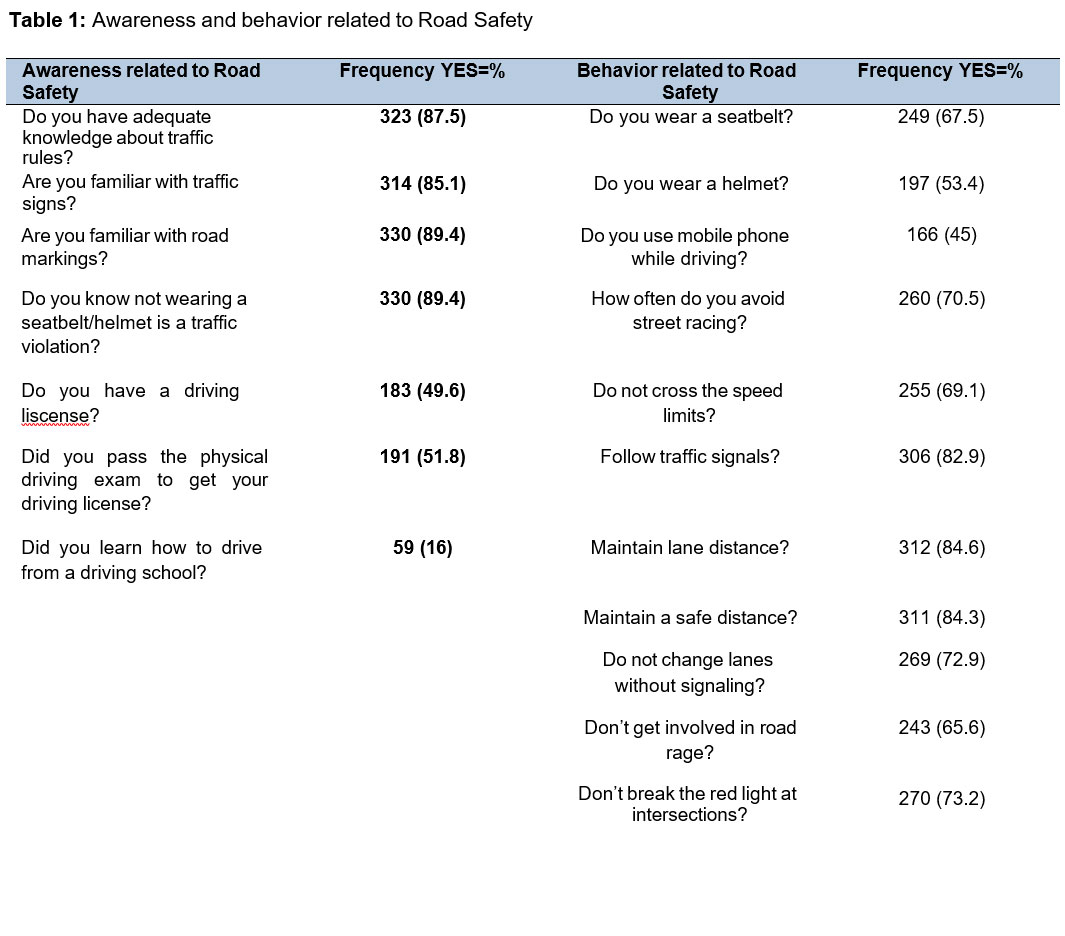
The data shown in the table depicts that while a high percentage of respondents have knowledge about traffic rules and violations, their actual practices related to road safety, such as wearing seatbelts or helmets, tend to be lower.
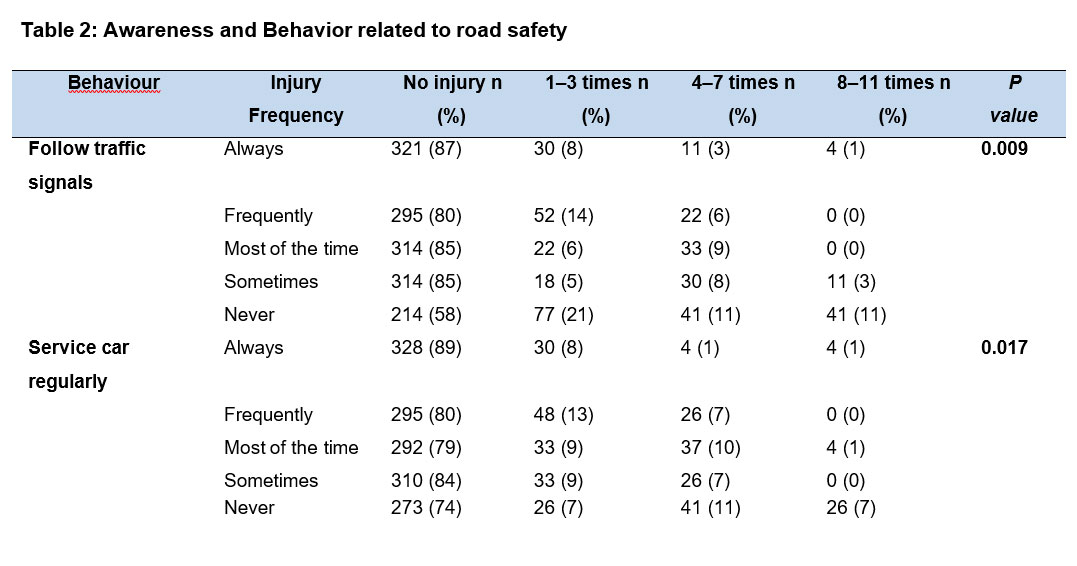
Among those who always followed traffic signals, 87% reported no injuries, while only 58% of those who never followed traffic signals reported no injuries. Participants who never followed traffic signals had higher rates of multiple injuries, with 21% reporting 1-3 injuries and 11% reporting 8-11 injuries during last year (Table 2).
Similarly, 89% participants who always service their cars reported no injuries while 74% reported 8-11 injuries last year and these students are those who never service their cars. Also, there is a higher percentage of
participants (7%) who had multiple injuries (8-11) who never serviced their cars as compared to those 1% of the participants who had multiple injuries but always service their cars.
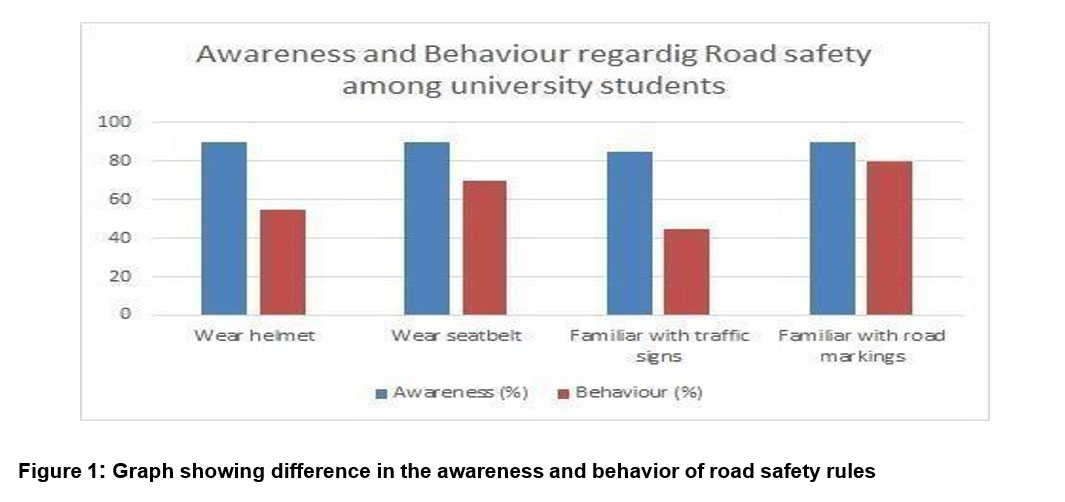
This graph (Fig 1) shows that there is a higher percentage of people who have awareness about road safety rules like wearing helmet, seat belts, familiarity with traffic signals and road markings but their behavior regarding these rules are not in accordance with their Awareness level.
Discussion
Among the university students, the researchers of this research found an open gap between understanding and proper practice related to safety on the road, and they also found that unsafe road safety practices have strong links with the number of injuries [17]. Students who always followed traffic lights incurred much less injuries (p =.009) and this confirms the protective importance of compliance. Similarly, car servicing also showed statistically significant protective effect (p = 0.017). These findings highlight the importance of following traffic rules and servicing of vehicles in reducing the incidence of injuries caused by driving [18]. Although there was high knowledge of the law, the participants demonstrated the conspicuous use of personal protective items like helmet and seatbelts [19]. Such a gap might be based on the generalized sense of invulnerableness of adolescents or the general role of ignoring personal safety precautions, which may be viewed as unnecessary or even as burdensome until authorities impose the necessary measures. The findings are consistent with the existing literature relevant to the fact that despite the high level of knowledge, even highly informed people often do not succeed in transferring the knowledge into practice, which might be explained by the overconfidence in their competence in driving or a distorted perception of the dangers of not following safety guidelines [20].
This study has confirmed the high correlation between a rise in frequency of traffic injuries and failure to comply with traffic lights. In comparison with adherents to traffic rules and regulations, students who indicated a tendency to nonadherence to traffic lights and reported a steady nonadherence rate to it had a significantly higher prevalence rate of multiple injuries. In order to influence obedience, this association emphasizes what the possible outcomes of ignoring the main principles of traffic regulation can be and why it is necessary to reinforce this process and, probably, to apply more serious punishment in case of breaking the rules [21].
Additionally, there is vehicle maintenance that turns out to be a major factor of road safety. Increased levels of injury were noted among the people that did not take their vehicles through regular maintenance procedures, a phenomenon that could be explained by breakdowns or malfunctions of vehicles, particularly in an emergency [22]. Periodical maintenance, in ensuring that the safety systems of a vehicle are functioning properly, as well as minimizing the occurrence of an accident as a result of mechanical malfunction also work to better the overall safety. The study only focused on students of one university and it is possible that this type of sample is not quite enough to generalize the results to the rest of the population in Lahore that comprises of youth. Also, the study is susceptible to the consequences of the recollection and social desirability bias because the self- reported data may consist of actions that are socially acceptable to the respondent and not reflect their real behaviors [23].
LIMITATIONS OF THE STUDY: The study used non-probability convenience sampling from a single university limits generalizability, while self-reported data introduces potential recall and social desirability biases, and the exclusive focus on student drivers may not capture broader population driving behaviors.
Conclusion
The research ended with the finding that, as the students in the university showed extensive knowledge about the principles of road safety, the same knowledge does not imply their behaviors to be applied on-road.
References
- Road safety, Accessed on:27 Sep , 2022 at 8:20pm Available from URL: https://www.lawinsider.com/dictionary/road-safety
- Traffic regulation, Accessed on:27 Sep , 2022 at 9:23 am Available from URL: https://www.lawinsider.com/dictionary/traffic-regulations
- SHERIN, “ROAD SAFETY: A MAJOR PUBLIC HEALTH ISSUE”. KHYBER MEDICAL UNIVERSITY JOURNAL, Vol. 13, no. 1, Mar. 2021, pp. 1-3. https://doi.org/10.35845/kmuj.2021.21475
- United Sustainable Development Goals. Accessed on:14 Sep , 2022 at 5:40 pm Available from URL: https://www.un.org/sustainabledevelopment/health/
- Road safety facility, accessed 30th Sep2022 at 03:00 pm Available from URL: https://www.roadsafetyfacility.org
- Hsiao H, Chang J, Simeonov Preventing emergency vehicle crashes: status and challenges of human factors issues. Human Factors. 2018 Nov;60(7):1048-72. https://doi.org/10.1177/0018720818786132
- Shabir G, Hayat MN, Hamad Why People Violate Traffic Rules in Pakistan. Journal of Information Engineering and Applications. 2014;4(12):40. https://www.iiste.org/Journals/index.php/JIEA/article/view/18376
- Riaz I, Shahid Knowledge, attitudes, and practice of drivers towards traffic rules and regulations in Multan, Pakistan. In 7th International RAIS Conference on Social Sciences 2018 Feb 25. https://doi.org/10.2139/ssrn.3152120
- Åkerstedt T, Kecklund G, Hörte Night driving, season, and the risk of highway accidents. Sleep. 2001 Jun 1;24(4):401-6. https://doi.org/10.1093/sleep/24.4.401
- Muhammad Farooq, Dr. Muhammad Ramzan, Dr. Rubeena Zakir Barriers in Enforcement of Traffic Regulations and Risk-Taking Behaviour: A Study of Public Service Vehicle Drivers. Pakistan Social Sciences Review. March 2021;5(I):858-869. https://doi.org/10.35484/pssr.2021(5-I)64
- Abd Rahman R, Mazle HA, Lim WM, Masirin MM, Hassan MF. ROAD SAFETY AWARENESS AMONG UNIVERSITY STUDENTS: CASE STUDY AT MALAYSIA UNIVERSITI TUN HUSSEIN ONN MALAYSIA. Journal of Civil Engineering, Science and Technology. 2021 Apr 30;12(1):56-65. https://doi.org/10.33736/jcest.3344.2021
- Harish K. Ratna, Rajesh S. S., Ashok Jayaram, Rajanna M. S., Venkatesh P., Krishna Iyenga. Int J Community Med Public Health. 2017 Apr;4(4):944-948. https://doi.org/10.18203/2394-6040.ijcmph20170947
- Shetty RS, Pahwa V, Vibha SP, Kamath A, Nair Road safety and the community: an awareness survey among the coastal population of Karnataka. Int J Community Med Public Health. 2018 Feb;5(2):116. https://doi.org/10.18203/2394-6040.ijcmph20175767
- Bucsuházy K, Matuchová E, Zůvala R, Moravcová P, Kostíková M, Mikulec Human factors contributing to the road traffic accident occurrence. Transp Res Procedia. 2020;45:555-61. https://doi.org/10.1016/j.trpro.2020.03.057
- Upadhyay P, Rajain M, Kumar A, Pachauri RK, Priyanka. (2022) Knowledge, practice and ocular manifestations on road safety measures among rural population of Uttar Pradesh. Int J Health Sci. 6(S6):2401–2412. https://doi.org/10.53730/ijhs.v6nS6.11014
- Government of Pakistan (GOP). Economic survey of Pakistan 2016–17. Ministry of Finance, Islamabad. https://www.finance.gov.pk/survey_1617.html
- Redhwan AA, Karim Knowledge, attitude and practice towards road traffic regulations among university students, Malaysia. IIUM Medical Journal Malaysia. 2010;9(2). https://doi.org/10.31436/imjm.v9i2.716
- Goel R, Tiwari G, Varghese M, et al. Effectiveness of road safety interventions: An evidence and gap map. Campbell Systematic Reviews. 2024;20(1):e1367. https://doi.org/10.1002/cl2.1367
- Khorasani-Zavareh D, Mohammadi R, Khankeh HR, et al. The requirements and challenges in preventing road traffic injury in Iran. BMC Public Health. 2009;9:486. https://doi.org/10.1186/1471-2458-9-486
- Haan. Framework for Assessing Secure Information Behavior in Organizational Context. Master’s thesis. https://studenttheses.uu.nl/handle/20.500.12932/49358
- Cramton Driver Behavior and legal sanctions: A study of deterrence. Mich. L. Rev. 1968;67:421. https://repository.law.umich.edu/cgi/viewcontent.cgi?article=4917&context=mlr
- Hsiao H, Chang J, Simeonov Preventing emergency vehicle crashes: status and challenges of human factors issues. Human Factors. 2018 Nov;60(7):1048-72. https://doi.org/10.1177/0018720818778516
- Davis CG, Thake J, Vilhena N. Social desirability biases in self-reported alcohol consumption and harms. Addictive Behaviors. 2010 Apr 1;35(4):302-11. https://doi.org/10.1016/j.addbeh.2009.11.001