
Evaluation of Child Feeding Practices in Children Presenting in Tertiary Care Hospitals of Punjab
Correspondence and article notes 8
ABSTRACT
Background: Infant feeding practices play a great role in growth and development of child. Introduction of complementary foods after the first six months and continuous exclusive breastfeeding are important in preventing malnutrition and infections.
Objective: The objectives of this study were to assess the frequency of exclusive breastfeeding and complementary feeding practices in children 0-24 months old in Pakistan, and analyze the impact of maternal factors associated with these practices.
Method: A cross-sectional study was carried out in pediatric departments of tertiary care hospitals, Pakistan. A total 202 mothers with children aged 0-24 months were interviewed; after their consent all participants were enrolled. Mothers with psychiatric problems and children with congenital malformation were excluded from the study. Information was obtained from a structured questionnaire consisting of sociodemographic characteristics, breastfeeding practices and complementary feeding patterns. Data were analyzed by descriptive statistics as frequencies and percentages. Pearsons-Chi-square and Fisher’s exact test was used to determine the relationship between maternal characteristics and feeding patterns.
Results: The predominant age group of mothers in this study was 20-29 years (65.8%). The frequency of exclusive breastfeeding for at least first six months was 46.53%. Maternal age significantly associated on-demand breastfeeding and daily breastfeeding feeding frequency (p<0.05). Maternal education, also had its effects on night-time breastfeeding, daily frequency and timing of complementary food introduction (p<0.05). The number of adults living in the house was found to be interrelated with number of time child breastfed.
Conclusion: Among the mothers included in this study, exclusive breastfeeding rate for the first 6 months was very low. Although majority of mothers-initiated breastfeeding soon after childbirth, numerous children were introduced complementary food before the recommended age of six months. Maternal age and education were the key factors that had major impact on feeding practices. Besides, household size was another important factor in relation to infant feeding behavior.
Keywords: Exclusive breastfeeding, Maternal, Breastfeeding, Malnutrition, Pakistan
INTRODUCTION
Early feeding practices in the initial years of childhood establish a foundation for growth and development and has implications for the child’s long-term health and well-being [1].
Exclusive breastfeeding (EBF) was as defined by WHO and included giving an infant only breast milk. Other foods or drinks not given to the baby, except drops and syrups of supplements, medications prescribed for the treatment of diseases and oral re-hydration solution were not allowed for up to 6 months [2].
Starting breastfeeding preferably no later than one hour after birth, and continuing exclusive breast feeding (EBF) for two years is important for providing healthy growth, immunity and cognitive development to the child. The advantages of EBF are well established, still the global compliance is very low; as only 50% of infants below the age of one month and 30% of infants aged one to five months receive exclusive breastfeeding [3]. Moreover, in Pakistan only 48-50% of children are exclusively breastfed which is equivalent to the rest of South Asia [4]. Many infants are not breastfed or not given appropriate complementary foods; resulting in increased vulnerability to undernutrition and long-term health problems. Exclusive breastfeeding is determined by a variety of factors like maternal education, occupation, knowledge, prenatal and postnatal counselling, maternal intentions, household income, delivery-related factors, infants characteristics, cultural beliefs, health care system support, and maternal health conditions [5].
As children grow, their nutritional demands increase (especially for iron, zinc and vitamin A) [6]. The process, usually termed weaning, consists of gradually introducing other foods as the breast milk alone becomes insufficient to sustain growth beyond 6 months [7]. Studies show that, in areas with little or no access to the right weaning foods, babies are more susceptible to illness, malnourishment and stunted growth [8]. The food environments that encourage high consumption of sugar and unhealthy fats at the expense of the other beneficial foods can begin early and persist for a long time [9]. All around the world, many babies and young children are missing healthy foods leading to malnutrition and health problems [10].
Eating processed foods can lead to both undernutrition and obesity creating a double burden of malnutrition [11]. A baby’s feeding habits are affected by many factors, including biology, family and environment [12]. A balanced diet is important for healthy growth, stronger immunity, and brain development, and early childhood is the best time to enforce healthy eating habits that can last into adulthood [13].
It is important to understand the significance of early feeding practices on long-term health in order to develop effective interventions and public health policies for the promotion of healthy child feeding.
METHOD
A cross-sectional research was conducted in three tertiary-care hospitals of Punjab (Central Park Teaching Hospital, DHQ Hospital Kasur, and Mother & Child Health Complex in Sheikhupura) from July to November 2025. The Ethical Committee of CPMC Lahore approved the study (Ref: CPMC/IRB-No/1538) on 01 December 2025.
The population of interest for this study consists of all mothers who have children in age range of 0-24 months, and who had actively been partaking in the feeding activity of their children, either through breastfeeding or complementary feeding. Exclusion criteria were mother’s having children with a congenital abnormality, mother’s who were mentally or medically impaired, and mothers of children older than 24 months. OpenEpi version 3.01 calculated the required sample size as 210 with a 95% confidence interval, 5% margin of error, and an estimated 77.9% rate of exclusive breastfeeding. However, after excluding incomplete questionnaires, the final dataset comprised 202 valid responses. [14].
A sample of 210 mothers was first recruited using a convenience sampling method. After data collection all questionnaires were checked for completeness. Eight questionnaires were incomplete and removed from analyses. So, 202 complete questionnaires were analyzed. EBF was evaluated by maternal recall in a retrospective manner. The questionnaire was divided into two parts; the first section Part A contained information regarding the mother and her household and the child’s birth history. Part B was divided into 3 sections; one regarding the breastfeeding practices, another regarding breastfeeding with additional food, and the last section about the child’s food consumption over the last seven days. Confidentiality and voluntariness of participation was maintained. Approximately 10% (21 mothers) of the total sample were enrolled for the pilot study and Cronbach’s alpha was calculated to assess the reliability of the questionnaire, which came as 82.5%.
SPSS version 26.0 was used for data analysis. Sociodemographic characteristics and feeding practices of the study population were summarized using descriptive statistics such as frequencies and percentages. To find out the maternal factors influencing breastfeeding and complementary feeding behaviors, pearsons chi-square and Fishers exact test was employed. Association with a p-value less than 0.05 were considered to be statistically significant. The chi-square and fishers exact test compared categorical variables such as maternal age, education level, and number of adults in the household with different infant feeding practices.
RESULTS
The study included 202 mothers from pediatric units of three hospitals in Lahore, Kasur and Sheikhupura. Over half of the families were from Lahore (55.9%), while the rest were from the nearby cities of Kasur (24.3%) and Sheikhupura (19.8%). Majority of the mothers were aged 20-29 (65.8%). More than half of the mothers (51%) reported that they had not received any formal education while only 19.3%had obtained college degrees or higher levels of education. Almost 88% of the families reported having less than six adults living in their home (88.1%). Most mothers delivered their babies in hospitals (89.6%) and only 5% delivered at primary health centers. Long travel distances (42.6%) and the cost associated with institutional delivery (35.6%) were cited as the main reasons for not delivering at a health facility (Table 1).
Table 1: Demographic Characteristics of the Population
| Characteristics | Category | n | % |
|---|---|---|---|
Child’s Gender |
Male | 124 | 61.4 |
| Female | 78 | 38.6 | |
Residence |
Lahore | 113 | 55.9 |
| Sheikhupura | 40 | 19.8 | |
| Kasur | 49 | 24.3 | |
Maternal Age (Years) |
< 20 | 7 | 3.5 |
| 20 – 29 | 133 | 65.8 | |
| 30 – 39 | 52 | 25.7 | |
| ≥ 40 | 10 | 5.0 | |
Mother’s Education Level |
Un Educated | 103 | 51.0 |
| Primary | 24 | 11.9 | |
| Secondary | 20 | 9.9 | |
| Intermediate | 16 | 7.9 | |
| Graduation | 31 | 15.3 | |
| Post-Graduation | 8 | 4.0 | |
No. of Adults in Household |
1-5 | 178 | 88.1 |
| 6-10 | 18 | 8.9 | |
| 11-15 | 3 | 1.5 | |
| 16-20 | 3 | 1.5 | |
Last Child Birth Location |
Hospital | 181 | 89.6 |
| Maternity | 3 | 1.5 | |
| Primary Health Care Center | 10 | 5.0 | |
| Traditional Birth Attendant | 2 | 1.0 | |
| At home with a TBA | 5 | 2.5 | |
| At home without TBA | 1 | 0.5 | |
Reason Non-Facility Birth |
Cost | 72 | 35.6 |
| Distance | 86 | 42.6 | |
| Care is not Good | 23 | 11.4 | |
| Not allowed by Family | 3 | 1.5 | |
| Others | 18 | 8.9 |
Among the 202 children in the research, 159 (78.7%) began nursing immediately after birth. 148 (73.3%) were offered colostrum. 129 (63.9%) were breastfed during the night, 120 (59.4%) were breastfed whenever they were hungry. 166 children (82.2%) were breastfed less than eight times a day, while 36 (17.8%) were breastfed eight times or more.
Maternal age had a significantly associated with “on-demand” breastfeeding (p = 0.032) and the frequency of daily breastfeeding (p = 0.048); younger mothers adopted on-demand feeding and fed their children less than eight times per day. Night-time breastfeeding associated with mother’s age (p = 0.046). Maternal age (p = 0.003) was strongly associated with timing of introducing complementary meals. Children of mothers in their twenties were more likely to initiate complementary feeding before six months (Table 2).
Table 2: Effect of Mother's Age on Infant Feeding Patterns
| Breastfeeding Practices | Maternal Age (Years) | Fisher’s Exact test Statistic | P-Value | ||||
|---|---|---|---|---|---|---|---|
| < 20 | 20 -29 | 30 - 39 | ≥ 40 | ||||
| Breastfeeding Initiation at Birth | Yes (159) No (43) |
6 (3.8%) 1 (2.3%) |
107(67.3%) 26 (60.5%) |
40 (25.2%) 12 (27.9%) |
6 (3.8%) 4 (9.3%) |
2.632 | 0.448 |
| Colostrum Feeding Practices | Yes (148) No (54) |
6 (4.1%) 1 (1.9%) |
98 (66.2%) 35 (64.8%) |
38 (25.7%) 14 (25.9%) |
6 (4.1%) 4 (7.4%) |
1.431 | 0.736 |
| On-Demand Breastfeeding | Yes (120) No (82) |
5 (4.2%) 2 (2.4%) |
85 (70.8%) 48 (58.5%) |
28 (23.3%) 24 (29.3%) |
2 (1.7%) 8 (9.8%) |
8.329 | 0.032 |
| Night-Time Breastfeeding | Yes (129) No (73) |
4 (3.1%) 3 (4.1%) |
77 (59.7%) 56 (76.7%) |
41 (31.8%) 11 (15.1%) |
7 (5.4%) 3 (4.1%) |
7.661 | 0.046 |
| Daily Breastfeeding Frequency | < 8 times (166) ≥ 8 times (36) |
7 (4.2%) 0 (0.00%) |
109 (65.7%) 24 (66.7%) |
45 (27.1%) 7 (19.4%) |
5 (3.0%) 5 (13.95) |
7.354 | 0.048 |
| Age at Introduction of Complementary Foods | < 6 months (103) ≥ 6 months (99) |
4 (3.9%) 3 (3.0%) |
79 (76.7%) 54 (54.5%) |
16 (15.5%) 36 (36.4%) |
4 (3.9%) 6 (6.1%) |
12.972 | 0.003 |
Children whose mothers had primary or intermediate education were more likely to be breastfed during
nighttime ( p=0.043). Breastfeeding eight or more times daily was common among mothers with a bachelors or master’s degree ( p=0.005). The age of introducing other foods to kids also depended on mother’s education (p<0.001): the less-educated started earlier while the more-educated waited until six months or later (Table 3).
Table 3: Effect of Mother's Education Level on Infant Feeding Habits
| Breastfeeding Practices | Mother’s Education Status | Fisher’s Exact test Statistic | P-Value | ||||||
|---|---|---|---|---|---|---|---|---|---|
| Un-educated | Primary | Secondary | Intermediate | Graduate | Post Graduate | ||||
| Breastfeeding Initiation at Birth | Yes (159) No (43) |
77 (48.4%) 26 (60.5%) |
20 (12.6%) 4 (9.3%) |
12 (7.5%) 8 (18.6%) |
14 (8.8%) 2 (4.7%) |
28 (17.6%) 3 (7.0%) |
8 (5.0%) - |
9.757 | 0.069 |
| Colostrum Feeding Practices | Yes (148) No (54) |
71 (48.0%) 32 (59.3%) |
19 (12.8%) 5 (9.3%) |
11 (7.4%) 9 (16.7%) |
13 (8.8%) 3 (5.6%) |
27 (18.2%) 4 (7.4%) |
7 (4.7%) 1 (1.9%) |
8.597 | 0.114 |
| On-Demand Breastfeeding | Yes (120) No (82) |
54 (45.0%) 49 (59.8%) |
17 (14.2%) 7 (8.5%) |
12 (10.0%) 8 (9.8%) |
11 (9.2%) 5 (6.1%) |
18 (15.0%) 13 (15.9%) |
8 (6.7%) - |
9.743 | 0.078 |
| Night-Time Breastfeeding | Yes (129) No (73) |
57 (44.2%) 46 (63.0%) |
17 (13.2%) 7 (9.6%) |
12 (9.3%) 8 (11.0%) |
10 (7.8%) 6 (8.2%) |
26 (20.2%) 5 (6.8%) |
7 (5.4%) 1 (1.4%) |
11.225 | 0.043 |
| Daily Breastfeeding Frequency | < 8 (166) ≥ 8 (36) |
90 (54.2%) 13 (36.1%) |
23 (13.9%) 1 (2.8%) |
16 (9.6%) 4 (11.1%) |
13 (7.8%) 3 (8.3%) |
18 (10.8%) 13 (36.1%) |
6 (3.6%) 2 (5.6%) |
15.991 | 0.005 |
| Age at Introduction of Complementary Foods | < 6 months (103) ≥ 6 months (99) |
70 (68.0%) 33 (33.3%) |
9 (8.7%) 15 (15.2%) |
9 (8.7%) 11 (11.1%) |
5 (4.9%) 11 (11.1%) |
8 (7.8%) 23 (23.2%) |
2 (1.9%) 6 (6.1%) |
26.486 | <0.001 |
The number of times per day a baby was breastfed were also associated by the number of adults in the house ( p=0.043). The age at which the child was given other food was not significantly associated by family size (Table 4).
Table 4: Effect of Number of Adults in Home on Child Feeding Behaviors
| Breastfeeding Practices | Number of Adults in Household | Chi Square Test | P-Value | ||
|---|---|---|---|---|---|
| ≤5 | >5 | ||||
| Breastfeeding Initiation at Birth | Yes (159) No (43) |
140 (88.1%) 38 (88.4%) |
19 (11.9%) 5 (11.6%) |
0.003 | 0.954a |
| Colostrum Feeding Practices | Yes (148) No (54) |
130 (87.8%) 48 (88.9%) |
18 (12.2%) 6 (11.1%) |
0.042 | 0.838a |
| On-Demand Breastfeeding | Yes (120) No (82) |
106 (88.3%) 72 (87.8%) |
14 (11.7%) 10 (12.2%) |
0.013 | 0.909a |
| Night-Time Breastfeeding | Yes (129) No (73) |
117 (90.7%) 61 (83.6%) |
12 (9.3%) 12 (16.4%) |
2.267 | 0.132a |
| Daily Breastfeeding Frequency | < 8 (166) ≥ 8 (36) |
143(86.1%) 35 (97.2%) |
23 (13.9%) 1 (2.8%) |
4.468 | 0.043τ |
| Age at Introduction of Complementary Foods | < 6 months (103) ≥ 6 months (99) |
87 (84.5%) 91 (91.9%) |
16 (15.5%) 8 (8.1%) |
2.678 | 0.102a |
a Pearson Chi-Square, τ Fisher's Exact Test
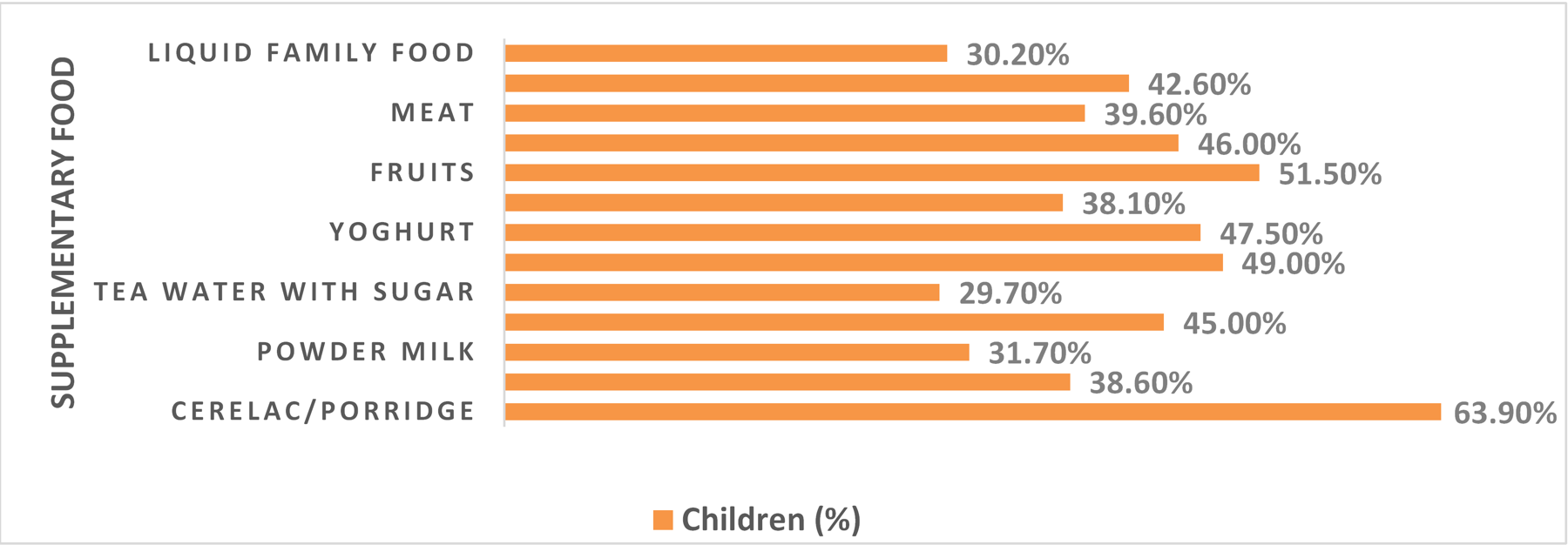
The consumption of foods used for weaning was different for the different children. Majority of children (63.9%) started weaning with porridge. Many children consumed fruits (51.5%), Khichri (49%), yogurt (47.5%), eggs (46%), and cow’s milk (45%). A fair number of children consumed mashed family foods (42.6%) and meat (39.6%). A lesser number of children ate vegetables (38.1%) and used infant formula (38.6%), or powdered milk (31.7%) (Figure 1).
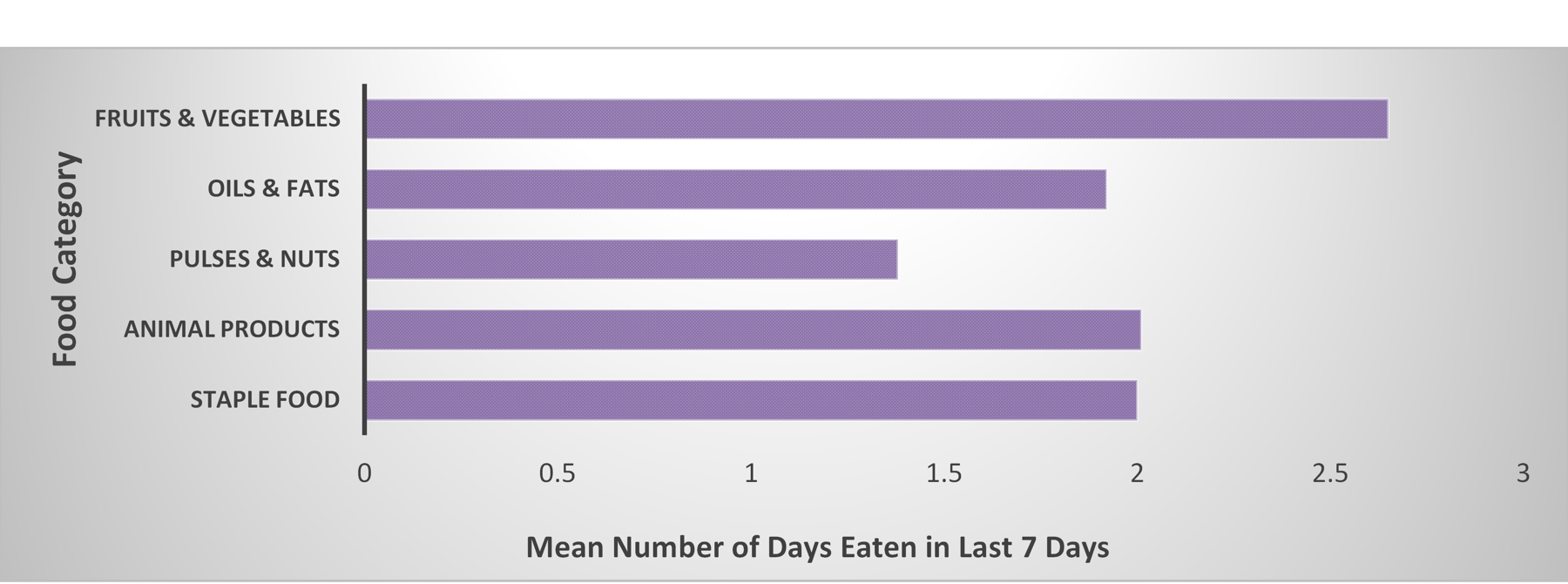
The most common foods children ate each week were fruits and vegetables which they consumed about 2-3 times weekly along with staple foods and animal products taken about twice a week (Figure 2).
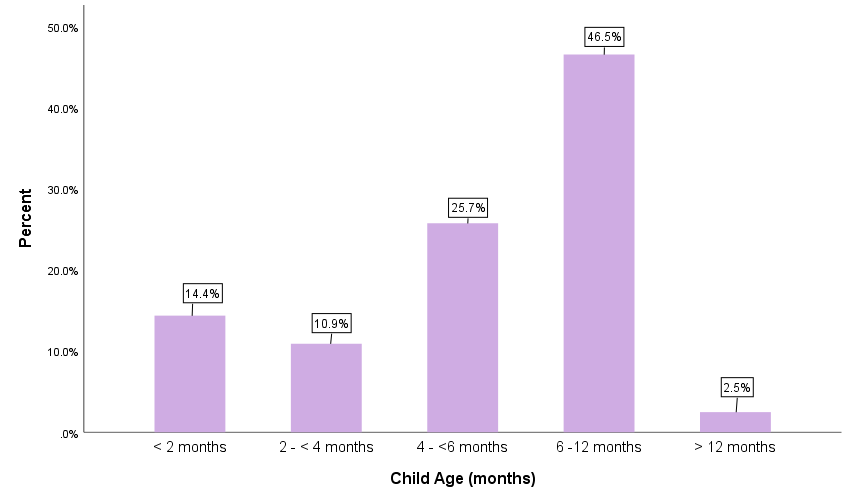
Total 94 (46.53%) children exclusively breast fed to at least 6 months and was introduced complementary foods thereafter. About 14.4% of children were introduced with food other than breast milk (complementary food) prior to 2 months of age, 10.9% were introduced at 2-<4 months of age,2.5% of children was introduced later at more than12months of age (Figure 3).
DISCUSSION
Among 202 mothers of children interviewed ,159 (78.7%) began nursing immediately after birth and 148 (73.3%) were given colostrum too. However, one other study reported in Pakistan showed colostrum feeding rates of 16.4% [15]. In our study 78.71% mothers start breastfeeding within one hour after delivery and 46.53% mothers had exclusive breastfeeding up to the six-month period. In compared, results of a similar study conducted in Pakistan had lower rates for only 49% initiated Breastfeeding within an hour after birth and 37% practice exclusive breastfeeding for the initial six months. The previous study demonstrated a rate 70% for complement feeding within 6–8-month period [16]. The results from the Faisalabad study found that 83.5% of women breastfed, 37% exclusively breastfed their youngest child, and 89% responded they believed a baby should be breastfed immediately after birth [17]. Likewise, one study from Pakistan documented that 206 (53.5%) infants exclusively received breast feeding and 36 (9.4%) infants exclusively formula fed and the other 122 (31.7%) infants received both breast and formula feedings [18]. With regards to weaning practices, the present study showed that maternal education was positively associated with initiating complementary feeding at the recommended time of around 6 months of age. Most (63.9%) of the children received porridge at six months. Other frequently introduced food items were fruits (51.5%), khichri (49%), curd (yogurt) 47.5%, egg 46% and cow’s milk 45%. A large fraction of the children were fed mashed family diet (42.6%) and meat was only used by 39.6%; vegetable consumption ranked low; only 38.1% of children ate vegetables. Moreover, a significant percentage (38.6%) of mothers reported they had given formula milk to their children, while powdered milk was reported to be given to (31.7%) of them. These findings were consistent with the results of another study conducted among 110 mothers in Farash Town in Islamabad, showing that only 36.4% of mothers started complementary feeding at six months of age. Over one-third of the mothers (55.5%) faced problems during the initiation of semi-solid feeding. Mothers living in joint family had a better knowledge about the right age of initiation of complementary feeding then those living in a nuclear family [19]. Similarly, another study found that 90% exhibited adequate knowledge concerning appropriate methods of weaning. In contrast, despite their knowledge, only 56% introduced solid foods to their infants at six months of age. Like our study, their first foods given to infants were rice/cereals (72%). Culture too had a role influencing a significant number of mothers (54%) who had internalized knowledge concerning weaning from their grandmothers [20]. Also, it was found in another study the relation of maternal knowledge with the extension of breastfeeding, being that 25% of the mothers had no knowledge about the need for a larger caloric intake for their child; the other 37.5% do not know that it is of significance and the 37.5% had received from nobody any recommendation on the matter [21].
In this study, 159(78.7%) mothers-initiated breastfeeding with their babies from the time of birth. Whereas, in another study, early initiation of breastfeeding was within one hour of life among 69(33.3%) neonates (p=0.049) and on exclusive breastfeeding 120(58.5%) neonates during hospital stay. Large percentage of babies initiated with breastfeeding might be a matter of different study population, hospital environment [22].
We need educational activities to raise awareness among young women and expectant mothers about the ways breastfeeding can benefit their babies for life. Additionally, training students on early childhood nutrition will provide them with the real-world information they need to know to raise healthy generations of tomorrow.
CONCLUSION
The practice of immediate initiation of breastfeeding within the first one hour of birth was high (78.7%), and 73.3% of the mothers claimed to provide colostrum. The practice of exclusive breastfeeding for at least six months was still low and only 46.53% children were exclusively breastfed at least first six months. Maternal age and education had significant association with varied feeding and complementary feeding practice. Particularly with feeding on demand, feeding at night time, the frequency and timing for initiation of complementary feeding.
Porridge/cereals, fruits, khichri, yogurt, egg were the most common food given at the time of complementary feeding. Early introduction of complementary food practice was still prevalent.
Author Contributions:
SK, MS, MAC, FBS, EBS, ES
Each author made substantial contributions to the conception and design of the study, or acquisition, analysis, and interpretation of data.
All authors were involved in drafting the manuscript or critically revising it for important intellect content.
All authors approved the final version of the manuscript to be published and agree to be accountable for all aspects of the work.
REFERENCES
- Hollis JL, Collins CE, DeClerck F, Chai LK, McColl K, Demaio AR. Defining healthy and sustainable diets for infants, children and adolescents. Global Food Security. 2020;27:100401. https://doi.org/10.1016/j.gfs.2020.100401
- Organization WH. Indicators for assessing infant and young child feeding practices: definitions and measurement methods. 2021. https://www.who.int/publications/i/item/9789240018389
- Black RE, Victora CG, Walker SP, Bhutta ZA, Christian P, De Onis M, et al. Maternal and child undernutrition and overweight in low-income and middle-income countries. The lancet. 2013;382(9890):427-51. https://doi.org/10.1016/S0140-6736(13)60937-X
- United Nations Children’s Fund (UNICEF). Key findings report 2019. Islamabad: UNICEF Pakistan; 2019. Available from: https://www.unicef.org/pakistan/media/1951/file/Final%20Key%20Findings%20Report%202019.pdf
- Tan KL. Factors associated with exclusive breastfeeding among infants under six months of age in peninsular Malaysia. International breastfeeding journal. 2011;6(1):2. https://doi.org/10.1186/1746-4358-6-2
- Child WHODo, Health A. Management of the child with a serious infection or severe malnutrition: guidelines for care at the first-referral level in developing countries: World Health Organization; 2000. https://library.au.int/management-child-serious-infection-or-severe-malnutrition-guidelines-care-first-referral-level-8
- Mekuria G, Edris M. Exclusive breastfeeding and associated factors among mothers in Debre Markos, Northwest Ethiopia: a cross-sectional study. International breastfeeding journal. 2015;10(1):1. https://doi.org/10.1186/s13006-014-0027-0
- Rowland MG. The weanling's dilemma: are we making progress? Acta Paediatrica. 1986;75:33-42. https://doi.org/10.1111/j.1651-2227.1986.tb10348.x
- Martineau C. 2020 Global Nutrition Report-Action on equity to end malnutrition. 2020. https://media.globalnutritionreport.org/documents/GNR2020_UNSCN_Presentation_j5uSoBP.pdf
- Gonah L, Mutambara J. Determinants of weaning practices among mothers of infants aged below 12 months in Masvingo, Zimbabwe. Annals of global health. 2016;82(5):875-84. https://doi.org/10.1016/j.aogh.2016.10.006
- Popkin BM, Corvalan C, Grummer-Strawn LM. Dynamics of the double burden of malnutrition and the changing nutrition reality. The Lancet. 2020;395(10217):65-74. https://doi.org/10.1016/S0140-6736(19)32497-3
- Balogun OO, Dagvadorj A, Anigo KM, Ota E, Sasaki S. Factors influencing breastfeeding exclusivity during the first 6 months of life in developing countries: a quantitative and qualitative systematic review. Maternal & child nutrition. 2015;11(4):433-51. https://doi.org/10.1111/mcn.12180
- Berti C, Agostoni C. Establishing healthy eating patterns in infancy. Early nutrition and long-term health: Elsevier; 2022. p. 493-535. https://doi.org/10.1016/S0140-6736(19)32497-3
- Centers for Disease Control and Prevention (CDC. Racial and ethnic differences in breastfeeding initiation and duration, by state--national immunization survey, United States, 2004-2008. MMWR: Morbidity & Mortality Weekly Report. 2010 Mar 26;59(11). http://www.jstor.org/stable/23319650
- Patil CL, Turab A, Ambikapathi R, Nesamvuni C, Chandyo RK, Bose A. et al. Early interruption of exclusive breastfeeding: results from the eight-country MAL-ED study. J Health Popul Nutr 34, 10 (2015). https://doi.org/10.1186/s41043-015-0004-2
- Khan GN, Ariff S, Khan U, Habib A, Umer M, Suhag Z. et al. Determinants of infant and young child feeding practices by mothers in two rural districts of Sindh, Pakistan: a cross-sectional survey. Int Breastfeed J 12, 40 (2017). https://doi.org/10.1186/s13006-017-0131-z
- Malik N. Perception and practices of mothers about feeding practices of newborn babies in Faisalabad, Pakistan. Mediterr J Soc Sci. 2014 Jan 1. https://doi.org/10.5901/mjss.2014.v5n4p662
- Tabassum M, Ayub A, Subhani FA, Awan FA, Ahmad B, Ullah I. Exclusive breastfeeding and its determinants among infants attending a tertiary care hospital serving an underprivileged population in Rawalpindi, Pakistan: a cross-sectional study. BMJ open. 2026;16(7):e106081. https://doi.org/10.1136/bmjopen-2025-106081
- Asif R, Khan R, Babar NF. Assessment of determinants of complementary feeding practices in mothers of less than 2 Years children in rural setting of islamabad. Journal of Ayub Medical College Abbottabad. 2020;32(3):336-41. https://ayubmed.edu.pk/jamc/index.php/jamc/article/view/6876
- Rasheed Y, Rizwan B, Fatima N, Khanum F, Shahid M, Munawar S. Assessment Of Knowledge Regarding Weaning Practices Among Mothers of Gulab Devi Educational Complex: Knowledge Regarding Weaning Practices. Pakistan Journal of Health Sciences. 2022:140-4. https://doi.org/10.54393/pjhs.v3i04.102
- Chaudhry R, Humayun N. Weaning practices and their determinants among mothers of infants. Biomedica. 2007;23(2):120-4. http://www.thebiomedicapk.com/articles/116.pdf
- Ali KQ, Rizvi SA, Khowaja S, Ali ST, Jiwani U, Ariff S. Breastfeeding Practices and Morbidity among Infants Born to Covid-19 Mothers at a Tertiary Care Hospital Karachi, Pakistan: A Prospective Cohort Study. National Journal. 2025;10(1):38. https://doi.org/10.21089/njhs.101.0037