
Investigation of anti-neoplastic potential of Mentha piperita and Mentha spicata crude extract using cell line, VERO
Correspondence and article notes 9
ABSTRACT
Background: Mentha species have demonstrated anticancer activity, but their cytotoxicity toward normal cells must also be evaluated to assess their safety and therapeutic potential.
Objective: This study aimed to evaluate the cytotoxic potential of Mentha spicata and Mentha piperita plant extracts in normal cell line, Vero.
Methods: Cell line was cultured in complete dulbecco’s modified eagle medium media along with fetal bovine serum via using cytotoxic assay, MTT. Mentha spicata and Mentha piperita treated cells were not only compared with untreated cells but also compared with positive control, cisplatin, a standard anticancer drug available in market to analyze its efficacy on normal cells.
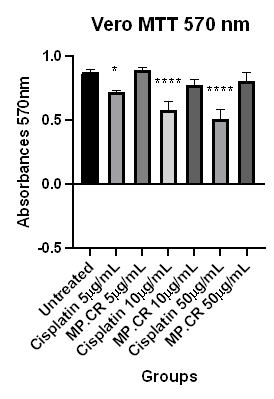
Results: Results displayed mild toxicity effect of plant extracts at different doses 5µg/ml (0.8600 ± 0.1260, 0.8940 ± 0.01513), 10µg/ml (0.8340 ± 0.03305, 0.7727 ± 0.04430) and 50µg/ml (0.7490 ± 0.04521, 0.8050 ± 0.06509) as compared to cisplatin with same doses 5µg/ml (0.7203 ± 0.01365*), 10µg/ml (0.5783 ± 0.06964****) and 50µg/ml (0.5073 ± 0.07950****) as cell viability was more in plant extracts treated cells than cisplatin treated cells and absorbance values of plant extracts treated cells were close to values of untreated cells (0.8733 ± 0.02517). Data were analyzed using GraphPad Prism 8.1 with one-way ANOVA followed by Bonferroni’s post-hoc test. P < 0.05 was considered statistically significant.
Conclusion: Mentha spicata and Mentha piperita crude extracts exhibited relatively low cytotoxicity toward normal Vero cells compared with cisplatin under the tested conditions. However, their safety and anticancer potential require further investigation using cancer cell lines, additional normal cell models, and in-vivo studies to determine their therapeutic potential.
Keywords: Mentha spicata, Mentha piperita, MTT assay, crystal violet assay, Vero cells
INTRODUCTION
The Lamiaceae family comprises hundreds of genera and thousands of species of flowering plants that are rich in diverse bioactive compounds, including terpenoids, iridoids, flavonoids, volatile compounds, and phenolics. These phytoconstituents contribute to a wide range of pharmacological activities and have potential applications in the management of neurodegenerative disorders, diabetes, cancer, and cardiovascular diseases. Mentha spicata (MS), also known as Mentha viridis, belongs to the Lamiaceae family and has been traditionally used to treat various ailments, including liver and gastrointestinal disorders, jaundice, asthma, fever, cold, and cough. Several Mentha species, including MS, have demonstrated therapeutic potential, and their cytotoxic effects have been reported against various cancer cell lines [1,2]. Mentha piperita (MP) is widely used in pharmaceutical, cosmetic, and nutraceutical products and is an important ingredient in various herbal preparations. It contains numerous phytoconstituents that have been investigated for their diverse biological and pharmacological activities [3].
MS, commonly known as spearmint or garden mint is widely distributed in many parts of world including tropical to temperate regions. It is a perennial herb that grows up to one meter in height and have long leaves with pointed tips. MS is popular in many countries as spice herb in food industry. Traditionally, it has been used to treat upper respiratory infections, hemorrhoids, common cold, and digestive disorders, and is widely used in food, beverages, cosmetics, and pharmaceutical products. Mentha spicata is rich in carvone, which contributes to its characteristic aroma and is a major component of its essential oil in several regions, including Pakistan [4]. It also contains phenolic compounds such as ferulic, p-coumaric, and sinapic acids. Traditionally used as mint tea and for various ailments, MS has demonstrated anticancer, anti-inflammatory, antidiabetic, antiparasitic, and antimicrobial activities in both in-vitro and in-vivo studies. Mentha piperita is a perennial aromatic hybrid species widely cultivated for its medicinal and commercial applications. Previous studies have reported that Mentha species possess a range of pharmacological properties, including anti-inflammatory, antimicrobial, antioxidant, and anticancer activities, supporting their potential for therapeutic applications. The Vero cell line is an immortalized cell line derived from African green monkey kidney epithelial cells [5]. This cell line is used as cell substrate for various pharmacological activities such as vaccine manufacturing and development [6-8], to study viral morphology and viral replication [9,10]. Many anticancer studies used this cell line as normal control such as study against breast cancer cell line and cervical cancer cell line [11,12].
Thus, in present study, cytotoxic potential of Mentha Spicata plant crude extract (MS.CR) and Mentha Piperita plant crude extract (MP.CR) was evaluated in normal cell line.
METHODS
Following the ethical approval vide letter no. 263-2025-/PHEC Dated 11th February 2025 from Pharmacy Human Ethics Committee, The Islamia University of Bahawalpur, this study was conducted between March 2025 and November 2025. Normal cell line, Vero was used according to study [13]. Cells were thawed and cultured according to method mentioned in study [14]. For the sake of cell proliferation, the cell line of Vero was cultured onto 96 well plates. One group remained untreated while the remaining were treated with doses of cisplatin (positive control) and MS.CR and MP. CR along with Dulbecco’s modified eagle medium-high glucose (DMEM-HG) but the fetal bovine serum (FBS) was made absent where CR refers to the crude extract of the respective species.Treatment of 72 hours was subjected to the cultured cells of Vero cell line. After completing 72 hours, for applying cell proliferation assay, 96 well-plate was used and the used medium was analyzed with MTT assay [15]. Cell viability was assessed via MTT assay according to study [16]. Statistical analyses were performed using GraphPad Prism version 8.1. Data are presented as mean ± standard deviation (SD) of the experimental replicates. Differences in cell viability among the treatment groups and untreated control were analyzed using one-way analysis of variance (ANOVA), followed by Bonferroni’s multiple-comparison post-hoc test to identify differences between individual groups. A P value of <0.05 was considered statistically significant. Statistical significance is indicated as P < 0.05, P < 0.01, and P < 0.001 in the relevant tables and figure legends. Where applicable, exact P values are reported.
RESULTS
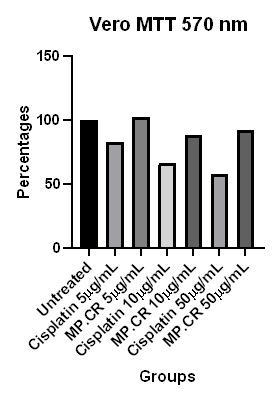
Vero cells were treated with Mentha spicata crude extract (MS.CR) and Mentha piperita crude extract (MP.CR) at concentrations of 5, 10, and 50 µg/mL and compared with the standard anticancer drug cisplatin at the same concentrations. To ensure reliable results, all treatments were evaluated in triplicate using the MTT assay. Compared with the untreated control cells, both MS.CR and MP.CR showed relatively low cytotoxicity across the tested concentrations, with no clear dose-dependent cytotoxic effect observed. In contrast, cisplatin produced a greater reduction in cell viability, indicating higher cytotoxicity toward normal Vero cells. The absorbance values and cell viability percentages for MS.CR are presented in Table 1 and Figures 1 and 2, while those for MP.CR are presented in Table 2 and Figures 3 and 4. Overall, MS.CR- and MP.CR-treated cells demonstrated viability levels relatively comparable to the untreated control, whereas cisplatin showed a more pronounced cytotoxic effect, suggesting that both Mentha extracts were comparatively less toxic to normal Vero cells under the conditions tested.
Table 1: The cell viability values of cisplatin and MS.CR on untreated and treated Vero cells
| Groups & Doses | Values (Mean ± SD) |
|---|---|
| Untreated | 0.8733 ± 0.02517 |
| Cisplatin (5μg/ml) treated | 0.7203 ± 0.01365 |
| MS.CR (5µg/ml) treated | 0.8600 ± 0.1260 |
| Cisplatin (10μg/ml) treated | 0.5783 ± 0.06964 |
| MS.CR (10µg/ml) treated | 0.8340 ± 0.03305 |
| Cisplatin (50μg/ml) treated | 0.5073 ± 0.07950 |
| MS.CR (50µg/ml) treated | 0.7490 ± 0.04521 |
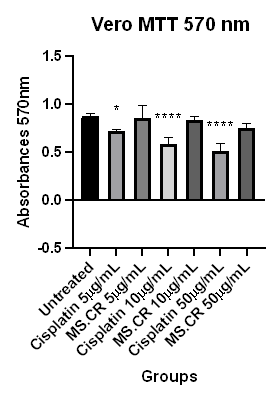
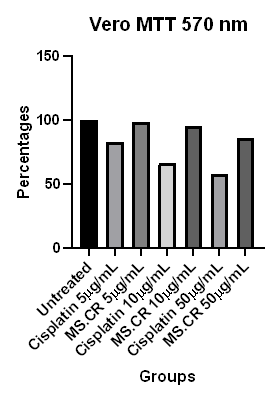
Table 2: The cell viability values of cisplatin and MP.CR on untreated and treated Vero cells
| Groups & Doses | Values (Mean ± SD) |
|---|---|
| Untreated | 0.8733 ± 0.02517 |
| Cisplatin (5μg/ml) treated | 0.7203 ± 0.01365 |
| MP.CR (5µg/ml) treated | 0.8940 ± 0.01513 |
| Cisplatin (10μg/ml) treated | 0.5783 ± 0.06964 |
| MP.CR (10µg/ml) treated | 0.7727 ± 0.04430 |
| Cisplatin (50μg/ml) treated | 0.5073 ± 0.07950 |
| MP.CR (50µg/ml) treated | 0.8050 ± 0.06509 |
DISCUSSION
An Iranian study conducted in 2010 evaluated Mentha spicata and other Mentha species against Vero cells using the MTT assay and reported some degree of cytotoxicity at different concentrations. However, that study did not include a positive control, and the plant material was obtained from Iran, whereas the M. spicata used in the present study was collected from Bahawalpur, Pakistan. These differences in experimental design and geographical origin may contribute to variations in the observed cytotoxic effects [17]. Similarly, a study conducted in Oman in 2018 reported the cytotoxic potential of M. spicata against cancer cell lines. Mentha piperita contains several bioactive compounds, including phenolic acids, tannins, and flavonoids [3], and its anticancer activity has been reported against human skin, breast, colorectal, and lung cancer cell lines, as well as in breast cancer patients [18,19]. In the present study, the cytotoxic activity of M. spicata was evaluated using the MTT assay, a widely used in-vitro method for assessing cell viability and cytotoxicity based on cellular metabolic activity. The assay measures the reduction of yellow MTT by metabolically active cells to purple formazan, with the resulting absorbance being proportional to cell viability [20]. The findings demonstrated that M. spicata extract produced cell viability values close to those of untreated Vero cells, while viability was comparatively higher than that observed with the positive control, cisplatin. Among the tested concentrations, 5 and 10 µg/mL produced negligible cytotoxic effects, whereas 50 µg/mL showed only mild cytotoxicity. In contrast, cisplatin demonstrated considerably greater cytotoxicity at all corresponding concentrations. These findings suggest that M. spicata extract has relatively low cytotoxicity toward normal Vero cells under the conditions tested [21,22]. However, the absence of marked toxicity in normal cells alone does not establish its safety or anticancer efficacy. Therefore, further studies using different cancer cell lines and additional normal human cell models are warranted to determine its selective cytotoxicity, establish IC₅₀ values, identify the responsible bioactive constituents, and elucidate the underlying molecular mechanisms. Such investigations may help determine the potential of M. spicata as a source of candidate compounds for future anticancer research [23,24,35].
Further studies are recommended to evaluate the anticancer activity of Mentha spicata and Mentha piperita extracts against different cancer cell lines and normal human cells, determine their IC₅₀ values, and investigate their active phytochemical constituents and underlying mechanisms. The main limitations of this study were the use of a single normal cell line (Vero), a limited range of extract concentrations, and the absence of cancer cell lines and mechanistic investigations.
CONCLUSION
To be viable, anticancer agents must selectively target malignant cells without harming normal tissues. Here, the MS.CR extract showed minimal toxicity and little to no antiproliferative activity against normal Vero cells, underscoring its potential safety for future oncology applications. To advance this research, the extract should be screened against diverse human cancer lines to map its specific molecular pathways. Additionally, detailed phytochemical analysis and purification are required to identify the precise active constituents. These preliminary data offer a promising foundation for engineering plant-based cancer therapies designed to maximize therapeutic efficacy while minimizing adverse side effects.
Author Contributions:
BN, AJ, QJ, MMS. MA, FH:
Each author made substantial contributions to the conception and design of the study, or acquisition, analysis, and interpretation of data.
All authors were involved in drafting the manuscript or critically revising it for important intellect content.
All authors approved the final version of the manuscript to be published and agree to be accountable for all aspects of the work.
REFERENCES
- 1. Chatterjee A, Singh N, Chanu WK, Singh CB, Nagaraj VA. Phytochemical screening, cytotoxicity assessment and evaluation of in vitro antiplasmodial and in vivo antimalarial activities of Mentha spicata L. methanolic leaf extract. Journal of ethnopharmacology. 2022;298:115636 https://doi.org/10.1016/j.jep.2022.115636
- 2. El Menyiy N, Mrabti HN, El Omari N, et al. Medicinal uses, phytochemistry, pharmacology, and toxicology of Mentha spicata. Evidence‐Based Complementary and Alternative Medicine. 2022;2022(1):7990508. https://doi.org/10.1155/2022/7990508
- 3. Hudz N, Kobylinska L, Pokajewicz K, et al. Mentha piperita: Essential oil and extracts, their biological activities, and perspectives on the development of new medicinal and cosmetic products. Molecules. 2023;28(21):7444. https://doi.org/10.3390/molecules28217444
- 4. Alsaraf S, Hadi Z, Akhtar MJ, Khan SA. Chemical profiling, cytotoxic and antioxidant activity of volatile oil isolated from the mint (Mentha spicata L.,) grown in Oman. Biocatalysis and Agricultural Biotechnology. 2021;34:102034. https://doi.org/10.1016/j.bcab.2021.102034
- 5. Konishi K, Yamaji T, Sakuma C, et al. Whole-genome sequencing of Vero E6 (VERO C1008) and comparative analysis of four Vero cell sublines. Frontiers in Genetics. 2022;13:801382. https://doi.org/10.3389/fgene.2022.801382
- 6. Sène MA, Xia Y, Kamen AA. Overview of recent advances in Vero cells genomic characterization and engineering for high‐throughput vaccine manufacturing. Clinical and Translational Discovery. 2022;2(2):e40. https://doi.org/10.1002/ctd2.40
- 7. Kiesslich S, Kim GN, Shen CF, Kang CY, Kamen AA. Bioreactor production of rVSV‐based vectors in Vero cell suspension cultures. Biotechnology and bioengineering. 2021;118(7):2649-2659. https://doi.org/10.1002/bit.27785
- 8. Sène M-A, Kiesslich S, Djambazian H, Ragoussis J, Xia Y, Kamen AA. Haplotype-resolved de novo assembly of the Vero cell line genome. npj Vaccines. 2021;6(1):106. https://doi.org/10.1038/s41541-021-00358-9
- 9. Laue M, Kauter A, Hoffmann T, Möller L, Michel J, Nitsche A. Morphometry of SARS-CoV and SARS-CoV-2 particles in ultrathin plastic sections of infected Vero cell cultures. Scientific reports. 2021;11(1):3515. https://doi.org/10.1038/s41598-021-82852-7
- 10. Witt ASA, Trindade GdS, Souza FGd, et al. Ultrastructural analysis of monkeypox virus replication in Vero cells. Journal of Medical Virology. 2023;95(2):e28536. https://doi.org/10.1002/jmv.28536
- 11. Sangour MH, Ali IM, Atwan ZW, Al Ali AAALA. Effect of Ag nanoparticles on viability of MCF-7 and Vero cell lines and gene expression of apoptotic genes. Egyptian Journal of Medical Human Genetics. 2021;22(1):9. https://doi.org/10.1186/s43042-020-00120-1
- 12. Milliana A, Sari RA, Miranda SA, Mutiah R. Evaluation of anticancer activity and mechanism of action of Myricetin on HeLa, T47D, and Vero cells: Comparative analysis with cisplatin and doxorubicin. Biomedical and Pharmacology Journal. 2025;18(1):835-847 https://doi.org/10.13005/bpj/3133
- 13. Ahmad I, Maqbool T, Naz S, Hadi F, Atif M. Apoptotic potential of geranyl acetate in HepG2 liver cancer cells. International Journal of Applied and Experimental Biology. 2023;2(2):89-96. https://doi.org/10.56612/ijaeb.v1i1.57
- 14. Abid F, Saleem M, Leghari T, et al. Evaluation of in vitro anticancer potential of pharmacological ethanolic plant extracts Acacia modesta and Opuntia monocantha against liver cancer cells. Brazilian Journal of Biology. 2022;84. https://doi.org/10.1590/1519-6984.252526
- 15. Abid F, Saleem M, Muller CD, et al. Anti-proliferative and apoptosis-inducing activity of Acacia Modesta and Opuntia Monocantha extracts on HeLa cells. Asian Pacific Journal of Cancer Prevention: APJCP. 2020;21(10):3125. https://doi.org/10.31557/APJCP.2020.21.10.3125
- 16. Maqbool T, Awan SJ, Malik S, Hadi F, Shehzadi S, Tariq K. In-vitro anti-proliferative, apoptotic and antioxidative activities of medicinal herb Kalonji (Nigella sativa). Current pharmaceutical biotechnology. 2019;20(15):1288-1308. https://doi.org/10.2174/1389201020666190821144633
- 17. Rahimifard N. Cytotoxic effects of essential oils and extracts of some Mentha species on Vero, Hela and Hep2 cell lines. Journal of Medicinal Plants. 2010. https://dor.isc.ac/dor/20.1001.1.2717204.2010.9.35.9.9
- 18. Saravanan R, Natesan R, Samiappan SC, Ramalingam S. Anti-oxidant, anti-bacterial and anti-cancer activity of Mentha piperita against MCF-7 cells. Biomed Pharmacol J. 2021;14(3):1685-1694. https://doi.org/10.13005/bpj/2270
- 19. Abedinpour N, Ghanbariasad A, Taghinezhad A, Osanloo M. Preparation of nanoemulsions of mentha piperita essential oil and investigation of their cytotoxic effect on human breast cancer lines. BioNanoScience. 2021;11(2):428-436. DOI:10.1007/s12668-021-00827-4
- 20. Yücel D, Sezer CV, Yücel E, Kutlu HM. Antiproliferative and cytotoxic activities of Mentha x piperita L. essential oil in non-small cell lung cancer cells. Indian Journal of Experimental Biology (IJEB). 2022;60(10):753-758. https://doi.org/10.56042/ijeb.v60i10.47280
- 21. Dolghi A, Coricovac D, Dinu S, et al. Chemical and antimicrobial characterization of Mentha piperita L. and Rosmarinus officinalis L. essential oils and in vitro potential cytotoxic effect in human colorectal carcinoma cells. Molecules. 2022;27(18):6106. https://doi.org/10.3390/molecules27186106
- 22. Kelidari HR, Alipanah H, Roozitalab G, Ebrahimi M, Osanloo M. Anticancer effect of solid-lipid nanoparticles containing Mentha longifolia and Mentha pulegium essential oils: In vitro study on human melanoma and breast cancer cell lines. Biointerface Research in Applied Chemistry. 2022;12(2):2128-2137. https://doi.org/10.33263/BRIAC122.21282137
- 23. Jahanafrooz Z, Mousavi MMH, Akbarzadeh S, Hemmatzadeh M, Maggi F, Morshedloo MR. Anti-breast cancer activity of the essential oil from grapefruit mint (Mentha suaveolens× piperita). Fitoterapia. 2024;174:105875. https://doi.org/10.1016/j.fitote.2024.105875
- 24. Maqbool T, Hadi F, Naz S, et al. Pulegone induced apoptotic and anti-proliferative potential in cervical cancer via P53, BAX and BCL2. Scientific Reports. 2025;15(1):34217. https://doi.org/10.1038/s41598-025-15963-0
- 25. Maqbool T, Hadi F, Razzaq S, et al. Synergistic Effect of Barbadensis miller and Marsdenia Condurango Extracts Induces Apoptosis Promotes Oxidative Stress by Limiting Proliferation of Cervical Cancer and Liver Cancer Cells. Asian Pacific Journal of Cancer Prevention: APJCP. 2021;22(3):843. https://doi.org/10.31557/APJCP.2021.22.3.843