
Assessment of utilization of ChatGPT on Medical Research Paper Writing Practices amongst University students in Lahore, Pakistan
Correspondence and article notes 8
ABSTRACT
Background :The integration of artificial intelligence (AI) in academic applications has transformed medical research writing. ChatGPT is an AI-based language model that has been introduced by Open AI. It is been commonly used for literature review, manuscript organization, and writing research papers and articles.
Objective: To assess utilization of ChatGPT on medical research writing practices among university students.
Method: An analytical cross- sectional study conducted among university student of The University of Lahore and Rashid Latif Khan University. The study participants were split into 3 groups on the basis of their enrolled degree programs; MBBS, BDS and Allied health sciences (undergraduate, graduate and post-graduate students). Duration of study was from January 2025 to June 2025. Descriptive statistics, frequencies, percentages, and cross-tabulations were employed to summarize the demographic features. For inferential testing, statistical tests were used to investigate the relationship between the question variable utilization of ChatGPT and Chi-square (χ²) tests were used to detect relationships between categorical variables. Following an extensive study of the literature, a questionnaire was prepared. Total of 381 students were selected according to sample size. A sample of 381 students was selected using non probability convenience sampling technique. A self-constructed online validated questionnaire was used.
Results: Among 381 participants, 81.9% of participants agreed that it improved their academic writing. A majority of respondents (92.1%) found it is easy to comprehend difficult ideas. Furthermore, 74.0% found that it helped them to organize their ideas while writing research papers. In addition, 79.0% students felt that it improved their ability to research independently. However, 70.9% students said inaccuracies were present in ChatGPT’s results. 50.1% agreed to use the text generated by ChatGPT without further validation.
Conclusion: ChatGPT enhances enrolled university students’ academic writing, manuscript structure, conceptual understanding, time management, productivity and critical thinking. However, due to risks of inaccuracies and ethical concerns, its use must involve human oversight, verification, and adherence to academic integrity.
Keywords: ChatGPT, Artificial Intelligence, Medical Research Writing, Academic Writing, Medical Education, Academic integrity, Research Productivity
INTRODUCTION
Medical research writing helps in the development of science. Through medical writing, scientists can justify their claim with enough evidence. They can also present their inputs to the researchers all over the globe. A medical research article is a long-winded writing that takes a lot of effort to write [1]. An academic medical paper is written after many hours of research. The investigator has to go through a tremendous amount of medical literature. Next they interpret the findings and start writing. Things have changed immensely ever since the inception of AI [2].
The ‘ChatGPT’ model developed by OpenAI has created a buzz in medical research field. The AI can summarize research articles, rewrite technical medical terms in plain language, correct ungrammatical sentences and draft manuscript sections [3]. Of course, for early-stage researchers and those who don’t speak English as a native language, all of this is probably of great help. In the same vein, AI technology can assist in generating research questions, deciphering the researcher's findings, or maintaining the quality of scholarly writing. While a number of benefits accrue due diligence must be exercised to ensure accuracy, reliability and integrity [4]. The groundbreaking work of Turing and McCarthy, who laid the groundwork for artificial intelligence in the middle of the 20th century, is the source of the field's rich history. Over the ensuing decades, advances in machine learning and natural language processing (NLP) allowed for the development of complex language models that could produce text that was human-like [5]. Despite such developments, there are still many issues. Most of the existing studies are focusing on the possibility of AI, but not its utilization in real medical writing [6]. Due to the possibility of providing credible actions that are not right, neglecting medical specifics, or adhering to the biases of the training data, there are still questions regarding the accuracy and reliability of AI-generated content. Additional ethical issues include authorship, plagiarism and being transparent in the implementation of AI algorithms. Additionally, it lacks the information on how to incorporate AI into the preparation of the manuscript and understand how it influences the quality of publishing and the peer review [7]. Moreover, little information about the effectiveness of AI in such specialized directions as epidemiology, clinical trials, and systematic reviews is provided[7, 8]. At this moment, there are no established norms in evaluating scientific writing created with the help of artificial intelligence. More so, the prejudice in training sets can cause a false source of information and skewed scientific communication greatly. The impact of AI on students in terms of critical thinking in the field of medicine, even in the long term, has yet to be studied [9, 10]. A Pakistani study determined that although accuracy and reliability were a concern, both undergraduate and postgraduate medical students found ChatGPT helpful to learn [11]. This research aims to assess utilization of ChatGPT on medical research writing practices among enrolled university students. This paper provide the evidence-based recommendations on how AI can be properly introduced to medical academia, evaluating its accuracy, ethical implications and possible biases.
METHODS
This cross-sectional study was conducted within University of Lahore and Rashid Latif Khan University, between January to June 2025 after the institutional ethical committee approval (Letter No. IRB/2025/12). A sample of 381 students was selected by using non probability convenience sampling using a prevalence rate of 45.8%, confidence level of 95% and margin of error was 5% [12], out of which 191 participants from University of the Lahore and 190 participants from Rashid Latif Khan University were taken. The study participants were split into 3 groups on the basis of their enrolled degree program; MBBS, BDS and Allied health sciences (undergraduate, graduate and post-graduate students). Prior to conducting large-scale data gathering, a pilot study of fifteen respondents was carried out to test the clarity, pertinence, and generalizability of the questionnaire. The internal reliability of the tool was tested using Cronbach's alpha and the coefficient value was obtained as 0.81, which proved to be highly reliable and confirmed the strength of the questionnaire for further data gathering and analysis. A standardized validated questionnaire was employed to gather data from enrolled students that was piloted on fifteen students from different institutes. The questionnaire was administered in both electronic and hard copy forms in order to make it accessible to everyone. Participants who were confident with self-administration answered the questionnaire on their own, while participants who needed clarification or support were administered the questionnaire in a face-to-face manner. This method allowed all participants to freely express their experiences and views on the effect of free version ChatGPT on medical research writing practices. SPSS version 25 was used for data entry and analysis. Mean, standard deviation, frequency & percentage were used to express the numerical and categorical data respectively. The Chi-square test was used to assess association between categorical variables. A p value ≤0.05 was considered statistically significant.
RESULTS
A total of 381 undergraduate, graduate and post-graduate students from Allied Health Sciences, MBBS, and BDS schools took part in the study from Rashid Latif Khan University and University of Lahore. The main socio demographic traits are summarized in Table 1. About 94% of the sample were young adults (17–25 years old), and only six percent were older than 26. Of the participants, 41.2% were males and 58.8% were females. Just 7.1% of respondents were postgraduate students, while the majority (92.9%) were undergraduate students. This demographic distribution demonstrates that opinions were primarily influenced by young, inexperienced researchers who had varied exposure to academic writing and research methodologies.
Table 1. Distribution of affirmative responses to ChatGPT-related questions by gender, age group, and academic status
| Q# | Question | Female (Yes) | Male (Yes) | Young Adults (17–25) (Yes) | Middle Adults (26–35) (Yes) | Older Adults (36–53) (Yes) | PG (Yes) | UG (Yes) |
|---|---|---|---|---|---|---|---|---|
| 1 | Has ChatGPT helped you understand complex concepts better? | 207 | 144 | 329 | 21 | 1 | 25 | 326 |
| 2 | Has ChatGPT made you more reliant on external tools for learning? | 166 | 112 | 260 | 17 | 1 | 21 | 257 |
| 3 | Do you feel that ChatGPT improves your ability to conduct independent research? | 178 | 123 | 285 | 15 | 1 | 14 | 287 |
| 4 | Has ChatGPT improved your academic writing? | 190 | 122 | 296 | 15 | 1 | 19 | 293 |
| 5 | Has ChatGPT enhanced your critical thinking? | 161 | 112 | 261 | 11 | 1 | 12 | 261 |
| 6 | Do you believe ChatGPT has improved your overall academic performance? | 173 | 121 | 279 | 14 | 1 | 15 | 279 |
| 7 | Has using ChatGPT increased your interest in academic research? | 162 | 114 | 260 | 15 | 1 | 16 | 260 |
| 8 | Has ChatGPT helped you manage your time while writing research papers? | 183 | 131 | 300 | 13 | 1 | 16 | 298 |
| 9 | Has ChatGPT improved your understanding of medical research topics? | 193 | 127 | 302 | 17 | 1 | 18 | 302 |
| 10 | Has ChatGPT improved your confidence in writing research papers? | 177 | 120 | 283 | 13 | 1 | 18 | 279 |
| 11 | Has ChatGPT assisted you in performing or understanding statistical analyses? | 165 | 114 | 266 | 12 | 1 | 15 | 264 |
| 12 | Has ChatGPT helped you navigate complex medical terminologies? | 181 | 122 | 283 | 19 | 1 | 21 | 282 |
| 13 | Has ChatGPT streamlined the structure and language of your medical research writing? | 165 | 117 | 262 | 19 | 1 | 22 | 260 |
| 14 | Have you used ChatGPT for drafting or summarizing medical literature? | 162 | 115 | 261 | 15 | 1 | 18 | 259 |
| 15 | Do you always cross-check ChatGPT’s information with external sources? | 146 | 94 | 225 | 14 | 1 | 17 | 224 |
| 16 | Do you trust ChatGPT-generated information without further validation? | 110 | 81 | 182 | 8 | 1 | 11 | 180 |
| 17 | Have you ever found ChatGPT’s information to be inaccurate? | 164 | 105 | 251 | 17 | 1 | 20 | 249 |
| 18 | Do you believe ChatGPT is a reliable source for academic information? | 157 | 108 | 255 | 9 | 1 | 14 | 251 |
| 19 | Have you ever directly cited ChatGPT in your academic work? | 146 | 95 | 232 | 10 | 0 | 9 | 232 |
| 20 | Do you ensure that ChatGPT content aligns with medical research standards? | 148 | 99 | 230 | 17 | 1 | 17 | 230 |
| 21 | Have you noticed limitations in ChatGPT’s medical knowledge? | 148 | 115 | 246 | 16 | 1 | 20 | 243 |
| 22 | Do you verify the accuracy of ChatGPT’s summaries? | 155 | 103 | 242 | 16 | 1 | 19 | 239 |
The findings of this paper indicate that utilization of ChatGPT on enrolled medical research writing of health research students. The vast majority of the respondents estimated that ChatGPT made their writing on academic topics more effective (190 females, 122 males), assisted them in comprehending complex ideas better (207 females, 144 males) and was able to make them easier to structure and organize research papers (165 females, 117 males). It also enhanced critical thinking (161 females, 112 males), independent research (178 females, 123 males) and general academic achievement (173 females, 121 males). The results showed that students stated they were more productive when summarizing, editing, and organizing their material due to improved time management when preparing their manuscripts. In all of the domains, the maximized benefits belonged to young persons (17-25 years old), which is a reflection of the active implementing of AI methods by early researchers.
Table 2. Descriptive Statistics of ChatGPT Utilization in Medical Research Writing Practices
| Q# | Question (Abbreviated) | Overall Yes, n (%) | Female Yes, n (%) | Male Yes, n (%) | PG Yes, n (%) | UG Yes, n (%) |
|---|---|---|---|---|---|---|
| 1 | Helped understand complex concepts | 351 (92.1%) | 207 (93.7%) | 144 (90.0%) | 25 (92.6%) | 326 (92.1%) |
| 2 | Increased reliance on external learning tools | 278 (73.0%) | 166 (75.1%) | 112 (70.0%) | 21 (77.8%) | 257 (72.6%) |
| 3 | Improved ability to conduct independent research | 301 (79.0%) | 178 (80.5%) | 123 (76.9%) | 14 (51.9%) | 287 (81.1%) |
| 4 | Improved academic writing | 312 (81.9%) | 190 (86.0%) | 122 (76.3%) | 19 (70.4%) | 293 (82.8%) |
| 5 | Enhanced critical thinking | 273 (71.7%) | 161 (72.9%) | 112 (70.0%) | 12 (44.4%) | 261 (73.7%) |
| 6 | Improved overall academic performance | 294 (77.2%) | 173 (78.3%) | 121 (75.6%) | 15 (55.6%) | 279 (78.8%) |
| 7 | Increased interest in academic research | 276 (72.4%) | 162 (73.3%) | 114 (71.3%) | 16 (59.3%) | 260 (73.4%) |
| 8 | Helped manage time while writing research papers | 314 (82.4%) | 183 (82.8%) | 131 (81.9%) | 16 (59.3%) | 298 (84.2%) |
| 9 | Improved understanding of medical research topics | 320 (84.0%) | 193 (87.3%) | 127 (79.4%) | 18 (66.7%) | 302 (85.3%) |
| 10 | Improved confidence in writing research papers | 297 (78.0%) | 177 (80.1%) | 120 (75.0%) | 18 (66.7%) | 279 (78.8%) |
| 11 | Assisted with statistical analyses | 279 (73.2%) | 165 (74.7%) | 114 (71.3%) | 15 (55.6%) | 264 (74.6%) |
| 12 | Helped navigate complex medical terminology | 303 (79.5%) | 181 (81.9%) | 122 (76.3%) | 21 (77.8%) | 282 (79.7%) |
| 13 | Streamlined structure and language of research writing | 282 (74.0%) | 165 (74.7%) | 117 (73.1%) | 22 (81.5%) | 260 (73.4%) |
| 14 | Used for drafting or summarizing medical literature | 277 (72.7%) | 162 (73.3%) | 115 (71.9%) | 18 (66.7%) | 259 (73.2%) |
| 15 | Always cross-checked information with external sources | 240 (63.0%) | 146 (66.1%) | 94 (58.8%) | 17 (63.0%) | 224 (63.3%) |
| 16 | Trusted ChatGPT without further validation | 191 (50.1%) | 110 (49.8%) | 81 (50.6%) | 11 (40.7%) | 180 (50.8%) |
| 17 | Found ChatGPT information to be inaccurate | 270 (70.9%) | 164 (74.2%) | 105 (65.6%) | 20 (74.1%) | 249 (70.3%) |
| 18 | Considered ChatGPT reliable for academic information | 265 (69.6%) | 157 (71.0%) | 108 (67.5%) | 14 (51.9%) | 251 (70.9%) |
| 19 | Directly cited ChatGPT in academic work | 241 (63.3%) | 146 (66.1%) | 95 (59.4%) | 9 (33.3%) | 232 (65.5%) |
| 20 | Ensured ChatGPT content aligns with research standards | 247 (64.8%) | 148 (67.0%) | 99 (61.9%) | 17 (63.0%) | 230 (65.0%) |
| 21 | Noticed limitations in ChatGPT’s medical knowledge | 263 (69.0%) | 148 (67.0%) | 115 (71.9%) | 20 (74.1%) | 243 (68.6%) |
| 22 | Verified accuracy of ChatGPT summaries | 258 (67.7%) | 155 (70.1%) | 103 (64.4%) | 19 (70.4%) | 239 (67.5%) |
Denominators used for the calculations: overall N=381; Female n=221, Male n=160; Young adults (17–25) n=350, Middle adults (26–35) n=21, Older adults (36–53) n=10; PG n=27 and UG n=354. Because the PG group is small, its comparisons should be interpreted cautiously.
The denominators and total number of participants have been checked and found to be consistent throughout all tables. The overall sample comprised 381 participants (221 females and 160 males), including 27 postgraduate and 354 undergraduate students. Percentages were calculated using the appropriate subgroup denominators for each analysis.
Table 3. Significance testing of ChatGPT utilization according to gender, age group and academic status
| Q# | χ² Gender | p-value | χ² Age | p-value | χ² PG vs UG | p-value |
|---|---|---|---|---|---|---|
| 1 | 1.719 | 0.190 | 96.468 | <0.001 | 0.009 | 0.926 |
| 2 | 1.230 | 0.267 | 21.087 | <0.001 | 0.341 | 0.559 |
| 3 | 0.753 | 0.386 | 30.671 | <0.001 | 12.913 | <0.001 |
| 4 | 5.916 | 0.015 | 38.095 | <0.001 | 2.600 | 0.107 |
| 5 | 0.371 | 0.542 | 24.022 | <0.001 | 10.592 | 0.001 |
| 6 | 0.371 | 0.542 | 28.206 | <0.001 | 7.701 | 0.006 |
| 7 | 0.196 | 0.658 | 20.137 | <0.001 | 2.529 | 0.112 |
| 8 | 0.055 | 0.814 | 44.907 | <0.001 | 10.751 | 0.001 |
| 9 | 4.368 | 0.037 | 42.227 | <0.001 | 6.485 | 0.011 |
| 10 | 1.399 | 0.237 | 31.733 | <0.001 | 2.154 | 0.142 |
| 11 | 0.551 | 0.458 | 24.536 | <0.001 | 4.630 | 0.031 |
| 12 | 1.820 | 0.177 | 31.617 | <0.001 | 0.055 | 0.815 |
| 13 | 0.114 | 0.736 | 24.395 | <0.001 | 0.842 | 0.359 |
| 14 | 0.095 | 0.757 | 20.444 | <0.001 | 0.534 | 0.465 |
| 15 | 2.129 | 0.145 | 12.419 | 0.002 | 0.001 | 0.974 |
| 16 | 0.027 | 0.870 | 8.148 | 0.017 | 1.025 | 0.311 |
| 17 | 3.294 | 0.070 | 18.988 | <0.001 | 0.169 | 0.681 |
| 18 | 0.549 | 0.459 | 25.619 | <0.001 | 4.300 | 0.038 |
| 19 | 1.786 | 0.181 | 20.858 | <0.001 | 11.193 | <0.001 |
| 20 | 1.056 | 0.304 | 15.742 | <0.001 | 0.044 | 0.833 |
| 21 | 1.045 | 0.307 | 17.061 | <0.001 | 0.346 | 0.556 |
| 22 | 1.409 | 0.235 | 16.311 | <0.001 | 0.094 | 0.760 |
Pearson's chi-square test was used for categorical comparisons. For PG versus UG, Fisher's exact test is preferable for interpretation because PG n=27 is small.
Among the 381 participants, ChatGPT was predominantly perceived as beneficial for medical research and academic activities. The most frequently reported benefit was improved understanding of complex concepts, with 351 (92.1%) participants responding positively. This was followed by improved understanding of medical research topics (320, 84.0%), better time management while writing research papers (314, 82.4%), and improved academic writing (312, 81.9%). Furthermore, 303 (79.5%) participants reported that ChatGPT helped them navigate complex medical terminology, while 301 (79.0%) reported improved ability to conduct independent research. Improvements in confidence in writing research papers and overall academic performance were reported by 297 (78.0%) and 294 (77.2%) participants, respectively. Similarly, 282 (74.0%) participants reported that ChatGPT streamlined the structure and language of medical research writing, while 279 (73.2%) reported assistance with performing or understanding statistical analyses. ChatGPT was also used for drafting or summarizing medical literature by 277 (72.7%) participants and was reported to increase interest in academic research by 276 (72.4%) participants.
With respect to critical evaluation and responsible use, 270 (70.9%) participants reported that they had encountered inaccurate information generated by ChatGPT, and 263 (69.0%) had noticed limitations in its medical knowledge. Despite these concerns, 265 (69.6%) participants considered ChatGPT a reliable source of academic information. Verification practices were comparatively less frequent: 258 (67.7%) reported verifying the accuracy of ChatGPT-generated summaries, while 247 (64.8%) reported ensuring that ChatGPT-generated content aligned with medical research standards. 240 (63.0%) participants reported always cross-checking ChatGPT information with external sources. Notably, 191 (50.1%) participants reported trusting ChatGPT-generated information without further validation. In addition, 241 (63.3%) participants reported directly citing ChatGPT in their academic work.
Subgroup findings: Gender-specific analysis showed that female participants generally reported slightly higher utilization or perceived benefits than male participants across most domains. The largest differences were observed for improved academic writing, reported by 190 (86.0%) females compared with 122 (76.3%) males, and improved understanding of medical research topics, reported by 193 (87.3%) females compared with 127 (79.4%) males. These differences were statistically significant for academic writing (p=0.015) and understanding of medical research topics (p=0.037). However, the remaining domains did not demonstrate statistically significant gender differences, suggesting that the overall pattern of ChatGPT utilization was broadly similar across male and female participants.
Academic-status analysis showed greater variability between postgraduate and undergraduate participants. For example, improvement in independent research ability was reported by 14 (51.9%) postgraduate participants compared with 287 (81.1%) undergraduates, while improvement in critical thinking was reported by 12 (44.4%) postgraduates compared with 261 (73.7%) undergraduates. Similarly, improved academic performance was reported by 15 (55.6%) postgraduates and 279 (78.8%) undergraduates, and improved understanding of medical research topics by 18 (66.7%) postgraduates and 302 (85.3%) undergraduates. Statistically significant differences were observed for independent research ability, critical thinking, academic performance, time management, understanding of medical research topics, statistical analysis, perceived reliability of ChatGPT, and direct citation. However, these findings require cautious interpretation because the postgraduate group comprised only 27 participants compared with 354 undergraduate participants. The small postgraduate sample limits statistical precision and may produce unstable estimates. Age was significantly associated with all 22 ChatGPT utilization outcomes (p<0.05). Most associations had p<0.001, while the associations for always cross-checking ChatGPT information with external sources and trusting ChatGPT-generated information without further validation had p=0.002 and p=0.017, respectively. The age-group analysis demonstrated statistically significant associations for the reported ChatGPT-utilization variables. However, interpretation should be undertaken cautiously because the age groups were substantially unequal, particularly the older-adult group. The relatively small number of participants in the older age category may result in sparse contingency-table cells and unstable chi-square estimates. Therefore, these findings are better considered exploratory and should be confirmed in studies with larger and more evenly distributed age groups.
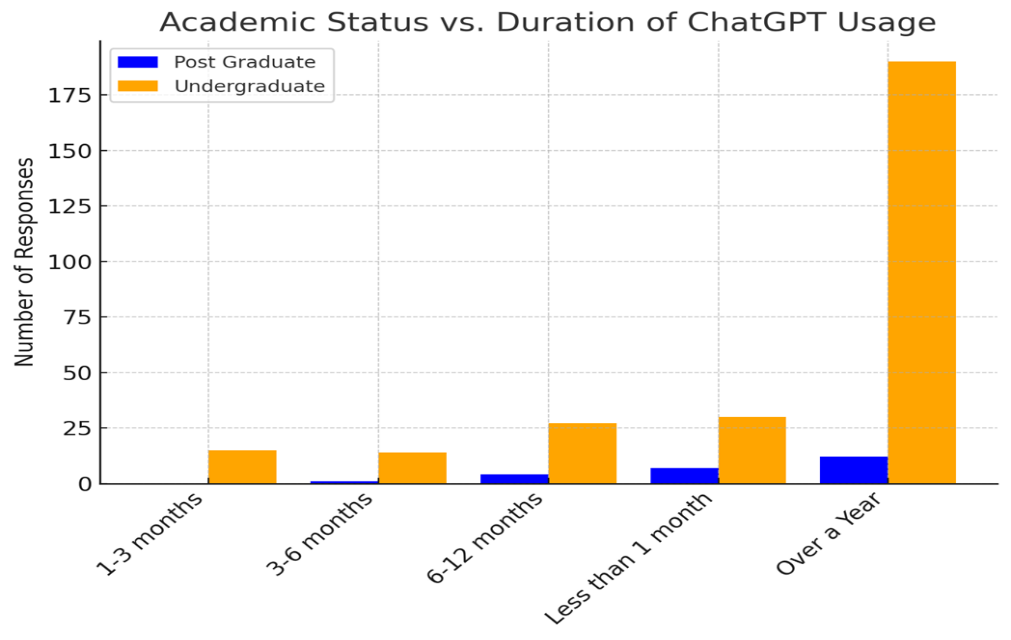
The correlation between academic status of the students and the duration of use of ChatGPT was strong (type of inferential analysis (χ² = 44.1, p = 0.007). The findings indicated that the use of the postgraduate and undergraduate research students was rather different. The length of the ChatGPT period of both groups was summarized above. That was why the given information indicated that postgraduates were more skeptical and selective in using AI tools as research tools, whereas undergraduates tended to use ChatGPT earlier and integrate it into their studies.
DISCUSSION
The research showed the versatile usefulness of ChatGPT as an academic aid when examining the importance of using ChatGPT in writing medical research among the health research students [13]. A large proportion of the respondents noted that ChatGPT enhanced their skills and cognition in understanding challenging concepts (92.1%), made academic writing readable and well-organized (81.9%), and even better equipped to organize their comparison papers (74.0%). These findings aligned with the studies in literature review that emphasized the growing popularity of AI in educational institutions and its effectiveness in facilitating such outcomes as refining the topics, synthesizing the literature and pretextual writing [14]. Moreover, students claimed to have managed their time better because ChatGPT did not place them with the burden of writing assignments but they devoted more time to the formation of hypotheses, the interpretation of the further results, to the development of their analytical abilities [15]. Adoption was unequal based on age, academic status and in academic disciplines. Young people aged 17-25 years were the most common users, which can be referred to their comfort and ease with the usage of digital learning tools [16]. 79.0% of them used ChatGPT in independent research, whereas 72.6% of undergraduates asserted greater dependence on it in self-directed learning, conceptual integrity, and in aid of critical thinking due to having limited experience in research [17]. On the other hand, postgraduate students were less inclined to use ChatGPT, as they focused more on source validation, verification, and careful incorporation of AI-generated data since they were more familiar with research processes [18].
Gender differences were also noticeable [19].
The variations also manifested the different patterns of usage by variations in the field of research, particularly in the organization of arguments, gathering of content and analysis of the information[12]. However, the usage among MBBS and BDS student needs are more practical skill base and a less risky approach to using AI technologies in academic writing [20]. Its effectiveness in the study had specific problems concerning the accuracy, dependability, and academic integrity in spite of the evident benefits. 63.3% of the participants directly cited ChatGPT and 50.1% trusted ChatGPT without validation [21]. The patterns attracted the attention to the threats of fake news and the ethical consequences of the overuse of AI technologies. Postgraduate students were more cautious highlighting the significance of human supervision, fact-checking and critical analysis [22]. In general, the findings suggested that participants reported perceived benefits of ChatGPT on academic performance, research productivity, and understanding and in particular early-stage researchers [23]. Nevertheless, to ensure a healthy balance that promoted the development of accuracy, critical inquiry, and academic integrity, its proper and efficient application required adequate AI literacy training, moral protocols and discipline-related policies [24]. The findings also showed the transitional value of ChatGPT in impacting the current medical research education, particularly in the lower-resource institutions. The aid can be enhanced the confidence of learners and reduced mental load during the training of early research. The discovered dependency patterns, in their turn, can be emphasized the importance of implementing AI utilization within a guided academic setting. Unless students were mentored appropriately, they were overestimated AI reliability or use of source literature [25]. Thus it become a crucial importance to consider the inclusion of organized training modules on ethical practices of citing, critical assessment, and responsible use of AI into medical education. Faculty-based leadership had the potential to support long-term competency in research and academic rigor by making sure that ChatGPT remained a supplement to academic thinking, but not to replace its role [26].
CONCLUSION
Participants perceived that ChatGPT enhance academic writing skills, the structure of the writing manuscripts, and understanding of challenging ideas in medical research writing, primarily among undergraduate students. It also improves time management, productivity in research as well as critical thinking. Yet, such problems as incorrect data, excessive dependence and ethical problems stress the importance of precautionary use. In order to maximize its benefits, responsible integration, confirmation of material generated by AI, and compliance with academic integrity are essential. ChatGPT can be applied effectively in research writing as it facilitates human oversight that is essential but does not replace it.
Author Contributions:
AH, RS, NA, AK, AM, TF:
Each author made substantial contributions to the conception and design of the study, or acquisition, analysis, and interpretation of data.
All authors were involved in drafting the manuscript or critically revising it for important intellect content.
All authors approved the final version of the manuscript to be published and agree to be accountable for all aspects of the work.
REFERENCES
- Doyal AS, et al. ChatGPT and artificial intelligence in medical writing: concerns and ethical considerations. Cureus. 2023;15(8). https://doi.org/10.7759/cureus.43292.
- Lee PY, et al. Use of ChatGPT in medical research and scientific writing. Malays Fam Physician. 2023;18:58. https://doi.org/10.51866/cm0006.
- Boscardin CK, et al. ChatGPT and generative artificial intelligence for medical education: potential impact and opportunity. Acad Med. 2024;99(1):22–27. https://doi.org/10.1097/ACM.0000000000005439.
- Sallam M. ChatGPT utility in healthcare education, research, and practice: systematic review on the promising perspectives and valid concerns. Healthcare (Basel). 2023;11(6):887. https://doi.org/10.3390/healthcare11060887.
- Dave T, Athaluri SA, Singh S. ChatGPT in medicine: an overview of its applications, advantages, limitations, future prospects, and ethical considerations. Front Artif Intell. 2023;6:1169595. https://doi.org/10.3389/frai.2023.1169595.
- Ruksakulpiwat S, Kumar A, Ajibade A. Using ChatGPT in medical research: current status and future directions. J Multidiscip Healthc. 2023:1513–1520. https://doi.org/10.2147/JMDH.S413470.
- Curtis N. To ChatGPT or not to ChatGPT? The impact of artificial intelligence on academic publishing. Pediatr Infect Dis J. 2023;42(4):275. https://doi.org/10.1097/INF.0000000000003852.
- Lingard L. Writing with ChatGPT: an illustration of its capacity, limitations and implications for academic writers. Perspect Med Educ. 2023;12(1):261–270. https://doi.org/10.5334/pme.1072.
- Salvagno M, Taccone FS, Gerli AG. Can artificial intelligence help for scientific writing? Crit Care. 2023;27(1):75. https://doi.org/10.1186/s13054-023-04380-2.
- Mahmood S, Khan MO, Hameed I. With great power comes great responsibility—deductions of using ChatGPT for medical research. EXCLI J. 2023;22:499. https://doi.org/10.17179/excli2023-6163.
- Ullah Makhdoom A, et al. Exploring perceptions and experiences of ChatGPT in medical education: a qualitative study among undergraduate and postgraduate students. Gomal J Med Sci. 2025;23(4). https://doi.org/10.46903/gjms/23.4.2128.
- Pallivathukal RG, et al. ChatGPT for academic purposes: survey among undergraduate healthcare students in Malaysia. Cureus. 2024;16(1). https://doi.org/10.7759/cureus.53032.
- Gao CA, et al. Comparing scientific abstracts generated by ChatGPT to real abstracts with detectors and blinded human reviewers. NPJ Digit Med. 2023;6(1):75. https://doi.org/10.1038/s41746-023-00819-6.
- Bhargava DC, et al. ChatGPT in medical research: challenging time ahead. Med Leg J. 2023;91(4):223–225. https://doi.org/10.1177/00258172231184548.
- Biswas S. ChatGPT and the future of medical writing. Radiology. 2023;307(2). https://doi.org/10.1148/radiol.223312.
- Kitamura FC. ChatGPT is shaping the future of medical writing but still requires human judgment. Radiology. 2023;307(2). https://doi.org/10.1148/radiol.230171.
- Wooldridge M. A brief history of artificial intelligence: what it is, where we are, and where we are going. New York: Flatiron Books; 2021.
- Haenlein M, Kaplan A. A brief history of artificial intelligence: on the past, present, and future of artificial intelligence. Calif Manage Rev. 2019;61(4):5–14. https://doi.org/10.1177/0008125619864925.
- Bhullar PS, Joshi M, Chugh R. ChatGPT in higher education—a synthesis of the literature and a future research agenda. Educ Inf Technol. 2024;29(16):21501–21522. https://doi.org/10.1007/s10639-024-12723-x.
- Cascella M, et al. Evaluating the feasibility of ChatGPT in healthcare: an analysis of multiple clinical and research scenarios. J Med Syst. 2023;47(1):33. https://doi.org/10.1007/s10916-023-01925-4.
- Moorhouse BL, Yeo MA, Wan Y. Generative AI tools and assessment: guidelines of the world's top-ranking universities. Comput Educ Open. 2023;5:100151. https://doi.org/10.1016/j.caeo.2023.100151.
- Rasul T, et al. The role of ChatGPT in higher education: benefits, challenges, and future research directions. J Appl Learn Teach. 2023;6(1):41–56. https://doi.org/10.37074/jalt.2023.6.1.29.
- Abd-Alrazaq A, et al. Large language models in medical education: opportunities, challenges, and future directions. JMIR Med Educ. 2023;9(1). https://doi.org/10.2196/48291.
- Koivisto M, Grassini S. Best humans still outperform artificial intelligence in a creative divergent thinking task. Sci Rep. 2023;13(1):13601. https://doi.org/10.1038/s41598-023-40858-3.
- Guo AA, Li J. Harnessing the power of ChatGPT in medical education. Med Teach. 2023;45(9):1063. https://doi.org/10.1080/0142159X.2023.2198094.
- Ray PP. ChatGPT: a comprehensive review on background, applications, key challenges, bias, ethics, limitations and future scope. Internet Things Cyber Phys Syst. 2023;3:121–154. https://doi.org/10.1016/j.iotcps.2023.04.003.