
Hemoglobin Drop and Blood Transfusion Requirement After Primary Knee Arthroplasty with or Without Drain Insertion: A Comparative Study
Correspondence and article notes 8
ABSTRACT
Background: Postoperative blood loss after primary total knee arthroplasty (TKA) remains a concern, and the value of routine closed suction drainage is uncertain.
Objectives: This study aimed to compare hemoglobin drop and need for blood transfusion among patients undergoing PKA with or without drain insertion.
Methods: A randomized, open-label trial was performed at the Department of Trauma and Orthopaedic Surgery, Shifa International Hospital, Islamabad, from September 2025 to April 2026 (NCT07494708). 92 adults undergoing unilateral primary TKA were divided into two groups using random sequencing generated through computer (46 per group). Standard perioperative care, including tranexamic acid, was provided. Hemoglobin was measured before surgery and at 24 and 48 hours; transfusions and hospital stay were recorded.
Results: All 92 randomized patients were analyzed. Preoperative hemoglobin was 12.74 ± 1.15 g/dL in the drain group versus 12.95 ± 1.13 g/dL in the no-drain group (p = 0.367). At 24 hours, values were 10.39 ± 1.04 versus 11.52 ± 0.97 g/dL, and at 48 hours, 9.65 ± 1.01 versus 10.79 ± 0.99 g/dL (both p < 0.001). Reported hemoglobin drop was 2.47 ± 0.79 versus 1.46 ± 0.65 g/dL (mean difference 1.01 g/dL, 95% CI 0.71–1.30; p < 0.001). Transfusion was required in 9 (19.6%) versus 3 (6.5%) patients (p = 0.063). Transfused units did not differ significantly (p = 0.058), whereas hospital stay was longer with drainage (median 6 versus 5 days; p = 0.003).
Conclusion: Drain insertion was associated with greater reported hemoglobin decline and longer hospital stay. Differences in transfusion frequency and units transfused were not statistically significant. Routine drainage should be assessed individually rather than avoided categorically.
Keywords: Arthroplasty, Replacement, Knee; Drainage; Drainage Drainage; Blood Transfusion.
INTRODUCTION
Primary knee arthroplasty (PKA) is a definitive surgical procedure for advanced knee disease when pain, deformity and functional restriction are no longer adequately controlled by conservative treatment [1]. In 2020, approximately 595 million people worldwide (7.6% of the global population) were affected by osteoarthritis, marking a 132.2% increase since 1990, with the number expected to reach nearly one billion by 2050 [2]. In older patients, particularly those with cardiovascular disease, chronic kidney disease, other medical conditions, or low preoperative hemoglobin levels, blood loss during knee replacement surgery is a concern. Although primary knee arthroplasty can improve joint function and reduce pain, bleeding during and after surgery remains a problem in some patients. Surgery is usually considered when knee osteoarthritis becomes severe enough to cause persistent pain, difficulty walking, and restriction of daily activities[3]. As knee osteoarthritis advances, patients often experience worsening pain and difficulty walking, which can affect their daily activities and quality of life. Primary knee arthroplasty can relieve pain and improve joint function. However, blood loss during and after surgery is a concern, especially in older patients and those with low preoperative hemoglobin levels, cardiovascular disease, chronic kidney disease, or other medical conditions [3]. A considerable fall in hemoglobin following surgery may delay mobilization, increase the duration of hospital stay, and lead to blood transfusion, adding to the overall cost of treatment [4]. Closed suction drains have traditionally been inserted after knee arthroplasty to remove intra-articular blood, reduce hematoma formation, decrease wound tension and monitor postoperative bleeding [5]. However, their routine use has become increasingly debated because drainage may reduce the natural tamponade effect within the operated knee and thereby increase measured blood loss. Existing studies report inconsistent effects of drains on blood loss and recovery, leaving uncertainty about routine drainage in modern tranexamic acid-assisted TKA [6]. In a study of 146 patients undergoing primary total knee replacement with intravenous tranexamic acid, Maliarov et al. noted no difference in expected blood loss or hospital stay between patients managed with or without suction drainage, although complications requiring further treatment were more frequent in the drain group [7]. Smimmo et al. reported a significantly greater postoperative hemoglobin drop with drainage, with estimated blood loss of 1366 mL in the drain group compared with 957 mL in the no-drain group [8]. Previous studies have reported different findings regarding drain use after total knee arthroplasty. Maliarov et al. conducted a randomized trial in patients receiving intravenous tranexamic acid [7], while Smimmo et al. carried out a prospective multicenter study [8]. In a retrospective study, Metoki et al. found that drains may not be required when intra-articular tranexamic acid is used [9]. Differences in the methods used to control bleeding and assess postoperative blood loss may partly explain these findings. However, the effect of drain insertion on postoperative hemoglobin levels and the need for blood transfusion remains uncertain, particularly when patients receive the same perioperative care. Postoperative hemoglobin levels were assessed at 24 and 48 hours, along with the need for blood transfusion and the duration of hospital stay. These outcomes were compared between the two groups, as decisions regarding transfusion and hospital discharge may vary in clinical practice.
METHODS
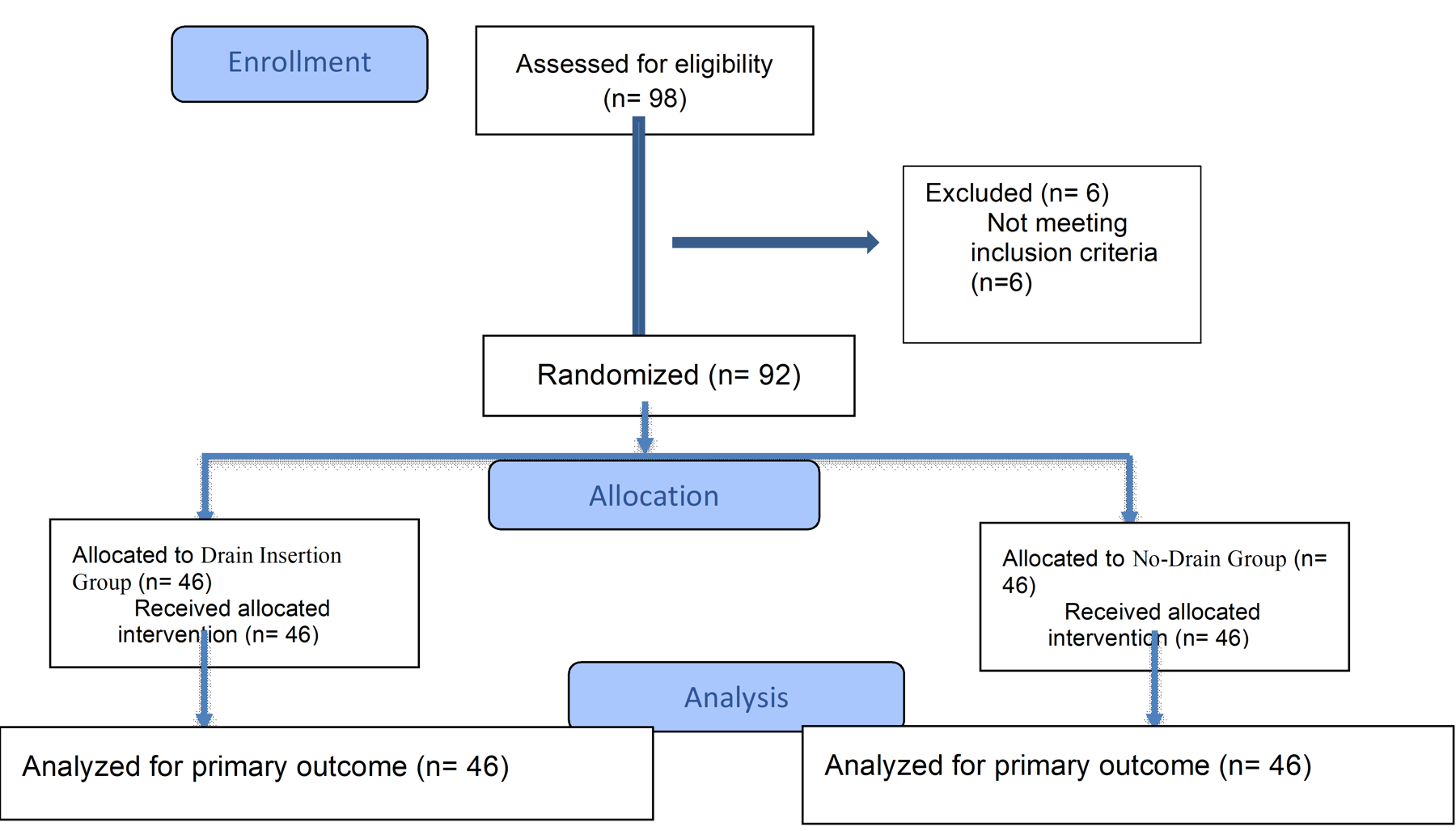
This randomized controlled trial was registered at was conducted in the Department of Orthopaedic Surgery, Shifa International Hospital, Islamabad (ClinicalTrials.gov: NCT07494708), from September 2025 to April 2026. The study was conducted after approval from the institutional ethical review committee (407-25). A sample size of 98 patients (49 in each group) was calculated based on comparative mean hemoglobin drop, where mean hemoglobin reduction was 1.8 ± 1.0 g/dL in patients undergoing PKA with drain insertion and 1.2 ± 0.7 g/dL in patients without drain insertion, with 80% power and a two-sided significance level of 0.01 (99% confidence level), using a two-sample comparison of means [10]. During recruitment, 98 patients were assessed for eligibility; six patients did not fulfill the eligibility criteria and were excluded before randomization. Consequently, 92 eligible patients were randomized, with 46 patients allocated to each group, and all randomized patients were included in the final analysis. Patients aged 18 years or above, of either gender, were included if they were undergoing unilateral primary total knee arthroplasty for primary knee osteoarthritis, rheumatoid arthritis (RA), post-traumatic arthritis, osteonecrosis, or avascular necrosis. Eligible patients had documented failure of conservative treatment, preoperative Knee Society Score ≤60, and hemoglobin level ≥10 g/dL. Patients were excluded if they had revision total knee arthroplasty, bilateral arthroplasty, periprosthetic fracture, abnormal coagulation profile, bleeding disorder or recent antiplatelet or anticoagulant use within seven days before surgery. Patients with severe cardiopulmonary disease, heart failure, pulmonary embolism or stroke, severe chronic kidney disease, severe hepatic dysfunction, active systemic infection or pregnancy/lactation were also excluded.
Eligible patients were assigned in a 1:1 ratio to drain insertion or no-drain treatment using a computer-generated random sequence. Allocation was concealed in sequentially numbered, opaque, sealed envelopes opened only after enrollment, immediately before surgery. The registered study design was open-label. All patients underwent primary knee arthroplasty under standard operating room conditions. Preoperative assessment was performed by the orthopedic and anesthesia teams. Baseline demographic and clinical variables were recorded before surgery, including age, gender, BMI, preoperative diagnosis, preoperative Knee Society Score, ASA status and side of surgery. The operative approach and perioperative care pathway were standardized across both groups, apart from drain allocation, including intravenous tranexamic acid (1 g preoperatively and 1 g intraoperatively) for blood conservation. The operative side was prepared and draped under aseptic precautions. Primary knee arthroplasty was performed using standard arthroplasty techniques. Hemostasis was secured before wound closure. In patients allocated to the drain group, a closed suction drain was inserted before final wound closure according to institutional practice. In patients allocated to the no-drain group, wound closure was performed without insertion of a drain. The operative duration was recorded in minutes from skin incision to final wound closure. Preoperative hemoglobin was recorded from the complete blood count performed within 24 hours before surgery. Postoperative hemoglobin was obtained at 24 and 48 hours from routine laboratory reports. The registered primary outcomes were the declines in hemoglobin from baseline at 24 and 48 hours; the 48-hour change was the principal comparison presented here. Blood transfusion was recorded when packed red blood cells were transfused during the same hospital admission after surgery. The same institutional transfusion criteria applied to both groups: postoperative hemoglobin <8 g/dL or clinically significant symptomatic anemia, such as persistent tachycardia, hypotension, dyspnea, chest pain or evidence of inadequate tissue oxygenation despite supportive treatment. The number of blood units transfused was recorded from blood bank documentation and inpatient treatment charts. Length of hospital stay was calculated in days from date of surgery to date of discharge. Postoperative care, analgesia, thromboprophylaxis, antibiotics, mobilization, wound care and rehabilitation were provided according to the standard departmental protocol. Statistical analyses were conducted using SPSS. Normality of continuous variables was assessed before analysis. Normally distributed variables were presented as mean ± standard deviation and compared between the drain and no-drain groups using the independent-samples t-test, whereas non-normally distributed variables were presented as median (IQR) and compared using the Mann–Whitney U test. Preoperative, 24-hour postoperative, and 48-hour postoperative hemoglobin levels were compared between groups at each respective time point. Categorical outcomes were compared using the chi-square test or Fisher’s exact test where appropriate. The zero-inflated number of blood units transfused was compared with the Mann–Whitney U test; the categorical distribution of 0, 1 or 2 units was examined separately using Fisher’s exact test. Between-group mean differences were accompanied by 95% confidence intervals where reported. Analyses followed randomized allocation. A two-sided p-value <0.05 was used for statistical significance.
Text in the figure
Allocation Received allocated intervention (n= 46)Allocated to Drain Insertion GroupReceived allocated intervention (n= 46)Received allocated intervention (n= 46) Analyzed for primary outcome (n= 46)
Analyzed for primary outcome (n= 46)Analyzed for primary outcome (n= 46)
RESULTS
Of 98 patients assessed, six were excluded before randomization; all 92 randomized patients received their assigned intervention and were analyzed (Figure 1). The mean age was 63.48 ± 7.49 years in drain insertion and 65.54 ± 6.81 years in the no-drain group (p = 0.170). Mean body mass index was 28.92 ± 3.83 kg/m² in drain and 29.40 ± 3.57 kg/m² in no-drain group (p = 0.534). The preoperative Knee Society Score was 48.57 ± 6.63 and 47.57 ± 5.91 in drain and no-drain groups, respectively (p = 0.447) (Table 1).
Table 1: Baseline Demographic and Clinical Characteristics of Study Participants
| Variable | Drain Insertion (n=46) |
No-drain (n=46) |
p-value |
|---|---|---|---|
| Age, years, mean ± SD | 63.48 ± 7.49 | 65.54 ± 6.81 | 0.170‡ |
| Body mass index, kg/m², mean ± SD | 28.92 ± 3.83 | 29.40 ± 3.57 | 0.534‡ |
| Preoperative Knee Society Score, mean ± SD | 48.57 ± 6.63 | 47.57 ± 5.91 | 0.447‡ |
| Gender | 0.810† |
||
| Male | 11 (23.9%) | 12 (26.1%) | |
| Female | 35 (76.1%) | 34 (73.9%) | |
| Diabetes mellitus | 14 (30.4%) | 15 (32.6%) | 0.822† |
| Hypertension | 24 (52.2%) | 22 (47.8%) | 0.677† |
| Chronic kidney disease | 4 (8.7%) | 2 (4.3%) | 0.677* |
| Preoperative diagnosis | 0.940† |
||
| Primary knee osteoarthritis | 39 (84.8%) | 40 (87.0%) | |
| Rheumatoid arthritis | 5 (10.9%) | 4 (8.7%) | |
| Post-traumatic arthritis | 2 (4.3%) | 2 (4.3%) | |
| ASA physical status | 0.955† |
||
| Class I | 5 (10.9%) | 5 (10.9%) | |
| Class II | 35 (76.1%) | 34 (73.9%) | |
| Class III | 6 (13.0%) | 7 (15.2%) | |
| Side of surgery | 0.834† |
||
| Right knee | 25 (54.3%) | 24 (52.2%) | |
| Left knee | 21 (45.7%) | 22 (47.8%) | |
*Fisher’s exact test; †chi-square test; ‡independent-samples t-test. Categorical values are n (%); continuous values are mean ± SD. No enrolled patients had osteonecrosis or avascular necrosis.
Preoperative hemoglobin was comparable between groups, with a mean value of 12.74 ± 1.15 g/dL in drain insertion and 12.95 ± 1.13 g/dL in no-drain group (p = 0.367). However, postoperative hemoglobin values were lower in drain group at both measured postoperative intervals. The total hemoglobin drop from preoperative level to 48 hours was greater in drain insertion, 2.47 ± 0.79 g/dL, compared with 1.46 ± 0.65 g/dL in no-drain group, with a mean difference (MD) of 1.01 g/dL (95% CI 0.71–1.30; p < 0.001) (Table 2).
Table 2: Comparison of Hemoglobin Levels and Hemoglobin Drop Between Groups
| Variable | Drain Insertion (n=46) | No-drain (n=46) | Mean Difference (95% CI) | p-value |
|---|---|---|---|---|
| Preoperative hemoglobin, g/dL | 12.74 ± 1.15 | 12.95 ± 1.13 | -0.21 (-0.68 to 0.26) | 0.367 |
| 24-hour postoperative hemoglobin, g/dL | 10.39 ± 1.04 | 11.52 ± 0.97 | -1.13 (-1.55 to -0.71) | <0.001 |
| 48-hour postoperative hemoglobin, g/dL | 9.65 ± 1.01 | 10.79 ± 0.99 | -1.14 (-1.55 to -0.73) | <0.001 |
| Hemoglobin drop, g/dL | 2.47 ± 0.79 | 1.46 ± 0.65 | 1.01 (0.71 to 1.30) | <0.001 |
Blood transfusion was recorded in 9 (19.6%) patients in the drain group and 3 (6.5%) in the no-drain group; this difference was not statistically significant (chi-square test, p = 0.063). The distribution of blood units transfused was not significantly different between the drain and no-drain groups: 0 units in 37 (80.4%) versus 43 (93.5%), 1 unit in 6 (13.0%) versus 3 (6.5%), and 2 units in 3 (6.5%) versus 0 (0.0%), respectively (Fisher’s exact test, p = 0.096); the Mann–Whitney U comparison of units transfused also was not significant (p = 0.058) (Table 3).
Table 3: Operative Duration, Transfused Blood Units and Length of Hospital Stay
| Variable | Drain Insertion (n=46) | No-drain (n=46) | p-value |
|---|---|---|---|
| Operative duration, minutes | 98.13 ± 8.49 | 95.76 ± 9.52 | 0.211† |
| Blood units transfused, mean ± SD [median (Q1–Q3)] | 0.26 ± 0.58 [0 (0–0)] | 0.07 ± 0.25 [0 (0–0)] | 0.058* |
| Length of hospital stay, median (Q1–Q3), days | 6 (5–7) | 5 (4–6) | 0.003* |
*Mann–Whitney U test; †independent-samples t-test. The categorical distribution of units (0, 1 and 2) was evaluated separately with Fisher’s exact test (p = 0.096).
DISCUSSION
In this study, postoperative hemoglobin levels and blood transfusion requirements were compared between patients undergoing primary TKA with and without closed suction drains. Patients in the drain group had a greater fall in hemoglobin and stayed longer in hospital. However, the differences in transfusion frequency and the number of blood units transfused were not statistically significant. At 48 hours after surgery, the reported mean hemoglobin reduction was 2.47 ± 0.79 g/dL in patients with drains and 1.46 ± 0.65 g/dL in those without drains. The mean difference between the groups was 1.01 g/dL (p < 0.001). Similar findings were reported by Shamseer et al., who observed lower hemoglobin levels on the first and second postoperative days in patients with drains. This difference was observed despite both groups having comparable preoperative hemoglobin levels and functional scores [11]. Similarly, Tan et al. demonstrated significantly lower postoperative hemoglobin and hematocrit values at days 1, 3 and 7 in the drainage group [12]. Mohamed et al. reported lower postoperative hemoglobin in the drain group (8.46 ± 1.36 g/dL versus 9.79 ± 1.40 g/dL; MD 1.33 g/dL; p = 0.007) [13]. These findings favor reduced blood loss without drains; however, Maliarov et al. [7] observed no difference in expected blood loss, possibly reflecting differences in perioperative tranexamic acid use, drainage procedures and study populations. Albasha et al. further reinforced this observation, reporting a significantly greater hemoglobin drop in the drain group (1.8 ± 1.0 g/dL versus 1.2 ± 0.7 g/dL), along with a greater hematocrit reduction and higher transfused packed red blood cell units [10]. Smimmo et al. found greater estimated blood loss with drainage; four patients in the drain group required transfusion compared with none in the no-drain group (p = 0.0003) [8]. Thakur et al., in a single-arm observational study of 186 patients undergoing drainless TKA with intraoperative TXA, reported a mean hemoglobin drop of 1.46 g/dL in unilateral cases with no transfusion requirement, reinforcing that drainless arthroplasty combined with pharmacological hemostasis can achieve favorable blood conservation outcomes [14]. Loss of an intra-articular tamponade effect is one proposed explanation for higher measured blood loss with drainage [15,16], but this mechanism was not directly evaluated in the present trial. With regard to blood transfusion, the present study recorded a transfusion rate of 19.6% in drain and 6.5% in no-drain group (p = 0.063), a difference that was not statistically significant. Mean units transfused were 0.26 ± 0.58 versus 0.07 ± 0.25, but the Mann–Whitney U comparison was not statistically significant (p = 0.058); this test was used because most patients received no transfusion. Previous reports were mixed: Mohamed et al. reported a transfusion rate of 45.5% versus 2.6% in drain versus no-drain patients (p = 0.001), while Albasha et al. identified an overall transfusion rate of 7.6%, with significantly higher transfused units in the drain group [10,13]. In a study involving 50 patients, Mohamed et al. found that those with drains stayed in hospital for 6.45 ± 3.35 days, compared with 5.25 ± 1.60 days for those without drains. Although the difference was 1.19 days, it was not statistically significant (p = 0.100) [7]. Regarding blood transfusion, Mishra et al. found no significant difference between the two groups in either postoperative hemoglobin levels or transfusion rates [17].
The hospital stay was longer in the drain group in the present study (6 (5–7) versus 5 (4–6) days; p = 0.003). A larger difference was reported by Albasha et al., with hospital stays of 10.7 ± 4.7 days in the drain group and 5.4 ± 4.6 days in the no-drain group (p < 0.001) [10]. Mohamed et al. recorded a numerically longer stay in the drain group (6.45 ± 3.35 versus 5.25 ± 1.60 days; mean difference 1.19 days) (p = 0.100), possibly due to the limited sample size of 50 patients [13]. Similar results were obtained by Maliarov et al., whose study showed no significant difference in transfusion requirements, with only one patient receiving blood in the drain group [7]. Within enhanced recovery after surgery (ERAS) pathways, longer postoperative stays may affect resource use, although discharge decisions also depend on institutional protocols and clinical factors not assessed here [18,19]. Operative duration was comparable between groups in the present study (98.13 ± 8.49 versus 95.76 ± 9.52 minutes; p = 0.211), although a nonsignificant operative-time comparison alone cannot exclude confounding. Özmen et al. also found no correlation between operative duration and magnitude of hemoglobin decline (r=0.050; p = 0.644) [20]. The main strength of this study was the direct comparison of two commonly used surgical practices in primary knee arthroplasty, with equal group distribution and clearly defined outcome measures. Baseline characteristics, including age, BMI, preoperative diagnosis, ASA status, side of surgery, preoperative Knee Society Score and preoperative hemoglobin, were generally similar between groups; nonsignificant baseline tests do not establish group equivalence. Hemoglobin was assessed at fixed postoperative intervals, and transfusion data were recorded objectively. This study was conducted at a single center with a relatively small sample size. As patients and surgeons were aware of the treatment allocation, the possibility of bias cannot be excluded. The small number of patients requiring blood transfusion also limits the interpretation of these results. In addition, functional recovery was not assessed, and differences in clinical decisions regarding hospital discharge may have affected the length of stay.
CONCLUSION
Patients who underwent primary TKA with drain insertion had a greater reported reduction in postoperative hemoglobin and a longer hospital stay than those without drains. However, no statistically significant differences were found in transfusion rates or the number of blood units transfused. Considering the limitations of this study and the varying results reported in previous studies, the decision to insert a drain should be based on individual patient requirements, particularly when tranexamic acid is used. With the same perioperative care provided to both groups, future randomized studies involving more patients should examine long-term safety, wound complications, recovery of knee function, and the need for blood transfusion.
Author Contributions:
HA, SH, AA, STT, AK:
Each author made substantial contributions to the conception and design of the study, or acquisition, analysis, and interpretation of data.
All authors were involved in drafting the manuscript or critically revising it for important intellect content.
All authors approved the final version of the manuscript to be published and agree to be accountable for all aspects of the work.
REFERENCES
- Mahajan U, Akhtar M, Sain B, Sain A. Knee arthroplasty types: an educational framework for multidisciplinary healthcare teams. Cureus. 2025;17(7):e89127. https://doi.org/10.7759/cureus.89127.
- GBD 2021 Osteoarthritis Collaborators. Global, regional, and national burden of osteoarthritis, 1990–2020 and projections to 2050: a systematic analysis for the Global Burden of Disease Study 2021. Lancet Rheumatol. 2023;5(9):e508-22. https://doi.org/10.1016/S2665-9913(23)00163-7.
- Langworthy M, Dasa V, Spitzer AI. Knee osteoarthritis: disease burden, available treatments, and emerging options. Ther Adv Musculoskelet Dis. 2024;16:1759720X241273009. https://doi.org/10.1177/1759720X241273009.
- Teimouri M, Salehi A, Shahsavan M, Rezaei H, Dayani Dardashti A. Effectiveness of total knee arthroplasty on pain reduction and functional improvement in elderly patients: a quasi-experimental study. Adv Biomed Res. 2025;14:86. https://doi.org/10.4103/abr.abr_409_24.
- Naqshband MS, Ahmad R, Taqi M, Shahid S, Niazi SNK, Cheema KN, et al. Outcomes of drain versus no drain following a total knee joint replacement. Ann King Edw Med Univ. 2025;31(3):279-83. https://doi.org/10.21649/akemu.v31i3.5754.
- Kim MK, Ko SH, Nam YC, Jeon YS, Kwon DG, Ryu DJ. Optimal release timing of drain clamping to reduce postoperative bleeding after total knee arthroplasty with intraarticular injection of tranexamic acid. Medicina (Kaunas). 2022;58(9):1226. https://doi.org/10.3390/medicina58091226.
- Maliarov A, Newman N, Sabouret P, Al-Shakfa F, Chergui S, Lavoie F. Suction drainage in total knee replacement does not influence early functional outcomes or blood loss: a randomized control trial. Arthroplasty. 2023;5(1):8. https://doi.org/10.1186/s42836-022-00158-z.
- Smimmo A, Basilico M, Bonfiglio N, Ruberto P, Vitiello R, Bocchino G, et al. Clinic and ultrasound evaluation of suction drainage in total knee arthroplasty procedure: a multicentric prospective trial. Indian J Orthop. 2025;59:1840-8. https://doi.org/10.1007/s43465-025-01501-7.
- Metoki Y, Iwase D, Kusumoto Y, Aikawa J, Mukai M, Fukushima K, et al. The necessity of suction drainage when intra-articular injection of tranexamic acid is used during primary total knee arthroplasty: a retrospective study. BMC Musculoskelet Disord. 2024;25:475. https://doi.org/10.1186/s12891-024-07604-w.
- Albasha A, Salman LA, Elramadi A, Abudalou A, Mustafa A, Abu Hejleh HA, et al. Outcomes of drain versus no drain in total knee arthroplasty: a retrospective cohort study. Int Orthop. 2023;47(12):2985-9. https://doi.org/10.1007/s00264-023-05946-z.
- Shamseer KV, Kumar PT, Shameem GM, Khan PS. Comparison of the patients undergoing total knee arthroplasty with and without drain in terms of functional outcome, hemoglobin drop and infection rate. Int J Res Orthop. 2025;11(4):733-40. https://doi.org/10.18203/issn.2455-4510.IntJResOrthop20251792.
- Tan S, Zhao D, Yu X, et al. The effect of placing or not placing drainage after primary unilateral total knee arthroplasty on blood loss and knee function: a retrospective study. Res Sq. 2024. https://doi.org/10.21203/rs.3.rs-4535094/v1.
- Mohamed MA, Nungu SM, Mrita F, Muse AH. Short-term outcomes of improvised closed suction drainage versus no drainage after primary total knee arthroplasty: a prospective cohort study. J Orthop Rep. 2025;5(1):100679. https://doi.org/10.1016/j.jorep.2025.100679.
- Thakur SK, Choudhary SK, Kumar M, Hiremath RN, Jaidev KP, Rohini VK, et al. Primary total knee replacement without drain: a good and safe practice to inculcate. Indian J Health Sci Biomed Res KLEU. 2023;16(1):147-52. https://doi.org/10.4103/kleuhsj.kleuhsj_383_22.
- Hasan Khan MN, Jamal KY, Shafiq H, Qureshi AI, Khan BG, Farrukh S. Study to estimate the average blood loss in different orthopedic procedures: a retrospective review. Ann Med Surg (Lond). 2021;71:102965. https://doi.org/10.1016/j.amsu.2021.102965.
- Hulse N, Raghu BV, Yogarakshith AR. Suction drainage increases the need for blood transfusion in bilateral total knee arthroplasty. J Clin Orthop Trauma. 2025;65:102987. https://doi.org/10.1016/j.jcot.2025.102987.
- Mishra J, Das TK, Kanungo P, et al. Outcomes of drain versus no drain in total knee arthroplasty. C J Ger Med. 2025;10:33-8. https://doi.org/10.61336/cmejgm.
- Zhao X, Chen L, Huang F, Huang Z, Zhou H. Enhanced recovery after surgery in patients undergoing total joint arthroplasty: a retrospective study. Pak J Med Sci. 2023;39(3):644-9. https://doi.org/10.12669/pjms.39.3.7169.
- Ishaku Z, Koshy DI, Adamu Bala M. Enhanced recovery after surgery pathways in elective total joint arthroplasty. Cureus. 2025;17(9):e91481. https://doi.org/10.7759/cureus.91481.
- Özmen E, Barış A, Malkoç FE, Aktaş SA, Gazaioğlu MY, Karaca KY, et al. Impact of drain use and tourniquet release timing on blood loss, operative time, and wound complications in total knee arthroplasty. Istanbul Med J. 2025;26(1):42-6. https://doi.org/10.4274/imj.galenos.2025.60963.